admin

417 posts
Map of India representing corporate tax compliance and regulatory structure for foreign businesses

India’s Corporate Tax Rules: A Structural Guide for US-Backed Companies Entering the Market

For a US-backed company weighing its first move into India, India’s corporate tax rules rarely announce themselves as urgent. They surface later, in a board deck that does not reconcile, in a diligence process that stalls over undocumented related-party pricing, or in a cash flow model that never accounted for a minimum tax on book profits. The regulatory environment reflects both India’s federal structure and its scaling ambitions, whatever the entry point.

Futuristic digital illustration representing go-to-market technology, with a glowing GTM icon connected to data charts, gears, and analytics dashboards

The GTM Tech Stack Blueprint: A CFO Framework for Scalable Growth

A GTM tech stack assembled by impulse becomes a liability once a company scales past the size where founders can hold every customer relationship in their heads. I treat the go-to-market tech stack as a designed system, not a collection of tools, since every disconnected platform is a claim on capital finance must justify. Feature comparison never answers the question a board asks: whether the stack moves cash faster than the one it replaced.

GTM tech stack concept graphic with gears, charts, and data dashboards representing a go-to-market technology system

Building a Revenue Operations Structure That Scales with the Business

Every organization that outgrows its earliest go-to-market model confronts the same design question. Should the revenue function centralize for consistency, or distribute across regions for speed and customer proximity? A well-designed revenue operations structure does not choose a side. It blends both, governed by shared standards and disciplined operating rhythms rather than rigid hierarchy, and that blend is what lets a business absorb complexity without losing coherence.

Aviation crew member wearing headset standing beside military fighter jet on carrier deck

Sales Pipeline Forecasting: From Ritual to Trusted Signal

Most organizations still treat sales pipeline forecasting as a monthly checkpoint, a ritual in which numbers are presented and then defended rather than genuinely understood. Reframed correctly, the pipeline review becomes one of the most valuable diagnostic tools a finance organization has, tracing a shift away from static, stage-based forecasting toward a model anchored in velocity, conversion patterns, and observable buyer behavior. Productive friction between finance and sales strengthens forecast reliability, the Deal Desk earns a seat at the forecast table, and early bottleneck detection protects a quarter before the final numbers arrive.

Young child learning counting with a colorful wooden abacus

Audit Readiness: Building Financial Systems That Explain Themselves

Audit readiness is often mistaken for a formatting exercise. Many assume clean spreadsheets and a working familiarity with GAAP can resolve it on their own. More than two decades of finance leadership across cybersecurity, SaaS, gaming, logistics, digital marketing, medical devices, and nonprofit organizations point to a different picture. Audit readiness is a test of systems, habits, and culture. It is not a test of arithmetic. Companies rarely stumble over a complex technical error buried in the ledger. They stumble because of gaps in process. A revenue policy nobody wrote down. An accrual with no supporting schedule. Equity records out of sync with a board approval. Documentation assembled the week before auditors arrived, instead of maintained continuously.

Bronze thinker statue in a sunlit park, symbolizing strategic financial decision-making

Financial Decision Making as a Strategic CFO Catalyst: How Finance Becomes the Engine of Growth

For much of the history of the corporate finance function, organizations have treated financial decision making as an afterthought. It’s been recordkeeping, mostly, reconciling a spreadsheet against outcomes it had no hand in shaping. That posture no longer serves organizations that compete on speed and precision. Across cybersecurity, gaming, consumer products, and mission-driven organizations, finance teams have too often sat outside the room where strategy takes shape. They arrive only once the numbers need explaining. A stronger model exists. It treats financial decision making as a design discipline. In this model, finance builds the dashboards, the incentive structures, and the governance systems. These tools make good outcomes more likely, before a single decision is reached.

CFO reflecting on strategic planning surrounded by financial data and analytics icons

CFO Strategy: How Real Options Thinking Replaces the Fixed Forecast

Effective CFO strategy no longer rests on the ability to predict what a market will do next quarter. It rests on the discipline of building real options into every material decision, so that capital, people, and attention can shift the moment new information arrives. This article draws on more than twenty-five years leading finance across cybersecurity, SaaS, gaming, logistics, digital marketing, medical devices, and nonprofit organizations, and it argues that the deal desk, the capital allocation process, the forecasting cadence, and even compensation design can each be rebuilt as a set of contingent, threshold-based bets rather than fixed annual commitments.

Business intelligence dashboard displaying financial metrics and KPI analytics to support strategic reporting and executive decision-making.

Dashboard Optimization Best Practices for Strategic Clarity

Executives rarely suffer from a shortage of data. What they lack, more often than not, is signal. It’s the kind of clarity that changes what a leadership team decides to do next. I’ve spent more than 25 years leading finance across cybersecurity, SaaS, gaming, logistics, digital marketing, medical devices, and nonprofit organizations. In that time, dashboards have multiplied. Decision quality has stalled in place. That paradox sits at the center of these dashboard optimization best practices.

Executive team reviewing cross-border tax strategy and financial performance dashboards during a business expansion planning meeting.

Corporate Governance KPIs: Turning Board Data into Trust and Strategic Clarity

Most boards leave their quarterly meeting holding a thicker packet than the one they arrived with. Yet somehow, they leave less certain of what actually matters. Across more than two decades of building finance functions and sitting across the table from directors, one thing stands out. The shortfall is almost never a shortage of data. It is a shortage of decision-grade clarity. Closing that gap is the real work of corporate governance KPIs.

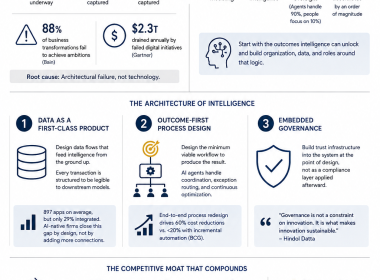
The AI-Native Enterprise: Why Digital Transformation Is Being Rewritten

EXECUTIVE SUMMARY  The era of incremental digitization is over. Organizations that spent the last decade moving workflows online and calling it transformation now face a reckoning: a new class of AI-native enterprises is building from a fundamentally different blueprint. Where traditional transformation layered technology onto existing processes, AI-native design begins with intelligence at the architectural core. This shift is not evolutionary; it is structural. Leaders who grasp this distinction will architect durable competitive advantage. Those who do not will find themselves optimizing systems that were obsolete before they were finished.