
Executive Summary
Effective CFO strategy no longer rests on the ability to predict what a market will do next quarter. It rests on the discipline of building real options into every material decision, so that capital, people, and attention can shift the moment new information arrives. This article draws on more than twenty-five years leading finance across cybersecurity, SaaS, gaming, logistics, digital marketing, medical devices, and nonprofit organizations, and it argues that the deal desk, the capital allocation process, the forecasting cadence, and even compensation design can each be rebuilt as a set of contingent, threshold-based bets rather than fixed annual commitments.
What follows is not a theory of finance leadership assembled from the outside. It is a working account of what changes when a CFO stops trying to be right about the future and starts building an organization that can act well no matter which future arrives. The reward for that shift shows up first in the deal desk and the forecast, and eventually in how a company presents itself to its own board.
The Limits of the Traditional Budget
Every finance leader eventually meets the moment when a carefully reconciled budget collides with reality. Often it happens without much warning: a key renewal slips, or a regulatory shift in a foreign market quietly erases a tax credit the annual plan had assumed would hold. Within weeks, a model that once looked airtight reads like a photograph already out of date. The temptation is to blame the forecasting method rather than the premise underneath it.
That experience marks the real starting point for modern CFO strategy. The role was never to control outcomes in the first place. It was to design the organization’s capacity to adapt to them. Most finance functions are still built for the former job rather than the latter.
Revenue operations sit at the center of this shift. Shifting buying cycles, hybrid go-to-market models, and persistent macro noise have made a single-point forecast less useful than a set of plausible paths, each one attached to a signal that tells leadership when to move from one path to another. Treating the CFO as something closer to a chief option architect reflects this reality more honestly than the traditional scorekeeper framing ever did. When prediction becomes unreliable, design has to take its place, and design is a discipline finance can actually own.
Systems Thinking as the Foundation of Strategic CFO Decision Making
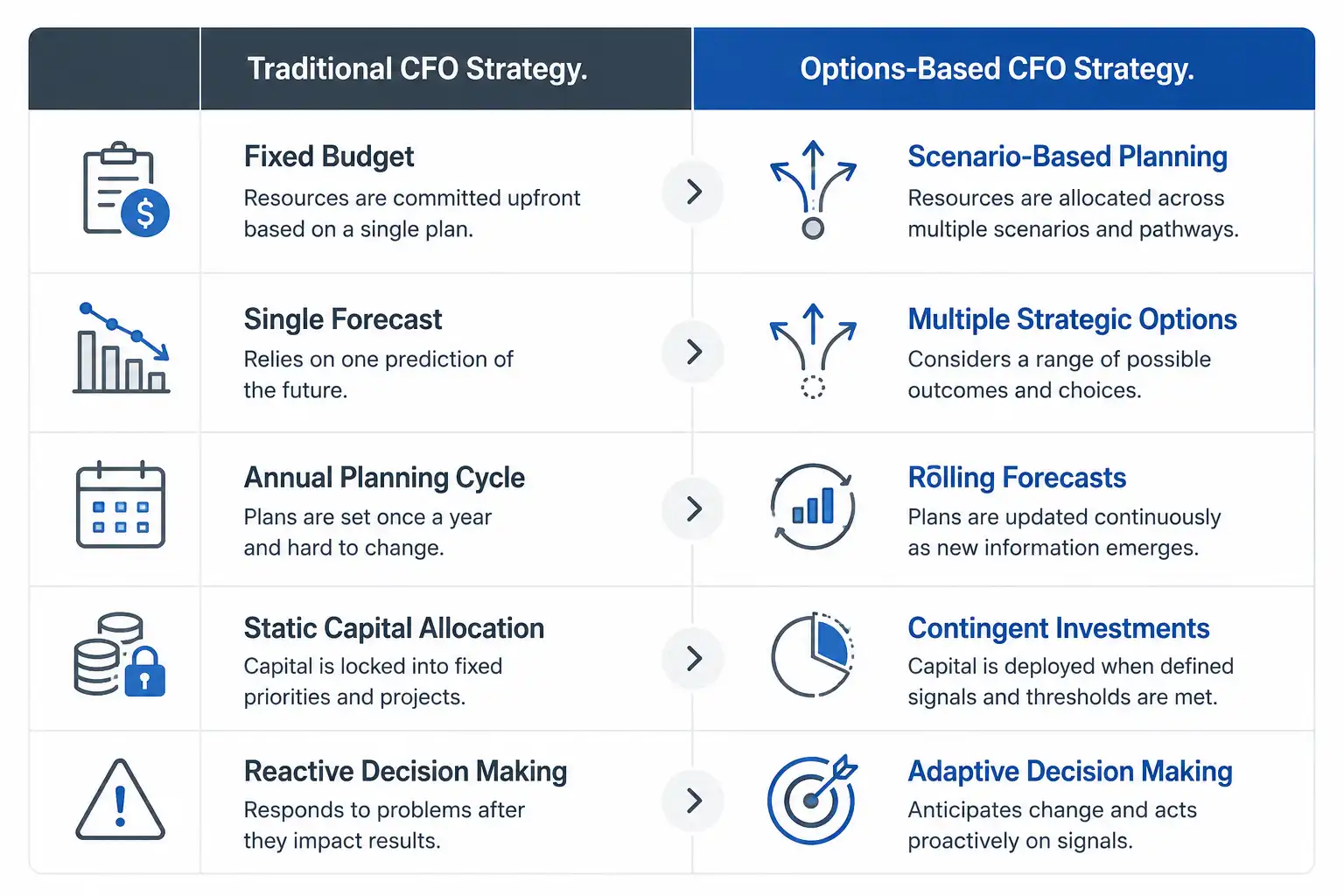
This shift is not a rejection of rigor. It borrows from systems thinking, where the goal is structure rather than control. It also borrows from real options theory in financial economics, where the value lies in preserving the right, but not the obligation, to act as new information arrives.
Applied to capital deployment, this means resisting a binary choice: funding a new go-to-market motion in full, or not funding it at all. A strategic CFO instead builds scenario trees. One branch might be a phased pilot with a defined learning checkpoint. Another might be a product launch gated by usage signals rather than a fixed calendar date.
These trees do more than organize a decision. They surface the paths not taken, and in doing so they sharpen how a company allocates not just capital but attention, which tends to be the scarcer resource in any organization moving quickly. The trees themselves matter less than the habit of building them, because a team that has practiced mapping branches once will keep doing it long after the specific forecast has expired.
Reframing the Deal Desk as a Decision Node
Nowhere does this shift show up more clearly than in the deal desk. Traditionally, the deal desk functions as a compliance checkpoint for pricing and terms. It’s a place where a discount gets approved or denied. Viewed through an options lens, it becomes something more interesting.
A steeply discounted enterprise deal can carry usage-based triggers, re-pricing clauses, and soft-commit expansion terms. Structured that way, it behaves like a call option on future account growth, not a one-time concession. Once the deal desk is rebuilt as a decision node inside a larger options tree, rather than a gate that only says yes or no, sales teams tend to say yes more often. Finance, in turn, gains far better visibility into the risk it is actually carrying.
Building the Trigger Logic into the System
Bringing this into practice at a high-growth cybersecurity and identity access management company meant reworking CPQ systems and retraining legal teams. It also meant coaching account executives to present optionality credibly to customers, rather than as a negotiating trick.
Templates carried optionality clauses coded directly into CRM workflows. Once an account crossed a defined utilization threshold, the next best action routed automatically to the account executive and the customer success team. No one needed to remember to check a spreadsheet.
This kind of systems-driven trigger logic is second nature once a finance leader has built multi-entity architecture and automated revenue recognition under ASC 606 across five country entities. The underlying instinct is the same: replace judgment calls made under pressure with logic built in advance.
From Annual Cycles to Rolling, Threshold-Based Planning
Elegant deal structures still fail if the broader planning rhythm underneath them stays linear. That is why the more durable version of CFO strategy replaces rigid quarterly forecasting with rolling, scenario-based planning. Planning built around forecast bands rather than point estimates.
If churn in a specific cohort exceeds a defined level, how does that ripple through the expansion coverage ratio three quarters out? If deal velocity in a region slows, how does that compress the gap between bookings and billings? And at what point does that gap become a cash problem rather than a reporting nuance?
Mapping these as cascading outcomes, rather than isolated misses to be explained away individually, gives leadership teams a shared and structured way to reason about volatility together.
Data analytics does the heavy lifting here, not to predict a single outcome but to simulate a range of plausible ones. Regression modeling, time-series decomposition, and agent-based simulation, run in tools such as R, produce controlled chaos exercises rather than forecasts, and the output matters less than the mindset the exercise builds. Teams stop asking what will happen and start asking what they will do if it does, which is a more useful question for almost every function outside of finance as well.
Capital Allocation Through Contingent Commitments
This logic extends naturally into capital allocation. Annual budgets tend to lock resources into static swim lanes. Lanes that made sense in November and stopped making sense by February.
Gated resourcing tied to defined thresholds offers a better alternative. It lets a finance function pre-approve investment, contingent on a signal actually firing. That signal might be churn holding below a set level. It might be expansion trends staying steady. Or a new vertical crossing a deal threshold that justifies the next tranche of spend.
This contingent approach reflects a thread that runs through two experiences. One: overseeing supply chain and logistics analytics for a $127M global consumer products company, where more than doubling inventory turns — from three times to seven times — freed working capital that had been sitting quietly on a shelf for years. Two: an earlier-stage turnaround that cut monthly burn from $800K to $200K by tying every dollar of spend to evidence rather than to the calendar.
The same thinking has proven valuable in raising capital itself. That lesson took shape while leading a $37M capital raise across equity and venture debt at a mission-driven education institution, and while taking part in fundraising exceeding $120M and M&A transactions exceeding $150M across sectors including gaming and digital entertainment. Investors do not need to believe a single base case. They need to believe the organization has options, mapped in advance, with clear gates for when to pull back and when to lean in, because that structure is what survives contact with a market that refuses to cooperate with anyone’s spreadsheet.
Guardrails Against Indecision
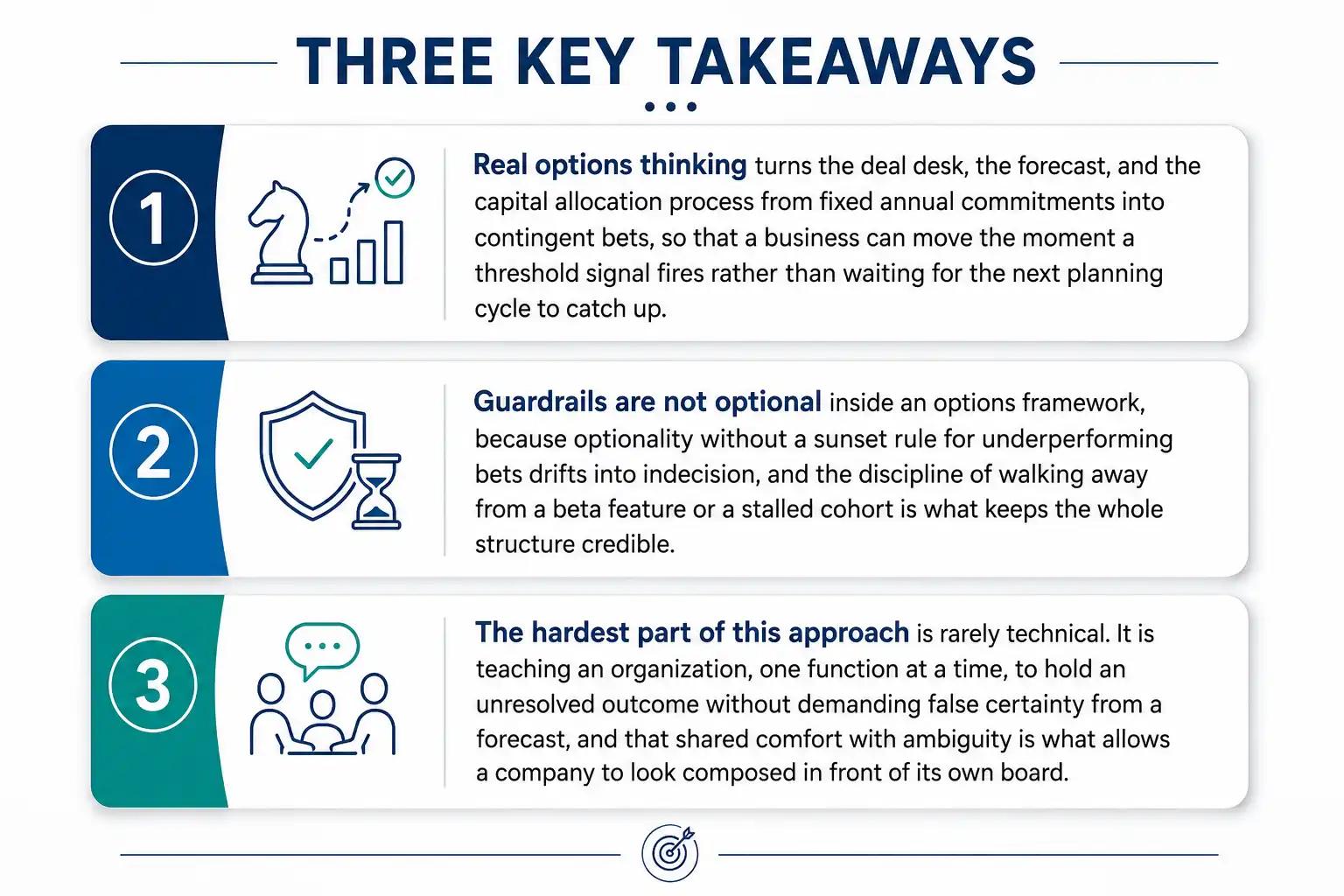
Optionality without discipline drifts into indecision, so guardrails matter as much as the options themselves:
- If a cohort’s net revenue retention declines for three consecutive months and win-back efforts fail, the motion gets sunset rather than nursed along for another quarter out of attachment.
- If a beta feature does not reach usage velocity within a quarter, its development budget gets reallocated elsewhere without ceremony.
These are not emotional decisions, and treating them as the logical conclusion of an option that has run its course, rather than as failures that require a postmortem, is central to sound CFO decision making.
The Human Element Behind the Models
The hardest part of any options-based approach to CFO strategy is rarely the modeling. It’s the human resistance to ambiguity that surfaces the moment a forecast stops being a single number.
People want certainty. They want confidence in a forecast, and clarity in how results get communicated internally and externally. An options framework asks them to sit with an unresolved outcome instead.
Coaching a finance team, and often coaching oneself, to hold that discomfort is a different skill entirely from building the model in the first place. It tends to be the skill that determines whether the framework survives its first bad quarter.
Decision science offers a useful frame in the concept of bounded rationality, the idea that people make the best decisions available to them with the information and time they have, rather than with perfect foresight. There is no version of finance leadership that eliminates uncertainty. There is only a better way of framing it. This is where overplanning becomes its own risk: a hiring plan that no longer reflects market conditions three months after approval, or a customer acquisition cost threshold that collapses under macro pressure, tends to push organizations toward doubling down rather than adjusting course. An options-based approach does the opposite, pulling back when a signal calls for it, and the organization tends to look more stable as a result, not less.
Building Shared Language Across Functions
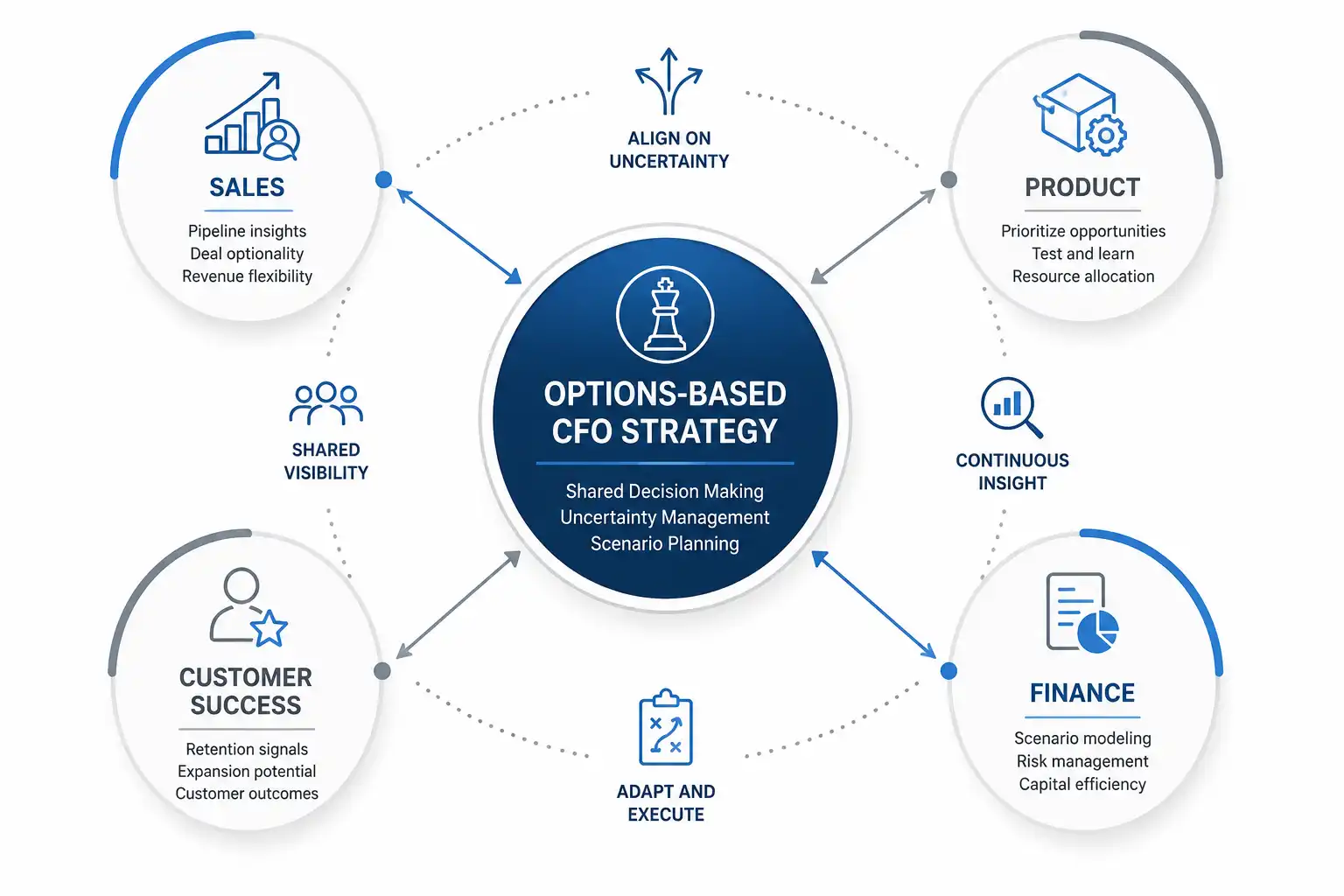
Embedding this thinking into an organization works best when it becomes a shared vocabulary rather than a finance-only exercise:
- Sales teams begin to see the value in deferring a portion of go-to-market investment until usage data validates real demand.
- Product teams begin to treat feature development as a portfolio of choices some higher risk with greater upside, others safer with a lower ceiling.
- Customer success teams begin to describe renewal and expansion probability as a weighted signal on a curve rather than a binary yes or no, which changes how they prioritize their own time long before a renewal date arrives.
None of this requires every function to think like a finance team. It requires only a shared language for describing uncertainty, one that a strategic CFO is well positioned to introduce because forecasting, by its nature, already sits at the intersection of every department’s assumption. Across a career spanning cybersecurity, SaaS, gaming, logistics, digital marketing, medical devices, and nonprofit work, including a stretch founding and building a small HR-technology venture from a blank page, it becomes clear that this cross-functional fluency matters more than any single spreadsheet. A framework that only finance understands rarely survives contact with a fast-moving commercial organization, while one that sales, product, and customer success can each apply to their own decisions tends to outlast any individual planning cycle.
Communicating Optionality to the Board and Compensation Planning
How this thinking gets communicated matters as much as the modeling behind it. Presenting probability-weighted scenario trees to a board shifts the conversation from justification to readiness. It replaces the ritual of defending a single fixed forecast, one that everyone in the room already suspects will be wrong within a quarter.
Investors respond well to this framing, and so do executive teams. It allows genuine disagreement on assumptions while still preserving alignment on what to do next. The branches, after all, have already been mapped before the disagreement starts.
Compensation Planning Under the Same Rigor
Compensation planning benefits from the same discipline. Sales compensation is fragile under volatility in a way few other line items are. Redesigning quota targets and commission accelerators around scenario bands, tested against best, base, and downside cases, produces plans that hold up under pressure. This reduces the need for a panicked mid-year reset.
These payout curves also go through simulation, including Monte Carlo methods. The goal is to check how often actual results would land in an unmotivating zone or an overly generous one.
This analytical discipline comes naturally after building forecasting engines and revenue operations reporting for a venture-backed digital marketing organization. That company scaled from $9M to $180M in twenty-four months. Its customer acquisition cost, lifetime value, and contribution margin framework had to hold together through three funding rounds and three acquisitions.
The certifications behind that background include CPA, CMA, and CIA. Graduate study spans both a Master of Science program and an MBA. All of it points toward the same habit: building financial structures that are as rigorous as they are flexible.
Conclusion
The organizations that endure volatility well are rarely the ones that predict it correctly. They are the ones that remain ready to act when conditions shift. This is the core of effective CFO strategy: replacing the comfort of a fixed forecast with a structured map of branches, signals, and gates.
A strategic CFO does not walk into a planning offsite with a single number to defend. They walk in with a set of well-designed options. Each one is built not to guess the future, but to help the organization meet it with composure.
Across cybersecurity, SaaS, gaming, logistics, digital marketing, medical devices, and nonprofit work, the sectors change but the discipline does not. Real CFO decision making is built on preparation rather than certainty, on thresholds rather than instinct. It comes from the quiet confidence of having already mapped the path before the fog clears.
Disclaimer: This article is intended for informational purposes only and does not constitute legal, tax, or accounting advice. You should consult your own tax advisor or counsel for advice tailored to your specific situation.
Hindol Datta is a four-time CFO and senior finance executive with over 25 years of leadership experience across cybersecurity, SaaS, gaming, logistics, digital marketing, medical devices, consumer products, and nonprofit organizations. He has led more than $120M in fundraising and over $150M in M&A transactions while building the financial and operational systems that let complex businesses scale with confidence. He is the author of seven books in the Systems CFO Series and holds active CPA, CMA, and CIA credentials.
AI-assisted insights, supplemented by 25 years of finance leadership experience.