Executive Summary
Strategic forecasting in high-inflation environments asks finance leaders to plan while costs, prices, and rates keep shifting. Costs jump between planning sessions, pricing windows narrow, and the gap between decision and consequence stops behaving predictably. The annual budget, built on an unspoken promise of stability, loses its authority long before the fiscal year ends.
This article explains why conventional forecasting logic fractures under inflation and how CFOs can rebuild strategic forecasting as a calibration discipline. It then shows how rolling forecasts, forecast corridors, and pre-wired decisions move into pricing, capex, compensation, and working capital.
Why Strategic Forecasting Breaks Down in High-Inflation Environments
During an inflationary cycle, a financial model can stay technically intact while losing its usefulness. The formulas still work, and currency headwinds appear in the notes. The problem is that inflation seldom breaks the math; it undermines the assumptions beneath it.
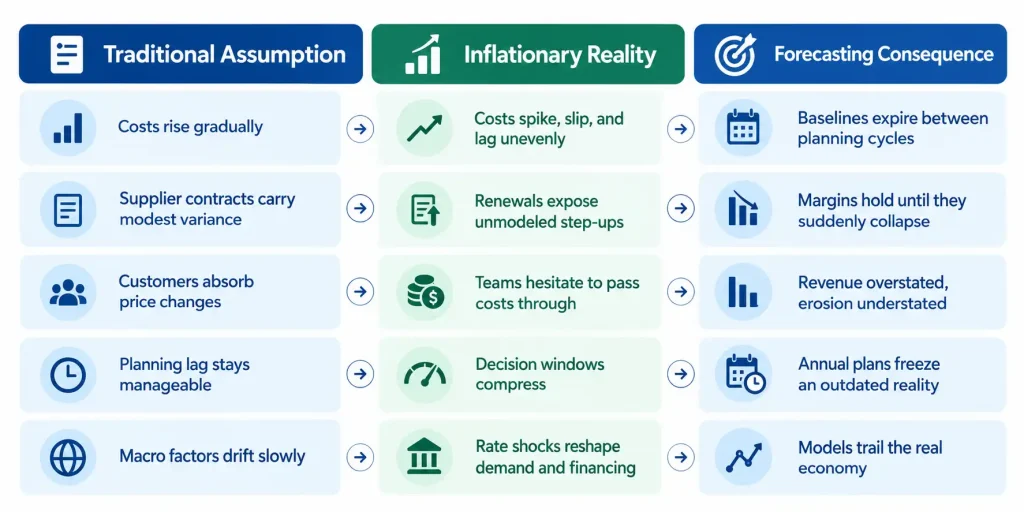
Baseline Drift and Lagging Input Costs
Baseline drift is usually the first symptom finance teams notice. Salary bands, freight rates, commodities, software contracts, and utilities all shift between planning sessions. Forecasts expire monthly instead of annually, and yesterday’s conservative case quietly becomes today’s optimistic one. Procurement starts over-ordering as a buffer, while sales teams struggle to quote prices that hold. At that point, the forecast stops guiding strategy and turns into a short-term survival tool.
Lagging input costs create a subtler and more dangerous problem. Contracts signed in a lower-cost era keep rolling forward, and margins look healthy until those agreements expire. Each renewal then exposes the business to step-ups that nobody modeled cleanly, producing false confidence followed by a sudden reckoning.
Pricing Hesitancy and Distorted Macro Feedback Loops
Pricing decisions carry emotional and cultural weight in most companies. Teams resist passing costs to customers because they fear churn or damage to perceived value. Inflation narrows the window for adjustment, so every month of delay turns into lost margin. A forecast that ignores this hesitancy overstates revenue and builds in optimism that nobody has tested.
Central bank policy adds another layer of distortion. Sharp rate moves affect interest expense, but they also reshape customer behavior, capex appetite, and access to financing. Most forecasts struggle to absorb this macro momentum and simply assume a stable world with a higher price tag.
Where Traditional Forecasting Assumptions Fracture
Rebuilding Strategic Forecasting as a Calibration Discipline
Forecasting at its core is less about being right and more about staying aligned and honest under uncertainty. In high-inflation environments, no single forecast can hold for a full year. Strategic forecasting works better as a system of continuous calibration, with updates as frequent as the changes in the operating environment.
Rolling Forecasts That Recalibrate Judgment
Annual operating plans, locked in Q4 and politely adjusted at mid-year, freeze the company inside a reality that no longer exists. Rolling forecasts give strategic forecasting a better rhythm when they work as genuine recalibrations, not budget refreshes. Each cycle should ask what has changed, which signals deserve trust, and how the next 90 to 180 days now look.
Consider a cybersecurity and identity SaaS company with roughly $30M in ARR. Its driver-based forecasting engine and capacity model held actuals within plus or minus 5% of forecast for 8 consecutive quarters. That accuracy came from disciplined cadence and clear drivers, not from any single brilliant prediction.
Tagging Assumptions by Volatility and Decay Rate
Calibration depends on structure as much as on frequency. Instead of sorting assumptions only as fixed or variable, finance teams can tag each one by volatility and decay rate. Fast-decaying inputs earn more frequent review, while stable ones can rest longer between updates.
| Assumption | Volatility Sensitivity | Suggested Review Cadence |
| Labor and wage inflation | High | Monthly |
| Freight and raw materials | High | Monthly |
| Cloud and software contracts | Medium | Quarterly |
| Regulatory tariffs | Low | Semi-annually |
Forecast Corridors and Pre-Wired Decisions
Point estimates create false precision when costs refuse to stabilize. A forecast corridor brings more honesty to strategic forecasting. Instead of projecting next-quarter EBITDA at $7.2M, the CFO presents a range of $6.4M to $7.8M. Wage acceleration and input volatility define the edges, and specific conditions narrow the range as the quarter unfolds.
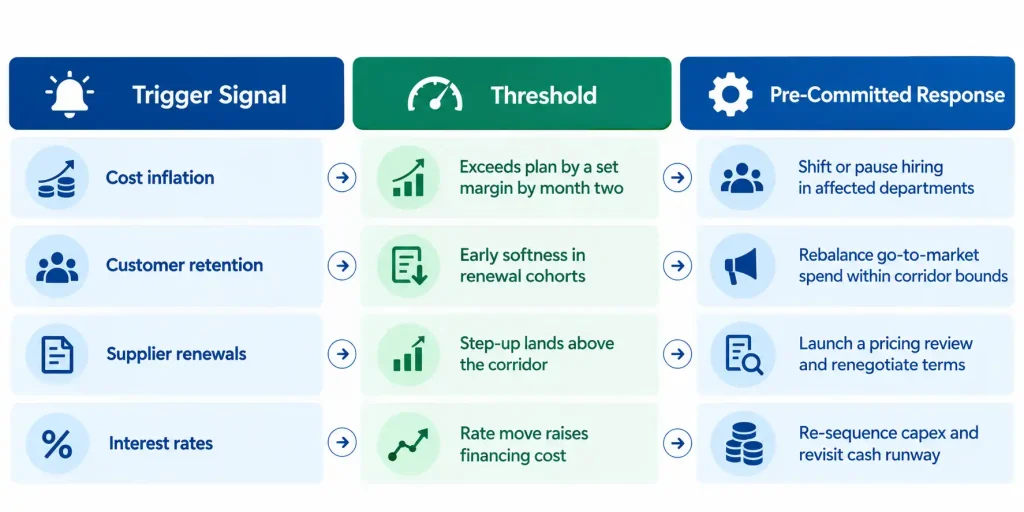
Within each corridor, the CFO can pre-wire decisions to defined thresholds. These responses are commitments made in advance, not reactions made in panic. The forecast then behaves less like a snapshot and more like an operating system for the business.
Example Trigger and Response Framework
Operationalizing Strategic Forecasting Across the Business
A model that never reaches pricing, procurement, compensation, and capital planning delivers little practical value to the business. Inflation-aware strategic forecasting must turn modeling into movement. Each function can then govern its response velocity, even when price levels sit beyond its control.
Pricing Reviews and Elasticity Modeling
Pricing needs frequent review during inflation for margin survival as well as competitiveness. The CFO should partner with go-to-market and product leaders to pass cost increases through in rhythm with customer psychology. Strategic forecasting for pricing depends on a few modeling capabilities:
- Elasticity models that forecast customer tolerance, not just cost inflation
- Dynamic pricing logic, even in SaaS, logistics, and B2B services
- Simulations that balance margin protection against churn inflection points
- Near-real-time revisions as customer behavior responds to each change
Capex Timing and Compensation Pressure
Capital loses purchasing power quickly in high-inflation cycles, which flips the traditional logic of conservatism. The answer is not spending fast but spending intentionally early. Finance teams should model an inflation-adjusted timing premium, comparing price erosion curves against volatility-adjusted project IRRs.
Employees feel the effects of inflation well before their companies do. Wage pressure belongs in the model as a retention signal, not only as a budget constraint. A sound compensation forecast tracks how much of the workforce is losing purchasing power under current policy. It also sets the attrition threshold that should trigger an off-cycle adjustment.
Working Capital Under Inflationary Stress
Working capital forecasting must blend credit sensitivity with supplier awareness. Inventory needs enough buffer to absorb volatility without excessive obsolescence risk. Receivables aging deserves stress tests against downstream cost spikes. Payables cadence must also adapt as pressured suppliers push for faster terms.
Consider a $127M global consumer products company sourcing from China and Vietnam. Through demand planning and SKU rationalization, the business more than doubled inventory turns from 3x to 7x. That shift released trapped working capital and gave the company room to absorb freight and input shocks.
The CFO’s Leadership Role in High-Inflation Environments
In high-inflation environments, clarity often erodes before margin does. Procurement fights cost creep, sales adjusts prices, and HR fends off attrition while the CEO explains it all to investors. Beneath this activity, the organization can lose track of why it is doing what it does.
The CFO keeps everyone aligned by explaining what the changing numbers mean for the business. The message should be calm and honest about where things stand, how assumptions have changed, and what people can count on next. Inflation punishes overconfidence, but it punishes silence even more, because silence breeds fear and stalls investment.
A mission-driven education and research institution in Silicon Valley provides another example. Its finance leadership delivered monthly board reporting and modeled multi-year scenarios under variable funding conditions. That steady cadence kept the board aligned and supported a $37M raise in equity and venture debt.
Strategic forecasting, in this sense, becomes a communication tool that turns volatility into clear priorities. Teams ignore a mechanical forecast but follow a trusted one, even when the numbers shift. The true measure of strategic forecasting during inflation is the ability to preserve direction without pretending to preserve control.
Three Key Takeaways
- Strategic forecasting in high-inflation environments works best as a calibration system built on rolling forecasts, volatility-tagged assumptions, and corridors. The pacing of updates matters more than their perfection.
- A forecast creates value only when it moves into pricing, capex, compensation, and working capital decisions. Pre-wired responses tied to defined thresholds let teams act with intention instead of panic.
- The CFO’s most valuable role during inflation is preserving clarity through consistent, honest communication. Leaders who design the rhythm of updates well keep the whole organization aligned.
Disclaimer: This article is intended for informational purposes only and does not constitute legal, tax, or accounting advice. You should consult your own tax advisor or counsel for advice tailored to your specific situation.
Hindol Datta is a four-time CFO and senior finance executive with over 25 years of leadership experience across cybersecurity, SaaS, gaming, logistics, digital marketing, medical devices, consumer products, and nonprofit organizations. He has led more than $120M in fundraising and over $150M in M&A transactions while building the financial and operational systems that let complex businesses scale with confidence. He is the author of seven books in the Systems CFO Series and holds active CPA, CMA, and CIA credentials.
AI-assisted insights, supplemented by 25 years of finance leadership experience.