
Executive Summary
Many leaders cast talent management and cost intelligence as opposing forces. Finance guards the budget, and People leaders guard the culture. Yet the companies that endure treat them as one discipline. When cost intelligence shapes how a company creates, pays, and develops roles, every people decision carries both empathy and evidence.
This article explains why headcount outpaces capability. You’ll see how return logic improves hiring sequence, location, and functional mix. Compensation strategy, too, can rest on a capital model instead of reaction. The final section turns to the human side of financial leadership. There, the CFO holds the balance sheet and the dignity of every person on payroll in the same frame.
Why Headcount Grows Faster Than Capability
Growth has a seduction of its own. As capital arrives, product ships, and new markets open, hiring moves from careful to frenetic. Each milestone justifies another team. Each goal produces another function. Within a few years, the org chart has changed from a line into a forest.
The Bloat Trap
Somewhere in that climb, a company of 200, 500, or 900 people starts to feel slower than at 100. Decisions take longer, meetings multiply, accountability diffuses, and leadership starts asking where the leverage went. This is the bloat trap, where headcount scales while capability plateaus. It is hard to spot from the inside because the headline metrics still look healthy. Burn was budgeted, revenue is growing though more slowly, and engagement scores remain solid.
Most organizations hire to relieve pressure rather than to unlock leverage. When a team feels stretched, the answer is a new role. When a function feels underpowered, the answer is another layer. Few leaders make these decisions with the full cost narrative in view.
Headcount as an Investment Thesis
Every role carries assumptions about throughput, coverage, innovation, and velocity. Planning models often reduce those assumptions to averages like revenue per employee, span of control, and headcount per manager. These are useful signals, but they are not strategy. Before approving a requisition, finance and People leaders can ask four questions together.
- What is the realistic time to productivity for this role?
- Which backlog will this role resolve, and how soon will the relief show up?
- What new surface area of coordination does this role create?
- What fixed cost pressure does this role introduce as the company scales?
A professional services firm grew from $12M to $63M in revenue within eight months. Its first engagement-level profitability and utilization analytics covered 5 business units. That gave leadership a clear view of where the firm created margin and where it leaked. That visibility changed the conversation about where additional headcount belonged.
Cost Intelligence in Workforce Planning and Hiring
A role is a signal of belief, because every approved requisition answers the same question about whether the investment will create more value than it consumes. Cost intelligence makes that answer explicit by treating each role as an economic position in the operating model, with all of its bundled costs, including salary, equity, benefits, managerial time, system access, and long-term burn.
Value Timing Over Cost Timing
Many CFOs think about when an expense will hit, while the stronger question is when a role will begin to return value. The lag differs widely by role, and understanding it lets a company hire in rhythm instead of in response.
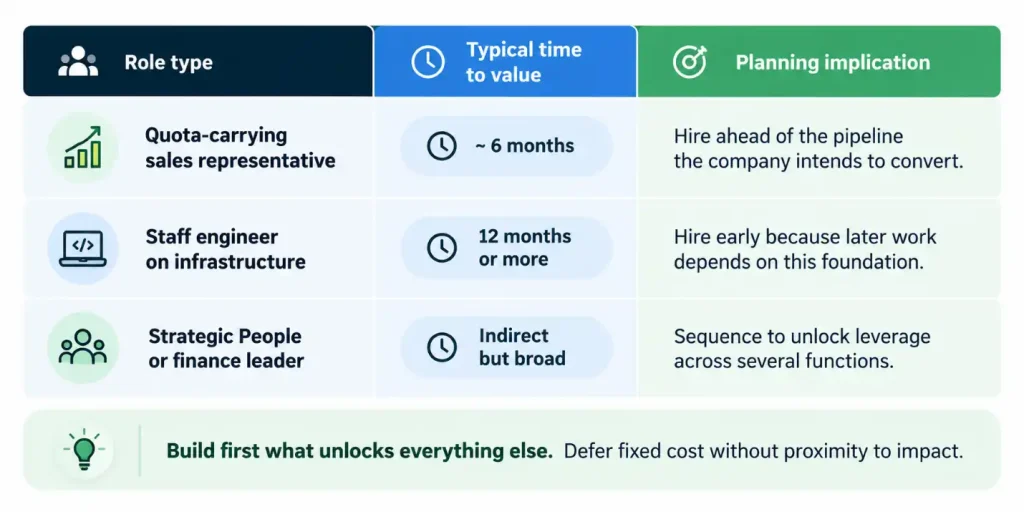
Build first what unlocks everything else, and defer what adds fixed cost without proximity to impact.
Location and Functional Mix
In a distributed world, cost parity is a myth, since market rates, benefit structures, and retention curves vary by geography. The goal is the right cost-to-value ratio, which means sourcing where cost structure, time zone, skill concentration, and leadership load intersect most intelligently. In a cybersecurity and identity SaaS company with roughly $30M in ARR and more than 230 employees across the United States, Canada, Mexico, India, and Nepal, active management of the mix between full-time staff and subcontractors held bench utilization under 5% to 7% during rapid growth. Pricing discipline, workforce composition, and delivery cost management together lifted gross margin by 12%.
Functional mix deserves the same scrutiny. Companies tend to over-rotate toward the functions where success is easiest to measure, such as sales, product, and engineering, while retention may be the real growth engine or operations may be the real constraint. Leadership teams that use cost intelligence in workforce planning ask three things in sequence.
- What is the true constraint on growth right now?
- What is the true lever that would relax that constraint most efficiently?
- What is the smartest sequence of hires to pull that lever?
When this discipline holds, workforce planning becomes a narrative of momentum instead of a cycle of urgency, and each role enters as a financial bet with a timeline and a logic behind it.
Building Compensation and Career Systems on a Capital Model
Approving a headcount is one commitment, and funding that person’s future is another. A new employee joins an implicit contract of belief, trusting that the work matters, that performance will be rewarded, and that time spent here will compound in skills, scope, pay, and pride. Most companies underwrite that belief without a financial model.
The Cost of Ambiguity
Promotions happen opportunistically, raises arrive reactively, bands drift out of sync with the market, titles inflate, and retention is defended through counteroffers. The organization becomes bloated in incoherence as well as in size, and people cannot tell why colleagues earn more or rise faster. This cost rarely appears on the P&L, yet it surfaces in morale, attrition, internal equity drag, and a slow erosion of trust in leadership judgment.
In a mission-driven education and research institution in Silicon Valley, the CFO role extended across Finance, HR, IT, Legal, and Facilities, so hiring, onboarding, performance management, and benefits administration sat beside the budget. In that setting compensation could never be treated as a separate conversation from capital, and that proximity made the case for designing both together.
Compensation Architecture, Career Pathing, and Incentive Design
The CFO does not dictate pay. The role is to create the financial clarity in which a fair, consistent, and strategic compensation strategy can live, and that clarity has four components.
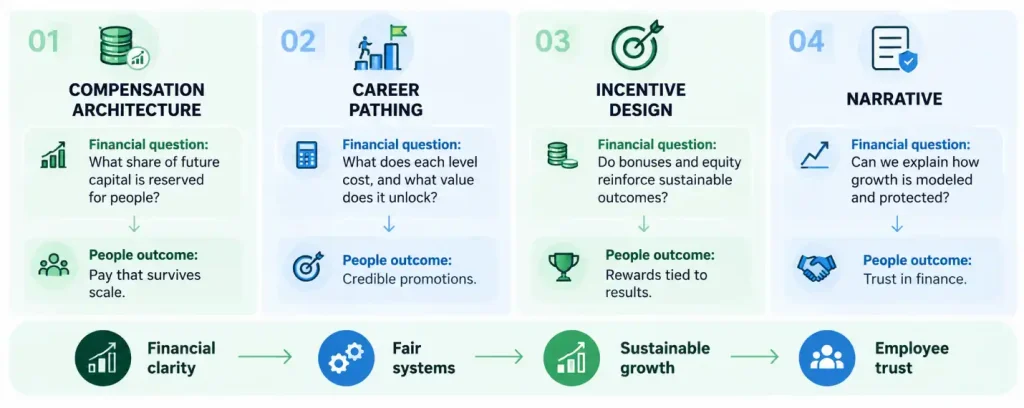
Career pathing deserves particular honesty about motive. Leaders should ask whether a promotion reflects excellence or the fear of losing someone, and whether a new layer reflects a real need for leadership or a reluctance to reset expectations. A single misleveled promotion can set off years of compensation inflation, while a clear path backed by transparent logic does the opposite.
When this system is in place, cost intelligence sounds less like restraint and more like respect. People no longer need to guess their worth or negotiate in the shadows, because they understand the rules of the game.
Stewarding People and Capital Together
Few places are lonelier than the CFO seat when a reduction in force must be modeled. In the hours before an all-hands, the spreadsheet is cold and clean, with percentages, runway extension, and fixed cost reduction all arithmetically sound. Behind every cell, however, is someone who relocated, stayed late to close the quarter, or mentored a colleague, and a decision that feels surgical in Excel feels sacred in reality.
In an early-stage email marketing and community technology company, a turnaround that reduced monthly burn from $800K to $200K demanded choices that were financially necessary and personally heavy. The way those choices were explained shaped trust long after the numbers stabilized.
Stewardship begins long before any crisis. It shows up in the patience to ask whether hiring comes from panic or plan, in the willingness to protect internal equity under pressure from external benchmarks, and in the ability to name trade-offs without collapsing them into binary approvals. Promotions are discussed as responsibilities and not as appeasements, teams are structured for operating leverage and not for optics, and cost is discussed with clarity and accountability instead of shame.
This does not mean withholding hard truths. It means delivering them with structure, context, and care, so people know the rules, understand the path, and feel seen inside the plan. Over time, they stop viewing finance as the function that limits growth and begin viewing it as the function that makes growth real.
Three Key Takeaways
- Treat every requisition as an investment thesis with a stated time to value, a defined constraint it resolves, and a known fixed cost, so hiring follows return logic and not discomfort.
- Build compensation architecture, career paths, and incentives inside a capital model that finance and People leaders own together, so pay stays fair, consistent, and sustainable as the company scales.
- Apply cost intelligence with grace, because the discipline that models headcount must also explain hard decisions with structure and care, and that combination is what earns lasting trust.
Disclaimer: This article is intended for informational purposes only and does not constitute legal, tax, or accounting advice. You should consult your own tax advisor or counsel for advice tailored to your specific situation.
Hindol Datta is a four-time CFO and senior finance executive with over 25 years of leadership experience across cybersecurity, SaaS, gaming, logistics, digital marketing, medical devices, consumer products, and nonprofit organizations. He has led more than $120M in fundraising and over $150M in M&A transactions while building the financial and operational systems that let complex businesses scale with confidence. He is the author of seven books in the Systems CFO Series and holds active CPA, CMA, and CIA credentials.
AI-assisted insights, supplemented by 25 years of finance leadership experience.