Executive Summary
Lasting EBITDA improvement starts with understanding cost, not simply cutting it. EBITDA isolates the operating engine and shows how well a company turns effort into earnings. Yet most organizations still manage cost in broad ledger categories. Digital cost intelligence links spend to the activities, customers, and workflows that drive it, turning cost into a source of strategic insight.
The sections ahead cover five parts of EBITDA improvement, starting with reading EBITDA as a signal and building the data architecture. They then address cost literacy, simulation within the forecasting process, and culture. Together they show how the CFO can earn margin that investors respect instead of margin that looks manufactured.
EBITDA as a Signal of How the Business Runs
EBITDA draws both praise and criticism from investors and analysts. Supporters value it as a clean view of operating performance, while skeptics see it as a veil for fragility. For the operational CFO, it reflects how efficiently the company converts motion into margin.
From Cost-Cutting to Cost Intelligence
Traditional approaches equate EBITDA improvement with trimming expenses, announcing a leaner base, and moving on. That playbook can help in a crisis, yet it rarely lasts. Cost intelligence takes a different stance, treating each dollar of spend as data about how the company believes it creates value.
Cost-Cutting Versus Cost Intelligence
| Dimension | Traditional Cost-Cutting | Digital Cost Intelligence |
| Starting question | Where can the company save? | What does this cost reveal about how value is created? |
| Unit of analysis | General ledger categories | Activities, customers, products, and workflows |
| Typical outcome | One-time margin gain | Durable clarity that guides pricing and investment |
| Ownership | Finance alone | Shared across every function |
Spending patterns often speak loudly about how a business operates day to day. A product team may overinvest in a feature that never converts, or a sales group may pay for overlapping enablement tools. One business unit may even carry 18% higher SG&A per revenue dollar than its peers. Each pattern reflects decisions made by people who believed they were acting in the company’s interest.
With the right data, the CFO can spot that a high-margin product line drives a heavy support burden. Finance might also find that a cheaper supplier triples downstream labor hours, which shows the value of seeing instead of cutting. Once leaders see how costs move, they can choose where to push, pause, or exit.
Building the Data Architecture for EBITDA Improvement
Cost structures are rarely as obvious as the ledger suggests. Invoices, allocations, and accruals sit buried under ledger codes designed for accounting, not understanding. Companies manage cost by category but experience it through workflows, and that gap is where insight disappears.
Granularity, Dimensions, and a Unified Data Spine
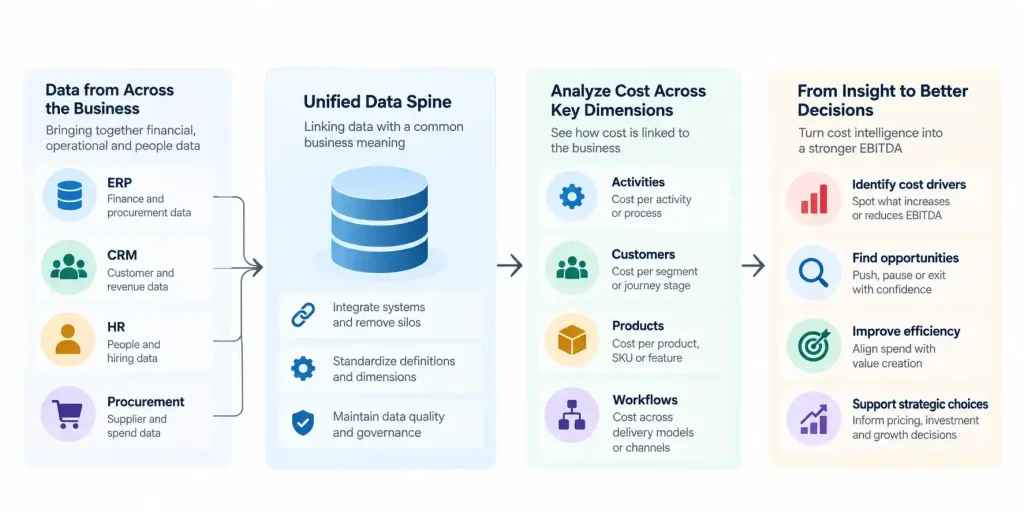
Digital cost intelligence begins with granularity at the level of real activity. Spend must map to activity, such as cost per user, per SKU, per customer journey stage, or per cloud compute hour. Instead of asking what the company spent on go-to-market, leaders can ask about cost per qualified lead in a high-churn segment. They can then compare that figure with lifetime value.
Reaching that resolution requires linking cost data to operational activity, from software usage logs to hiring timelines and support ticket volumes. Dimensional models then let finance view one expense line by cohort, lifecycle stage, delivery model, or channel without custom spreadsheets. Underneath, a unified data spine must join CRM, HR, and product systems with ERP and procurement data while keeping business meaning intact.
With that foundation in place, a good cost intelligence system supports several capabilities that drive EBITDA improvement:
- Real-time anomaly detection, such as a regional CAC rising 40% against comparable cohorts
- Scenario modeling, such as consolidating cloud spend with a single provider
- Unit economics clarity, such as margin by customer segment net of support burden
- Behavioral benchmarking, such as which teams deliver the lowest cost per retained dollar
A professional services firm with five business units shows the value of this granularity. Engagement-level profitability and utilization analytics, built from scratch, gave leadership its first clear view of where the business created margin and where it leaked. That visibility turned broad cost categories into actionable insight.
Spreading Cost Literacy Across the Organization
Insight that stays inside the finance team rarely changes anything. Product managers, marketers, and customer success leaders must all learn to read cost signals. Cost carries emotional weight, so the CFO must shift language from blame to analysis. Comparing a team’s cost per retained user with peers works far better than accusing it of overspending.
Embedding Cost Logic in Daily Work
Training should focus on thinking, not spreadsheet skills. Budget owners learn to interpret variance, break down drivers, and use benchmarks so they can act as credible stewards of EBITDA improvement in their area. Systems reinforce the habit when dashboards show cost-to-yield metrics, benchmarks appear inside everyday tools, and variance commentary explains the reasoning behind each gap.
A cybersecurity SaaS company with roughly $30M in ARR shows how this shared ownership pays off. Gross margin improved by twelve percent through pricing discipline, workforce composition, and delivery cost management. An optimized mix of employees and subcontractors also kept bench utilization under five to seven percent during rapid growth.
When operational insights flow back to the center, they sharpen the forecasting process. Edge-level observations about adoption, campaign quality, or support load improve reforecasts and make the company adaptive instead of reactive.
Simulating Trade-Offs Within the Forecasting Process
Once cost becomes intelligible, it also becomes portable across planning scenarios. Leaders can project it, adjust it, and test choices before committing. The central question shifts from what something costs to what would happen if the company chose differently.
Levers, Relationships, and Constraints
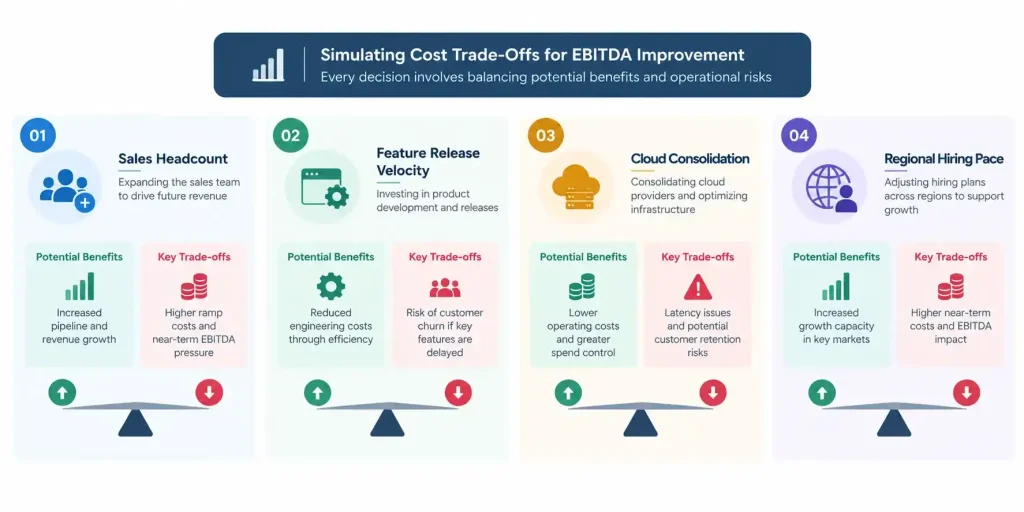
Effective simulation depends on adjustable levers connected to revenue, margin, and operating structure. Each lever behaves in its own way, and finance should model those behaviors as relationships within the forecasting process.
Common Simulation Levers and Their Trade-Offs
| Lever | Potential Benefit | Possible Trade-Off |
| Sales headcount | More pipeline and bookings | Higher ramp cost and infrastructure strain |
| Feature release velocity | Lower engineering cost when slowed | Higher churn in competitive markets |
| Cloud consolidation | Lower cost of goods sold | Higher latency and retention risk in distant regions |
| Hiring pace by region | Faster capacity for growth | Lag in quota attainment and near-term EBITDA drag |
These relationships form a map of friction and trade-offs across the enterprise. With that map, the CFO can ask which levers produce the most efficient EBITDA improvement per dollar of change. Quarterly reviews then shift from defending variance to analyzing options, such as how a rise in interest rates or enterprise churn would reshape spending.
Simulation should not stay locked inside the office of the CFO. When line leaders can use simple, governed scenario tools in their own language, foresight spreads across the company. Every scenario must state its assumptions and risk bounds. A model that ignores capacity limits or assumes unlimited demand misleads more than it helps.
Embedding EBITDA Discipline into Culture
Every company has a cost culture, whether it acknowledges it or not. Some hide from cost, some worship it, and some use it as leverage in budget battles. Lasting EBITDA improvement comes from treating cost as a shared language of decisions and values.
Rituals, Language, and Literacy
Culture forms through rhythm more than through memos or mandates. Monthly reviews tie spend to strategy, quarterly retrospectives revisit cost assumptions honestly, and cross-functional forums reason through forecasts and actuals together as part of the forecasting process. A shared glossary also matters, because terms like productivity can mean revenue per employee to finance and feature velocity to product.
Literacy completes the picture of a strong cost culture. A product manager should understand marginal return on R&D, and a recruiter should grasp how hiring cycle time affects EBITDA. When team leads offer reallocation ideas unprompted and engineers suggest cheaper architectures after seeing unit costs, cost becomes a compass instead of a brake.
Competitors can copy pricing, products, and hiring playbooks, but they struggle to copy how a company thinks about cost. That embedded judgment makes EBITDA improvement a durable advantage, because a margin is only as strong as the reasoning behind it.
Three Key Takeaways
- Durable EBITDA improvement comes from understanding cost drivers at the level of activities, customers, and workflows, not from one-time cuts.
- A unified data spine and shared cost literacy let every function act on cost signals and feed better insight into the forecasting process.
- Simulating trade-offs and building rituals around cost turn EBITDA discipline into a cultural habit that competitors find hard to copy.
Disclaimer: This article is intended for informational purposes only and does not constitute legal, tax, or accounting advice. You should consult your own tax advisor or counsel for advice tailored to your specific situation.
Hindol Datta is a four-time CFO and senior finance executive with over 25 years of leadership experience across cybersecurity, SaaS, gaming, logistics, digital marketing, medical devices, consumer products, and nonprofit organizations. He has led more than $120M in fundraising and over $150M in M&A transactions while building the financial and operational systems that let complex businesses scale with confidence. He is the author of seven books in the Systems CFO Series and holds active CPA, CMA, and CIA credentials.
AI-assisted insights, supplemented by 25 years of finance leadership experience.