
Executive Summary
Effective investor relations turns each earnings cycle from a scripted ritual into a lasting source of trust. Every ninety days, the company speaks publicly about itself, and a single phrase or hesitation can shift valuation and investor sentiment. Strategic communication during these moments depends on accuracy, transparency, and disciplined restraint, not on polished spin.
The sections ahead cover five parts of investor relations, starting with the earnings narrative and the audiences that listen. They then address communication during misses, internal alignment, and the earnings cycle as a long-term lever. Together they show how the CFO can use each quarter to deepen credibility instead of simply surviving scrutiny.
Building the Earnings Narrative in Investor Relations
For the CFO, the earnings call is the moment when private conviction must withstand public light. Too often, teams write calls to please instead of to clarify. Numbers arrive without story, achievements drown in jargon, and shortcomings hide behind euphemism.
Finding a Voice of Earned Clarity
Great earnings communication begins with voice, meaning the narrative tone a company uses to tell its own truth. That tone compounds over quarters, becoming either a mark of reliability or a slow erosion of trust. Some companies sound mechanically competent but cold, while others sound defensively optimistic and never fully convincing.
The strongest voice names success without arrogance and explains challenges without retreat. It lays out trade-offs openly and tells investors the truth before they ask. In investor relations, the structure of the call should support that voice:
- Open with framing: what the company set out to do, what changed, and what surprised leadership
- Present numbers as supporting evidence, read in relation to each other instead of in isolation
- State trade-offs plainly, such as raising R&D spend at the expense of short-term EBITDA
- Close with perspective on the signals leadership is watching and the uncertainties it is modeling
Investors rarely punish deliberate trade-offs, but they do punish concealment. The best calls sound less like press releases and more like briefings from a trusted advisor. They may not lift the share price in the moment, yet they build credibility over time.
Understanding Who Listens to Strategic Communication
An earnings call delivers one message through one channel, yet many different minds interpret it. Each audience listens for its own signals, and strong investor relations accounts for all of them.
Earnings Call Audiences and What They Listen For
| Audience | What They Listen For | How the CFO Should Respond |
| Sell-side analysts | Changes from prior guidance and shifts in key terms | Provide clear structure, consistent frameworks, and reasoned guidance |
| Buy-side investors | Signal consistency and fidelity to long-term strategy | Show direction, discipline, and a steady strategic compass |
| Algorithms | Sentiment, keyword frequency, and unexpected phrases | Keep phrasing consistent, sequencing clear, and exceptions careful |
| Employees | Whether leadership sounds proud, honest, and in control | Speak as if addressing an all-hands meeting |
Sell-side analysts notice when language shifts, such as “disciplined investment” replacing “accelerated ramp.” Buy-side investors watch for new qualifiers or missing metrics. Algorithms react to tone and word choice, and their first wave of trading can shape what follows.
Employees may be the most important audience of all. They hear whether the public voice matches the private reality, and any gap creates dissonance that no internal presentation can repair. Seasoned CFOs therefore speak as if their own teams sit across the table, because in practice they do.
Strategic Communication During Misses and Disappointment
Even with strong investor relations, every company eventually misses a quarter, whether by a single point of revenue or through a major customer loss. Many CFOs instinctively soften the message, reorder the results, or bury the surprise. Markets, however, punish evasion far more than they punish failure.
Name, Explain, and Correct
Strong strategic communication during a miss follows a clear sequence. First, name the miss early and plainly, such as stating that revenue came in below guidance. Second, diagnose the cause honestly, whether it was external pressure, execution error, or over-forecasting.
Third, explain the implications for guidance, strategy, and resource allocation. Finally, show visible correction by describing what the company has already done and what it will do by next quarter. Companies that treat misses as mirrors instead of bad weather tend to rebuild confidence faster.
Tone matters most during the unscripted Q&A portion of the call. Answering hard questions directly and calmly earns more trust than repeating talking points. Most capital on the line belongs to investors who want to believe, so giving them coherent data to defend the company serves everyone. Employees listening in should also hear what the team did well, what leadership missed, and what the plan is.
Internal Alignment Behind the Public Voice
To the market, the CFO appears to stand alone on the call. In reality, credible investor relations depends on an internal ensemble working in rhythm. When companies treat earnings as a quarterly scramble, the market hears the seams.
Building the Message in Layers
The process should start weeks in advance with one question: what story does the quarter truly tell? An earnings working group then brings together several lenses. FP&A explains the movement behind each line item, IR brings market intelligence and likely questions, and Legal ensures disclosure precision.
Communications aligns the press release, shareholder letter, and employee messages, while the CEO connects the quarter to the long-term mission. The CFO conducts this group, timing each contribution without letting any single voice dominate.
Materials work best when built in three layers. The truth layer captures the raw facts, and the meaning layer explains why results moved. The message layer then expresses that truth in a tone that is neither inflated nor evasive.
A Euronext Paris-listed gaming company shows how demanding this coordination can be. Board engagement, audit oversight, and consolidated reporting across five countries under IFRS and US GAAP all fed a single public voice. The same company also led an S-1 and IPO-readiness process with investment bank underwriters and Big Four auditors.
Preparation extends to rehearsing likely questions and briefing executives before the call. When employees understand the investor relations narrative early, they reinforce it in investor meetings, recruiting calls, and customer conversations. Consistency must also span the call, the press release, the slides, and every interview that follows.
Using the Earnings Cycle as a Long-Term Lever
Markets trade in quarters, yet culture, strategy, and trust develop over years. The most effective CFOs treat each call as a chapter in a longer story instead of an isolated performance. When every data point sits inside a visible framework of meaning, markets trade more on understanding and less on surprise.
Vision, Discipline, and Signaling
Three elements turn the earnings cycle into a strategic lever. Vision restates the long-term arc in each call, because the market rarely remembers last year’s investor day. Discipline shows stewardship, such as phasing go-to-market spend until product readiness justifies it.
Strategic signaling previews direction without making commitments, such as noting early traction in a new vertical. These cues shape the hundreds of investor conversations that follow each call. Investor relations must carry the same emphasis through the following weeks, and the CEO’s public remarks should match.
A venture-backed digital marketing company that raised $36.5M across three funding rounds shows the value of consistent investor communication. Its CAC, LTV, and contribution margin discipline gave investors a steady logic to follow from round to round. That consistency helped each new conversation build on the last.
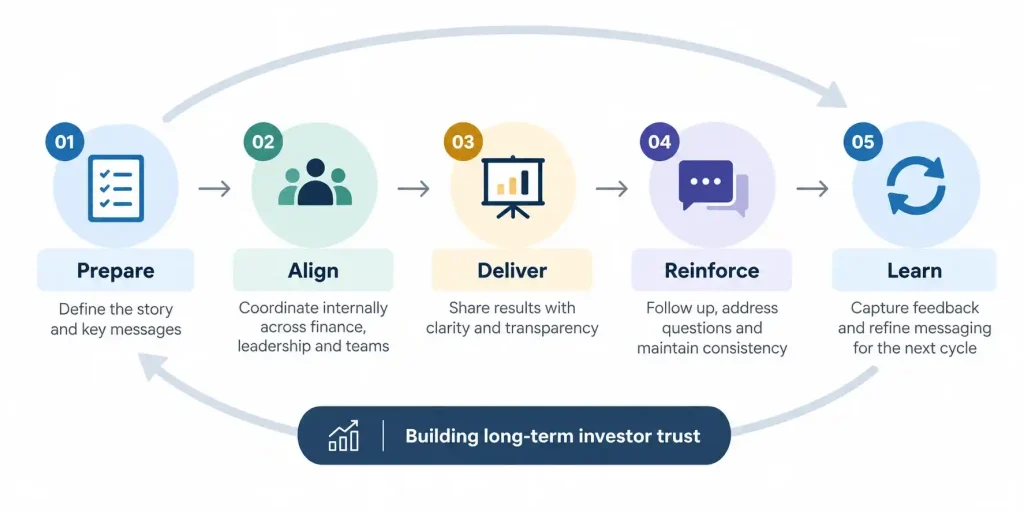
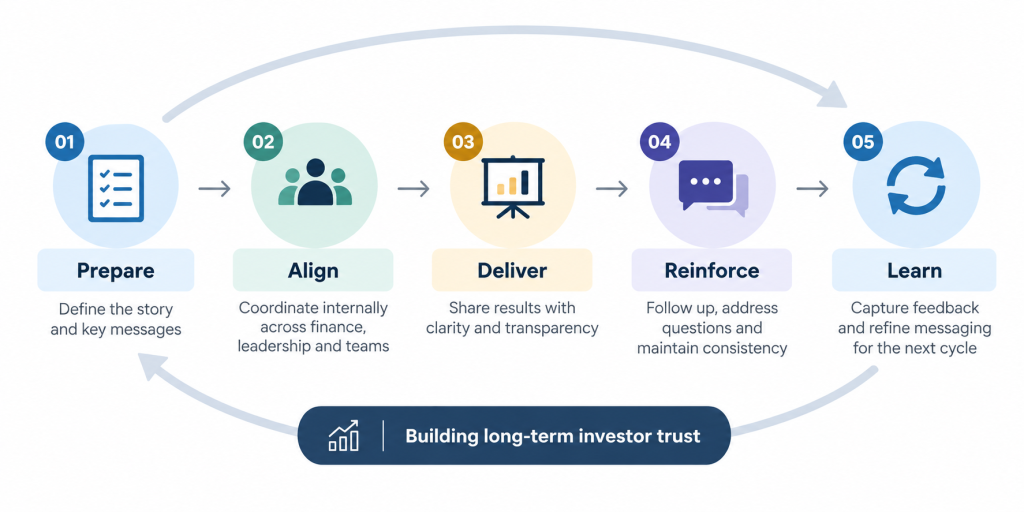
The Earnings Communication Cycle
| Prepare | Align | Deliver | Reinforce | Learn |
| Define the story of the quarter | Coordinate FP&A, IR, Legal, and Comms | Present narrative, numbers, and trade-offs | Echo key themes in follow-up meetings | Refine messaging for the next cycle |
The great CFOs do not aim to impress in 45 minutes. They aim to compound belief over 12 quarters, building a company that markets understand and employees believe in.
Three Key Takeaways
- Investor relations works best when each earnings call leads with narrative framing and states trade-offs openly. Each call should close with honest perspective on what leadership is watching.
- Strategic communication must reach several audiences at once, from analysts and investors to algorithms and employees, without diluting the core message.
- Credibility grows fastest when leaders name misses plainly, explain them honestly, and pair them with visible correction. Tight internal alignment across finance, legal, and investor relations makes that possible.
Disclaimer: This article is intended for informational purposes only and does not constitute legal, tax, or accounting advice. You should consult your own tax advisor or counsel for advice tailored to your specific situation.
Hindol Datta is a four-time CFO and senior finance executive with over 25 years of leadership experience across cybersecurity, SaaS, gaming, logistics, digital marketing, medical devices, consumer products, and nonprofit organizations. He has led more than $120M in fundraising and over $150M in M&A transactions while building the financial and operational systems that let complex businesses scale with confidence. He is the author of seven books in the Systems CFO Series and holds active CPA, CMA, and CIA credentials.
AI-assisted insights, supplemented by 25 years of finance leadership experience.