
Executive Summary
Board governance is often described as oversight, yet its real substance is judgment exercised under uncertainty. With structured financial frameworks in the boardroom, directors stop reviewing numbers in isolation. They start weighing choices through a shared logic of value creation.
This article shows how a CFO can read the board, build three core frameworks and embed them in the calendar. It also covers how those tools mediate conflict and build a lasting culture of financial reasoning.
Why Board Governance Needs More Than Accurate Numbers
A particular quiet settles over a boardroom just before a quarterly review begins. For many CFOs, this setting invites caution, and the role narrows to presenting results and absorbing questions.
That role is too small for what effective board governance requires. Precision is mandatory, but accuracy alone does not build alignment with directors. Relevance does, and many finance leaders present the right numbers while telling the wrong story. They explain performance without the pattern behind it, or show a chart without the choice it represents.
Consider two versions of the same margin update. The first states that EBITDA improved 160bps due to operating leverage. The second traces the gain to fixed-cost absorption in the go-to-market platform. It adds that leverage will moderate as new regions launch, so automation spending will protect margin. One version reports, while the other guides the next decision.
Reading the Psychology of the Board
Every board has its own way of absorbing information and digesting risk. Some directors want regression tables and waterfall logic, while others prefer narrative and precedent. Strong board governance begins with listening, so the CFO can pitch each discussion at the right altitude.
Board engagement works in seasons, not slides, and each interaction builds or erodes cognitive alignment. In multi-entity companies, that alignment often depends on every subsidiary adopting one definition of revenue. With a common language in place, debates turn on variables instead of belief systems.
Turning Board Packets into Decision-Support Tools
Board materials should work as decision-support systems, not compliance documents, and every packet should answer two questions:
- What should the board understand after reading it?
- What should the board help management decide?
A deck that cannot answer both is a compliance artifact, not a board governance tool. Even boards that prefer line-by-line review can evolve when the CFO introduces ROI ladders, investment heat maps and risk-weighted forecasts.
Three Financial Frameworks That Strengthen Board Governance
To govern is to choose among paths shaped by limited capital, bounded time and uncertain return. Without frameworks, boards default to instinct, narrative bias and power dynamics. With them, directors gain transparency into the assumptions beneath each decision.
The Capital Allocation Map
This map visualizes intention instead of spend by tracking capital across growth, innovation, maintenance, risk mitigation, M&A and shareholder returns. The income statement records where money went, while the map explains why and what went unfunded. Its greatest value lies in rehearsing reallocation, such as shifting 10% from channel expansion to product. That exercise moves the board from monitoring to modeling.
The Return-on-Strategy Grid
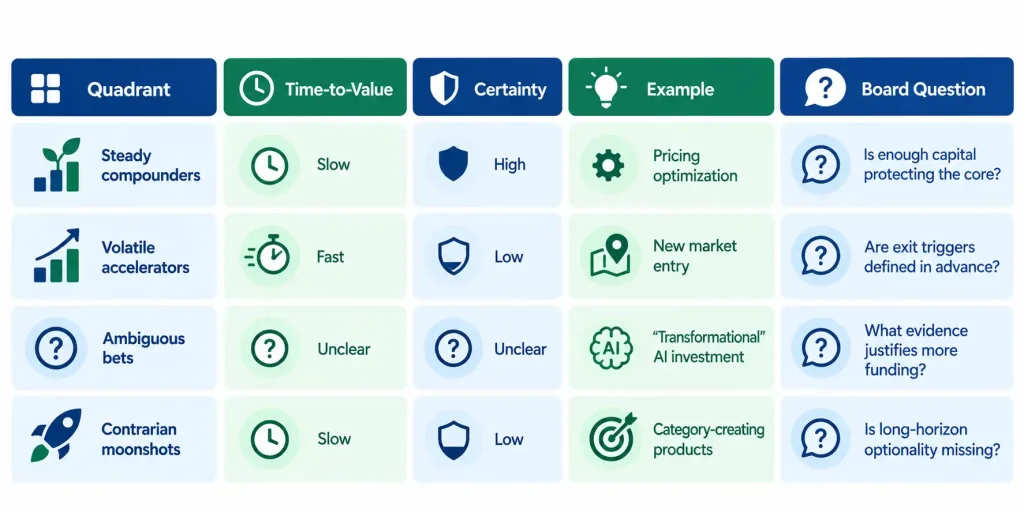
This bespoke framework plots initiatives by time-to-value and certainty of return. Directors see the portfolio of bets in tension and can spot when too many cluster in one quadrant. In this setting, the CFO acts as a portfolio strategist, not a gatekeeper.
Return-on-Strategy Grid Quadrants
The Scenario Cone
The Scenario Cone replaces a single forecast with a central case bounded by upside and downside paths. Its purpose is preparedness, so turbulence arrives as something the board has already rehearsed. In mission-driven organizations, scenarios built on variable philanthropic and earned revenue sharpen board governance. They give the audit committee a disciplined way to judge long-term sustainability.
Keeping Frameworks Alive as the Company Grows
These frameworks are languages, and they belong across the entire board governance rhythm. Capital allocation should inform compensation, the strategy grid should test acquisitions, and the Scenario Cone should frame investor messaging. Frameworks also need pruning, because a capital map built at $100M ARR may fail at $1B.
Core Board Governance Frameworks Compared
| Framework | What It Shows | Board Question | Where It Applies |
| Capital Allocation Map | Intended capital flows | Does funding match strategy? | Semi-annual reviews, compensation |
| Return-on-Strategy Grid | Initiatives by speed and certainty | Is the portfolio balanced? | Quarterly reviews, M&A |
| Scenario Cone | Base, upside and downside paths | How prepared is the company? | Annual planning, investor messaging |
Embedding Frameworks into the Board Governance Calendar
Governance at its worst is episodic, a series of rushed updates and retroactive approvals. At its best, each meeting continues the last. The CFO orchestrates pattern recognition instead of narrating variance.
Governance Cadence and Framework Use
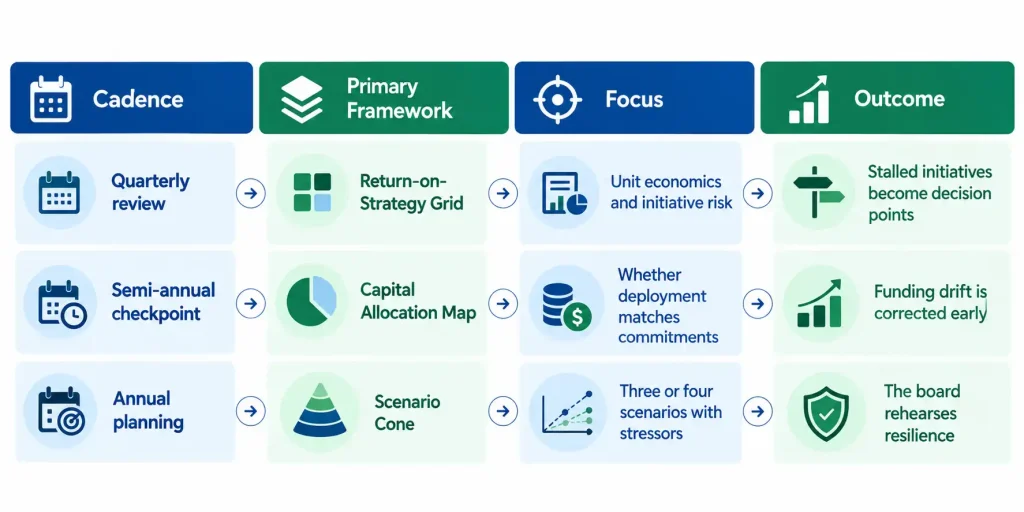
Annual planning calls for humility: a base case, the top drivers of deviation and a response playbook. When actuals hold within 5% of forecast for several consecutive quarters, the board stops questioning numbers and starts debating direction.
Rituals That Build Institutional Memory
Rituals turn good governance ideas into institutional memory, and three practices stand out:
- Open each meeting with a three-slide capital update in the same format every time.
- Close each quarter with a “lessons from variance” session that uncovers flawed assumptions without assigning blame.
- Refresh the frameworks every 18 months, or whenever stage or strategy shifts.
Over time, rhythm builds memory, and memory builds the trust a board needs when conversations turn hard.
Using Financial Frameworks to Mediate Board Disagreement
Every boardroom eventually reaches a point of fracture over an acquisition, an earnings miss or a leadership transition. The problem is rarely disagreement itself but disagreement without shared structure. A growth-minded director fears underinvesting, while an audit chair watches covenant headroom. Frameworks offer neutral containers where these views can be processed instead of polarized.
Turning Conviction Versus Caution into a Bounded Choice
Suppose international headwinds emerge through regulatory change and currency volatility. The CEO wants to double down, while a director argues for pulling capital until predictability returns. With a Scenario Cone in place, the CFO walks through the downside case and the upside if demand holds. If the gap is $42M in year-three free cash flow, the board decides how much to underwrite. At that point, the debate moves from belief to bounds.
Workforce Reductions, Debt and Risk Appetite
A proposed workforce reduction improves margin immediately, yet some directors fear talent loss and brand erosion. Placing the cut on the Return-on-Strategy Grid shows how it drains funding from medium-certainty, high-return initiatives. Debt debates follow a similar path when one director sees acceleration and another sees fragility. If new borrowing lifts buffer utilization from 60% to 85%, directors test that against their risk appetite.
Board Governance When the Business Faces Structural Decline
When unit economics stop scaling or a disruptive entrant arrives, governance shifts from optimization to clarity in retreat. The CFO frames the gross margin trajectory, breakeven assumptions and the remaining optionality window. Three moves usually remain: reinvention, sale or managed shrinkage. A board with framework muscle memory asks what the numbers mean, not who is to blame.
Building a Lasting Culture of Financial Reasoning
The deepest layer of board governance is cultural, shaped by the way a company’s stewards reason together over time. As board governance matures, the questions directors ask begin to change. They stop asking why SG&A rose and start asking how spend velocity compares across strategy lanes.
That shift signals ownership, and it matters because CEOs come and go while shared reasoning provides ballast. The Capital Allocation Map becomes a mental model directors use even when the CFO is absent. Disagreement turns into constructive rehearsal of bull and bear cases. In high-growth companies, metrics such as CAC, LTV and contribution margin become a common board language. Any CFO can report results, but the rarest ones teach an organization how to understand them.
Three Key Takeaways
- Treat every board packet as a decision-support system that states what directors should understand and decide. Relevance builds alignment in ways accuracy alone cannot.
- Anchor board governance in three frameworks: the Capital Allocation Map, the Return-on-Strategy Grid and the Scenario Cone. Tie each one to a fixed point in the governance calendar.
- Use those frameworks to turn disagreement into bounded, quantified choices. Over time, the board builds a culture of financial reasoning that survives leadership changes and market shocks.
Disclaimer: This article is intended for informational purposes only and does not constitute legal, tax, or accounting advice. You should consult your own tax advisor or counsel for advice tailored to your specific situation.
Hindol Datta is a four-time CFO and senior finance executive with over 25 years of leadership experience across cybersecurity, SaaS, gaming, logistics, digital marketing, medical devices, consumer products, and nonprofit organizations. He has led more than $120M in fundraising and over $150M in M&A transactions while building the financial and operational systems that let complex businesses scale with confidence. He is the author of seven books in the Systems CFO Series and holds active CPA, CMA, and CIA credentials.
AI-assisted insights, supplemented by 25 years of finance leadership experience.