
Executive Summary
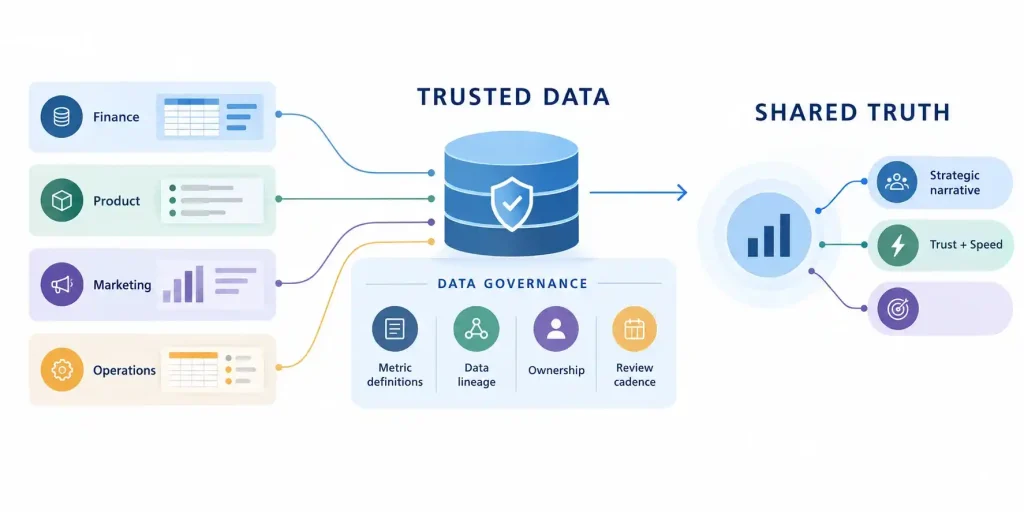
Data does not create value simply by existing. People have to understand it, trust it, and share it meaningfully across functions. That is the actual work of a data governance strategy. This article makes the case that governance is not a compliance exercise. It is the foundation of strategic alignment. It determines whether finance, product, and marketing debate strategy itself, instead of debating whose number is correct.
The article covers how misalignment quietly fragments an organization, and how governance gets embedded into daily workflow rather than sitting in a policy binder. It also covers how the CFO translates governed data into strategic narrative, and how mature governance becomes a genuine competitive advantage. Readers will find the practical mechanics behind each stage.
The Anatomy of Misalignment
A quarterly review can surface two different gross margin numbers for the same business unit, shown on two different slides. Neither number is technically wrong. Both reflect different assumptions, drawn from teams working off slightly different definitions. That single moment often does more damage to strategic clarity than any single bad decision.
How Small Fractures Compound
This kind of misalignment rarely arrives as a dramatic failure. It erodes confidence and cohesion slowly, the way a ship drifts off course. Sales and marketing disagree on funnel conversion because their lead definitions diverge. Finance and operations cannot reconcile inventory because SKUs carry different classifications in each system. These small fractures compound until strategic decisions rest on a foundation of half-truths.
This is not a technology failure. Most companies already own the cloud platforms and analytics stacks that should produce data harmony, at least in theory. Governance is not a software feature. It is a set of agreements, sometimes codified and often cultural, about what an organization considers true, and those agreements need ongoing maintenance.
Naming Misalignment as a Breakdown in Shared Truth
CFOs sit at the intersection of product ambition, market momentum, and investor expectation. They translate these often conflicting signals into coherent financial language. When the underlying data is fragmented, that translation becomes difficult and genuinely risky. A misalignment in how deferred revenue gets recognized can distort guidance and capital planning, often unnoticed until results diverge.
Misalignment carries an emotional dimension too. Teams sometimes treat data as territory, and dashboards turn political once metrics become bargaining chips. None of this is inevitable. Naming the problem correctly matters first: not a failure of systems, but a breakdown in shared truth. When teams work from inconsistent definitions, they are not simply disagreeing. They operate in parallel realities that no amount of additional reporting will fix.
| Governance element | What it defines | Who should own it |
| Metric definitions | What counts as revenue, churn, or active user | A cross-functional council, not IT alone |
| Data lineage | Where a number originated and how it moved | Data stewards embedded in each function |
| Ownership | Who is accountable for a dataset’s accuracy | Named owners, not a shared inbox |
| Review cadence | When definitions get revisited | Finance, tied to planning cycles |
Some of the most strategically coherent organizations maintain something like a living data constitution. It is an agreement about the definitions, sources, and custodianship of critical metrics, maintained by a council spanning finance, product, marketing, and operations. That council does not need unanimity. It needs clarity, and its job includes making disagreement explicit and arbitrating it.
Embedding a Data Governance Strategy Into the Flow of Work
Governance drafted as a framework and filed away rarely survives contact with the actual business. Products launch and leads get chased while the static framework sits quietly in a folder, unused. That is not a failure of will. It is a failure of integration between policy and practice.
From Policy Document to Daily Habit
Most data errors originate in small, local decisions that feel entirely rational at the time. A sales rep might create a lead with an incomplete account hierarchy, or a campaign might tag regions inconsistently. Each act seems minor alone, but downstream it disrupts forecasting. The only durable fix meets these decisions where they happen. It embeds stewardship into the texture of daily work, rather than adding a separate review step.
This starts with redefined expectations, not new headcount. Every function already carries data responsibilities, whether it acknowledges them or not. The goal is not turning everyone into a data scientist. It is making everyone a data citizen. Product managers should understand clean event schemas, marketers should trace a lead’s lifecycle, and engineers should respect the downstream implications of log structure.
Automation, Rituals, and Ongoing Recalibration
Systems need to carry governance forward automatically. Relying on memory does not scale. Validation rules, traveling metadata, and anomaly alerts all function as silent guardians, visible only when needed. One useful pattern treats a data catalog as a living object, where each metric carries a profile showing its owner, query frequency, and last validation date.
Rituals matter alongside systems. A quarterly metric audit asks whether the team is still measuring what it thinks it is measuring, and a planning cycle that opens with a reconfirmation of definitions keeps a data governance strategy from calcifying. Planning cycles and forecasting rhythms are natural points of convergence for this work, and capital allocation requests should include a provenance review of the underlying data.
Governance also needs deliberate recalibration over time. Business models evolve, and definitions that were once precise grow fuzzy. The CFO can steward the forums where definitions get refreshed, asking plainly whether a customer or cost center definition still matches how the business operates.
The CFO as Translator: Turning Governed Data into Strategic Narrative
Raw data tells stories of activity. Sales reports surge and stall, and product telemetry pulses in real time. None of it hints at strategy until someone stitches the fragments together. In the modern enterprise, the CFO increasingly functions as a translator of meaning, not language. That means turning dissonant data into a narrative the board and the market can follow with confidence.
Listening Before Narrating
Translation starts with immersion in how the business actually operates, not just what the dashboards report on the surface. What does active user mean in product? How does revenue get allocated across bundles in sales? What does churn mean when contracts run multi-year but usage tracks monthly? These are strategic inflection points, not semantic trivia, and skipping this step risks building conclusions on assumptions that no longer hold.
A forecasting model can drift into quiet dysfunction over time without anyone noticing. It keeps producing numbers and hitting deadlines. It no longer reflects how the business actually works, though, perhaps because seasonality assumptions no longer match buyer behavior, or CAC gets averaged across channels that have diverged wildly. The fix is not rebuilding the model immediately. It is sitting with product, marketing, and operations to ask what changed, and how the team knows.
From Fragments to a Whole Narrative
The board does not want raw telemetry. It wants to understand why a two-point drop in gross margin matters, and what a shift in cohort behavior suggests about pricing power. These are narrative questions, and only a CFO fluent in the business can answer them with integrity. The narrative has to honor complexity without surrendering to it, since too little detail turns the story into fiction and too much into noise.
Governance is what makes this translation reliable, rather than guesswork. With clean definitions and clear lineage, patterns become discernible and the business gains a mirror that does not distort. Stewardship matters more than persuasion in the CFO’s responsibility here, so the story needs to stay faithful to reality, including its risks and uncertainties, instead of getting polished for applause.
Data Governance Strategy as a Lasting Strategic Advantage
The organizations that move fastest are often the ones that first learned to slow down. They took the time to define, clarify, and agree before acting. That discipline is governance. Far from slowing execution, it functions as the hidden engine behind it.
Trust as an Operating Condition
When governance holds firm, decisions speed up. Not because they are rushed, but because they stop needing to be repeated. Cross-functional teams move in parallel on a shared frame of reference, and investors lean in because the story stays consistent. Trust becomes an operating condition once everyone can depend on the same definitions and lineage.
Governance also confers resilience during volatility, when it matters most. Companies with strong data governance respond to a market shift with clarity rather than panic, isolating impacts and re-forecasting quickly.
Scaling Without Splintering
At a high-growth company navigating international expansion, teams launched in new markets every quarter. Revenue definitions, cost structures, and user taxonomies stayed governed by a centralized but adaptive model throughout. Local teams still moved fast within a defined frame, and their data rolled up cleanly regardless. The company grew without splintering, and its board debates focused on deciding the future rather than reconciling the past.
Governance does not remove complexity. It keeps complexity legible instead, which is a different and more useful thing. Reaching that state requires governance to become culture, not just a function, so teams experience it as protection rather than bureaucracy. External perception benefits too, since governance is what makes an earnings call and a later filing tell the same story.
Three Key Takeaways
- Name data misalignment for what it is, a breakdown in shared truth rather than a technology gap, and build a cross-functional council to own key metric definitions.
- Embed a data governance strategy into daily workflow through automation, clear ownership, and recurring rituals like metric audits, rather than leaving it in a policy document.
- Use governed data to build faithful strategic narrative and treat governance as a genuine strategic advantage that scales trust and speed together, not as a compliance cost.
Disclaimer: This article is intended for informational purposes only and does not constitute legal, tax, or accounting advice. You should consult your own tax advisor or counsel for advice tailored to your specific situation.
Hindol Datta is a four-time CFO and senior finance executive with over 25 years of leadership experience across cybersecurity, SaaS, gaming, logistics, digital marketing, medical devices, consumer products, and nonprofit organizations. He has led more than $120M in fundraising and over $150M in M&A transactions while building the financial and operational systems that let complex businesses scale with confidence. He is the author of seven books in the Systems CFO Series and holds active CPA, CMA, and CIA credentials.
AI-assisted insights, supplemented by 25 years of finance leadership experience.