
Executive Summary
A strong board communication strategy gives directors more than accurate numbers. It offers meaning, context, and a clear view of where the business is heading. For the CFO, communicating with the board of directors is a form of stewardship that shapes confidence long before any vote takes place.
This article examines four disciplines behind effective board communications: earning credibility, shaping a narrative, holding confidence through volatile quarters, and building a steady cadence of updates. Each section offers practical frameworks a finance leader can apply before the next board meeting.
Why Board Communication Strategy Shapes Boardroom Outcomes
A particular stillness settles over a boardroom just before the CFO begins to speak. It is neither deference nor doubt, but something closer to readiness. Directors arrive to question, to sense, and to judge, carrying experience that sits above the daily machinery of the business.
Board members want more than data from the finance leader. They want to know whether the business understands itself and sees its own assumptions. In the CFO, directors look for an interpreter who offers visibility without confusion, accountability without evasion, and foresight without hubris.
A sound board communication strategy is a conversation practiced with precision, not a performance. The work involves selecting, shaping, and sequencing the story of the business so that truth arrives without embellishment. It also rests on a set of quieter habits:
- Never surprising the board with news it should have heard earlier.
- Avoiding absolutes when the evidence supports only probabilities.
- Preparing a point of view, not just a slide.
- Knowing when silence serves the room better than defense.
Earning the Right to Be Heard in the Boardroom
No board hands over its trust on the first day. Credibility accrues quietly through consistency and patient attention to detail.
Preparation as Strategic Memory
Earning credibility begins with preparation, though not the kind that produces a deck polished the night before. The CFO who communicates well carries the narrative spine of the business at all times. That means knowing what happened, why it happened, and what might happen next. Numbers become signals instead of totals, and each metric traces back to a decision made months earlier.
Knowledge alone does not earn trust, but judgment does. The CFO must show which parts of the story deserve the board’s attention, without drowning concern in detail or softening reality with abstraction. What earns trust is the willingness to state, early and plainly, what the board needs to know.
The Economy of Language in Board Reporting
Effective board reporting refuses to confuse length with weight. A useful structure for any board update looks like this:
- Three points that frame the current risk.
- Two signals that capture what has shifted.
- One insight that changes the context.
This structure is not reductionism but clarity that only comes through effort.
Trust Built Between Meetings
Much of the credibility in board communications forms in the weeks between sessions. The CFO calls when the unexpected occurs instead of waiting for the quarterly meeting to raise a quiet flag. Over time, this consistency becomes a kind of strategic intimacy, and directors stop wondering what leadership might be holding back.
At a cybersecurity and identity access management company with roughly $30M in ARR, finance held actuals within 5% of forecast for 8 consecutive quarters. That track record changed the tone of board discussions. Directors spent less time testing the forecast and more time debating strategy.
Shaping the Narrative: The Core of Any Board Communication Strategy
Once trust exists, the work shifts from validation to vision. Instead, directors listen for pattern, tension, and direction, and the CFO must become a narrator in place of a messenger.
Narrative in this sense has nothing to do with spin. A well-formed narrative binds facts, risks, and forward judgment into something coherent. The contrast below shows how the same quarter can reach directors in two different ways.
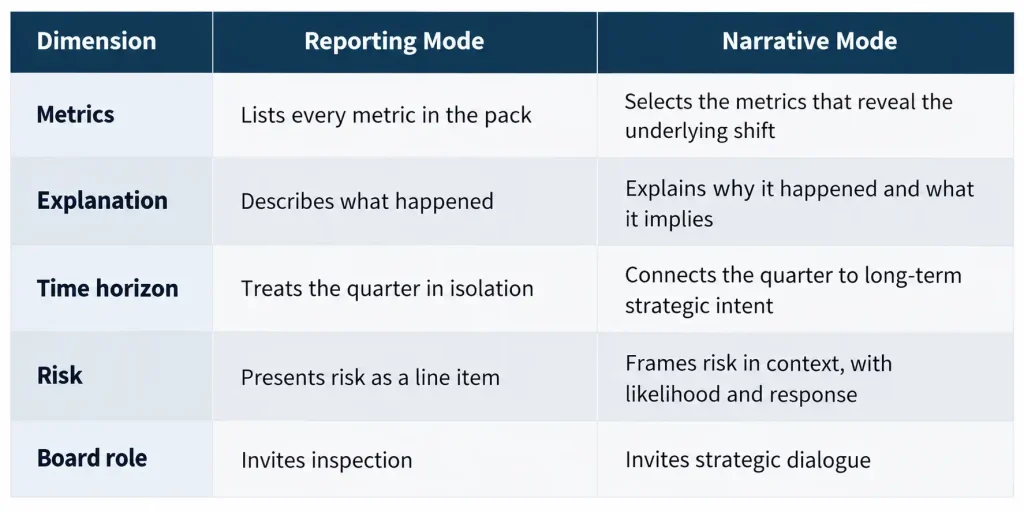
Connecting the Quarter to Long-Term Strategy
Before saying a word, the CFO must decide what story the numbers are telling. It should be the true story, not the one that reassures. From there, the focus narrows to what changed since last quarter, which assumptions now face challenge, and which parts of the plan still hold. Directors remember turning points far longer than they remember metrics.
The central question is never just what happened, but whether it supports where the company is trying to go. At a publicly listed gaming and digital entertainment company operating across five countries, subsidiaries once reported revenue under inconsistent definitions. A single, unified revenue definition across every entity did more for the board than any slide redesign. Once directors trusted the numbers, discussion moved from reconciliation to strategy.
Nuance and Timing in Board Communications
Board members are intelligent readers who notice what sits between the lines. The CFO must name risks without dramatizing them and show progress without overstating its permanence. Striking that balance gives directors confidence rooted in candor.
Timing matters as much as content in a board communication strategy. The best updates anticipate questions before anyone asks them and draw the eye to what matters most. When that happens, the boardroom shifts from a forum for inspection to a space of shared stewardship.
Holding Board Confidence Through Complexity and Volatility
In hard quarters, forecasts falter, margins compress, and familiar correlations dissolve into contradiction. Directors accept volatility as part of business, but they cannot tolerate opacity.
Complexity is a condition to explain, not a problem to solve in a single meeting. The CFO shows where the noise originates, which parts of the system remain sound, and which now sit under stress. As the environment grows more volatile, the tone should grow more grounded and the framing more precise.
Returning to First Principles
Composure under pressure comes from a repeatable structure of inquiry. The following questions help restore orientation when signals scatter:
- What does the team know with confidence today?
- Which assumptions remain under active testing?
- What external change explains the shift in results?
- Which part of the plan proved most sensitive to that change?
- Does the data point to an anomaly or a new trend?
These questions exist to restore orientation, not to defend performance. An early-stage email marketing technology company offers a useful example. During an operational turnaround that cut monthly burn from $800K to $200K, the board needed candor more than comfort. Clear framing of what the team knew, what remained under test, and what would trigger the next decision kept directors aligned.
Composure Is Earned Before the Crisis
The credibility a CFO draws on in a hard quarter accumulates in the calmer quarters before it. Transparency in strength and candor in weakness earn that belief in advance. A CFO with that history can call a setback temporary, or call for a rethink of core assumptions, and the board will listen.
The board may not leave reassured, but it should leave aligned, sensing that the business is steering instead of spinning. The CFO does not need every answer, but she must offer a credible path to finding them.
Building a Board Communications Cadence Directors Can Rely On
Strong board relationships run on habit, not on occasional episodes. A disciplined board communication strategy sets a cadence that stays predictable in form but rich in substance. The framework below works across public, venture-backed, and mission-driven boards.
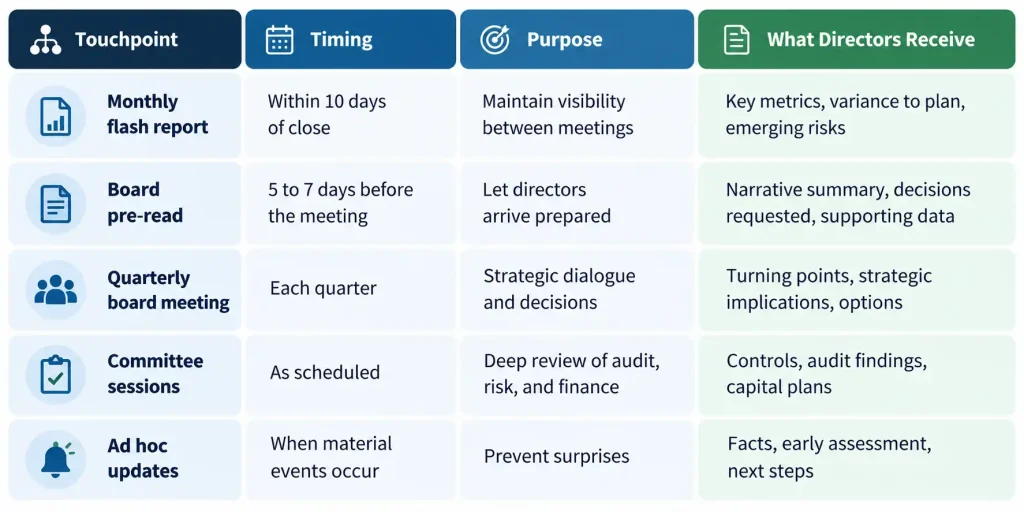
At a mission-driven education and research institution in Silicon Valley, the CFO staffed both the finance and audit committees while raising $37M in equity and venture debt, reporting to that board on a steady monthly rhythm. Over time, meetings moved from correction toward contribution, and dialogue centered on long-term sustainability instead of last month’s variances.
Directors rarely remember every chart, but they remember how the CFO guided them through the numbers. That is the quiet architecture of a strong board communication strategy, where every word counts and every silence speaks.
Three Key Takeaways
- Trust with the board forms long before any meeting, through consistent forecasts, early warnings, and plain speech when the news is hard. A board communication strategy built on that foundation earns the board’s lasting belief.
- Directors need narrative, not a flood of metrics, so each update should center on turning points and link the quarter to long-term strategy. A simple structure of three risks, two signals, and one insight keeps board communications focused.
- In volatile quarters, offer composure instead of comfort by returning to first principles and a predictable cadence. The board may not leave reassured, but it should leave aligned.
Disclaimer: This article is intended for informational purposes only and does not constitute legal, tax, or accounting advice. You should consult your own tax advisor or counsel for advice tailored to your specific situation.
Hindol Datta is a four-time CFO and senior finance executive with over 25 years of leadership experience across cybersecurity, SaaS, gaming, logistics, digital marketing, medical devices, consumer products, and nonprofit organizations. He has led more than $120M in fundraising and over $150M in M&A transactions while building the financial and operational systems that let complex businesses scale with confidence. He is the author of seven books in the Systems CFO Series and holds active CPA, CMA, and CIA credentials.
AI-assisted insights, supplemented by 25 years of finance leadership experience.