
Executive Summary
Strategic innovation is often described as inspiration, yet in practice it behaves more like a system that finance must fund and govern. The ideas matter, but the scaffolding around them decides which ones survive contact with the budget. That scaffolding increasingly sits with the CFO, who shapes the conditions for innovation rather than its content.
This article covers four levers that connect innovation and strategic management in daily practice. They are operating rhythm, staged capital allocation, learning-based measurement, and a portfolio culture that makes experimentation routine. Together, they let a company move faster without surrendering financial discipline.
Why Strategic Innovation Depends on Disciplined Execution
Many executives still treat financial rigor and creative ambition as opposing forces, which misreads both. Innovation does not succeed in chaos; it succeeds in motion, and motion requires timing, sequence, infrastructure, metrics, and trust.
Execution in this sense is orchestration, the discipline of translating aspiration into iteration. The CFO does not generate the idea but builds the platform where teams can test, challenge, resource, and scale it. That platform brings friction where there is fantasy and discipline where there is drift. That same platform protects time and capital for ideas that may fail once before they flourish.
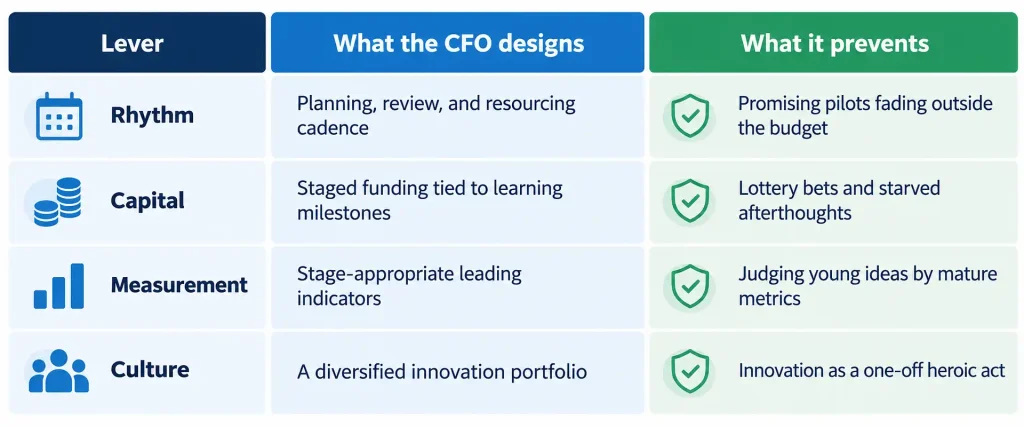
Without strategic execution, innovation becomes expensive noise that scatters capital and exhausts teams. Without innovation, execution turns mechanical, efficient on paper but stagnant in the market. The modern CFO sits at the fulcrum of that tension, designing the conditions for strategic innovation through the four levers below.
Designing an Operating Rhythm for Strategic Innovation
Jazz improvisation looks spontaneous, yet it lives inside fixed chord changes and an agreed tempo. Innovation inside an enterprise works the same way, and the CFO often keeps the time.
Embedding Innovation into the Business Cycle
Innovation rarely struggles for ideas; it struggles for continuity. A pilot may win applause, but it fades if it lives outside the budget and the roadmap. The CFO has to build early experiments into quarterly planning, capital allocation, talent deployment, and post-mortem review. None of this means lowering thresholds; it means recognizing that some investments buy capability, signal, or future options instead of immediate return.
A cybersecurity and identity access management company with roughly $30M in recurring revenue offers a useful illustration. Once a new forecasting engine and reporting cadence took hold, actuals stayed within five percent of forecast for 8 consecutive quarters. That predictability did not constrain new initiatives; it gave leadership the confidence to fund them.
Setting the Bandwidth for Experimentation
Traditional business cases demand net present value and internal rate of return. Innovation defies that precision early, so strategic innovation needs a new rhythm of justification built on staged funding and learning metrics. The practical questions are simple to ask and hard to answer:
- How much risk can the company absorb this year?
- How many concurrent experiments can it sustain?
- Where does failure become insight, and where does it become distraction?
- Do teams have the time, autonomy, and incentives to execute well?
A firm that launches 10 experiments and learns nothing has not innovated. A firm that runs three, tracks the outcomes, and folds the learning into its roadmap has built a rhythm that compounds.
The CFO also translates this rhythm for the board. She explains why an initiative has not yet produced cash and why a temporary margin dip may precede a gain in customer lifetime value. In that role, she tempers impatience without excusing aimlessness.
Funding Strategic Innovation Through Progressive Conviction
Funding innovation is less a single bet than a sequence of decisions made with growing information. Most organizations default to one of two flawed models:
| Funding model | How it works | What goes wrong |
| The lottery | Large upfront commitment to a visionary project | Overwhelms execution, hides warning signs |
| The afterthought | Small, symbolic allocation from leftover budget | Starves execution, forces constant justification |
| Progressive conviction | Capital released in stages tied to learning milestones | Demands discipline to add or withdraw funds |
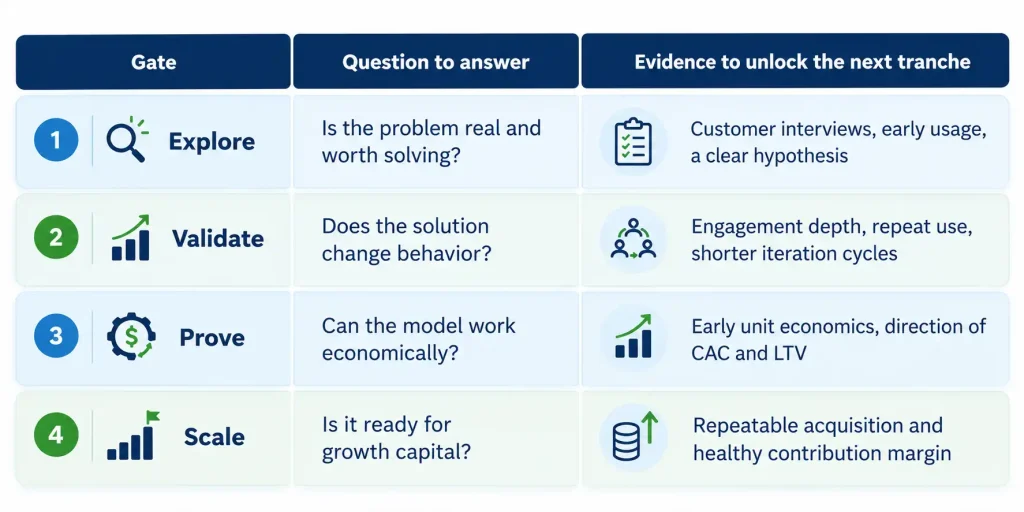
The strategic CFO charts the third course and funds hypotheses instead of outcomes, and she treats momentum as the earliest signal of value. When an idea shows traction through adoption, engagement, or strategic relevance, more capital follows. If it stalls, she withdraws funding calmly, which builds a culture of calibration over punishment.
Separating Innovation Capital from Growth Capital
Innovation often needs capital before there is a market or revenue, while growth scales what already works. Conflating the two burdens young projects with expectations they cannot meet, so the CFO should run separate funding streams, time horizons, and metrics for each.
This distinction mattered at a venture-backed digital marketing company that scaled revenue from $9M to $180M in 24 months. Growth capital flowed toward channels once CAC, LTV, and contribution margin discipline showed they worked. New offerings earned smaller, staged tranches until their own unit economics came into focus.
Investors do not expect every experiment to succeed, but they want evidence that the process behind strategic innovation is intentional.
Measuring Strategic Innovation Before It Reaches the Income Statement
By the time innovation reaches a financial statement, it is already mature. Return on invested capital and operating margin are not wrong measures of strategic innovation; they arrive late. Imposing them too early asks a child to run before learning to walk.
Innovation needs more measurement, not less, and the metrics should match the stage of the initiative, the nature of the risk, and the insight the team is pursuing.
| Stage | Learning signals | Financial signals |
| Explore | Customer engagement depth, problem validation | Burn against the milestone budget |
| Validate | Iteration cycle time, internal adoption, prototype defect rates | Cost per experiment |
| Prove | Retention, repeat usage, pricing tests | Early CAC, LTV, and contribution margin |
| Scale | Share of the target segment | Revenue growth, margin, and ROIC |
Shared Dashboards and the Discipline of Opportunity Cost
These signals work best on cross-functional dashboards that give product and finance a shared language of discovery. Leaders can then see where momentum exists and where a decision is overdue.
Finance should also track opportunity cost with the same care. Capital, talent, and executive attention are finite, so every initiative pursued defers another. Redeploying resources takes courage, yet it reflects refinement, not retreat.
A turnaround at an early-stage email marketing technology company, which cut monthly burn from $800K to $200K, made that discipline unavoidable. Every initiative had to justify its claim on scarce resources, and the ones that remained received sharper focus. Handled this way, scrutiny becomes support, and the company moves faster by learning at speed instead of rushing.
Making Innovation a Habit Through Portfolio Thinking
The most admired companies do not innovate occasionally; for them, innovation has become indistinguishable from execution. Paradoxically, the steward of predictability often becomes the architect of this creative normal.
Balancing the Innovation Portfolio
No single initiative can carry the full burden of strategic renewal. The CFO diversifies across time horizons and risk profiles, balancing incremental improvements with transformative bets. This is where innovation and strategic management meet most visibly, in the mix of what the company chooses to fund.
| Portfolio layer | Purpose | Typical funding approach |
| Core improvements | Optimize what already earns | Annual budget with standard ROI thresholds |
| Adjacent moves | Extend into nearby markets or products | Staged funding with milestone reviews |
| Transformational bets | Build future options | Small tranches with learning-based gates |
The balance must not tilt so far toward optimization that the company forgets how to invent, or so far toward novelty that it forgets how to earn.
Language, Safety, and Self-Reinforcing Systems
Language shapes perception more than finance leaders admit. If every initiative sounds like a moonshot, the company invites scrutiny it cannot withstand. Framed as a pipeline of learning, strategic innovation starts to look like a system that people can improve, and founders shift from defending a vision to demonstrating progress.
Over time, the system reinforces itself as teams see innovation funded predictably and reviewed constructively. People learn that trying is safe, and failure becomes the cost of staying relevant. The CFO does not create the spark but builds the wind tunnel, funds the platform, and makes room for what comes next.
Three Key Takeaways
- Build strategic innovation into existing planning, capital, and review cycles, because pilots that live outside the budget and roadmap rarely survive their first wave of enthusiasm.
- Fund innovation through progressive conviction, releasing capital in stages tied to learning milestones, and keep innovation capital separate from growth capital so young ideas escape mature standards.
- Measure what each stage can prove, weigh opportunity cost honestly, and manage innovation as a diversified portfolio so that experimentation becomes a habit rather than a heroic act.
Disclaimer: This article is intended for informational purposes only and does not constitute legal, tax, or accounting advice. You should consult your own tax advisor or counsel for advice tailored to your specific situation.
Hindol Datta is a four-time CFO and senior finance executive with over 25 years of leadership experience across cybersecurity, SaaS, gaming, logistics, digital marketing, medical devices, consumer products, and nonprofit organizations. He has led more than $120M in fundraising and over $150M in M&A transactions while building the financial and operational systems that let complex businesses scale with confidence. He is the author of seven books in the Systems CFO Series and holds active CPA, CMA, and CIA credentials.
AI-assisted insights, supplemented by 25 years of finance leadership experience.