
Executive Summary
International tax planning has moved out of the back office and into the center of corporate strategy, where rising scrutiny, the global minimum tax, and shifting treaties now shape how multinational companies grow. For the CFO, the task is no longer compliance alone. It is designing a structure that holds together under audit, public attention, and constant regulatory change.
This article sets out how finance leaders can read global tax complexity as a signal rather than noise, align structure with operational substance, communicate a tax position with credibility, and build a capability that adapts as the rules evolve. The result is a tax posture that supports growth instead of trailing behind it.
Why International Tax Planning Begins with Mindset
Tax has become a quiet dialogue between companies and the nations where they operate. Its filings reveal where a business moves, invests, and chooses to belong. Global tax planning was once an art of quiet margins, accepted as the reward of scale. That era has closed, and the CFO now works in full light, watched by regulators, investors, and journalists.
Reading Tax as a Signal of Sovereign Intent
The global tax system does not aspire to simplicity. Each jurisdiction expresses its own fiscal philosophy through codes, carve-outs, and enforcement. What looks arbitrary to a planner is usually deliberate to a state. A high statutory rate is a policy choice, a treaty network is a map of alignment, and transfer pricing rules reflect a view on where value is created. The CFO who reads these signals becomes a translator between company strategy and national intent.
Pillar Two and the Shift from Form to Substance
The OECD Base Erosion and Profit Shifting program and the Pillar Two global minimum tax have moved from theory into law across much of the world. The January 2026 side-by-side package eased some obligations for US-headquartered groups, yet qualified domestic minimum top-up taxes still apply. New substance-based rules also keep attention on where people and assets sit. For international tax planning, several questions once left to specialists now belong in the boardroom:
- Where do the employees who create and manage value actually work?
- Which entities hold the intellectual property, and does the development team sit there too?
- How would the effective tax rate move under different minimum tax scenarios?
Software can automate compliance, but it cannot judge what a tax authority will accept as fair. That judgment rests on experience and reputation, and in tax, reputation is capital.
Aligning Global Tax Planning with Business Strategy
A tax structure is only as strong as its fit with the economic logic of the enterprise. When a design suggests that profits emerge from a jurisdiction with no engineers, customers, or intellectual property, it may pass a technical review. It will still fail the test of coherence that tax authorities increasingly apply.
Where Value Is Created Determines Where Profit Belongs
Sound international tax planning starts with a plain question: where does the company create value, and who bears the risk of creating it? At a Euronext Paris-listed gaming company operating in the United States, France, the United Kingdom, Singapore, and South Korea, more than $100M in cross-border acquisitions demanded this mapping. Each deal changed where value lived and how profit was reported under IFRS and US GAAP.
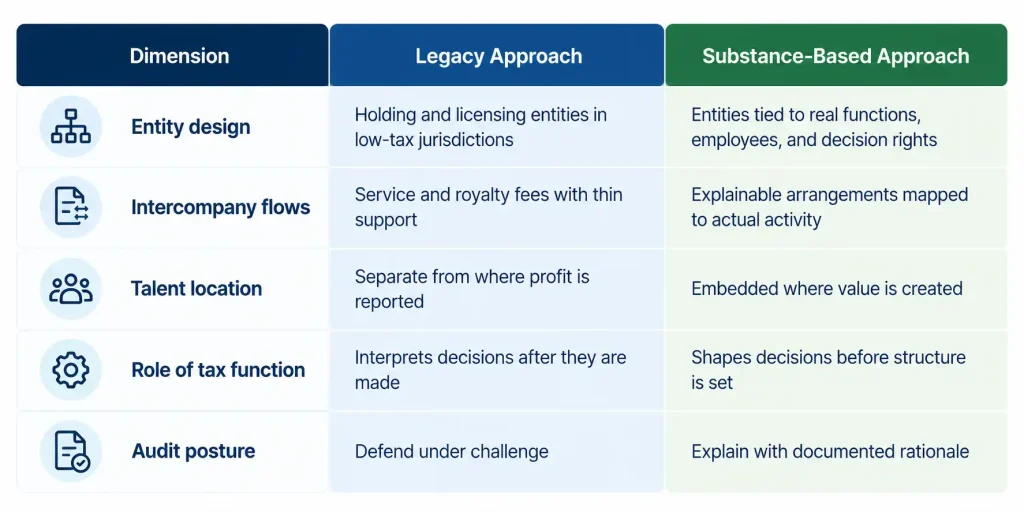
Modeling Tax Consequences Before Decisions Are Made
Alignment requires regular conversation with product, go-to-market, and technology leaders. Tax now follows how platforms are monetized, how AI shifts value attribution, and how data localization rules affect hosting. Global tax planning works best when consequences are modeled ahead of decisions such as these:
- Localizing product hosting in a new country and the effect on IP strategy
- Centralizing procurement in Europe and the resulting VAT and customs exposure
- Relocating a development team and the transfer pricing consequences
At a cybersecurity company with entities in the United States, Canada, Mexico, India, and Nepal, a single ERP rollout across 5 country entities made this modeling possible. It cut the monthly close from 18 days to 10 and showed leadership where profit and cost sat. When structure mirrors strategy, the board stops asking whether the structure will hold and starts asking how it enables the next phase of growth.
Transparency as a Pillar of International Tax Planning
In the old order, silence was safety and the footnotes were expected to suffice. Today silence reads as provocation, and regulators, investors, and the press now ask whether a tax footprint reflects business reality, not only whether the rules were followed. Companies seen as avoiding contribution, however lawfully, risk damage to talent, customer trust, and enforcement relations.
Transparency does not mean disclosing everything; it means being prepared to explain everything. The audience determines the form that explanation takes.
| Audience | What They Need to Understand | The CFO Posture |
| Board of directors | What the effective tax rate means, whether it stems from loss carryforwards or structure, and how it behaves under Pillar Two | Treat tax as enterprise and reputational risk, not a compliance update |
| External auditors | The intent and assumptions behind structural choices | Bring them in early to probe, building a shared record of reasoned judgment |
| Tax authorities | The link between structure and substance, and consistency across jurisdictions | Explain in the language of policy to earn credibility |
| Public and stakeholders | How the company contributes where it operates | Offer a calm, principled account when scrutiny arises |
Across public-company boards and nonprofit audit committees alike, directors engage with tax most productively when they see what the rate means, not only the number itself.
Building an Adaptive International Tax Planning Capability
Tax is a moving edge where law, politics, and commerce meet, so mastery is never a one-time achievement. The highest form of international tax planning is agility: a system that perceives change early and adapts without panic.
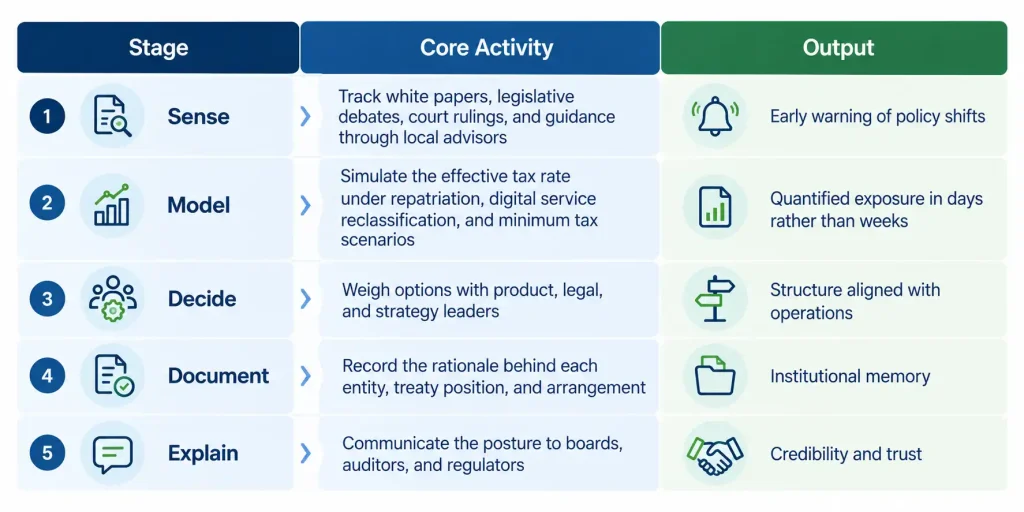
Institutional Memory and Documented Rationale
Companies often accumulate structures the way trees accumulate rings, each reflecting a moment in time and none connected to the present. The result is opacity, risk, and costly unwinding. Recording why each entity exists and which risk each arrangement mitigated turns legacy decisions into an architecture successors can inherit. At a marketplace SaaS company, a consolidated US and Polish reporting framework held up under diligence for a $20M Series B.
Sensing Policy Change and Modeling It Quickly
The tax function needs local advisors in key jurisdictions and data specialists working alongside tax lawyers and accountants. Together they make the tax posture testable, so the effective tax rate can be traced under several scenarios without weeks of manual work.
Culture, Reputation, and Continuity
Agility is as much a cultural discipline as a technical one. Executives must be willing to revisit old assumptions and resist attachment to past efficiency. At a $127M consumer products company sourcing from China and Vietnam, every sourcing and channel decision carried customs and transfer pricing implications. Those had to be designed in from the start rather than repaired later.
Global tax planning done well rests on coherence rather than cleverness: a structure that matches the business and a posture that matches the world. Practiced this way, international tax planning stops being a drag on growth and becomes one of its most reliable partners.
Three Key Takeaways
- Treat international tax planning as a reading of how each jurisdiction views value creation, and design structures that survive regulatory change rather than exploit temporary gaps.
- Anchor every entity, intercompany arrangement, and profit allocation in real functions, people, and decision rights, and model the tax consequences before operational decisions are finalized.
- Build a standing capability to sense, model, document, and explain the tax posture, so that boards, auditors, and regulators see a coherent position as the rules continue to shift.
Disclaimer: This article is intended for informational purposes only and does not constitute legal, tax, or accounting advice. Readers should consult a qualified tax advisor or counsel for advice tailored to their specific situation.
Hindol Datta is a four-time CFO and senior finance executive with over 25 years of leadership experience across cybersecurity, SaaS, gaming, logistics, digital marketing, medical devices, consumer products, and nonprofit organizations. He has led more than $120M in fundraising and over $150M in M&A transactions while building the financial and operational systems that let complex businesses scale with confidence. He is the author of seven books in the Systems CFO Series and holds active CPA, CMA, and CIA credentials.
AI-assisted insights, supplemented by 25 years of finance leadership experience.