
Executive Summary
Sustainability accounting brings environmental, social, and governance impact into the same language of rigor that has long defined financial accounting. It is not a compliance add-on. It is an expansion of what the CFO’s office is responsible for measuring. This article covers the regulatory and conceptual foundation of sustainability accounting, and how organizations turn ESG principle into operational process. It also covers how ESG metrics now shape capital markets and valuation, and the cultural leadership this work demands.
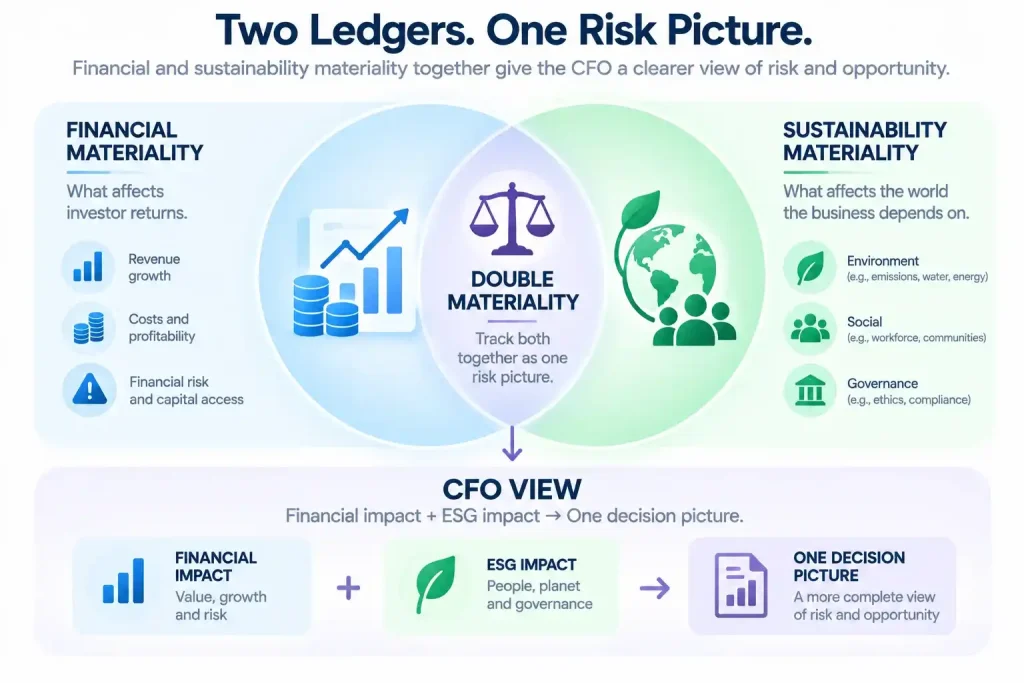
Materiality itself has expanded. Traditional financial materiality asks what affects the investor. Sustainability materiality asks what affects the world the investor depends on. Readers will find the practical mechanics behind each of these four areas.
The Foundation of Sustainability Accounting
Environmental, social, and governance impact once sat outside the reach of financial reporting. Measurement systems and accountability frameworks had not caught up with the scale of the underlying problem. That gap has closed quickly.
From Sidebar to Core Discipline
ESG reporting used to be ancillary work, produced by a sustainability officer and rarely connected to the financial statements. Companies chose their own disclosures and interpreted materiality loosely. The result was an uneven landscape, where genuine progress sat next to vague commitments and outright greenwashing. Capital markets and regulators eventually pushed back.
The EU’s Corporate Sustainability Reporting Directive and the Task Force on Climate-related Financial Disclosures both point to the same shift. So does the consolidation of standards under the International Sustainability Standards Board. Sustainability accounting now sits at the core of financial risk assessment and long-term value creation, not at its edge.
Double Materiality and the CFO’s Role
Finance holds the authority and analytical discipline to institutionalize sustainability accounting. Finance can link emissions to procurement decisions and connect water use to operational cost. It can tie workforce equity to retention risk in ways other functions cannot. Only finance can tell a board not just what a company spent, but what it impacted and under what assumptions.
Double materiality captures this dual view. It recognizes that what a company impacts today can become a financial liability tomorrow. That asks the CFO to read two ledgers at once, one in currency and the other in consequence.
| Materiality type | Central question | Who has historically owned it |
| Financial materiality | What affects the investor’s return | Finance and investor relations |
| Sustainability materiality | What affects the world the investor depends on | Sustainability or ESG teams |
| Double materiality | Both, tracked together as one risk picture | Increasingly, the CFO’s office |
Honest disclosure matters more than polish here. Reporting that emissions rose faster than reductions, or that a diversity target was missed, builds credibility. A sanitized narrative does not. Measurement methods, especially for Scope 3 emissions, remain imprecise, but that imprecision is not an excuse to stop measuring. The office of the CFO works with the best available data and improves the process over time.
Turning Principle into Process
Philosophical commitment to ESG does not deliver results on its own. Data, systems, and defined ownership turn a commitment into something durable rather than decorative.
Building a Data Foundation
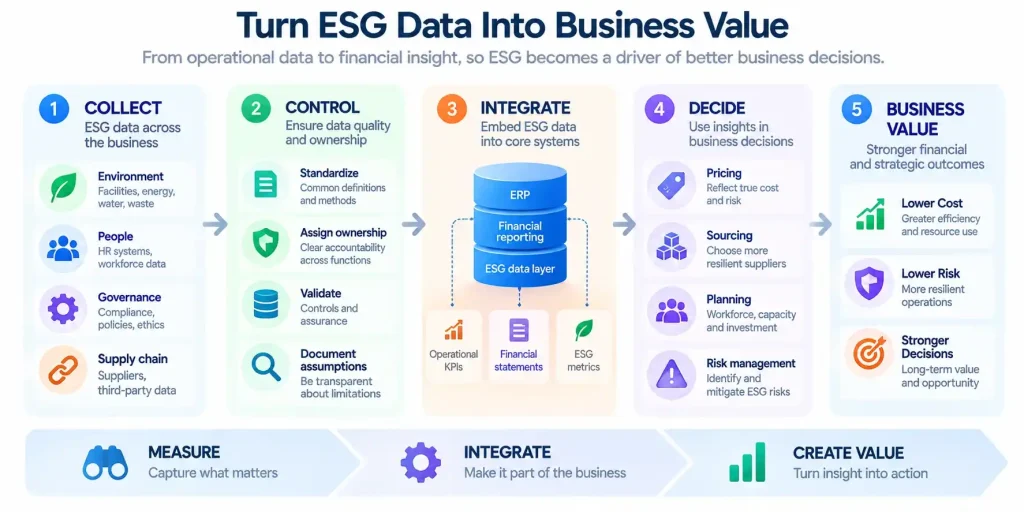
ESG data comes from facilities, supply chains, HR systems, compliance functions, and third-party assessments. Emissions require measurement across Scope 1, Scope 2, and the far more complex Scope 3. Water consumption, energy mix, and waste diversion need standardization across regions. Workforce demographics need monitoring closer to real time than an annual snapshot allows.
The first challenge is coherence rather than complexity. Data exists, but it sits fragmented across enterprise systems, spreadsheets, and regional teams using different definitions for the same variable. A CFO’s office can act as integrator here. It maps ESG indicators to existing operational KPIs and embeds sustainability data collection directly into ERP and financial reporting systems.
Technology accelerates this work through carbon accounting engines and ESG data platforms, but technology alone does not produce trustworthy numbers. Every data point needs a defined source, a control protocol, and a clear owner. Assumptions need documentation, and recalculations need version control, the same way financial close processes already require.
From Measurement to Business Insight
Once ESG data exists, it needs to inform decisions and not just satisfy disclosure requirements. Emissions per product line can inform pricing. Supplier ESG scores can shape sourcing. Workforce inclusion indices can shape retention forecasts. Treating ESG as a business variable, rather than a moral overlay, turns it into a genuine source of comparative advantage.
Supply chains illustrate this well. Scope 3 emissions are often the largest and hardest to measure. Closing that gap requires partnering with procurement and vendor management on supplier assessments, ESG contract clauses, and capacity-building for vendors that lag behind. Scenario modeling extends the same discipline to ESG. It asks what happens to cost of goods sold under a higher carbon price, or what capital expenditure a net-zero commitment actually requires. These are business planning questions as much as ESG questions.
At a mission-driven education institution, this kind of operational discipline showed up directly. Leadership tracked program costs against funding sources with the same rigor applied to donor reporting, giving the board a single, credible picture instead of two disconnected sets of numbers.
ESG Metrics and Capital Markets
Institutional investors now ask layered questions about climate transition risk, labor practices, and governance health alongside growth and margin. These questions are fiduciary, not ideological. They signal that ESG performance has become entwined with valuation rather than adjacent to it.
Translating ESG Performance into Financial Signals
Not every investor scrutinizes ESG the same way. Some integrate ESG factors broadly across a portfolio. Others run thematic funds with targeted screens, and others stay focused on financials while treating weak ESG performance as a proxy for operational weakness. All of them rely increasingly on ESG data from disclosures, third-party ratings, and regulatory filings.
That data ecosystem remains fragmented. Rating agencies diverge in methodology, so one firm’s top score can be another’s middling one. A CFO’s office cannot chase each rater’s individual preferences. It needs a reporting architecture that stays consistent and credible on its own terms. That is part of why standardization under frameworks like the ISSB, building on TCFD and SASB, matters so much.
Showing the Link Between ESG and Value
Disclosure alone does not move markets. A company needs to show, not just tell. Emissions reductions can map to energy cost savings, inclusive hiring can reduce churn, and water efficiency can reduce operational risk in drought-prone regions. Investor relations should present ESG performance alongside traditional KPIs in earnings calls and capital days. It should not sit as a separate appendix.
Capital access itself has started to shift. Green bonds, sustainability-linked loans, and impact funds now offer pricing incentives, including reduced interest rates. Companies earn them by credibly demonstrating ESG improvement over time. Credibility depends on consistency more than perfection. Science-based targets, clear baselines, and honest explanations matter when a sustainability target gets missed, the same way a missed earnings target requires explanation.
There is a defensive dimension too. ESG litigation and activist pressure are both rising. Poor ESG performance carries real risk of reputational harm and customer attrition. Scenario modeling should include regulatory fines, climate-related revenue disruption, and valuation impact from social backlash. These are quantifiable risks, not abstract ones.
Culture, Leadership, and the CFO as Steward
Systems and standards carry sustainability accounting only so far. Underneath the metrics sits a question of character. What does a company believe it owes beyond its margins, and what kind of leadership does it reward?
Embedding ESG into How Finance Thinks
Culture shows up in practice, not declaration. Reviewing ESG metrics only once a year signals that they are ornamental. Weaving them into monthly reporting and board updates, with the same rigor applied to revenue forecasts, sends a different signal. Sustainability counts as real performance.
This reshapes the finance function itself. Controllers can ask not only whether expenses are accurate but whether they are aligned with stated commitments. FP&A teams can forecast carbon curves alongside cost curves. Treasury can factor climate risk into liquidity scenarios, and audit can build ESG controls alongside financial ones. None of this is mission drift. It is mission deepening. It requires finance leaders to become conversant in sustainability science and regulatory pathways they were never trained on.
Holding the Line on Truth
Financial reporting lives in the present, while sustainability decisions play out over decades. Emissions released today shape climate risk for years, and governance structures set now either entrench or distribute power later. Holding both timeframes at once is one of the harder disciplines this role now demands. It means thinking quarterly while acting with a longer horizon in mind.
As measurement improves, the temptation to adjust definitions or choose favorable baselines will grow. Standing against that erosion is where a CFO’s credibility on this topic is actually earned. ESG commitments need costing, modeling, and tracking, not deferral. Saying no to shortcuts and performative initiatives protects the integrity of every other number the finance function reports.
Three Key Takeaways
- Treat sustainability accounting as core financial discipline, not an add-on. Read materiality both ways: what affects the investor, and what affects the world the investor depends on.
- Build the operational backbone first: defined data owners, documented assumptions, and ESG metrics embedded in monthly reviews. That turns principle into a repeatable process.
- Connect ESG performance directly to capital markets and culture. Show the financial link behind each metric, and hold sustainability targets to the same honesty standard as earnings targets.
Disclaimer: This article is intended for informational purposes only and does not constitute legal, tax, or accounting advice. You should consult your own tax advisor or counsel for advice tailored to your specific situation.
Hindol Datta is a four-time CFO and senior finance executive with over 25 years of leadership experience across cybersecurity, SaaS, gaming, logistics, digital marketing, medical devices, consumer products, and nonprofit organizations. He has led more than $120M in fundraising and over $150M in M&A transactions while building the financial and operational systems that let complex businesses scale with confidence. He is the author of seven books in the Systems CFO Series and holds active CPA, CMA, and CIA credentials.
AI-assisted insights, supplemented by 25 years of finance leadership experience.