
Executive Summary
Disruption rarely announces itself with a single dramatic event anymore. It moves in through shifting customer behavior, a nimble competitor, or a supply chain bending where it once held firm. A financial resilience strategy treats this volatility as normal, not as an exception to plan around. This article explains how to read the shape of modern disruption. It covers the structural elements that let a company bend without breaking. It also covers how scenario planning and capital redeployment turn resilience into action, and how culture sustains it.
Resilience is not caution dressed up in policy language. It is design: knowing which costs act as ballast and which act as sails, and building capital that can expand into opportunity or contract into preservation without disfiguring the business. Readers will find each of these elements broken down with concrete practices.
Understanding the Shape of Modern Disruption
Disruption today behaves less like a single event and more like an ongoing condition. It lingers, evolves, and changes shape instead of arriving once and receding. A CFO must learn to spot its patterns. These show up in subtle deviations in trendlines. They also show up where growth starts costing more than it used to.
How Disruption Erodes Assumptions
Disruption attacks what once felt stable. That includes customer loyalty, supplier reliability, price elasticity, and capital availability. It rarely announces the scale of its impact in advance. That gap between cause and visible effect is what makes it dangerous. By the time the full financial effect shows up in the numbers, many organizations have already reacted too late. Others react too rigidly.
Disruption enters through several paths. External vectors include input costs, consumer behavior, regulation, and currency. Internal vectors include technology debt, overreliance on one revenue stream, and a brittle fixed cost base. Each creates a different test. A supply shock strains working capital. A digital competitor strains pricing, and a liquidity contraction strains leverage.
Readiness Beats Speed
Traditional planning cycles assume variance around one central scenario. Disruption often makes that scenario obsolete mid-cycle. A resilient CFO does not cling to a forecast that has stopped working. Dynamic planning models trade certainty for adaptability. The goal shifts from being precisely right to being directionally right.
| Response type | What it looks like | Why it falls short of resilience |
| Reactive cost cutting | Freezing budgets and headcount across the board | Treats every dollar the same, ignoring what actually drives value |
| Pre-modeled elasticity | Reallocating spend toward high-retention segments | Preserves the logic of the business under stress |
| Static forecasting | Holding to one central scenario until it clearly fails | Delays the pivot until damage has already compounded |
| Dynamic scenario planning | Running several differentiated scenarios in parallel | Surfaces second-order effects before they hit |
Speed alone does not make a company resilient. A company that freezes marketing spend the moment demand softens is reacting, not adapting. One that has already modeled elasticity curves and lifetime value can redirect spend toward its strongest segments instead. That difference reflects genuine preparation, not panic.
Disruption also tends to compound. A rise in input costs can affect pricing power, which can affect churn, receivables, and eventually covenant compliance. Tracing these effects is disciplined planning applied to a connected system, not catastrophizing.
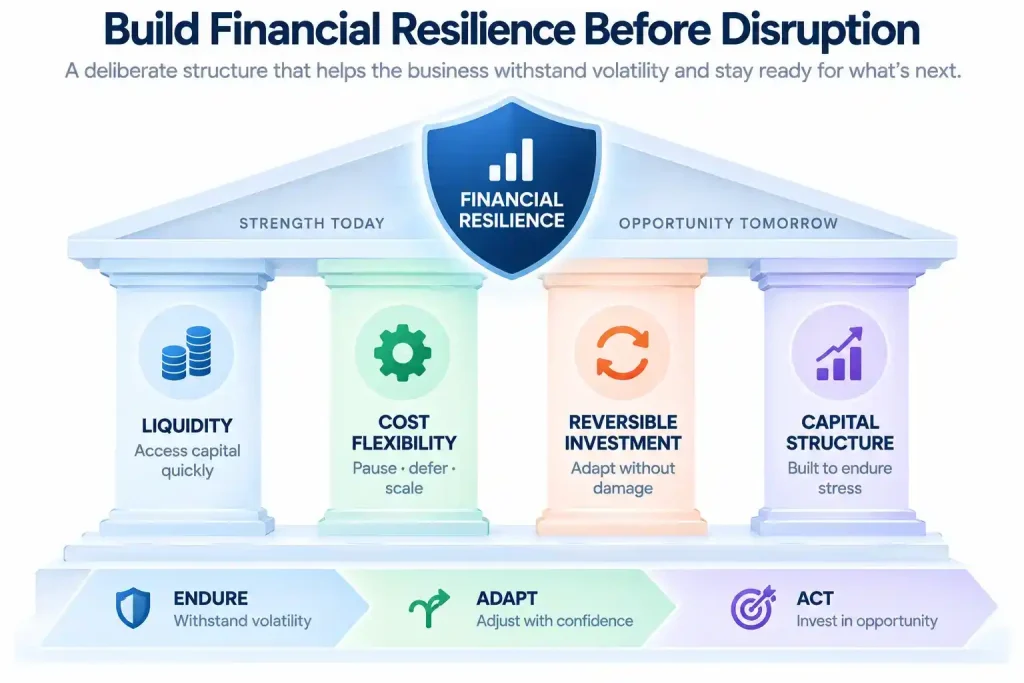
Designing the Architecture of a Financial Resilience Strategy
Resilience results from deliberate structural choices made before volatility forces the issue. It does not come from a mindset adopted in the moment. A financial resilience strategy starts with a blueprint. That blueprint reflects what markets are actually capable of doing, not what leaders hope they will do.
Liquidity, Cost Flexibility, and Reversible Investment
Liquidity functions as strategic oxygen, not a static safety net. Real discipline goes beyond the cash balance on a given day. It covers access speed, inflow predictability, credit lines drawn without reputational cost, and cash burn under layered stress scenarios.
Cost structure flexibility matters just as much. The old split between fixed and variable cost misses a spectrum in between. True cost agility means knowing which expenses can pause, defer, or scale with minimal friction. It also means knowing which levers make that faster.
Investment posture deserves this same scrutiny. Reviewing a portfolio only through expected return misses reversibility, which matters most in volatile conditions. Modular, milestone-based funding protects innovation, since some investments can slow down without damage while others cannot unwind once committed.
Balance Sheet, Margin, and Data Infrastructure
Leverage helps a business in expansion and threatens survival in contraction. A resilient capital structure preserves access to credit and maintains equity cushions. It also staggers debt maturities to avoid obligations clustering at once. The real question about debt is not whether a company carries it. It is whether that debt is patient enough to survive disruption.
Margin architecture matters too. Knowing which parts of gross margin a company controls matters more than the percentage itself. Thin but flexible margins can prove more resilient than high but brittle ones. Underneath all of this, real-time systems prevent delayed data from becoming delayed, costly decisions.
Calibration is the hardest part of this design work. Excess cash, overly broad hedging, and underleveraged capital all suppress returns. The goal pairs enough protection to endure with enough efficiency to thrive.
Scenario Planning and Capital Redeployment in a Financial Resilience Strategy
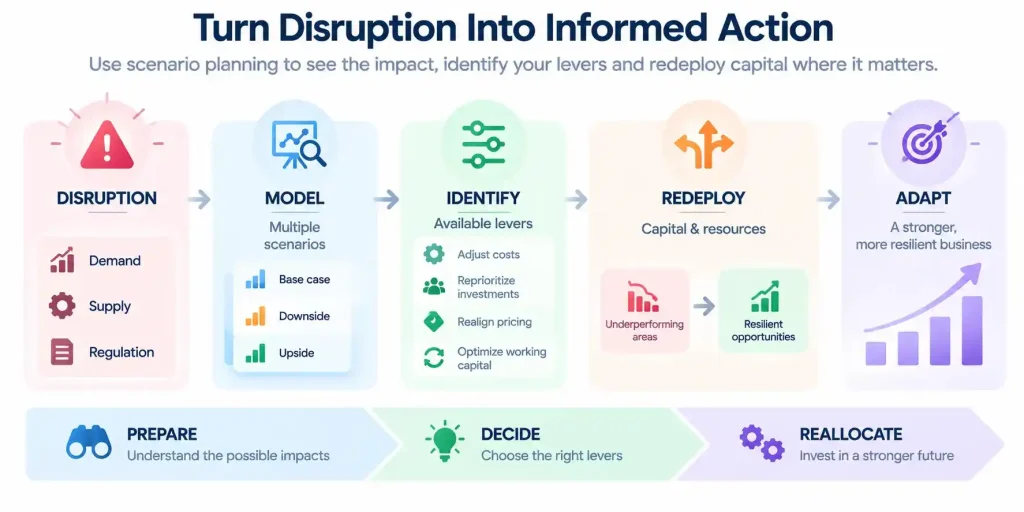
A resilience design that stays theoretical offers comfort but not protection. The real test comes under stress. Here a CFO shifts from architect to navigator, using scenario planning, capital redeployment, and disciplined risk-taking.
Building Scenarios That Reflect Real Consequences
Most planning exercises model one shock at a time. Revenue falls, or costs rise, or financing tightens. Teams rarely model these shocks together. They rarely trace the organizational response as part of the scenario itself either. A stronger approach builds differentiated scenarios. Sudden demand evaporation, a geopolitical supply disruption, and a regulatory cost shift each become their own story. Each has its own cause, timing, and response.
Within each scenario, the useful question extends past the financial output to the strategic levers available. How quickly can discretionary spending pause? Which capital projects can be resequenced? How does each path affect access to credit? Answering these in advance turns scenario planning into a genuine decision tool, not a spreadsheet exercise.
Redeploying Capital and Pricing Risk
Capital redeployment follows this analysis directly. The real question during disruption is rarely whether to spend. It is where. Moving capital out of underperforming legacy areas and into segments showing resilience is reorientation, not austerity. It requires confronting sunk cost thinking directly. If a team would not invest today in a project it already funds, that capital should move.
Risk deserves this same active management. The goal is not eliminating risk. It is pricing risk, segmenting it, and matching it to the organization’s actual capacity to absorb it. Risk-weighted return metrics and hurdle rates adjusted for uncertain markets help here. So does a clear risk appetite by segment. Together they turn risk from a vague warning into something quantifiable.
At a $127M global consumer products company with a supply chain spanning China and Vietnam, demand planning and logistics optimization lifted inventory turns from 3x to 7x. That freed working capital for higher-return uses instead of leaving it idle. Timing matters here as much as direction. Waiting for full clarity usually costs more than acting on informed, incomplete information.
Embedding a Financial Resilience Strategy in Culture
A resilient balance sheet keeps the lights on. A resilient culture keeps decision-making coherent when pressure builds. Building a genuine financial resilience strategy requires shaping how people across the company think and communicate. Modeling the numbers correctly is not enough on its own.
Transparency and Financial Fluency
Cultural resilience shows up in quiet decisions. It shows in how teams prioritize when goals compete, and how a company communicates when visibility narrows. Distributing basic financial fluency across functions, rather than keeping it inside finance, changes how teams operate. Sales starts understanding which contracts matter most to margin. Operations starts treating cost variance as something to manage rather than endure.
Building this fluency works best through shared inquiry, not memos or dashboards. Finance teams that host working sessions with other functions move away from being the department that says no. Sharing scenario assumptions, not only outputs, and inviting challenge makes finance a partner in foresight instead.
Feedback, Decision Rights, and Moral Courage
A resilient culture treats feedback as constant, not optional. Monthly forecast variance can become a narrative about what changed and what the team learned. It does not have to stay only a scorecard. Clear decision rights, pre-agreed criteria, and defined escalation paths prevent both reckless speed and paralyzing delay when conditions shift quickly.
At a mission-driven education institution, this kind of cultural discipline showed in how leadership brought difficult funding decisions directly to the board rather than deferring them. That built trust through consistent, honest reporting instead of only favorable updates. That same moral courage cannot be outsourced to a spreadsheet. It means being willing to cut an investment that no longer serves the strategy, or reprice a product facing rising costs. It has to be led directly, with consistency, for a financial resilience strategy to hold under real pressure.
Three Key Takeaways
- Treat disruption as a persistent condition, not an isolated event. Replace static forecasts with dynamic, scenario-based planning that traces second-order effects.
- Design the architecture of a financial resilience strategy around real liquidity and flexible cost structure. Add reversible investment and a capital structure built to endure contraction, not just expansion.
- Turn resilience into culture through financial transparency, constant feedback, and clear decision rights. Add the moral courage to make hard capital calls before a crisis forces them.
Disclaimer: This article is intended for informational purposes only and does not constitute legal, tax, or accounting advice. You should consult your own tax advisor or counsel for advice tailored to your specific situation.
Hindol Datta is a four-time CFO and senior finance executive with over 25 years of leadership experience across cybersecurity, SaaS, gaming, logistics, digital marketing, medical devices, consumer products, and nonprofit organizations. He has led more than $120M in fundraising and over $150M in M&A transactions while building the financial and operational systems that let complex businesses scale with confidence. He is the author of seven books in the Systems CFO Series and holds active CPA, CMA, and CIA credentials.
AI-assisted insights, supplemented by 25 years of finance leadership experience.