
Executive Summary
Profit is arithmetic at its simplest. It is revenue minus cost. A cost to serve model turns that arithmetic into a map. It shows which customers are worth the effort, which products hide inefficiency behind volume, and which services carry margin on paper while quietly draining the business. This article explains how cost to serve analysis reorients financial thinking and what data it requires. It also covers how the analysis changes pricing and segmentation, and how it eventually reshapes culture.
The core idea is simple. Cost is not distributed evenly across customers and products. It behaves according to complexity, urgency, and exception handling. A disciplined cost to serve model makes that pattern visible. Readers will find the foundational shift this analysis requires, the cross-functional data work behind it, the strategic decisions it should inform, and the cultural change that follows.
The Financial Reorientation Behind Cost to Serve
The most dangerous costs are the ones that stay invisible. They move through operations as late-night calls for low-margin clients, or expedited shipments that never show up on an invoice. A cost to serve model exists to make that invisible pattern visible.
Beyond Revenue Minus Unit Cost
The standard formulation of margin, revenue minus unit cost, works adequately at the macro level but stays blunt in practice. This formula assumes all revenue makes similar demands and that cost spreads evenly across products and customers. That assumption does not hold up in practice. Cost attaches disproportionately to what is complex, urgent, or poorly documented. None of that shows up in a standard P&L.
A cost to serve model maps how resources move through the actual delivery of value. It captures the process as customers experience it, not as designers intended it. This includes order customization, returns, channel complexity, service level differentiation, and nonstandard fulfillment. It asks the organization to look at behavior instead of averages. Once those behavioral patterns surface, they are difficult to unsee.
Defining the Cost Drivers
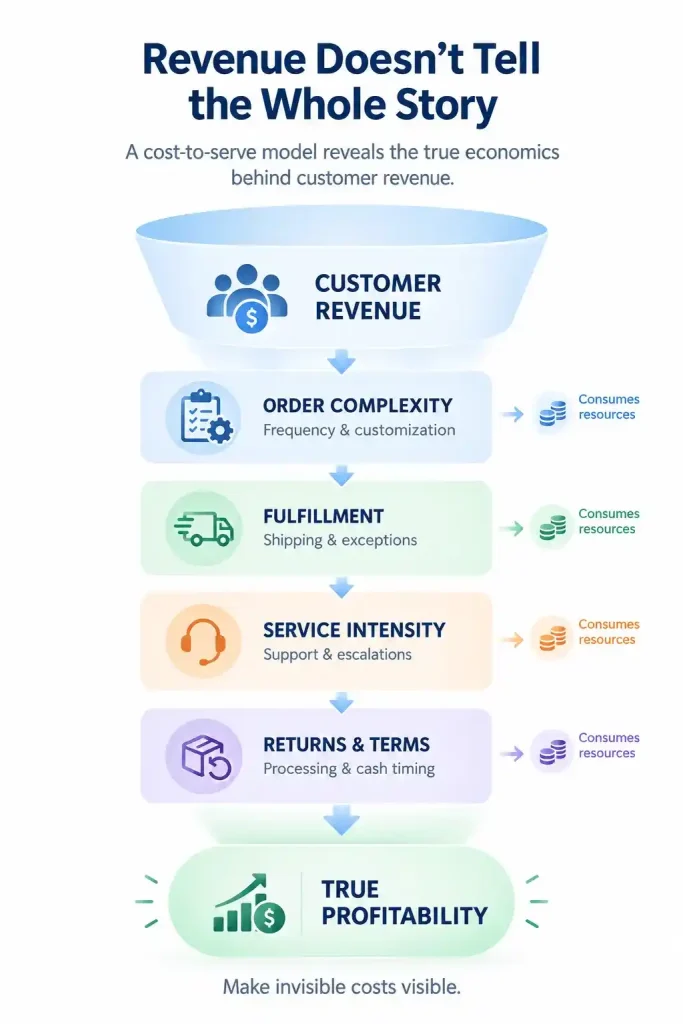
The first step is architectural. It means defining which cost drivers matter for a given business. These typically include order frequency, degree of customization, fulfillment method, service intensity, returns processing, and payment terms. None of these are theoretical variables. They are operational choices made over time through accommodation rather than strategy. Most senior leaders never see them directly.
| Cost driver | What it captures | Common blind spot |
| Order frequency and customization | How often standard process gets modified | Treated as a service win, not a cost |
| Fulfillment method | Expedited shipping, split batches | Rarely itemized back to the customer |
| Service intensity | Calls, escalations, account management time | Measured as satisfaction, not cost |
| Returns and payment terms | Processing burden and cash timing | Buried in aggregate operating expense |
Once a team identifies these drivers, tracing them down to the segment or account level requires collaboration. Finance, operations, and IT all need a seat at the table, since the underlying data rarely lives in one place. It sits in shipping logs, CRM notes, invoice histories, and payment aging schedules. Building a credible cost to serve model is as much detective work as design work.
Building a Cost to Serve Analysis from Operational Data
Modern finance functions are surrounded by data. Clarity often stays elusive anyway. A cost to serve analysis that holds real explanatory power has to start with behavior. Assumption is not a substitute.
Integrating Data Across Functions
The relevant questions do not sit easily inside a general ledger at all. How often are orders changed after entry? How many touchpoints does a single transaction require to complete? Do certain customers consistently pull on manual exception handling, while others move cleanly through automation? Answering these requires orchestrating collaboration between finance, IT, sales operations, and supply chain. Each function holds only a fragment of the cost picture.
CRM platforms capture service intensity. ERP systems reflect fulfillment paths and warehouse costs, and transportation logs show the gap between promised and actual logistics expense. Operations staff often hold the rest as tribal knowledge. They know which accounts always demand weekend shipping, but are rarely asked what that costs.
The Cultural Barrier to Better Data
The harder challenge is often cultural, not technical. Sales incentives are usually built on gross bookings. Service teams get measured on satisfaction rather than efficiency, and operations get pushed for throughput rather than segment profitability. Asking the business to view its processes through a cost to serve lens challenges these long-standing instincts head-on.
That challenge is also where the real shift begins. Sales leaders may see that their largest accounts consume the greatest service cost. They start asking different questions once they do. Product managers may realize that features added for a few high-maintenance customers degrade margin across the whole portfolio. Prioritization starts to change once they see it. A strong cost to serve analysis does not blame complexity. Many complex customers remain genuinely profitable. It simply insists that complexity be paid for, not absorbed silently.
Turning Cost to Serve Insight into Pricing and Segmentation Decisions
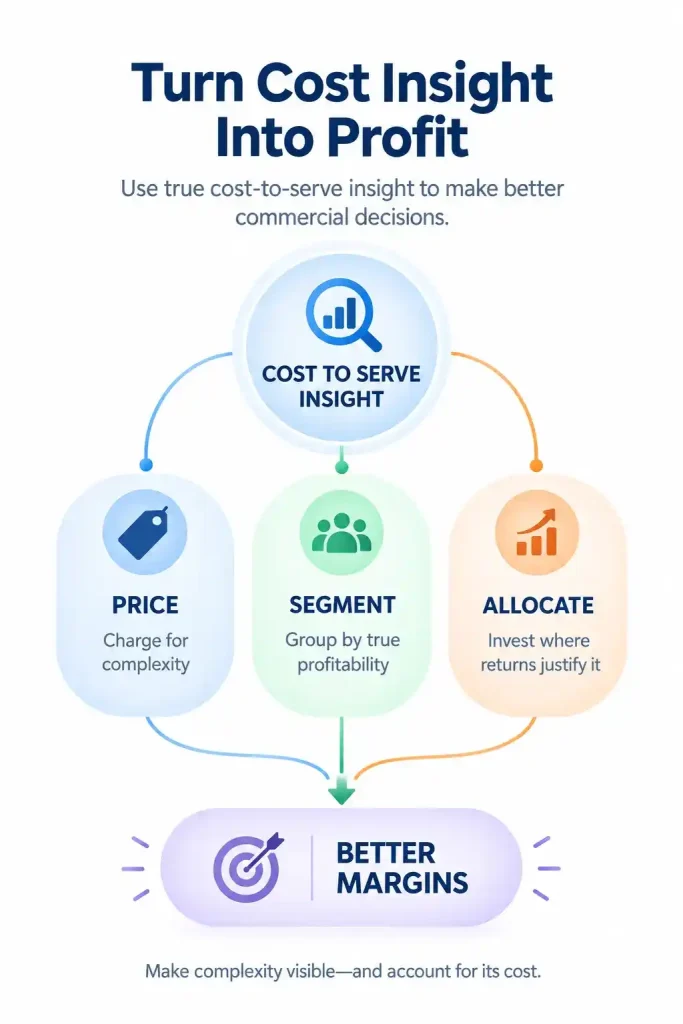
Insight by itself changes nothing on its own. A finely built cost to serve model sits quietly in the background otherwise. It needs translation into pricing, resource allocation, and segmentation decisions.
Pricing as Partnership, Not Just Policy
Standard pricing rewards volume rather than behavior. That simplicity is usually paid for in the margins of the most service-intensive customers. Reflecting cost to serve in pricing does not necessarily mean raising prices at all. It can mean re-tiering service levels and charging for premium delivery. It can also mean behavioral pricing that rewards stability, forecasting accuracy, and automation with better terms. The shift is from pricing as a fixed policy to pricing as a partnership. Customers who create complexity come to understand its financial implications.
Resource Allocation and Segmentation
Resource allocation benefits from this same clarity too. Most companies allocate capital, talent, and time based on historical patterns or internal negotiation. Actual profitability rarely drives the decision. A cost to serve model shows which segments, channels, or customer clusters deliver true profit after complexity. That shifts investment conversations from defending legacy share toward optimizing future yield.
Segmentation is the most human decision this analysis forces on a business. The largest accounts may not be the most profitable. The most demanding clients may not justify their cost either. Rethinking who belongs in a strategic accounts tier is not about abandoning customers at all. It is about alignment. Those who do not pay for complexity are asked to simplify, and those who value high-touch service are asked to participate in its economics. Implementation works best as collaboration rather than a mandate. Sales gets brought into the model, operations helps refine the assumptions, and product and marketing teams treat cost patterns as market intelligence they can act on directly.
When Cost to Serve Becomes Culture
The most durable outcome of a cost to serve model is not the margin it protects. It is the way the model reshapes how decisions get made. Financial clarity shifts from an analytical exercise into an instinct. The organization begins asking what things truly cost, rather than treating complexity as a given.
New Vocabulary, New Behavior
This shift shows up first in the language people use. Customers stop being described simply as large or small. The vocabulary expands to cover profitability profiles and cost drivers embedded in service delivery. That vocabulary signals a higher standard. It tells the organization that nuance is no longer optional. Product teams start asking whether feature requests disproportionately serve high-cost accounts. Sales teams start anticipating finance’s questions before they are asked, and operations teams start treating inefficiencies as redesign opportunities instead of complaints.
Protecting the Discipline Under Pressure
Pressure to bend the model never fully disappears. There will always be a case for an exception for a legacy client. There will always be a reason to defer a hard conversation until timing feels better. Holding the line here is not about being inflexible. It is about staying faithful to what the analysis actually shows, and to the long-term health of the business. Leadership is tested most in the moments when a model is inconvenient to follow, not when it is first being built.
Eventually, a mature cost to serve practice recedes from every slide. Its logic has been absorbed into how the business plans and prices by default. At a mission-driven education institution, this kind of discipline showed up in how program costs were tracked against funding sources with the same rigor applied to donor reporting, so that every program’s true cost to deliver was visible rather than assumed. What remains after the model fades into the background is a culture that measures success by quality of return rather than by bookings or revenue alone.
Three Key Takeaways
- Treat cost to serve as behavior rather than a static allocation, and map the specific drivers, order complexity, fulfillment method, and service intensity, that actually shape cost by account.
- Build a credible cost to serve analysis through cross-functional data integration, since the needed information lives in CRM, ERP, and logistics systems rather than the general ledger alone.
- Use cost to serve insight to reshape pricing, resource allocation, and segmentation, and protect that discipline under pressure so it becomes a lasting part of how the organization decides.
Disclaimer: This article is intended for informational purposes only and does not constitute legal, tax, or accounting advice. You should consult your own tax advisor or counsel for advice tailored to your specific situation.
Hindol Datta is a four-time CFO and senior finance executive with over 25 years of leadership experience across cybersecurity, SaaS, gaming, logistics, digital marketing, medical devices, consumer products, and nonprofit organizations. He has led more than $120M in fundraising and over $150M in M&A transactions while building the financial and operational systems that let complex businesses scale with confidence. He is the author of seven books in the Systems CFO Series and holds active CPA, CMA, and CIA credentials.
AI-assisted insights, supplemented by 25 years of finance leadership experience.