
Executive Summary
Finance has long been seen as the keeper of score. It anchors ambition to reality and grounds exuberance in math. At its best, finance does not constrain a business. It clarifies what is possible, what is sustainable, and what is worth funding. This article covers the leadership skills for finance managers that turn financial analysis into genuine influence over decisions.
The shift runs through four stages. It moves from stewardship to strategic imagination, then to influence built without relying on volume or authority. From there it shapes culture through the language of value, and finally multiplies leadership by developing financial judgment in others. Readers will find concrete behaviors for each stage.
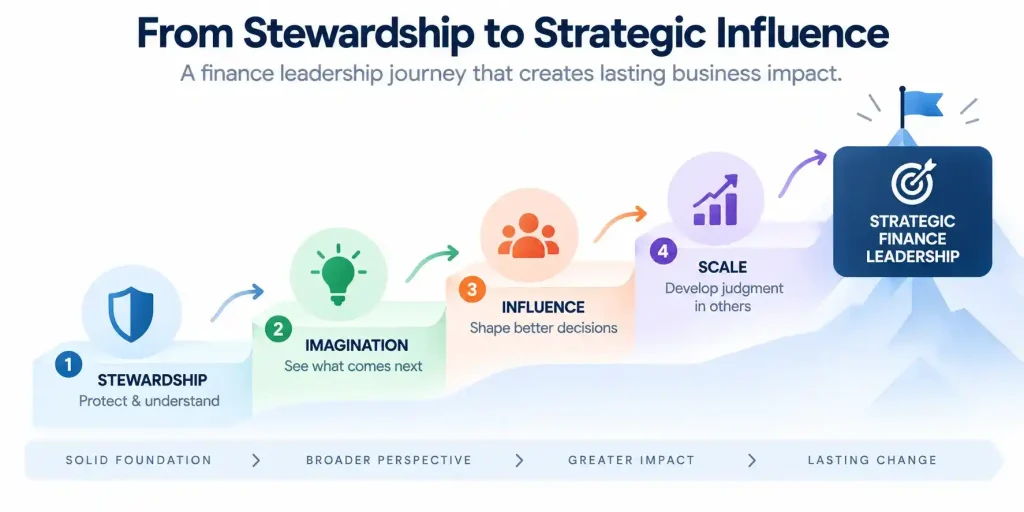
From Stewardship to Strategic Imagination
The traditional finance leadership role centered on guardianship. It meant safeguarding the balance sheet, ensuring compliance, and protecting the business from known and imagined risk. That work demanded rigor and discipline, and it still matters. As the pace of business increased, confirming facts stopped being enough on its own.
Reading Patterns to See What Comes Next
One of the core leadership skills for finance managers is strategic imagination. It begins with understanding the business and ends with foresight. It requires absorbing the complexity of an organization. The goal is distilling the handful of signals that actually matter, whether they come from margin, retention, capital flows, or market share. Those signals then need translation into a story the rest of the organization can follow and act on directly.
This work calls for fluency beyond financial modeling. Leading through finance means shaping how others think about risk, opportunity, and value. That requires the confidence to say plainly that an initiative will take longer than expected, or that a plan looks profitable but is not sustainable. These are strategic judgments built from data and experience, not pure calculations. They often mean speaking up before a consensus has formed.
Grounding Imagination in Discipline
Imagination without discipline becomes guesswork rather than strategy. A finance leader needs a working memory of how the business behaves over time. That includes its seasonal rhythms, its operational levers, and the human patterns that shape financial results. Pattern recognition built on that memory is what lets a forecast carry real weight. Without it, a forecast reads as an educated guess.
| Stage | Old behavior | Leadership skill for finance managers |
| Stewardship | Confirm the numbers after the fact | Name a pattern before it becomes a problem |
| Influence | Weigh in on every topic | Choose moments where financial insight changes the outcome |
| Culture | Track whether the forecast was hit | Ask whether growth is durable, not just visible |
| Scale | Stay the sole financial voice | Build financial judgment into every function |
Influence Without Volume
Among the most important leadership skills for finance managers is knowing that the loudest voice rarely carries the most weight. Their words recalibrate a conversation rather than dominate it. That effect comes from relevance, not authority.
Choosing Moments With Care
Strategic influence depends on knowing which conversations deserve the weight of financial insight. It also depends on entering those moments with clarity. The strongest finance leaders intercept rather than interrupt. They sense when ambition has drifted from operational reality, or when risk is being underestimated in the name of momentum. When they speak, the discussion realigns around perspective, not negativity.
This kind of influence is earned over years. It comes from showing that questions come from care rather than resistance, and that visibility into the numbers helps others see further rather than policing their plans. Restraint matters just as much as good timing does. A finance leader who comments on every overreach or inaccuracy dilutes the weight of their own voice. One who intervenes only when the stakes are strategic gives every comment more force.
Listening as a Leadership Skill
How a finance leader listens matters as much as what they choose to say. Synthesizing what a colleague is actually trying to communicate turns cross-functional coordination into collective strategy. Sometimes this happens before the colleague has fully articulated the point themselves. A product lead describing a launch window may really be describing a cash flow inflection point. Naming that connection out loud is itself a leadership act.
Over time, this kind of listening becomes a model. Others learn to trust it. Teams begin framing their own ideas more clearly, anticipating the questions a finance leader is likely to ask. Consensus starts to form because clarity was built into the conversation, not imposed on it afterward.
Shaping Culture Through the Language of Value
One of the less obvious leadership skills for finance managers is shaping culture itself. Finance is often the unseen architect of an organization’s beliefs. It teaches people what matters through what gets funded, celebrated, tolerated, and measured. This influence over culture builds up quietly. It becomes difficult to shift once it sets.
Redefining What Gets Measured
A finance leader can ask not simply whether a business unit is profitable, but whether its earnings reflect durable, high-quality growth. That question alone changes the cultural grammar of a company. Distinguishing margin as a number from margin as a reflection of operational discipline does not show up on any dashboard. It shows up in conversation, in habit, and in what gets expected of every team over time.
Culture is shaped just as much by what a leader does not allow to stand unchallenged. Letting a leader explain away weak performance with anecdote quietly lowers the bar for everyone watching. So does accepting a success without asking what capital it required to sustain. Meeting those moments with respectful inquiry signals something different. Rigor becomes a form of pride rather than punishment.
Expanding the Definition of Value
Cultural leadership also means insisting that value covers more than revenue and margin. It extends to capability, resilience, and ethical alignment. A finance leader can choose to treat an investment in customer experience that takes time to monetize as cost, or as care. That framing choice ripples through how the rest of the organization thinks about similar decisions.
What a finance leader celebrates carries the same weight as what they choose to measure. Acknowledging a missed forecast that still reflected a wise decision teaches that judgment matters more than perfection. Praising a team for surfacing a risk early shows that transparency is safer than silence. These moments accumulate. Over time, they build a culture where finance is followed rather than feared.
Multiplying Leadership Skills Across the Finance Function
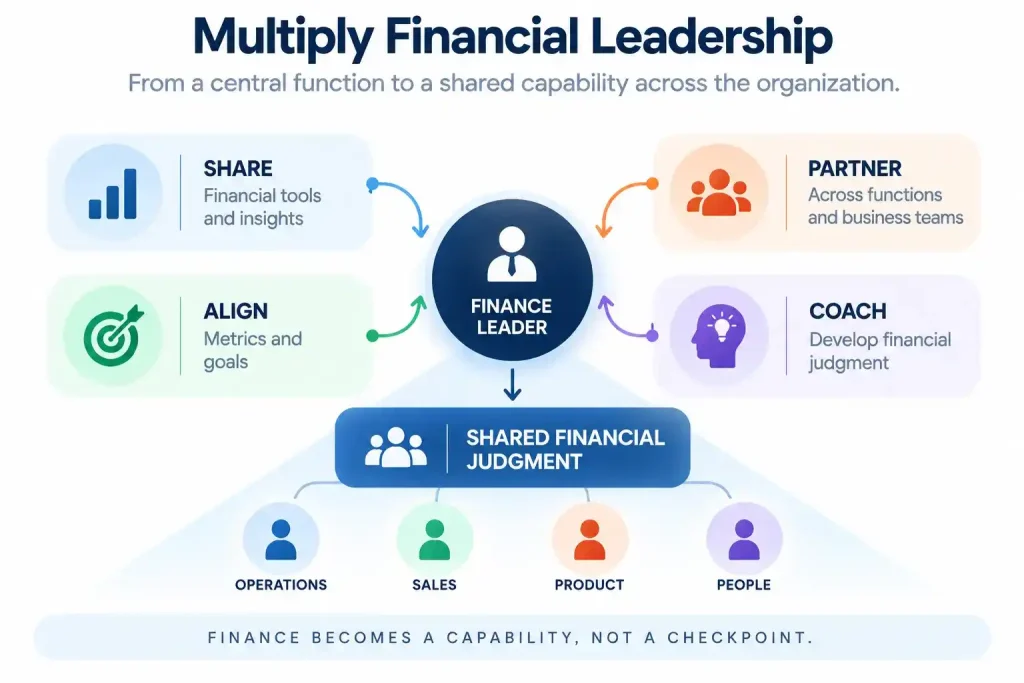
The most durable leadership skills for finance managers are the ones that spread. Leadership that is practiced well does not stay solitary for long. It multiplies. New standards take root, and other people learn to think more clearly and decide more wisely on their own.
Access, Alignment, and Partnership
Strategic finance cannot stay the domain of a small central team for long, either. Sharing its tools, without diluting its rigor, lets operational leaders understand the cost of their choices. It also shows them the long-term implications of short-term wins. A product leader who starts thinking in cohorts and contribution margin without being prompted shows that financial judgment has genuinely spread beyond the finance function.
Alignment has to follow access closely. A sales team measured only on volume, in a company that needs margin discipline, creates a mismatch. So does a product team measured on feature delivery rather than adoption. A finance leader needs to raise these mismatches directly. This is coherence rather than control. It ensures every part of the business solves for the same underlying reality, even when methods differ.
That coherence opens the door to real partnership across functions. A finance function that operating leaders consult early has earned a different kind of trust. They come to sharpen an idea, not just to receive final approval. At a mission-driven education institution, this kind of partnership showed up in how finance engaged the board and program leaders directly in planning conversations rather than only presenting results after the fact, which built shared accountability for outcomes rather than one-sided oversight.
Stepping Back to Develop Others
The final leadership skill for finance managers on this list is knowing when to step back. Resisting the pull to remain the only financial mind in the room matters here. It means giving space for analysts to shape recommendations rather than only surface data, and for business leaders to frame tradeoffs on their own. This looks like coaching rather than correcting. It means tolerating some mistakes rather than preventing every one.
When this takes hold, decision-making speeds up without becoming reckless. Resource allocation improves without becoming bureaucratic. Leaders across functions start to own their part of the P&L as a responsibility, not just a report. The finance function shifts from a checkpoint into a shared capability.
Three Key Takeaways
- Build the leadership skill of pattern recognition so forecasts carry genuine foresight, not just a record of what already happened.
- Practice influence through timing and restraint rather than volume, and listen for what a colleague means, not only what they say.
- Multiply leadership skills for finance managers by sharing financial tools broadly, aligning metrics with meaning, and stepping back so others can grow into financial judgment themselves.
Disclaimer: This article is intended for informational purposes only and does not constitute legal, tax, or accounting advice. You should consult your own tax advisor or counsel for advice tailored to your specific situation.
Hindol Datta is a four-time CFO and senior finance executive with over 25 years of leadership experience across cybersecurity, SaaS, gaming, logistics, digital marketing, medical devices, consumer products, and nonprofit organizations. He has led more than $120M in fundraising and over $150M in M&A transactions while building the financial and operational systems that let complex businesses scale with confidence. He is the author of seven books in the Systems CFO Series and holds active CPA, CMA, and CIA credentials.
AI-assisted insights, supplemented by 25 years of finance leadership experience.