
Executive Summary
A continuous improvement strategy asks the strategic review to keep listening long after the plan wins approval. Most annual cycles reward confident articulation over honest insight, and they trap a living strategy inside a frozen deck. Finance leaders who want strategy to stay relevant must change the review itself, not merely the numbers inside it.
This article rebuilds the strategic review process around four pillars: humility, cadence, conversation, and culture. Each section offers practical tools, from review triggers to agenda questions, that a CFO can apply within one quarter.
Why the Traditional Strategic Review Falls Short
The real work of strategy begins in the quiet after the meeting ends. It lives in the questions nobody fully answered and the assumptions nobody challenged. It also lives in the friction between what the plan says and what the business feels on the ground.
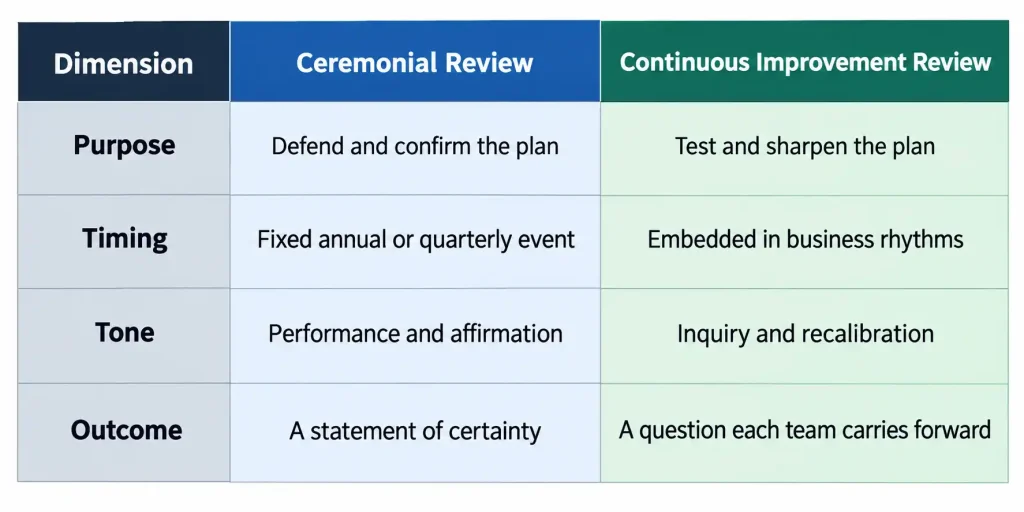
In practice, many strategic reviews have drifted from reckoning toward ritual. Leaders repeat the same format by habit, and the event becomes a performance instead of an honest look at direction. A continuous improvement strategy starts by admitting that gap. The process demands too much certainty too soon, and it rewards polished slides over genuine discovery.
A living strategy does not behave like a fixed document. Markets shift, competitors move, customers evolve, and new technologies arrive without waiting for the planning calendar. A strategy that cannot breathe with those changes hardens into a script that outlives its usefulness.
The CFO sits at the center of any continuous improvement strategy because finance often sees the first signs of dissonance. Actuals drift from intent, and resource allocation starts to contradict stated priorities. Those early tremors appear in the numbers well before the surface shakes.
Strategic Humility: The Mindset Behind a Continuous Improvement Strategy
When a Right Strategy Quietly Goes Stale
Being wrong from the start is not the greatest danger in strategy. A plan can be right for a moment and then go stale without anyone noticing. Markets move, the plan stays still, and teams keep executing a blueprint that no longer fits the terrain.
That failure comes from posture rather than judgment. A continuous improvement strategy fails when leaders treat strategy as a conclusion instead of a conversation. Strategic humility corrects this by holding assumptions lightly, even after the board endorses them and compensation plans absorb them.
A $127M global consumer products company offers a useful illustration. Inventory turns sat at 3x under a product assortment that once made perfect sense. Questioning that inherited logic through demand planning and SKU rationalization lifted turns to 7x and released trapped working capital.
Turning Noticing into Inquiry
The CFO does not see more than other leaders, but the role does see across functions, geographies, and quarters. That view reveals slow misalignments, such as investments that fail to return and initiatives that never fully integrate. Pattern recognition, not instinct, becomes the first signal that strategy needs a fresh hearing.
Raising those signals takes courage, especially when the finance team helped build the original plan. Good inquiry avoids blame and simply asks what no longer fits. One sincere question can open every strategic review with purpose. What do leaders know now that they did not know when the plan took shape?
Building a Strategic Review Cadence That Matches Reality
Moving from Episodic to Embedded Review
Every business has its own pulse, and it rarely follows the fiscal calendar. Product launches quicken it, long sales cycles slow it, and regulatory shifts can jolt it overnight. Binding strategic thinking to arbitrary cycles lets insight fall behind the pace of change. A continuous improvement strategy matches review frequency to that pulse.
A stronger strategic review cadence embeds reflection inside operational moments instead of adding more meetings. Under this model, a product launch becomes a test of go-to-market assumptions. Likewise, a procurement squeeze becomes a signal about input volatility, not just a cost line to manage.
| Business Moment | Strategic Question | Finance Role |
| Product launch | Do go-to-market assumptions still hold? | Compare early adoption to plan drivers |
| Procurement pressure | Is input volatility structural or temporary? | Model margin exposure under both cases |
| Capital allocation review | Which bets still produce learning? | Frame choices with curiosity, not judgment |
| Quarterly close | What changed in customer behavior? | Surface leading signals beside lagging results |
A cybersecurity and identity SaaS company with roughly $30M in ARR shows this rhythm at work, with a driver-based forecasting engine at its core. Monthly variance conversations tested assumptions long before the formal review. Actuals held within five percent of forecast for 8 consecutive quarters. As a result, the formal review consolidated insight instead of delivering surprises.
Balancing Vigilance with Patience
Continuous improvement in strategic planning also demands restraint, and a sound continuous improvement strategy separates signal from noise. Not every wavering metric needs a new plan, since experimentation, seasonality, and scale all create natural noise. The guiding test is simple: is the organization learning at the speed it is living?
Finance leaders can start a continuous improvement strategy small with a few practical habits:
- A recurring discussion with business unit leads focused on meaning over metrics.
- Post-mortems that explore what went differently and why it happened.
- Capital allocation reviews framed as curiosity, not verdict.
- A short list of leading indicators reviewed alongside every monthly close.
Designing the Conversation for Continuous Improvement
A review that merely reports is inert, while one that reveals stays alive. The difference lies in how the CFO designs the conversation itself. Small changes in agenda order, question choice, and tone have an outsized effect on candor.
Opening with inquiry instead of defense signals that the room exists for recalibration, not affirmation. That shift sits at the heart of any continuous improvement strategy. Changing course then looks like discipline instead of failure, especially when it happens before drift becomes decline.
The conversation must also reach beyond finance, because strategy is a set of choices made visible through behavior. Customer sentiment, delivery friction, and retention patterns rarely live inside the model. Operators who execute the plan often hear these signals first.
At a professional services firm with five business units, revenue grew from $12M to $63M in eight months. Engagement-level profitability analytics gave leadership its first clear view of where margin formed and where it leaked. Those insights reshaped review conversations because each unit could now discuss evidence instead of anecdotes.
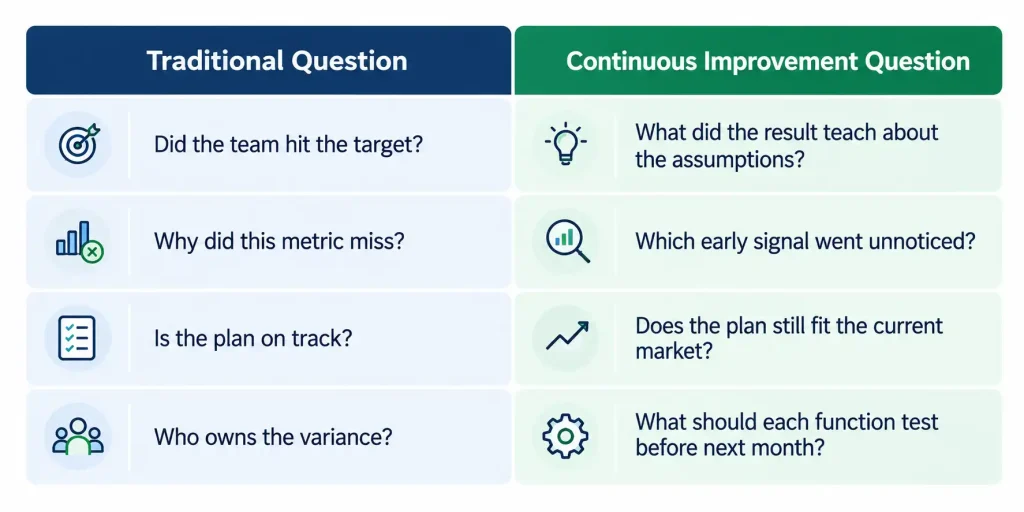
A well-run session ends with a question instead of a statement. Each function carries that question into its own rhythm, and the next review begins with better evidence.
Leading a Culture Where Continuous Improvement Strategy Endures
Resisting the Pull of Inertia
Every company feels a gravitational pull toward the familiar, from established metrics to plans already approved. That pull is not malicious; it is the byproduct of motion. Without someone to reopen the question of relevance, execution continues long after the world has shifted.
The CFO can resist that pull by committing to truth over skepticism. Leading continuous improvement means noticing when a project still consumes capital but no longer delivers learning. It also means seeing when a unit hits targets while losing relevance, or when growth drifts away from purpose.
The CFO as Strategic Conscience
This style of leadership is quiet and patient, and it listens before it speaks. It asks before it answers, which invites deeper thinking. Not every insight will win acceptance, and some concerns will prove wrong. Raising the question still keeps the organization honest.
At a mission-driven education and research institution, regular board and audit committee engagement showed how this posture spreads. Trustees began asking whether the institution remained on the right path, not only whether it performed. Business leaders brought questions to the table alongside results, and metrics turned from proof into inquiry.
Over time, the culture moves from compliance to curiosity, and a continuous improvement strategy becomes the default way of thinking. A durable continuous improvement strategy helps the company become more agile and more awake to change. Review stops being a verdict and becomes a practice of care.
Three Key Takeaways
- Strong CFOs treat strategy as a hypothesis instead of scripture. Each review opens by asking what has changed since the plan took shape.
- Review triggers belong inside launches, procurement shifts, and monthly closes. A continuous improvement strategy works best when the formal review consolidates insight instead of revealing surprises.
- The CFO shapes the review conversation and models the culture through daily behavior. A continuous improvement strategy survives only when leaders feel safe voicing doubt before drift becomes decline.
Disclaimer: This article is intended for informational purposes only and does not constitute legal, tax, or accounting advice. You should consult your own tax advisor or counsel for advice tailored to your specific situation.
Hindol Datta is a four-time CFO and senior finance executive with over 25 years of leadership experience across cybersecurity, SaaS, gaming, logistics, digital marketing, medical devices, consumer products, and nonprofit organizations. He has led more than $120M in fundraising and over $150M in M&A transactions while building the financial and operational systems that let complex businesses scale with confidence. He is the author of seven books in the Systems CFO Series and holds active CPA, CMA, and CIA credentials.
AI-assisted insights, supplemented by 25 years of finance leadership experience.