
Executive Summary
Forecasting accuracy depends less on smarter models than most people assume. FP&A organizational design matters more. It determines whether insight surfaces before decisions lock in, or only after. This article covers how the FP&A mandate needs to evolve, how reporting lines and embedded roles should work, what data and systems infrastructure requires, and the talent and culture that make the whole structure credible.
Good FP&A organizational design treats planning as a capability built into the enterprise. It does not bolt planning onto the end of decision-making. Readers will find practical changes across mandate, structure, systems, and people that make this shift real.
Evolving the FP&A Mandate
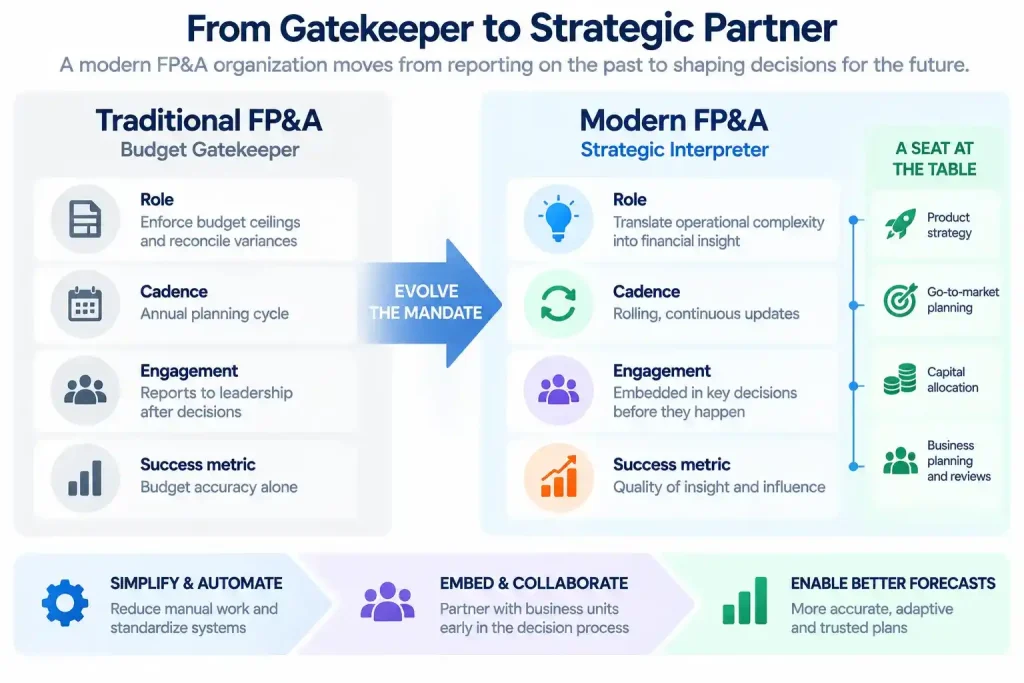
Many finance departments still carry an older identity. FP&A acts as gatekeeper, reminding business units of budget ceilings and reconciling variances after the fact. That role made sense when the world moved more slowly. It no longer fits.
From Gatekeeper to Interpreter
The modern enterprise needs interpreters more than gatekeepers. An interpreter explains the shape of a problem. They translate operational complexity into financial signal, and financial signal into strategic direction. This shift needs structural support, not just a new job description. FP&A needs a seat in product reviews, go-to-market strategy sessions, and capital allocation discussions before those decisions happen, not after.
Fluency matters as much as access. A strong FP&A partner in a sales planning meeting asks what assumptions underpin the pipeline. They ask how conversion has changed over time, not just how much pipeline exists. This kind of fluency comes from direct engagement with operating leaders, treated as a genuine partnership rather than an audit relationship.
Continuous Planning Over Annual Cycles
Annual planning cycles once set the heartbeat of FP&A. Continuous planning needs to replace them, updating monthly or weekly as new data arrives. This requires simplifying the mechanical side of the job first. Teams that spend most of their time reconciling spreadsheets have little bandwidth left for judgment. Automation and standardized systems need to come before the strategic ambition can take hold. A model that is 95% accurate and actually used beats one that is 99% accurate and ignored.
| FP&A shift | Old posture | New posture |
| Role | Budget gatekeeper | Strategic interpreter |
| Cadence | Annual cycle | Rolling, continuous updates |
| Engagement | Reports to leadership | Embedded in decisions before they happen |
| Success metric | Budget accuracy alone | Quality of insight and influence |
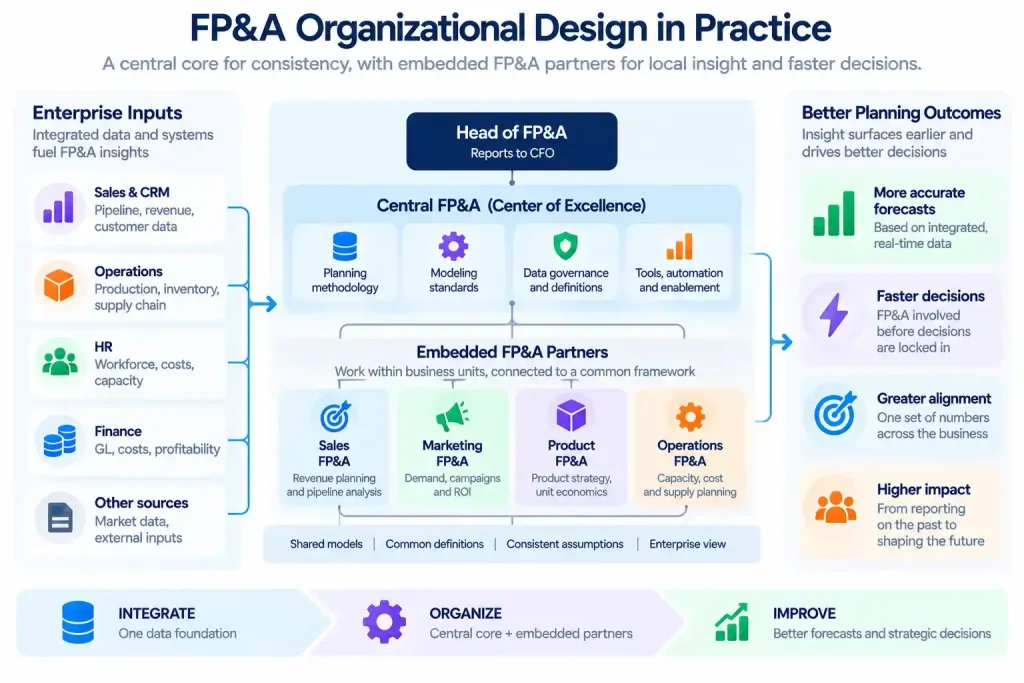
Scale matters here too. A single centralized FP&A team cannot fully serve a large, matrixed organization on its own. Hybrid models work better: a central center of excellence paired with embedded analysts in major business units.
Structuring the Organization Around FP&A
An organization’s reporting lines and decision forums shape how insight travels. Individual analyst skill matters less than the structure surrounding it. FP&A organizational design has to treat planning as a strategic capability built into that structure, not an afterthought layered on top.
Embedded Roles and a Central Core
FP&A typically sits functionally under the CFO but operates at a remove from daily decisions. Embedded finance roles can close that gap. Professionals assigned directly to sales, marketing, or product carry a real mandate to shape and challenge functional plans, rather than serving as informal liaisons.
These embedded roles only work well when they connect back to a central FP&A framework. That framework keeps modeling assumptions and definitions consistent. Without it, embedded analysts risk becoming loyal to their host function and detached from the rest of the enterprise. A dual system solves this: a central core sets standards, and a distributed network adapts them to local context. This gives an organization both a common spine and local intelligence at once.
Hierarchy, Cadence, and Shared Accountability
Deep reporting layers dilute FP&A’s insights before they reach decision-makers. The head of FP&A needs a genuine peer role in strategic discussions, not just a title implying one. Planning cadence also needs a place inside the operating rhythm itself. It should not exist as a quarterly ritual outside that rhythm. Integrating it into operational reviews, updated in tandem with business cycles, closes that gap.
Incentives need to reflect this shared responsibility. FP&A measured only on budget accuracy will act defensively. Business leaders rewarded solely on growth metrics may loosen assumptions to widen their own runway. Rewarding leaders for coherent, adaptable plans, and rewarding finance for enabling foresight rather than only managing variance, aligns incentives around planning quality itself. Accountability for a missed forecast should extend across the full cross-functional team as well. A forecast is a collective commitment, not a unilateral prediction from finance alone.
Systems and Data Infrastructure Behind FP&A Organizational Design
Poor infrastructure can silence even strong FP&A talent. Unreliable data and fragmented systems undercut the best forecasting judgment in an organization.
Data Integrity as a Strategic Priority
Sales orders, procurement timelines, and inventory levels move across the enterprise every day. They typically sit dispersed across systems, though, with inconsistent definitions and disconnected governance. Assigning clear ownership to business-critical data elements changes this. Automated reconciliation, instead of manual cleanup, turns data strategy from aspiration into daily operating reality.
Master data management deserves the same priority. Product hierarchies, customer groupings, and cost center structures form the backbone of every comparison FP&A makes. Margins cannot compare across geographies when a region carries different definitions in the CRM, the ERP, and the BI tool. These issues belong with the CFO’s office as strategic enablers, not with IT as background maintenance.
At a mission-driven education institution, this kind of data discipline connected program-level financial data directly to funding sources. That gave finance one consistent picture instead of two disconnected reports for different audiences.
Integrated Planning Systems
Planning systems bolted onto transactional systems as an afterthought force FP&A to stitch insight together from exported reports. That approach does not scale. Systems that integrate cleanly through APIs and shared data models, instead of email attachments and CSV files, reduce the lag between actuals and forecasts. Scenario planning can then become interactive rather than a rebuilt spreadsheet each time.
Modern planning platforms offer driver-based modeling, workflow collaboration, and audit trails. Tools alone do not create foresight, though. They need implementation in partnership with the business, not just IT or finance working alone. They also need governance around access that stays role-based and audit-logged. A forecast remains a model, not a certainty, and even a beautifully designed dashboard should not seduce leadership into overconfidence about precision it cannot actually deliver.
Talent and Culture in FP&A Organizational Design
Every system and every model eventually depends on a person asking the right question. FP&A organizational design succeeds or fails based on the professionals inside it and the culture shaping how they work.
Hiring and Creating Space to Think
The traditional profile, precise and historically focused, still matters. It is no longer sufficient on its own. Comfort with ambiguity and the ability to work across functions without defensiveness now matter as much as technical modeling skill. Backgrounds in engineering or behavioral economics can complement a traditional finance education well.
Talent alone does not produce insight when the environment buries it in manual work. A planner spending most of their time gathering and formatting data has little room left for the pattern recognition that actually matters, such as noticing a churn uptick that other explanations do not account for. Automation and streamlined reporting cycles create the space where that kind of observation becomes possible.
Building Psychological Safety and Credibility
Finance often faces an impossible expectation: precise but invisible, strategic but not political. A culture that lets FP&A name a flawed assumption plainly and early, without penalty, breaks that bind. Leadership has to model this from the top, rather than simply declaring it as a value. Incentives should reward the quality of insight and cross-functional influence, not just budget variance or forecast accuracy in isolation.
Rotational career paths build stronger leaders. Moving analysts into operations or strategy, then back into FP&A, teaches them the full arc of how the enterprise creates value. Credibility itself accrues slowly through reliability and integrity. It can vanish quickly, through even one instance of a number shaped to fit a narrative. A credible forecast admits what it does not know. It frames a range of possibilities and the assumptions behind them, rather than presenting a single confident number as certainty.
Three Key Takeaways
- Redefine the FP&A mandate around interpretation and continuous planning. Give the function real access to decisions before they happen, not just a report on decisions already final.
- Design the organizational structure with embedded finance roles tied to a central core, clear hierarchy for FP&A’s voice, and incentives that reward shared ownership of planning quality.
- Invest in FP&A organizational design at every layer, from data integrity and integrated systems to hiring, psychological safety, and rotational career paths that build lasting credibility.
Disclaimer: This article is intended for informational purposes only and does not constitute legal, tax, or accounting advice. You should consult your own tax advisor or counsel for advice tailored to your specific situation.
Hindol Datta is a four-time CFO and senior finance executive with over 25 years of leadership experience across cybersecurity, SaaS, gaming, logistics, digital marketing, medical devices, consumer products, and nonprofit organizations. He has led more than $120M in fundraising and over $150M in M&A transactions while building the financial and operational systems that let complex businesses scale with confidence. He is the author of seven books in the Systems CFO Series and holds active CPA, CMA, and CIA credentials.
AI-assisted insights, supplemented by 25 years of finance leadership experience.