
Executive Summary
An ERP implementation looks like an IT project on the surface: systems configuration, data migration, workflow alignment. For the CFO, it is something larger. It becomes the infrastructure that makes accurate forecasting a repeatable practice rather than a hope. This article covers the strategic case for ERP system implementation and the best practices that carry a project through its hardest phase. It also covers how integrated systems change planning accuracy, and the leadership that sustains the value afterward.
Enterprise Resource Planning, done well, is not centralization for its own sake. It is coherence: one living model of how a business operates, informing every decision from the forecast to the floor. Readers will find the strategic reasoning, the governance discipline, and the planning mechanics behind a strong ERP implementation. The leadership habits that make it pay off follow at the end.
The Strategic Case for ERP Implementation
Planning breakdowns follow familiar patterns. Marketing projects growth that sales cannot substantiate. Inventory assumptions in operations diverge from procurement timelines. An earnings forecast rests on numbers no one fully trusts. These misalignments rarely arrive dramatically. They build slowly, from incompatible systems and scattered data that have outgrown the tools meant to support them.
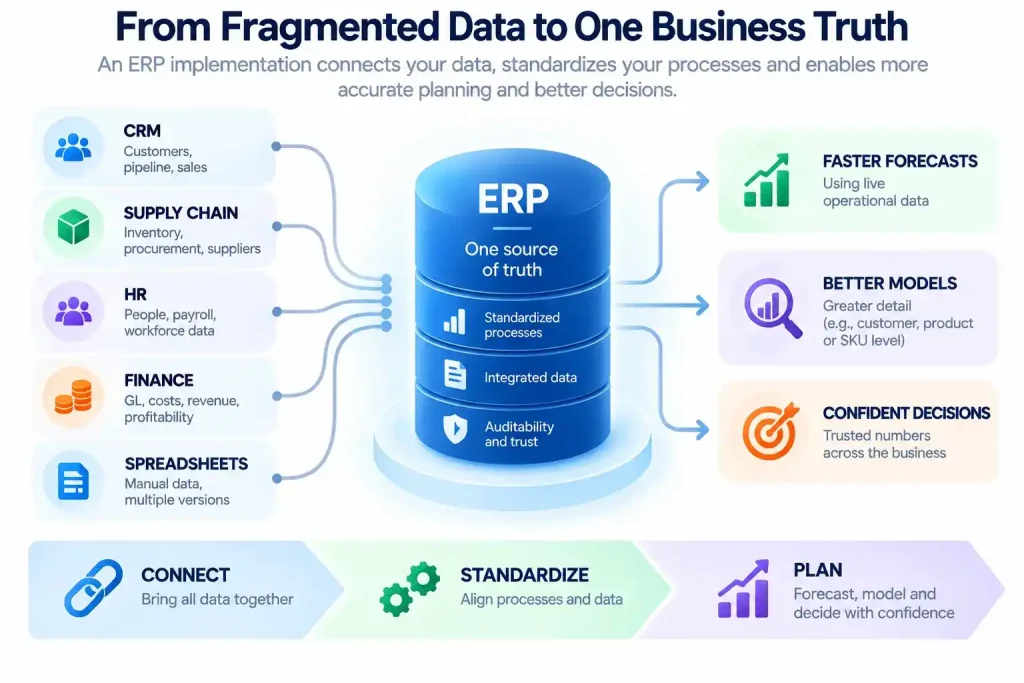
From Fragmented Systems to a Single Source of Truth
An ERP implementation is fundamentally a strategy reset, not a technology project. It marks the moment an enterprise stops connecting islands with makeshift bridges and commits instead to one navigable map. That decision carries real cost and real disruption, and it forces uncomfortable questions: why does procurement report margin one way and finance another, and why does sales forecasting sit outside the P&L logic?
These questions point directly at the opportunity. An ERP system implementation is a system of logic as much as a system of record. It standardizes what has grown idiosyncratic and turns anecdote into auditability. The case for it needs telling in terms of business outcomes, not software features. Rolling forecasts can reflect real-time inventory movement, margin analysis can work at the customer level, and revenue models can flex instantly as assumptions change.
Linking ERP Design to Planning Outcomes
Every design decision in an ERP implementation should trace back to a business question. Will this help the company forecast faster, model more accurately, or allocate capital with more confidence? Every customization needs to earn its place. It should not simply preserve a legacy habit.
| Strategic question | What good ERP design answers |
| Will this help forecast faster? | Rolling forecasts built on live operational data |
| Will this improve modeling accuracy? | Customer, product, or SKU-level granularity |
| Will this improve capital confidence? | Return on invested capital modeled across initiatives |
| Can everyone trust one number? | One canonical data source instead of five reconciled ones |
This work also needs governance beyond the ERP itself. It belongs inside a broader architecture that includes data strategy, performance management, and planning cadence. The CFO should partner closely with the CIO and Chief Data Officer so ERP outputs flow directly into strategic planning inputs.
ERP Implementation Best Practices for a Smoother Journey
An ERP implementation exposes a company’s habits, politics, and informal workarounds more than most transformation projects. Structured phases and steering committees sit on the surface, but underneath runs a collision between ambition and legacy reality.
Governance, Data, and Design Integrity
Sound ERP implementation best practices start with governance that is lean and decisive. That means a program management office with real authority, a steering committee with both strategic and operational voices, and clear owners for data, process, and decisions. The project needs governance as rigorous as a capital investment, because that is effectively what it is.
Design integrity matters just as much. Recreating the old system inside the new one, through excessive customization, degrades upgradability and undermines consistency later. The default should stay standard wherever possible, letting the new system reflect the business rather than its old silos. Data governance deserves the same discipline. Duplicate records and undefined attributes become roadblocks to planning. Data cleansing and master data alignment need to be first-order priorities, not technical afterthoughts.
Training carries equal weight in a well-run implementation. It should teach process logic, not just system navigation. It should also reach managers and executives who will rely on the new system’s output, not only the end users entering data. A SAP implementation, or any major platform rollout, tends to succeed or fail on these fundamentals. The vendor behind the interface matters far less.
Leadership Presence Through Go-Live
None of these best practices hold without visible leadership. The CFO needs to show up in project reviews, listen to front-line concerns, and engage directly with testing feedback. That presence signals that the project is strategic, not merely expensive. As go-live approaches and timelines compress, the goal shifts from perfectionism to steadiness. That means triaging issues, supporting teams, and protecting the critical path. A successful go-live is rarely seamless. It is survivable, and the harder work of adoption begins immediately after.
How ERP Implementation Drives Planning Accuracy
Accuracy in planning is not perfection. No forecast is ever entirely correct. It is calibration: a continuously refined understanding of which levers move the business and how they move together. A well-executed ERP implementation turns this from aspiration into daily practice.
From Fractured Data to Canonical Truth
In most enterprises, planning data sits scattered across CRM platforms, supply chain tools, HR systems, and spreadsheets. None of them speak the same language. That fragmentation produces distortion as much as delay, since the same metric can carry different definitions in different systems. A completed ERP implementation establishes one canonical source of truth. Sales and finance stop debating which version of the pipeline is accurate, and procurement stops working from mismatched timelines.
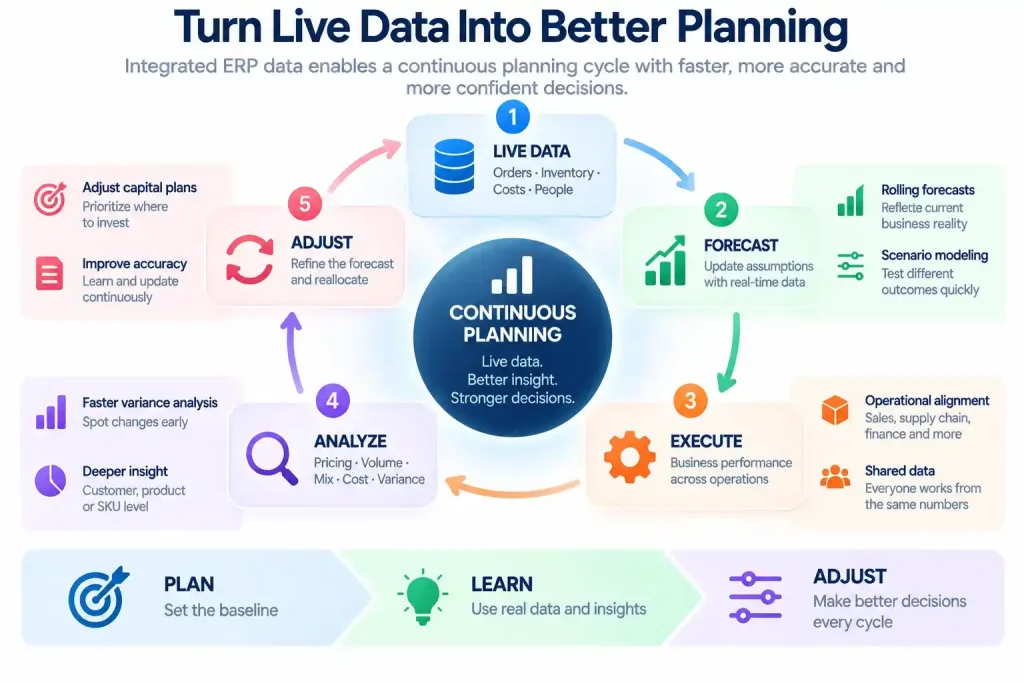
This alignment unlocks a higher fidelity in scenario planning. Questions that once took weeks in siloed spreadsheets can now run in hours. What happens if demand drops 7% in one region, or input costs rise 12% next quarter? Integrated, real-time data answers this quickly. Planning also becomes more granular. It moves from business-unit averages down to product, region, or customer-level detail that reveals which accounts actually drive margin variability.
Faster Variance Analysis and Rolling Forecasts
Variance analysis moves faster and gets sharper after a mature ERP implementation. The system can trace a deviation to pricing, volume, mix shift, or cost inflation with real specificity. That shortens the feedback loop between plan and execution and shifts planning conversations from negotiation toward learning.
Rolling forecasts that update monthly, or even weekly, become realistic once systems can support the cadence. They stay grounded in live orders and inventory data rather than static assumptions. This changes what FP&A teams actually do day to day. They shift from assembling data to interpreting signal. The question becomes what leading indicators show about revenue softness, not just how to build the model from scratch each cycle. AI-based forecasting and embedded analytics support this shift, but they augment judgment rather than replace it. No tool understands context the way a person reviewing the numbers does.
Sustaining ERP Implementation Value Through Leadership
Go-live is not the finish line. An ERP is a living infrastructure. Its value depends on the culture that uses it, not the code underneath it. The CFO’s role after go-live is stewardship, not celebration.
Building Trust in the System
Teams sometimes revert to legacy spreadsheet habits even after a technically successful ERP implementation. The system has simply not yet earned their trust. Addressing that drift starts with curiosity rather than reprimand. Why do teams not trust the system yet? What would make the data credible enough to plan from, not just report on?
Trust builds through consistent behavior. The system stops feeling optional once forecast reviews use system data, performance meetings reference integrated dashboards, and capital decisions visibly flow from ERP insights. Embedding it into the regular rhythm of monthly reviews and quarterly strategy sessions makes it feel inevitable rather than imposed.
Fighting Entropy and Building Talent
Systems degrade slowly without active maintenance. Definitions drift, and shadow processes creep back in without deliberate governance. That governance means clear data ownership, change control, and a defined issue resolution path. Continued investment matters too. No ERP implementation gets everything right on the first pass, and a backlog of improvement work deserves the same funding discipline as any other capital allocation decision.
Talent development closes the loop. A finance team fluent in systems logic and business process can question outputs and explain assumptions. Report-running alone does not build that fluency. Building, training, and rewarding for that fluency turns an ERP implementation from a one-time project into a lasting capability.
Three Key Takeaways
- Treat ERP implementation as a strategy reset, not an IT project. Trace every design decision back to a specific planning outcome it needs to support.
- Follow disciplined ERP implementation best practices, including lean governance, strict data quality standards, and design integrity that resists unnecessary customization.
- Sustain the value of an ERP system implementation through visible leadership and consistent use of system data in decisions. Keep investing in both the platform and the people who run it.
Disclaimer: This article is intended for informational purposes only and does not constitute legal, tax, or accounting advice. You should consult your own tax advisor or counsel for advice tailored to your specific situation.
Hindol Datta is a four-time CFO and senior finance executive with over 25 years of leadership experience across cybersecurity, SaaS, gaming, logistics, digital marketing, medical devices, consumer products, and nonprofit organizations. He has led more than $120M in fundraising and over $150M in M&A transactions while building the financial and operational systems that let complex businesses scale with confidence. He is the author of seven books in the Systems CFO Series and holds active CPA, CMA, and CIA credentials.
AI-assisted insights, supplemented by 25 years of finance leadership experience.