
Executive Summary
Cost remains one of the most enduring drivers of market positioning in any industry. It shapes how a company prices, invests, and survives across business cycles. Branding and innovation influence how customers perceive a company. Yet the underlying cost structure determines how long that perception can hold under pressure. That is why cost discipline belongs at the center of any serious conversation about market positioning, not at the edge.
This article treats cost efficiency as a structural capability, not an occasional budget exercise. That capability supports market positioning, protects customer experience, and compounds over time. The discussion draws on experience across cybersecurity, consumer products, gaming, and digital marketing organizations. It shows how positioning in marketing and finance intersect. It also shows how cost discipline becomes a permanent part of company identity rather than a reaction to hard times.
Why Cost Discipline Drives Market Positioning
A company with a lower cost base can price more competitively without eroding margin. It can invest through downturns while competitors retrench. It can also reinvest in growth when others have to cut. This is the practical link between cost structure and market positioning. It explains why leaders should design cost efficiency deliberately instead of waiting for a downturn to trigger it.
A $127M global consumer products company operated across direct-to-consumer, Amazon, and wholesale channels. Through demand planning and SKU rationalization, its inventory turns improved from three times to seven times. That shift released working capital for growth initiatives that competitors could not match on the same timeline. Financial flexibility of this kind is a form of market positioning in itself. It widens the range of strategic choices available when conditions shift.
Cost efficiency is not austerity and it is not a race to the bottom. It is the disciplined removal of friction, so resources concentrate where customers actually perceive value. The same principle governs sound positioning in marketing more broadly.
Building Cost Efficiency into Company Identity
Companies that hold a strong market position across multiple cycles treat cost as a structural design choice. They do not reach for it as a reflexive lever only when hardship hits. The starting question is simple though rarely asked with enough honesty. Where does the company genuinely create value, and does every function, process, and layer of approval earn its place around that center of gravity.
In a high-growth cybersecurity and identity access management company generating roughly $30M in annual recurring revenue across five countries, building a driver-based forecasting model and capacity plan from scratch held actual results within five percent of forecast for eight consecutive quarters, while gross margin improved by twelve percent through pricing discipline and delivery cost management. That kind of predictability becomes part of a company’s identity in the eyes of a board, an acquirer, or a customer evaluating long-term risk.
Cost clarity also depends on finance acting as an advisor rather than an enforcer. When functional leaders understand cost per outcome instead of simply cost per budget line, their decisions sharpen, and they begin advocating for efficiency rather than defending legacy spending.
Operational Levers That Strengthen Positioning in Marketing and Finance
Philosophy only matters if it becomes operational. The levers below have proven durable across industries ranging from manufacturing to professional services.
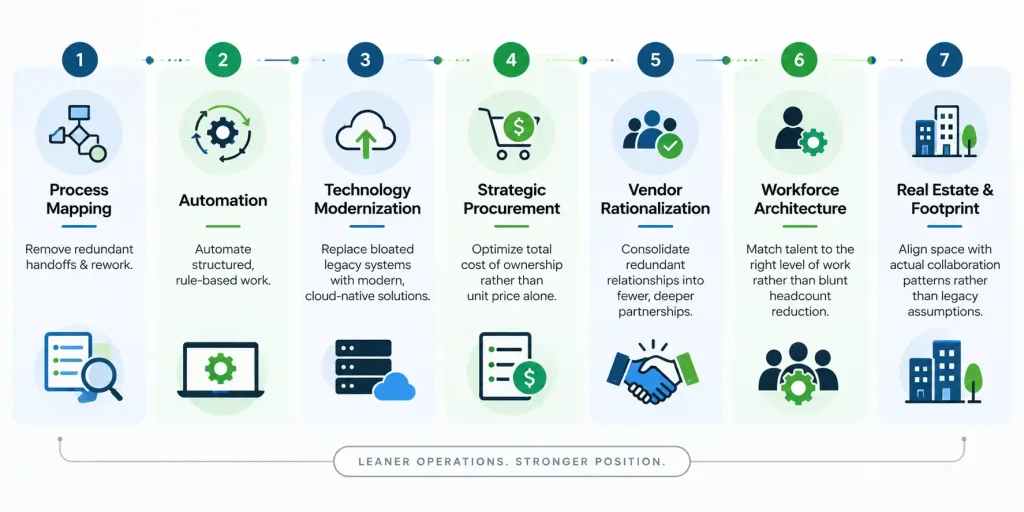
Technology and Process as Structural Advantage
A NetSuite implementation across five country entities compressed a monthly close from eighteen days to ten, which sounds like an operational detail until it becomes the difference between a board that trusts its numbers and one that does not. Positioning marketing and financial credibility both depend on this kind of underlying reliability, because customers, investors, and partners are all making judgments based on how consistently a company delivers.
Sequencing and Momentum
Programs that chase quick wins without addressing root causes tend to stall after the first round of savings. Sustainable efficiency behaves more like a flywheel, where early wins fund the harder structural work, and momentum compounds rather than fading after a single budget cycle.
Protecting Customer Experience While Improving Market Positioning
The idea that cost cutting and customer experience are opposing forces is one of the most persistent misconceptions in business strategy. Not all costs are equal in a customer’s eyes. Reliable delivery and responsive support are perceived and valued. Manual handoffs, duplicate data entry, and excess internal approvals are invisible to the customer and exist purely as internal friction.
In a venture-backed performance marketing organization that scaled revenue from $9M to $180M in twenty-four months, building customer acquisition cost, lifetime value, and contribution margin discipline into daily reporting allowed growth to continue without sacrificing unit economics, which protected both profitability and the customer relationships driving that growth.
Digital self-service tools reduce labor cost while giving customers more control, provided escalation paths to human support remain intact. Personalization through customer data allows differentiated service models, so high-value relationships receive more attention while other segments benefit from efficient self-service. Consistency also matters more than most companies assume. Customers tolerate occasional delay far better than they tolerate unpredictable service, which is why standard operating procedures and quality assurance mechanisms should be strengthened during any cost transformation rather than loosened.
Making Cost Efficiency Permanent Through Governance
A cost program that lives only in finance rarely survives past its first budget cycle. Institutionalizing efficiency requires ownership at every functional level, incentive structures that reward stewardship rather than arbitrary cost targets, and governance that treats structural cost trends as a standing board topic rather than an annual exercise.
In a mission-driven education and research institution, running Finance, HR, IT, Legal, and Facilities simultaneously while raising $37M in equity and venture debt demonstrated how far the operational mandate of a lean organization extends beyond the finance function itself, and how closely governance and cost discipline are linked when resources are constrained.
Real-time dashboards that expose cost drivers and utilization rates to operators and marketers, not just to finance teams, build the transparency needed for teams to self-correct. Cultural rituals also matter more than most leaders expect. A recurring practice of asking each function to identify one process or report it could eliminate tends to produce cultural clarity long before it produces measurable savings.
Three Key Takeaways
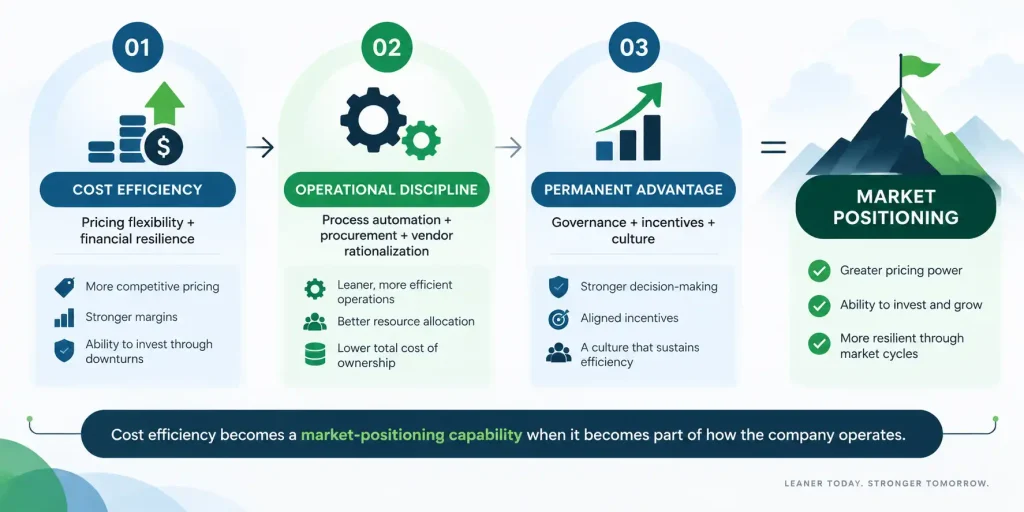
- Cost efficiency functions as a form of market positioning because it creates pricing flexibility and financial resilience that competitors without the same discipline cannot easily replicate, particularly during downturns when options narrow for everyone else.
- Operational levers such as process automation, procurement discipline, and vendor rationalization only produce lasting value when applied to a company’s true center of value creation, rather than layered onto processes that should have been simplified first.
- Sustainable cost programs treat governance, incentives, and cultural reinforcement as permanent structures rather than one-time initiatives, which is what separates companies where efficiency becomes identity from those where it fades once the pressure that created it has passed.
Disclaimer: This article is intended for informational purposes only and does not constitute legal, tax, or accounting advice. You should consult your own tax advisor or counsel for advice tailored to your specific situation.
Hindol Datta is a four-time CFO and senior finance executive with over 25 years of leadership experience across cybersecurity, SaaS, gaming, logistics, digital marketing, medical devices, consumer products, and nonprofit organizations. He has led more than $120M in fundraising and over $150M in M&A transactions while building the financial and operational systems that let complex businesses scale with confidence. He is the author of seven books in the Systems CFO Series and holds active CPA, CMA, and CIA credentials.
AI-assisted insights, supplemented by 25 years of finance leadership experience.