
Executive Summary
Margin expansion rarely comes from cutting alone, since durable gains grow out of strategic choices about focus and value. This article explains the margin expansion meaning for finance leaders and traces how those choices reshape the P&L.
The discussion moves through four levers, namely strategic planning, innovation, commercial strategy, and execution. Each section offers practical frameworks and examples drawn from real company situations.
Margin Expansion Meaning: Why Clarity Beats Cost Cutting
Margin sounds like a word for the edges of a page, yet it sits at the center of every company. It is the residue of discipline and the surplus that funds reinvestment. In plain terms, the margin expansion meaning is that profit grows faster than revenue over time. That improvement can show up in gross margin, operating margin, or EBITDA margin.
Most companies reach first for tactical levers such as cost cuts, price increases, or process trims. These tools are valid, but they chase efficiency without questioning effectiveness. Strategic initiatives begin with purpose, asking which customers the company serves best and where its value resists imitation.
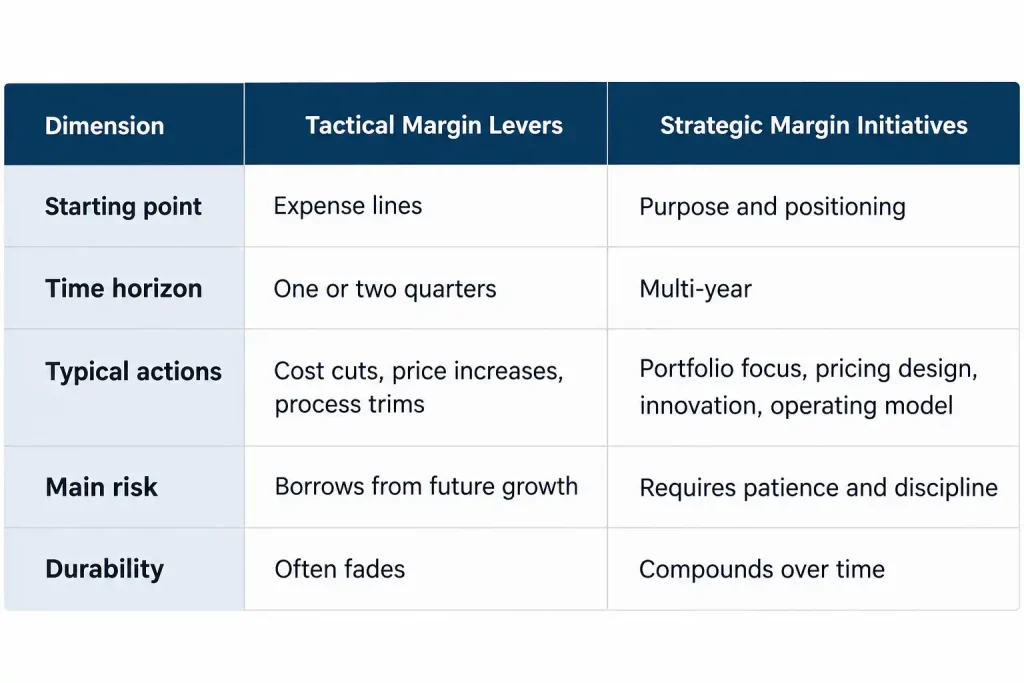
Seen this way, the P&L becomes a record of choices, not a fixed ledger. Margin is not the absence of cost; it is the presence of clarity.
Embedding Margin Expansion into Strategic Planning
Strategic planning charts ambition and forges priorities, yet many plans stay oddly silent on margin. Beneath polished decks sits a quiet assumption that margin is an outcome, not an input.
The CFO has to challenge that assumption early. Finance often joins planning after ideas have hardened, when margin can only arrive as a retrofit. Margin expansion works far better when leaders design it into the plan from the first draft.
Understanding the Company’s Margin Anatomy
Good planning starts with a granular view of profitability by product, customer, and channel. Activity-based costing or cost-to-serve models reveal the true burden of complexity. Without them, a company can grow revenue while silently eroding its bottom line.
A professional services firm that scaled from $12M to $63M in eight months offers a useful example. Engagement-level profitability analytics across five business units showed leadership where margin formed and where it leaked. With that anatomy in hand, finance can pressure-test each strategic priority:
- New geography: can local pricing meet corporate return thresholds?
- New product line: can the fixed cost base absorb it without fragmenting focus?
- Digital transformation: what margin unlock does it promise through automation, retention, or lower churn?
- Segment mix: which customers stay profitable once fully loaded costs are counted?
Modeling Paths and Mapping the Margin Timeline
Finance earns influence in strategic planning through modeling, not veto. Dynamic models let leaders simulate what happens to operating margin if the mix shifts toward higher-value customers. Timing matters here, because margin expansion is rarely immediate. A margin timeline shows when investments turn and when breakeven arrives. It separates strategically accretive dilution from moves that simply erode.
Margin also needs a shared vocabulary and a steady rhythm. Sales leaders should understand contribution margin, and product teams should know their unit economics. Planning works best as a continuous cycle, and finance should hold its own initiatives to the same discipline.
Innovation as a Margin Expansion Lever
Innovation carries glamour in corporate language because it keeps companies relevant. Yet every innovation is also an economic act that lands on the income statement. Managed poorly, it erodes margin even as it excites headlines. The CFO’s role is to act as a steward, not a skeptic.
Purpose, Business Cases, and Stage Gates
Vague goals such as becoming more digital or more agile destroy economic value. Each initiative needs a clear purpose with a distinct financial signature:
- Automating a process to reduce labor cost
- Launching a product that commands higher pricing
- Entering segments with a lower cost-to-serve
- Improving customer experience to reduce churn
Once the purpose is clear, finance and business leaders should model realistic scenarios and avoid ROI theatre. A new line with lower gross margins can weaken the core even as revenue grows. Innovation then deserves the same rigor as any capital investment: stage gates, leading indicators, postmortems, and reallocation triggers.
Patience matters as well, and captured learning becomes a margin asset because it shortens the path from idea to value.
Back-Office Productivity and Margin Resilience
Internal productivity remains one of the most overlooked sources of margin expansion. Automation, analytics, and workflow redesign show up directly in SG&A, COGS, and working capital. These gains look less glamorous than customer launches, but they arrive sooner. Innovations that stabilize the business deserve the same credit. Pricing algorithms and supply chain diversification reduce margin volatility, and risk reduction is a form of profit preservation.
Commercial Strategy and Gross Margin Expansion
Commercial strategy turns a company’s capability into a customer’s willingness to pay. Durable gross margin expansion comes from how a business prices and sells its value, not from what it saves. To lead here, the CFO has to become a student of the customer and treat pricing as a thesis.
Segmentation, Packaging, and Value-Based Pricing
Uniform pricing across a varied customer base creates margin leakage disguised as fairness. Contribution analysis shows who pays above average and who consumes disproportionate resources. High-value customers may warrant premium tiers, while low-margin segments may suit self-service channels. The aim is to serve wisely, not to serve less.
Packaging extends this logic, since smart bundles align price with usage and raise perceived fairness. Value-based pricing anchors price in outcomes by asking what problem the product solves and what inaction costs the buyer.
A cybersecurity and identity SaaS company with roughly $30M in ARR shows the payoff. Pricing discipline, a better workforce mix, and tighter delivery cost management together lifted its gross margin by 12%.
Discounting, Incentives, Channels, and Contracts
Discounting is where pricing pressure usually surfaces in daily deals. Frontline discounts feel tactical, but their arithmetic is brutal.
| Metric | Before Discount | After 10% Discount |
| Unit price | $100 | $90 |
| Unit cost | $70 | $70 |
| Gross profit per unit | $30 | $20 |
| Gross margin | 30% | 22% |
| Volume needed to hold gross profit | 1.0x | 1.5x |
A 10% price cut removes one third of gross profit per unit. Approval thresholds and guardrails keep that math visible to deal teams. Beyond discounts, three further levers shape commercial margin:
- Incentives: sales compensation should reward gross or contribution margin, not volume alone.
- Channels: direct, reseller, online, and partner routes each carry a different cost-to-serve profile.
- Contracts and global pricing: term lengths, renewals, and local adaptation within a global framework shape margin stability.
A venture-backed performance marketing company scaled from $9M to $180M in 24 months. CAC, LTV, and contribution margin discipline kept that growth healthy. Companies earn margin when they deserve it, not when they demand it.
Operationalizing Margin Expansion Across the Enterprise
Strategy lives or dies in execution, and margin ultimately takes shape in daily decisions far from the boardroom. Translation starts by breaking abstractions such as improving efficiency into specific operating changes for each function.
Ownership, Benefit Tracking, and Rolling Forecasts
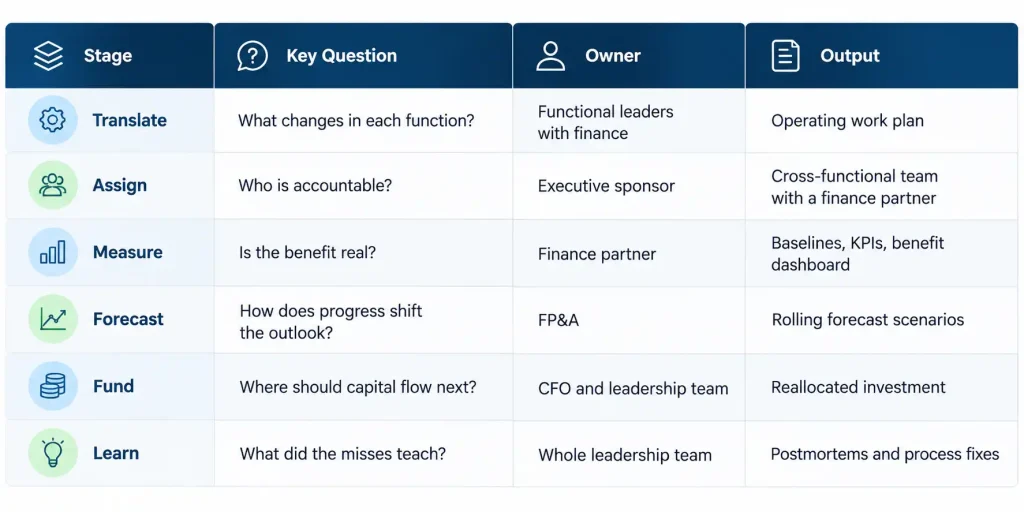
Each initiative needs an executive sponsor, a cross-functional team, and a dedicated finance partner. That partner validates assumptions and flags drift before it becomes expensive. A benefit realization framework should separate realized, banked, and forecasted benefits. Rolling forecasts should then absorb initiative progress, with scenarios for adoption curves and implementation risk.
One $127M global consumer products company more than doubled inventory turns from 3x to 7x through SKU rationalization. The gain released trapped working capital because operators, not only finance, owned the change.
Culture, Language, and Capital Allocation
Margin work often means doing fewer things better, retiring legacy products, or ending accommodations that no longer serve. Leaders should frame these choices as focus, not retreat, and language helps. The phrase capacity unlock lands better than headcount reduction.
Capital allocation remains the most powerful operational lever of all. Governance should route funding to initiatives with the strongest margin case, not the loudest advocates. When initiatives falter, postmortems turn misses into institutional knowledge, and margin expansion becomes a capability rather than a one-time win.
Margin Expansion as a Design Principle
Sustainable margin expansion reflects the quality of a company’s decisions, not the severity of its cuts. Treated as a design principle, margin becomes a statement of focus, integrity, and the ability to create surplus.
Three Key Takeaways
- Margin expansion belongs at the start of strategic planning, where granular profitability data shapes which bets the company makes.
- Gross margin expansion depends on commercial design, including segmentation, value-based pricing, disciplined discounting, and incentives that reward profitable growth.
- Execution turns intent into results, so each initiative needs an owner, a finance partner, and tracked benefits.
Disclaimer: This article is intended for informational purposes only and does not constitute legal, tax, or accounting advice. You should consult your own tax advisor or counsel for advice tailored to your specific situation.
Hindol Datta is a four-time CFO and senior finance executive with over 25 years of leadership experience across cybersecurity, SaaS, gaming, logistics, digital marketing, medical devices, consumer products, and nonprofit organizations. He has led more than $120M in fundraising and over $150M in M&A transactions while building the financial and operational systems that let complex businesses scale with confidence. He is the author of seven books in the Systems CFO Series and holds active CPA, CMA, and CIA credentials.
AI-assisted insights, supplemented by 25 years of finance leadership experience.