
Executive Summary
A Monte Carlo simulation replaces the single-point forecast with a full range of possible outcomes, and that shift changes how a company commits its capital. Most investment cases still rest on one IRR and one tidy set of assumptions. The future rarely arrives in a single shape, so the precision on the slide is often borrowed, not earned.
This article covers four dimensions of probabilistic capital allocation: the philosophy behind it, the mechanics of the model, its use in project and portfolio decisions, and the cultural work that makes it last. Finance leaders will gain a practical framework for reading distributions, valuing optionality, and building boardroom trust.
Why Single-Point Forecasts Fail Capital Allocation
Capital allocation is where a company’s beliefs about its own future become irreversible commitments. Yet most processes still lean on forecasts that imply false precision, hurdle rates that ignore uncertainty, and scenarios that assume one future.
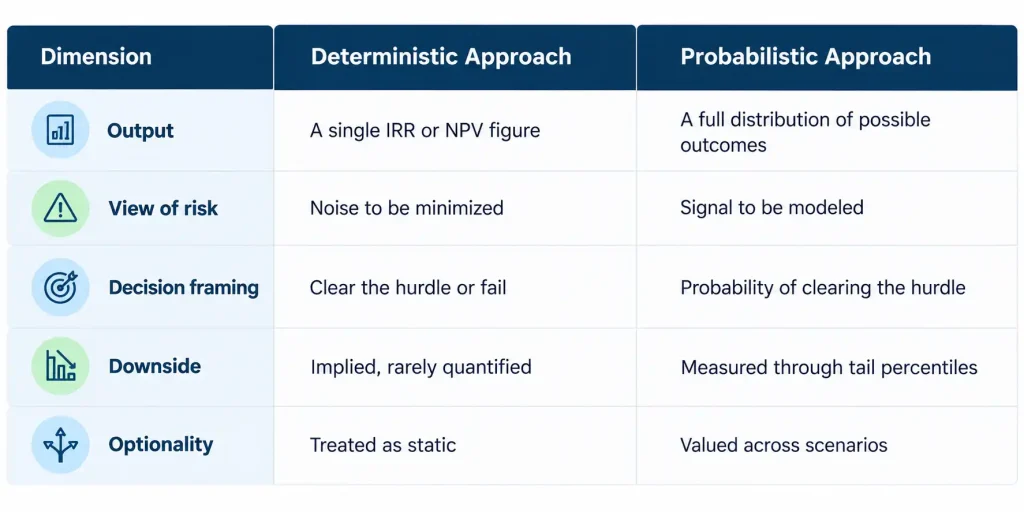
NPV, IRR, and payback period tend to frame each decision as a binary choice between investing and walking away. That framing treats the most likely outcome as the only outcome that matters. The process mistakes visibility for control and hides the shape of risk from approvers.
A capital committee might review two different projects in the same quarter. One offers a 5% IRR with little downside, while the other offers a 10% expected IRR with a 30% chance of exceeding 15%. A deterministic model ranks them on averages and misses the asymmetry that makes the second project more valuable.
The Questions That Probabilistic Capital Allocation Asks
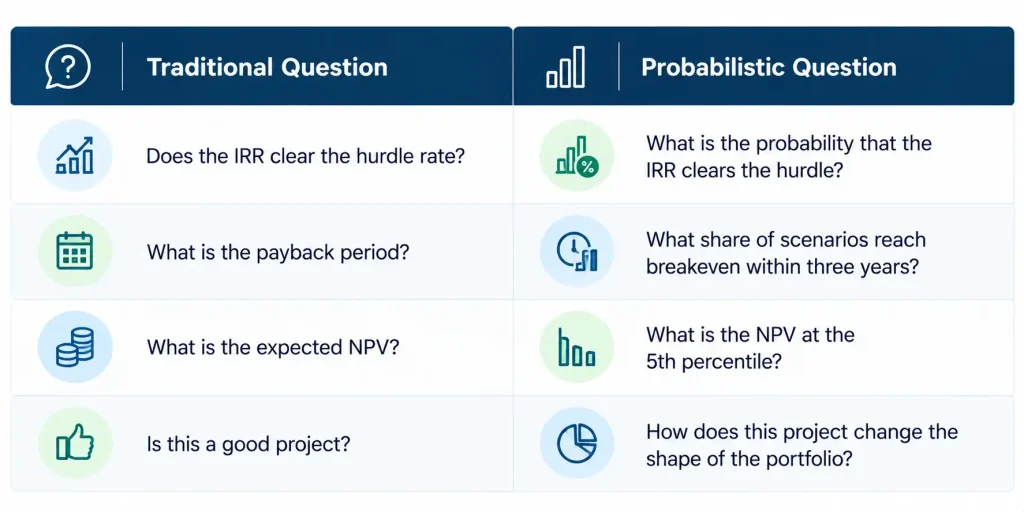
Probabilistic thinking begins with questions instead of equations, and those questions deepen the investment case:
- Which core uncertainties drive the performance of this specific investment?
- How sensitive are the outcomes to each of the key assumptions?
- What does the downside look like in probability, and not only in magnitude?
- Can the investment be staged, deferred, or exited if conditions change?
How a Monte Carlo Simulation Works in Capital Budgeting
Behind the single IRR that executives expect, a dozen variables shift quietly, from volumes and input costs to discount rates and timing.
A Monte Carlo simulation brings that hidden instability into view by giving each key assumption a probability distribution instead of a fixed value. The model samples from those distributions thousands of times and calculates NPV or IRR in each run. What emerges is a cloud of outcomes that reflects the true variability of the business.
Choosing the Right Inputs and Distributions
Not every assumption in a capital model deserves probabilistic treatment. The skill lies in isolating the value drivers that are both uncertain and consequential. Sales volume, unit price, cost inflation, adoption rate, and regulatory timing usually qualify.
| Variable | Typical Distribution | Why It Fits |
| Revenue growth | Normal | Centers on a historical mean with symmetric variation |
| Commodity and input prices | Lognormal | Captures skew and cannot fall below zero |
| Project timing and delays | Beta | Reflects bounded uncertainty between known limits |
| Expert estimates with thin data | Triangular | Uses minimum, most likely, and maximum values |
Input calibration is where any Monte Carlo simulation earns its credibility or loses it. Freight rates, landed costs, and currency swings in a global supply chain are rarely symmetric. Treating them as normal distributions understates the downside that matters most to cash conversion.
Reading the Output of a Monte Carlo Simulation
Once the iterations finish, the distribution shows the mean, median, spread, skew, and tails. Finance can state the probability of breaching the hurdle rate, losing capital, or earning outsized returns.
| Stage | What Happens | Output |
| 1. Identify | Select the few value drivers that are uncertain and material | A short list of modeled inputs |
| 2. Assign | Fit a probability distribution to each driver | Calibrated input ranges |
| 3. Correlate | Link drivers that tend to move together | A realistic dependency structure |
| 4. Iterate | Sample inputs and compute NPV or IRR thousands of times | A full set of simulated results |
| 5. Interpret | Read percentiles, tails, and hurdle probabilities | A decision-ready risk profile |
A Monte Carlo simulation is not magic, and three failures undermine it more often than any others:
- Poor input selection that models trivial variables and ignores the real drivers
- Miscalibrated distributions that encode optimism rather than evidence
- Missing or faulty correlations that make related risks look independent
Applying Monte Carlo Simulation to Project and Portfolio Decisions
Capital decisions often feel crisp inside the committee room, yet that crispness is frequently a performance, a still photograph of a landscape in motion.
Where Monte Carlo Simulation Earns Its Place
Not every capital request justifies a full simulation, and the dividing line is the materiality of variance:
- Use it for greenfield expansion, new product lines, acquisitions, and transformational digital programs
- Skip it for routine maintenance, small system upgrades, and renewal capex with stable returns
For strategic bets, the modeling team and project sponsor build assumptions together. Defining ranges often surfaces issues the deterministic model concealed. A market-entry case built on a flat three-year ramp looks different once slower penetration and pricing erosion enter the model.
The review then moves from expected return to the shape of outcomes. Sponsor and CFO examine the odds of clearing the hurdle, the odds of capital loss, and the worst 5% of cases. High-variance projects invite staging, conditional funding, or kill switches. Concentrated risks invite mitigation, such as letters of intent or fixed supply contracts.
Portfolio Risk, Correlation, and Optionality
The method shows its greatest power at the portfolio level. Returns across parallel initiatives are rarely as independent as they appear. One regional slowdown can hit three of five growth programs at once, and an energy spike can compress margins everywhere.
Cross-border acquisitions spread across several countries often carry overlapping currency, regulatory, and demand risks. A portfolio-level Monte Carlo simulation captures how those exposures move together, showing which deals drive volatility and which offer uncorrelated upside.
Monte Carlo simulation also turns abstract optionality into measurable value. A digital platform may lose money in most base cases yet unlock future offerings in upside scenarios, and modeling the choice to expand, defer, abandon, or pivot gives that option real weight.
Risk appetite also becomes measurable under this approach. If the executive committee will tolerate no more than a 10% chance of breaching a leverage covenant, the model can test every plan against that limit. Finance can then sequence projects to respect that boundary.
Building Organizational Trust in Monte Carlo Simulation
Finance teams can learn the mechanics within weeks, but organizations raised on point estimates need far longer to trust a clarity that admits the limits of knowledge.
Language, Governance, and Consistency
The first lever is language, and the framing of results matters more than most finance teams expect. Executives engage with distributions when they read as maps of likely outcomes, not as warnings. Over time, capital committees begin to ask different questions.
Applying Monte Carlo simulation only to controversial projects makes it feel like a hurdle, while standard use across major initiatives makes it a trusted lens.
Feedback Loops, Visuals, and Leadership Support
Feedback loops give probabilistic forecasting its lasting credibility. Once projects launch, finance should compare actual results against the simulated range and refine the inputs. A driver-based forecast that holds actuals within a narrow band of plan, quarter after quarter, shows what disciplined calibration can achieve. That kind of record makes any simulated range credible to a board.
Several practical habits help the practice spread beyond the finance team:
- Present results through histograms, cumulative probability curves, and tornado charts instead of dense tables
- Enlist the CEO, COO, and head of strategy as visible champions, especially when results counsel restraint
- Train teams with stories of decisions that Monte Carlo simulation changed
- Embed Monte Carlo simulation in budgeting, reforecasts, strategic planning, M&A diligence, and innovation reviews
When a board member asks about tail opportunity as readily as downside risk, the culture has shifted. Capital then flows with discipline, imagination, and respect for what remains unknown.
Three Key Takeaways
- A Monte Carlo simulation does not predict the future, but it reveals the full shape of possible outcomes. That lets capital decisions weigh the probability of loss and the size of upside, not just a single IRR.
- The value of any Monte Carlo simulation depends on calibrated inputs and realistic correlations. Finance should build assumptions with project sponsors and compare actual results against the simulated range.
- Probabilistic capital allocation succeeds only when it becomes an institutional habit. Clear language, consistent application, intuitive visuals, and executive sponsorship turn a modeling technique into a trusted discipline.
Disclaimer: This article is intended for informational purposes only and does not constitute legal, tax, or accounting advice. You should consult your own tax advisor or counsel for advice tailored to your specific situation.
Hindol Datta is a four-time CFO and senior finance executive with over 25 years of leadership experience across cybersecurity, SaaS, gaming, logistics, digital marketing, medical devices, consumer products, and nonprofit organizations. He has led more than $120M in fundraising and over $150M in M&A transactions while building the financial and operational systems that let complex businesses scale with confidence. He is the author of seven books in the Systems CFO Series and holds active CPA, CMA, and CIA credentials.
AI-assisted insights, supplemented by 25 years of finance leadership experience.