
Executive Summary
An internal audit maturity model lets a CFO ask a harder question than whether controls held. A clean review cycle, after all, tells only part of the story. The model asks whether the audit function can now read how the organization truly behaves. A less mature function simply logs exceptions and moves on to the next cycle. Most companies inherit an audit function that serves assurance alone. The work of the CFO is to move that function up a maturity curve. That curve runs from compliance chronicler toward something closer to a strategic partner.
This article traces that curve across four levels of audit maturity. It draws on finance and audit oversight work across very different businesses. These range from a high-growth cybersecurity platform to a publicly traded gaming company. Each level builds on the one before it. A CFO who knows where the function sits today can make deliberate choices about where to take it next.
What an Internal Audit Maturity Model Measures
Finance leaders borrowed the idea of a maturity model from operations and technology functions. Those teams plot capability along a curve that runs from ad hoc to optimized. Applied to internal audit, the model measures something less mechanical than a technology rollout. It measures how far the function has moved from cataloguing violations to reading them as signals of strategy in execution.
A useful way to picture the model is as four levels.
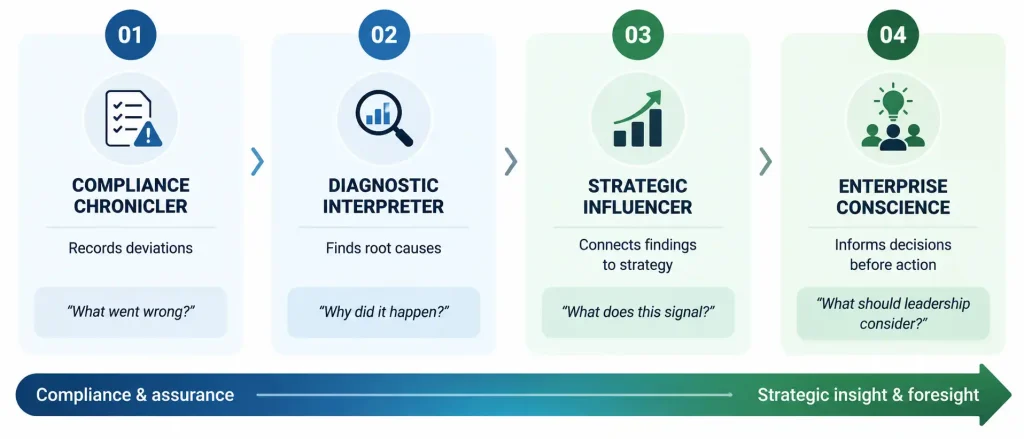
Most audit functions live somewhere between level one and level two. Few boards ask their CFOs to treat audit maturity as a deliberate program, not a byproduct of headcount.
Level One Mapping the Organization as a Silent Cartographer
Inside every company sits a map that almost no one fully understands. It records how people make decisions, how teams honor priorities, and how managers justify exceptions when urgency collides with process. A level one audit function traces this map, often without realizing that the mapping is the real value.
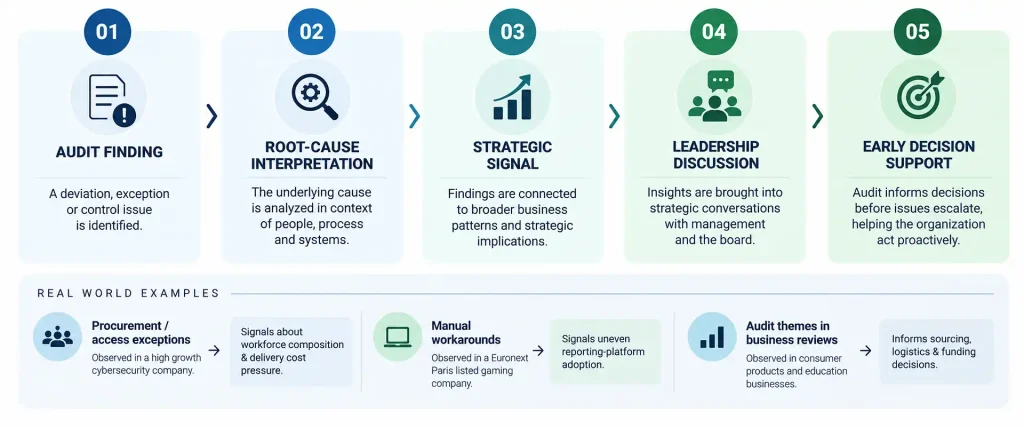
A high-growth cybersecurity and identity access management company scaled past $30M in annual recurring revenue across five country entities. In its early years, leadership treated audit exceptions there as isolated procurement or access control issues. Leadership had to move audit deliberately closer to strategic planning, instead of leaving it inside finance alone. Only then did those same exceptions start reading as signals about workforce composition and delivery cost pressure. Before that shift, the team had dismissed each one as a one-off mistake.
The shift from level one requires proximity without loss of independence. Audit gains access to the assumptions behind the plan while retaining its right to challenge those assumptions freely. A CFO who protects that balance turns an ordinary control finding into an early read on strategic drift. That read arrives long before the drift shows up in a variance report.
Level Two Diagnostic Interpretation Turns Findings into Signals
A level two audit function stops asking only whether a policy was followed and starts asking why a deviation was chosen in the first place, and what need it met that the official process could not. This is where audit becomes diagnostic instead of forensic, and where a dozen scattered observations start to resolve into a single narrative about decision velocity or system design.
At a Euronext Paris listed gaming and digital entertainment company operating across five countries, audit committee sessions ahead of an IPO readiness process were never treated as a formality. Recurring control exceptions tied to manual workarounds were read as evidence of how unevenly a new reporting platform had actually been adopted across subsidiaries, not simply as a list of items to remediate before the next filing.
This level of interpretation requires context that a checklist cannot provide. Audit needs to understand not only what the company protects, but what it is trying to become, and that understanding only arrives when audit sits inside the rhythm of strategic dialogue instead of at its edge.
Level Three Strategic Influence Moves Audit into the Boardroom
Reaching level three is less a technical achievement than a cultural one. Findings can be accurate and still change nothing if the organization treats every audit report as an interruption instead of as intelligence offered in good faith. The CFO who wants influence models it herself, treating findings as clarifying signals and not as evidence for a defense.
Four consecutive clean external audits at a $127M global consumer products company with a supply chain spanning two continents did not happen by accident, and they did not happen because problems disappeared. They happened because audit themes were discussed inside quarterly business reviews alongside inventory turns and cash conversion metrics, so that leadership started asking for audit input before major sourcing or logistics decisions instead of after a control gap surfaced. A mission driven education institution’s audit committee played a similar role, becoming a forum where funding assumptions were tested well ahead of the annual plan instead of defended after the fact.
Level Four the Enterprise Conscience Completes the Model
At level four, audit stops being a department that appears when something breaks and becomes a function the organization consults on its own initiative. Leaders begin requesting a review before launching a major initiative, treating it as preparation and not as a postmortem. This does not make audit moralistic, it makes the function attentive to the micro choices that accumulate into culture long before they ever appear on a balance sheet.
Reaching this level demands structure, not sentiment. Audit needs access to the truth without filtering or delay, and leadership needs the discipline to listen without becoming defensive. A CFO who builds forums where audit themes sit inside strategic planning, instead of at the tail end of a governance agenda, is doing the structural work that turns audit maturity into an asset the whole enterprise can draw on, especially when growth outpaces the systems built to support it.
Three Key Takeaways
- An internal audit maturity model is a deliberate program, not a byproduct of better tools, and a CFO who wants strategic value from audit has to decide which level the function should be operating at and invest accordingly.
- Diagnostic interpretation, not documentation volume, is what separates a mature audit function from an assurance checklist, and that shift only happens when audit has enough context about strategy to ask why a deviation occurred and not only whether it occurred.
- Trust is the final gate to full audit maturity, and it is built through structure instead of through memos, through recurring forums where audit themes reach leadership before decisions are made and not after problems surface.
Disclaimer: This article is intended for informational purposes only and does not constitute legal, tax, or accounting advice. You should consult your own tax advisor or counsel for advice tailored to your specific situation.
Hindol Datta is a four-time CFO and senior finance executive with over 25 years of leadership experience across cybersecurity, SaaS, gaming, logistics, digital marketing, medical devices, consumer products, and nonprofit organizations. He has led more than $120M in fundraising and over $150M in M&A transactions while building the financial and operational systems that let complex businesses scale with confidence. He is the author of seven books in the Systems CFO Series and holds active CPA, CMA, and CIA credentials.
AI-assisted insights, supplemented by 25 years of finance leadership experience.