
Executive Summary
Predictive financial reporting extends the traditional ledger into a forward-looking discipline. It combines financial forecasting, machine learning, and scenario modeling to show where the business is heading. Financial statements remain the foundation of accountability, yet their monthly cadence now lags the pace of markets.
The shift rests on a clear strategic case, a unified data architecture, and forecasts embedded in decision forums. Governance and culture then determine whether the capability lasts.
Why Traditional Financial Reporting Now Lags the Business
For decades, financial reporting has served as the authoritative ledger of corporate performance and the anchor of accountability. Its design looks backward, and by the time statements close, the decisions they could have informed are already made.
The conventional model was built for control and assumed a business that moved quarterly. Today entire markets shift within a single earnings cycle, and capital costs move with every macroeconomic signal. The gap between close and strategic relevance keeps widening, turning insight into artifact.
Predictive financial reporting answers that gap as an evolution of traditional reporting, not a replacement for it. It moves the question from what happened to what is likely to happen next, and why. Finance, in turn, shifts from historian to strategist and architect of forward signals.
The Strategic Case for Predictive Analytics in Finance
A CFO can be alerted mid-cycle that input costs will erode gross margin by 60 basis points. A board can see projected cash conversion gaps in real time, instead of EBITDA after the quarter closes. Leading firms already run these use cases, and predictive financial reporting offers three advantages:
- Decision velocity: prediction compresses the cycle between insight and action, so capital and pricing shift faster.
- Risk posture: predictive models flag where failure may occur, enabling earlier hedging and liquidity planning.
Capital efficiency: simulated returns help teams avoid overinvesting in softening markets or starving emerging ones.
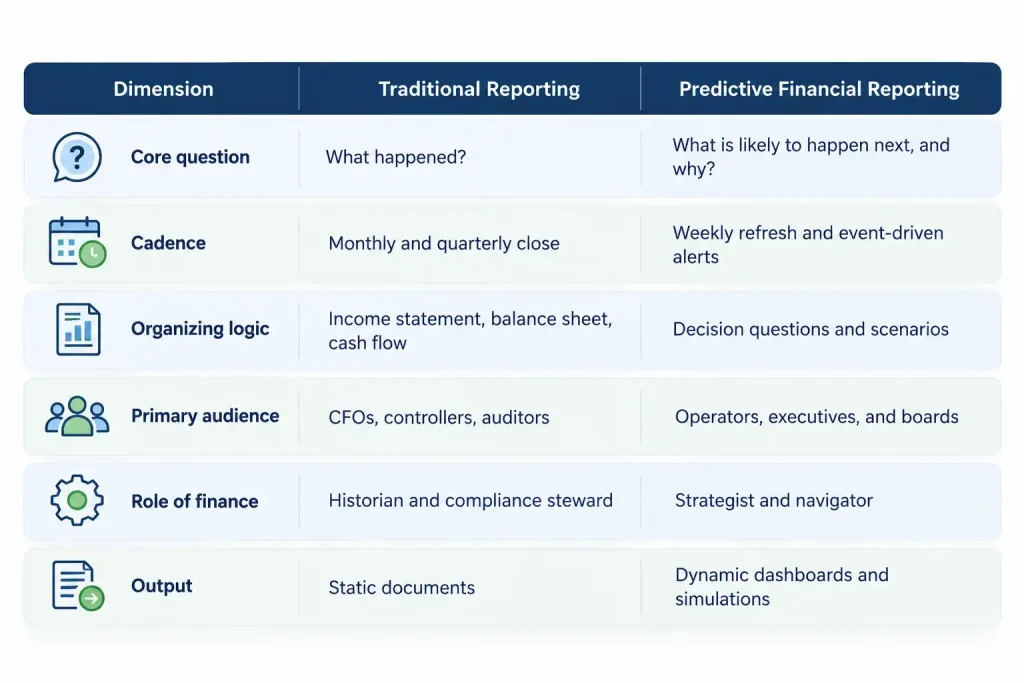
Why Adoption Remains Uneven
Despite this strong case, predictive financial reporting is not yet universal. Three forces explain most of the resistance to predictive reporting:
- Legacy systems that trap financial data in ERP platforms never designed for real-time analysis or external drivers.
- Cultural inertia rooted in the belief that data must be closed, verified, and audited before anyone can trust it.
- A perceived tension between accuracy and agility, with leaders fearing that forward-looking models will prove speculative.
These concerns are reasonable, because poor modeling produces false confidence. The remedy is to govern prediction instead of rejecting it, with transparent assumptions and forecasts tracked for accuracy. In this blended model, the general ledger remains the source of truth, and predictive tools become the source of anticipation.
Building the Data Architecture for Predictive Financial Reporting
No prediction is better than its data, and no insight helps if it arrives late. Predictive financial reporting therefore begins by unifying ledger, operational, customer, and market data in a modern warehouse. Governed pipelines, not spreadsheets, provide the trust and traceability that finance requires.
At a publicly listed gaming company operating across five countries, a firmwide Oracle Financials rollout created one definition of revenue. Statutory reporting cycles shortened, and no forward model would have been credible before that foundation existed.
Financial Forecasting Models and Their Monitoring
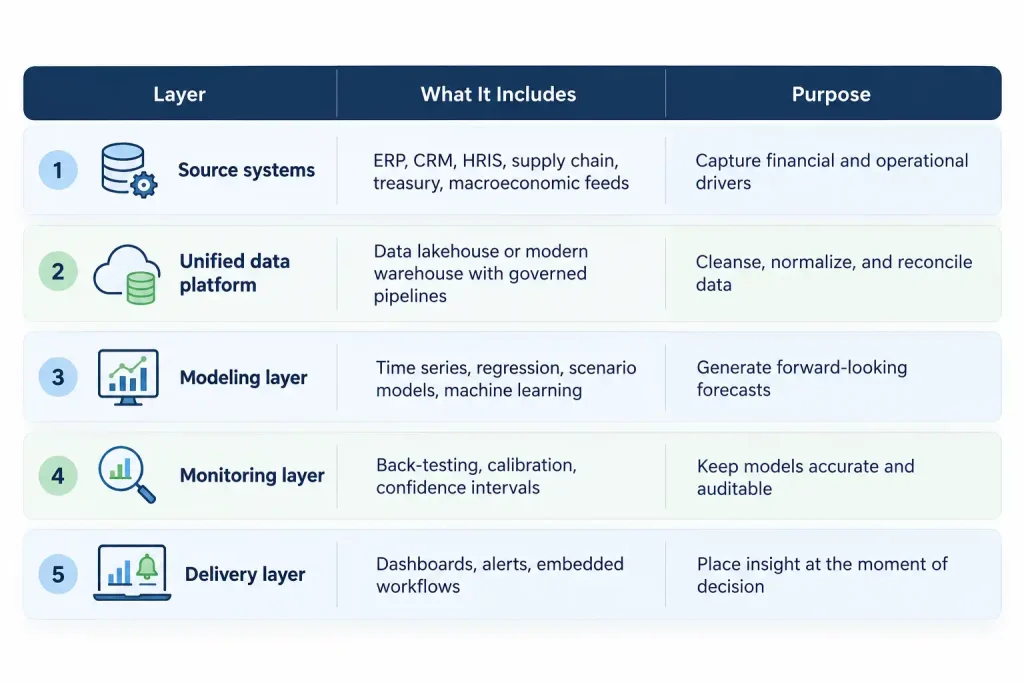
Once data is unified, financial forecasting models estimate revenue, costs, liquidity, and working capital as evolving outlooks. A model tying inventory to supplier delays and regional demand might flag a $2M sales risk next quarter. A traditional month-end close would never surface that kind of insight.
Platforms such as Azure ML, Anaplan, and Oracle EPM can support this work, though governance matters more. Models need back-testing and calibration, just as audited financials need reconciliation. At a $30M ARR cybersecurity SaaS company, a driver-based forecasting engine held actuals within 5% of forecast for 8 consecutive quarters.
People, Cadence, and Embedded Workflows
The infrastructure is human as well as technical, and it calls for new roles:
- Data scientists who build and maintain forecasting models.
- Analytics translators who align model logic with business questions and interpret results.
- Model governance leads who ensure forecasts are refreshed and updated responsibly.
Forecasts should refresh weekly or biweekly, and delivery must live inside workflows. A projected cash shortfall six weeks out should trigger an alert that starts short-term borrowing analysis. Prediction without integration is only noise, while integrated intelligence becomes action. Enterprise-grade security and controls must hold across every layer of the architecture.
Embedding Predictive Financial Reporting into Enterprise Decisions
The value of predictive intelligence lies in better decisions, not technical elegance. Strategic decisions emerge in recurring venues such as capital committees, quarterly business reviews, and pricing councils. If forecasts do not earn trust in those rooms, they remain peripheral, however sophisticated they may be.
Predictive financial reporting must therefore be organized around questions instead of functions. What will margin look like under alternative pricing models? How will rising rates affect debt coverage in six months? Where is the next liquidity constraint likely to emerge? A CFO reviewing discretionary spend should see how a three-month hiring delay changes cash runway under pessimistic revenue.
Bringing Forecasts into Planning and Capital Decisions
Top-performing organizations build predictive logic into quarterly reviews and rolling forecasts. Sales leaders see what the model suggests based on lead velocity and conversion cycles. When variance arises, discussion shifts from blame to investigation: is the model outdated, or are early signals appearing that it missed?
Capital committees can weigh simulated cash flows and return distributions, replacing single-scenario NPV calculations. If unit costs are predicted to rise 5% on raw material trends, procurement can renegotiate early. At a $127M global consumer products company, demand planning and SKU rationalization lifted inventory turns from 3x to 7x.
From Calendar-Driven to Threshold-Driven Reviews
Predictive financial reporting lets companies replace calendar rituals with event-driven reviews:
- A sudden deviation in forecasted working capital triggers a real-time cash flow huddle.
- A 10% change in forecasted unit economics triggers a pricing discussion.
- A rise in predicted churn probability triggers targeted customer success interventions.
Boards now expect simulations and risk sensitivity, not static packets of trailing data. At a mission-driven education and research institution, board discussions sharpened once funding scenarios under variable philanthropic conditions replaced single-point projections. Models will still miss surprises, so the goal is preparedness, and teams should treat models as decision aids, not oracles.
Governance and Culture That Sustain Predictive Finance
Predictive finance is a transformation, not a plug-in, and it endures only when it becomes institutional. The durability of predictive financial reporting rests on four pillars:
Model governance council: a cross-functional group from finance, technology, operations, and risk that validates assumptions and tracks accuracy.
- Model ownership: every forecast has an owner accountable for its logic, calibration, and business utility.
- Shared literacy: financial literacy for operators and analytical literacy for finance, so everyone can reason in ranges.
- Existing forums: predictive views sit beside actuals in current monthly reviews, not in new reporting layers.
Culture is the subtlest factor, and often the most decisive one. Waiting for perfect information often costs more than acting on directional truth. Early forecast errors should prompt calibration, and transparent assumptions earn trust.
When executives cite scenario analyses in board discussions, they signal that this is how the business now runs. KPIs expressed as ranges turn prediction into a tool instead of a threat. Financial reporting is not going away, but it is growing up. Done with rigor, predictive financial reporting becomes a compass for decisions still to come.
Three Key Takeaways
- Predictive financial reporting complements the general ledger without replacing it. The ledger remains the source of truth, while financial forecasting models become the source of anticipation.
- Credibility is decided by architecture, since unified data, governed pipelines, and routinely back-tested models separate trustworthy forecasts from false confidence.
- Forecasts create value only inside the forums where capital, pricing, and risk decisions are made. Clear model owners and a culture that rewards learning keep them there.
Disclaimer: This article is intended for informational purposes only and does not constitute legal, tax, or accounting advice. You should consult your own tax advisor or counsel for advice tailored to your specific situation.
Hindol Datta is a four-time CFO and senior finance executive with over 25 years of leadership experience across cybersecurity, SaaS, gaming, logistics, digital marketing, medical devices, consumer products, and nonprofit organizations. He has led more than $120M in fundraising and over $150M in M&A transactions while building the financial and operational systems that let complex businesses scale with confidence. He is the author of seven books in the Systems CFO Series and holds active CPA, CMA, and CIA credentials.
AI-assisted insights, supplemented by 25 years of finance leadership experience.