
Executive Summary
Financial stewardship is not enforced from above. It becomes a shared organizational instinct that values long-term care over short-term gratification. This article explains how leadership models fiscal behavior. It covers how incentives and decision rights reinforce it, how systems make it durable, and how it becomes the foundation for innovation and growth.
Discipline is not the opposite of ambition. Readers will find the leadership behaviors that set the tone and the incentive design that sustains it. The article also covers the planning infrastructure that scales stewardship and the reasoning that makes it an enabler of bold decisions.
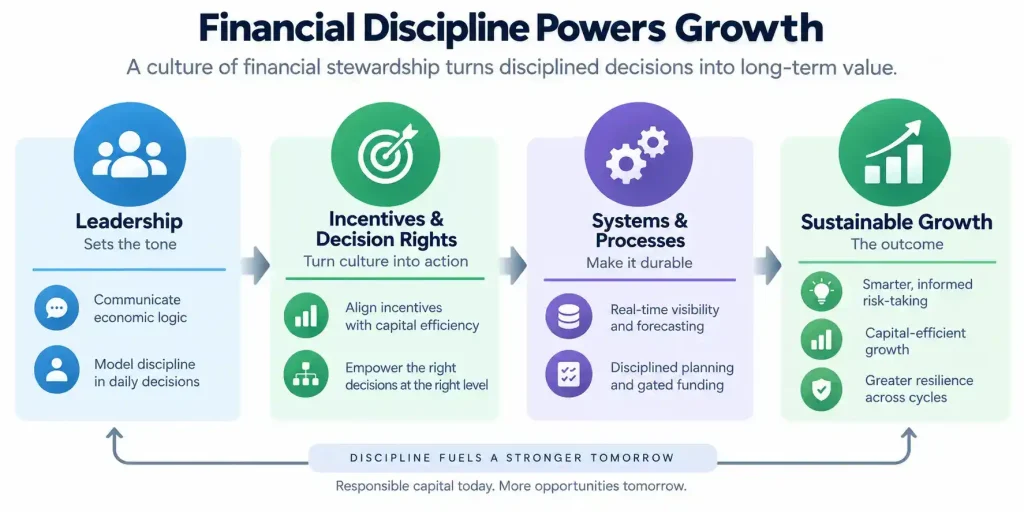
Leadership as the First Lever of Financial Stewardship
Culture does not form in policy documents. It forms in behavior, shaped most powerfully by how leaders act when no one is auditing the choice. Organizations with enduring financial stewardship share a trait: leaders model restraint and economic clarity in daily decisions, treating capital as seriously as reputation.
Communication and Clarity
Financial storytelling changes behavior more than raw numbers do. Consider when leaders explain why an attractive expansion was declined. It was not because the deal was infeasible. Its return simply fell short of the hurdle rate. This teaches the organization to think in capital-adjusted logic. These are cultural signals as much as rational decisions.
Financially disciplined cultures avoid euphemism. They do not dress up inefficiency as investment. They do not excuse underperformance as strategic patience. When leaders explain why capital flows to one line and not another, people learn to treat capital as earned, not limitless.
Modeling and Narrative
Clarity must pair with behavior. A CFO who insists on procurement rigor while approving inflated budgets undermines every initiative beneath that decision. Financial stewardship starts in small moments, such as declining unnecessary travel or enforcing a budget reallocation even when it is politically uncomfortable.
How wins and losses get narrated reinforces the same message. Teams that hit targets while holding fixed costs flat deserve recognition for how they won. That recognition should not stop at the fact that they won. Teams that miss targets but show rigorous cost control should also be acknowledged. Outcomes are judged through the lens of stewardship, not only the scoreboard.
Budgeting itself becomes a dialogue about return on capital. It stops being a tug-of-war between inflated forecasts and blind cuts. Leaders should ask what the unit economics of a given spend are and what measurable outcomes justify it. How leadership handles windfalls and shortfalls matters just as much. A stronger-than-forecast quarter should not trigger automatic spending. A shortfall should not lead to deferred cost discipline under pressure.
Language does real work here. A leader who speaks consistently about cash conversion and return on investment sends a signal. The organization should think like an owner, not a budget manager. None of this means avoiding risk. The most disciplined cultures often take the boldest bets. Those bets carry full understanding of risk and capital cost. Leadership’s task is to show that taking a risk is acceptable while wasting capital is not.
Aligning Incentives and Decision Rights with Financial Stewardship
Incentives and decision rights are the instruments that tune the rest of the organization once leadership sets the tone. Without this alignment, culture stays aspirational rather than operational.
Incentive Design
Compensation structures carry a deeper signal about what an organization truly values. Financial stewardship requires incentives that reward how outcomes are achieved, not only the outcomes themselves. This shifts emphasis from absolute growth to capital-efficient growth.
| Incentive focus | Risk if misaligned | Better anchor |
| Revenue alone | Thin-margin deals, deep discounting | Gross margin or net cash impact |
| Budget absorption | Spending to avoid losing next year’s budget | Value created per dollar spent |
| Headline growth | Capital spread too thin | Return on capital employed |
| Project launches | Ideas funded that never get retired | Milestone-based, gated funding |
A sales team paid purely on revenue may push thin-margin deals or stretch payment terms to hit targets. A team rewarded on gross margin or cash impact becomes a commercial steward instead. The same logic extends to R&D, marketing, and operations.
Decision Rights and Self-Regulation
Financial stewardship also requires clear decision rights. Financial authority often gets scattered across business units, finance, and strategy. Confusion and mistrust follow. In disciplined organizations, the person who owns the outcome also owns the spend and is accountable for the economic logic behind it.
Investment committees that vet material expenditures work as forums for alignment, not bureaucratic bottlenecks. A project must be defended to peers and not only to finance. Rolling forecasts paired with scenario thinking train teams to plan ahead. What would they cut if revenue declined? What would they accelerate if opportunity arose? A zero-based mindset, applied periodically rather than every cycle, reminds teams that no expense is sacred and entitlement is not strategy.
Compensation systems should also reward the person who says no, since deferring an overpriced acquisition or returning unspent budget is foresight and not failure. Real-time dashboards that show spend against plan let teams self-regulate, shifting the culture from compliance to ownership.
Systems and Cadence That Make Financial Stewardship Durable
Culture lives in infrastructure and not only in intention. Without systems to reinforce good behavior, financial stewardship becomes episodic rather than institutional.
Planning Cadence and Simplicity
Financially mature organizations treat planning as a continuous process rather than a one-time event, using rolling forecasts anchored in current performance and market signals. Deviations from plan become signals to interpret early rather than surprises to react to.
Time alignment matters as well. Business units often request resources quarterly while finance reviews monthly and the board thinks annually. That mismatch produces reactive decisions. Synchronizing these rhythms turns time into a lever of control instead of a cost. A well-designed enterprise performance management system integrates with ERP and CRM data. It lets finance simulate scenarios and test investment cases dynamically, not only track history.
Discipline also depends on simplicity. High-performing companies track a few core indicators tied to strategy, such as cash conversion cycle or return on invested capital. They do not try to track everything. Complex approval processes and bloated reports obscure control instead of enforcing it.
Gates, Variance, and Benchmarking
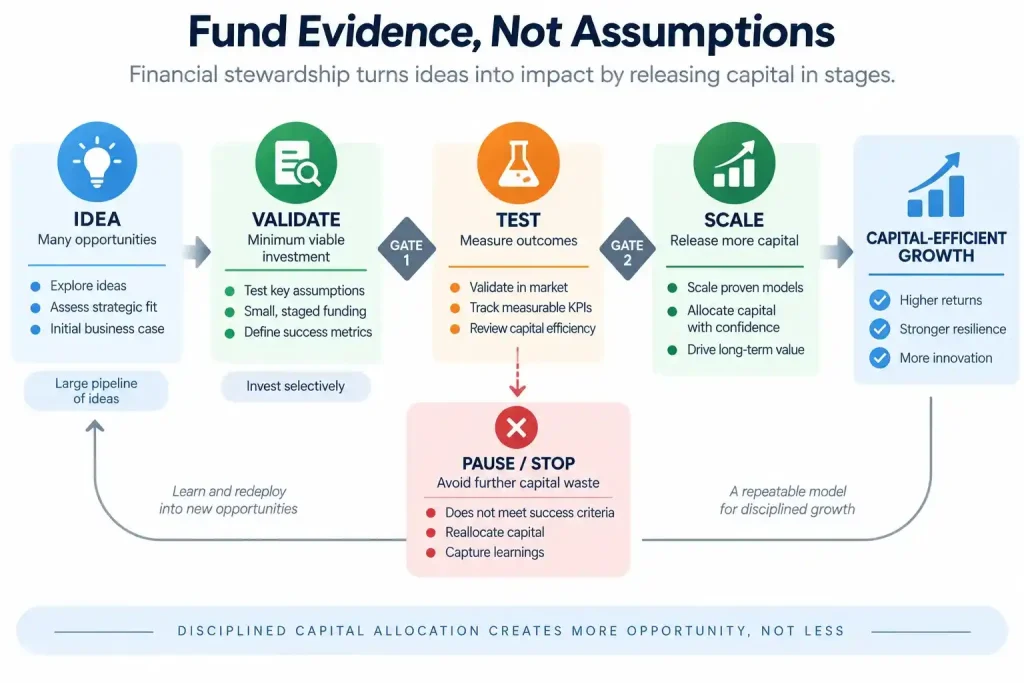
Milestone-based, gated funding releases capital in stages contingent on results. This lets teams course-correct or pause without shame. Variance analysis should focus on causality. Did a budget line run over due to timing, pricing, or execution? The answer should be treated as learning, not punishment.
External benchmarking against peers and historical performance provides context that internal numbers alone cannot. At a mission-driven education institution, disciplined monthly and annual board reporting gave leadership continuous visibility into financial health. Audit committee engagement reinforced the same benchmarked rigor. Technology, including AI-driven analytics that flag unusual spending, elevates these practices, but judgment still decides what the tools surface.
Financial Stewardship as the Foundation for Innovation and Growth
Financial stewardship is often mistaken for the enemy of innovation. The more accurate view is that it is the structure that lets innovation flourish without recklessness, turning risk into strategy rather than speculation.
Stage-Gated Innovation and Opportunity Cost
Without discipline, innovation efforts scatter across too many pilots with capital spread thin and no clear return. With financial stewardship embedded, teams ask what outcome they are trying to achieve and what the minimum viable investment is to validate a concept.
Stage-gated funding ties capital release to performance milestones instead of greenlighting a large spend upfront. This reduces waste, creates urgency, and lets leadership distinguish ideas that deserve scale from those that were only compelling on paper. Risk-taking benefits from the same structure. Treasury can model liquidity stress tests. Strategy teams can quantify optionality. This makes risk knowable and debatable rather than eliminating it.
Opportunity cost discipline raises the bar further. In firms without this mindset, a project gets funded if it looks good enough on a loose ROI estimate. In disciplined firms, every dollar deployed must outperform the alternative use, whether that is debt paydown or reinvestment in core capabilities. The question shifts from whether an idea is good to whether it is the best use of that capital relative to every alternative.
Culture, Resilience, and Enterprise-Wide Effect
Financial stewardship also governs the full life cycle of innovation. Successful pilots scale, and ideas kept alive only by political inertia get shut down without shame. When teams trust that capital is allocated on merit, risk becomes shared rather than personal, and failure becomes a lesson rather than a liability.
This discipline shows its value most clearly in downturns. Organizations that know their breakeven points and hold capital buffers can invest while others retreat. They reposition instead of merely surviving. The effect also cascades outward. Marketing teams link spend to customer lifetime value, and product teams measure features against usage. Financial stewardship becomes an enterprise-wide discipline, not a finance-only one.
Three Key Takeaways
- Model financial stewardship through leadership behavior and language, since teams mirror the tradeoffs leaders explain and the restraint they show in daily decisions.
- Align incentives and decision rights so that capital-efficient outcomes, not just volume, earn reward, and give the person who owns the outcome the authority over the spend.
- Build planning cadence, visibility, and gated funding into systems so that financial stewardship becomes durable infrastructure that also enables bolder, better-informed risk-taking.
Disclaimer: This article is intended for informational purposes only and does not constitute legal, tax, or accounting advice. You should consult your own tax advisor or counsel for advice tailored to your specific situation.
Hindol Datta is a four-time CFO and senior finance executive with over 25 years of leadership experience across cybersecurity, SaaS, gaming, logistics, digital marketing, medical devices, consumer products, and nonprofit organizations. He has led more than $120M in fundraising and over $150M in M&A transactions while building the financial and operational systems that let complex businesses scale with confidence. He is the author of seven books in the Systems CFO Series and holds active CPA, CMA, and CIA credentials.
AI-assisted insights, supplemented by 25 years of finance leadership experience.