
Executive Summary
Finance teams often reduce capital structure optimization to a spreadsheet exercise. They tune a ratio until the weighted average cost of capital reaches its lowest point. In practice, the mix of debt, equity, and hybrid instruments a company carries expresses something larger. It reflects priorities, risk appetite, and an obligation to the shareholders who fund its ambition. A balance sheet aligned with cash flow becomes an engine for long-term value. It grows stronger still when flexible enough to absorb shocks and built around a deliberate view of cost of capital. An inherited, outdated, or politically untouchable balance sheet does the opposite. It erodes performance quietly, year after year, until the erosion becomes impossible to ignore.
This article moves beyond the arithmetic of leverage ratios and into the discipline required to design, execute, and sustain a capital structure that actually serves the business it finances. It draws on lessons from finance leadership roles spanning cybersecurity, consumer products, gaming, and mission-driven organizations, where capital structure optimization was never a theoretical exercise but a live constraint on what the business could become.
Capital Structure Optimization Begins with Purpose, Not Precedent
Every company inherits its early capital structure from necessity rather than design. Founders fund the first stage with savings, friends, and early revenue. A bank line follows, then perhaps venture capital or mezzanine debt. These choices are rarely strategic in the moment; they are simply what was available. As a company matures, however, the opportunity arises to convert that inherited structure into something intentional, and this is where capital structure optimization becomes a discipline rather than a historical accident.
There is no universal answer to what an optimal capital structure looks like, because the right structure depends entirely on the cash flow profile, growth trajectory, and risk tolerance of the specific business. A capital-light software company with recurring revenue and high margins can absorb meaningfully more leverage than a cyclical manufacturer with thin margins and volatile demand. In one high-growth cybersecurity and identity access management environment carrying approximately $30M in annual recurring revenue across five countries, the forecasting engine and capacity model built from the ground up held actuals within plus or minus five percent of plan for eight consecutive quarters. That predictability, not the capital structure alone, was what gave the business room to negotiate financing on its own terms rather than under duress.
The Foundational Elements Worth Revisiting
Boards and management teams tend to conflate familiarity with prudence, treating a legacy structure as safe simply because it has not yet failed. A disciplined review typically covers the following:
- Common and preferred equity, and the dilution and governance rights attached to each
- Short-term and long-term debt, including covenant structure and refinancing risk
- Convertible instruments and the optionality they create or surrender
- Leases and contingent liabilities that behave like debt without appearing as debt
- Working capital facilities, such as asset-based revolvers, and how they interact with long-term debt capacity
A revolver that tightens in a downturn while long-term debt sits fully drawn does not represent a failure of leverage. It represents a misalignment between the source of capital and the need it existed to serve.
Cost of Capital, Leverage, and the Case for Capital Structure Optimization
Every conversation about financing eventually returns to a single question: does this decision lower or raise the cost of capital, and does it move the company closer to the shareholder value it exists to create. Debt, deployed carefully, amplifies return on equity by concentrating earnings across a smaller equity base. Equity extends the company’s time horizon and preserves strategic freedom, but it dilutes ownership and depresses per-share metrics when issued without a clear rationale. Neither instrument is inherently superior; the balance must shift with the business model and the macro environment.
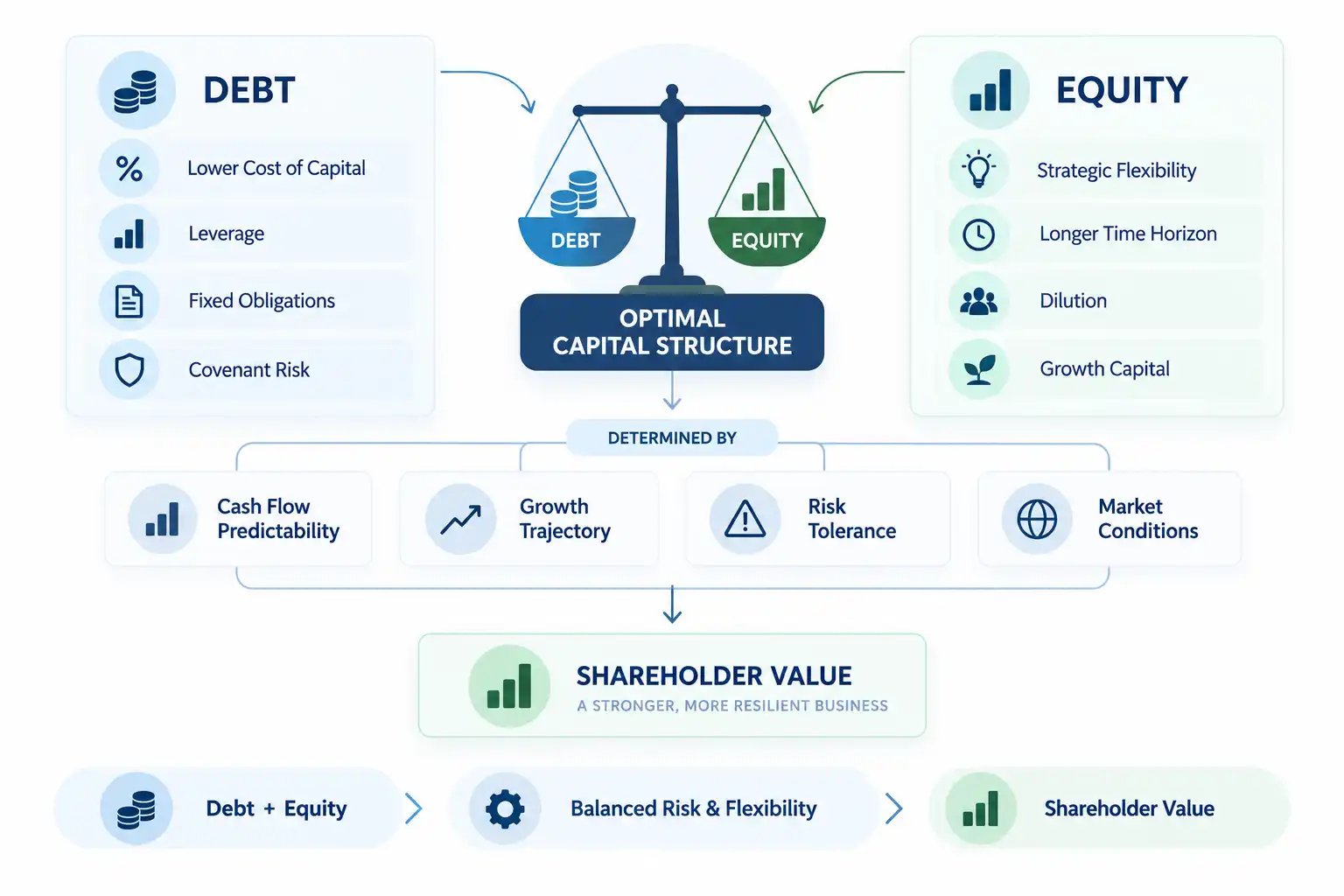
| Dimension | Debt-Heavy Structure | Equity-Heavy Structure |
| Time horizon | Compresses; urgency to generate cash | Extends; more room to invest and wait |
| Return on equity | Can be amplified through leverage | Diluted across a larger equity base |
| Risk in downturn | Covenant and refinancing exposure | Lower fixed obligation, more resilience |
| Investor appeal | Income-focused, yield-seeking investors | Growth-focused, long-term capital allocators |
| Strategic optionality | Constrained by fixed obligations | Preserved, at the cost of ownership |
The weighted average cost of capital is not a static number pulled from a model. It reflects how investors perceive the company’s risk, governance, and cash flow predictability, and a disciplined capital structure lowers that perceived risk directly. In a $127M global consumer products business with distribution across direct-to-consumer, Amazon, and wholesale channels, inventory turns more than doubled from three times to seven times through demand planning and SKU rationalization, releasing trapped working capital that reduced reliance on external financing and improved the effective cost of capital across the balance sheet. A $12M growth facility secured during that period carried better terms precisely because the underlying working capital discipline had already de-risked the credit story.
Equity raises tell a similar story about timing and credibility. A venture-backed digital marketing organization that scaled revenue from $9M to $180M in twenty-four months raised $36.5M across three funding rounds, and each round depended less on the size of the ask than on the credibility of the customer acquisition cost, lifetime value, and contribution margin discipline behind it. Capital markets do not reward ambition on its own; they reward ambition that arrives with evidence.
Executing a Capital Structure Transformation Under Real Market Conditions
Knowing what the right capital structure should look like and having the resolve to build it are two different things. A transformation touches lenders, equity investors, employees, and rating agencies simultaneously, and it rarely proceeds on a tidy timeline. The process begins with narrative rather than numbers: why this structure, why now, and why the current approach can no longer serve the strategy ahead. A shift toward long-term debt should be framed as a commitment to stability and growth investment, not as a transaction for its own sake.
Instrument selection is part financial modeling and part negotiation. Senior unsecured debt tends to be cheaper but carries stricter covenants. Convertible debt offers flexibility at the cost of future dilution. Preferred equity can bridge the gap but may signal distress if positioned poorly. In a Euronext Paris-listed gaming and digital entertainment company operating across five countries, more than $100M in cross-border mergers and acquisitions required an S-1 and IPO-readiness process involving investment bank underwriters and Big Four auditors, alongside a firmwide Oracle Financials and MicroStrategy rollout that created a single definition of revenue across every subsidiary. None of that infrastructure existed to satisfy auditors alone; it existed because credible capital structure decisions require a reporting environment that lenders and investors can trust without qualification.
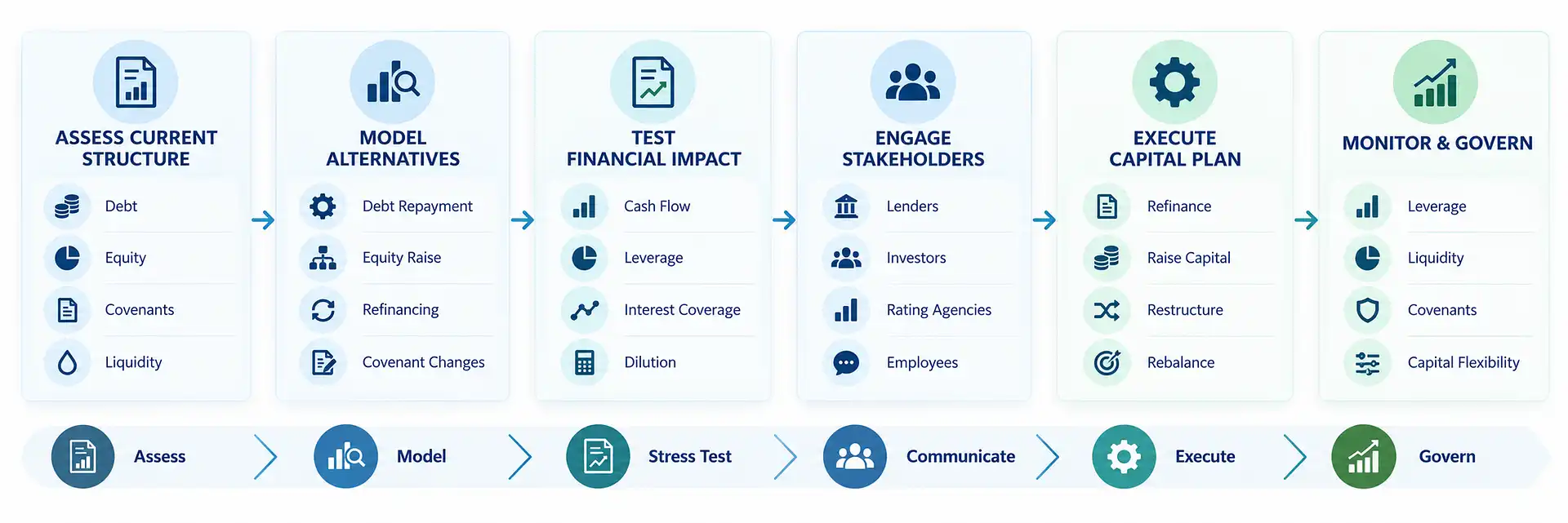
Execution also demands sequencing discipline. Practical steps typically include:
- Modeling how a debt repayment, equity raise, or covenant renegotiation ripples through financial statements, tax positions, and incentive plans
- Engaging lenders early on how leverage changes affect coverage ratios and covenant headroom
- Briefing rating agencies with proactive sensitivity analysis rather than waiting for their questions
- Communicating with equity-compensated employees so dilution or restructuring does not read as instability
- Maintaining shelf registrations and lender relationships in advance of the market window, not during it
Sustaining Capital Discipline After the Restructuring Is Complete
Transformation is the easier half. Sustaining the discipline that produced it is where most organizations drift, not from ignorance but from the accumulated pressure of growth, competition, and internal politics. Discipline that depends on a single champion is fragile; discipline embedded in governance, policy, and planning cadence survives leadership transitions and market cycles alike.
A mission-driven education and research institution that raised $37M in equity and venture debt structured its capital stack with full ownership of the investor narrative, board relationships, and audit committee engagement, while simultaneously running finance, HR, IT, legal, and facilities as a single operational mandate. That breadth is not unusual in lean organizations, and it illustrates why capital structure governance cannot be confined to a finance department operating in isolation. Sustaining the benefits of a transformation typically requires:
- A regular cadence of board-level review covering leverage tolerance, not just quarterly financial results
- Internal guardrails on target leverage ratios, liquidity minimums, and repurchase thresholds
- A post-investment review process for major financings and acquisitions, focused on learning rather than blame
- Real-time visibility into leverage, interest coverage, and liquidity, rather than static quarterly snapshots
- Consistent, principle-based communication with capital markets, even when short-term results vary
Three Key Takeaways
- Capital structure optimization has no universal template; the right mix of debt and equity must be calibrated to the specific cash flow profile, growth trajectory, and risk tolerance of the business rather than copied from precedent or convention.
- The cost of capital is shaped as much by perceived risk, governance quality, and reporting credibility as it is by market rates, which means operational discipline in areas like working capital and forecasting accuracy directly lowers the price a company pays for its financing.
- A capital structure transformation is not complete at signing; it survives only through embedded governance, board-level review cadence, and internal guardrails that keep discipline institutional rather than dependent on any single leader.
Disclaimer: This article is intended for informational purposes only and does not constitute legal, tax, or accounting advice. You should consult your own tax advisor or counsel for advice tailored to your specific situation.
Hindol Datta is a four-time CFO and senior finance executive with over 25 years of leadership experience across cybersecurity, SaaS, gaming, logistics, digital marketing, medical devices, consumer products, and nonprofit organizations. He has led more than $120M in fundraising and over $150M in M&A transactions while building the financial and operational systems that let complex businesses scale with confidence. He is the author of seven books in the Systems CFO Series and holds active CPA, CMA, and CIA credentials.
AI-assisted insights, supplemented by 25 years of finance leadership experience.