
Executive Summary
Strategic treasury management turns cash from a passive reserve into an active lever of competitive advantage. It shapes pricing power, funding speed, and risk-adjusted returns. It does more than confirm solvency. This article explains how CFOs can move treasury from reactive control to capital architecture.
Capital efficiency and optimization depend on real-time visibility, dynamic tools, and tight integration with strategy. Readers will find the mindset shift that starts this transformation, the technologies that make liquidity intelligent, how treasury should sit inside capital decisions, and the governance that makes the capability durable.
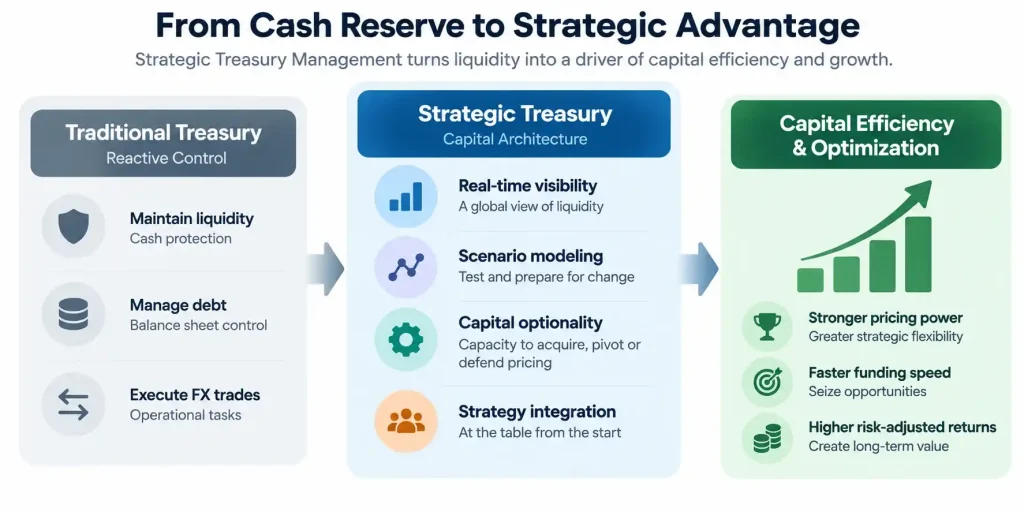
From Reactive Control to Strategic Treasury Management
Before strategic treasury management took hold, treasury existed mainly to maintain liquidity, manage debt, and execute FX trades. These tasks matter, but they are defensive. They are also tied to past conditions. Markets now move in minutes, and this model is no longer enough. The real question is not whether treasury can execute. It is whether treasury can lead.
Redefining the Purpose of Cash
Strategic treasury management starts with a mindset shift. Liquidity moves from insurance to leverage. Every dollar on the balance sheet should be assessed for optionality, not only security. Does it create the capacity to acquire, pivot, or defend pricing in a downturn?
This requires capital intelligence embedded into daily workflows. Cash forecasts become dynamic, probability-weighted curves. They replace static outputs from a budget variance model. A global industrial firm modeling working capital across five commodity price scenarios treats cash planning as active design. It is not hindsight reporting.
Capital efficiency and optimization also depend on proactive capital structure decisions. Treasury should continuously weigh debt against equity under different macro regimes. It should time refinancing or repurchase programs against forecast risk. A company with high operational leverage might reduce financial leverage preemptively. This is not because a ratio demands it, but because treasury forecasts signal compounding risk if revenue softens.
Partnering with Corporate Development
Treasury should sit at the table when capital deployment is first considered. It should not wait until financing is needed. Capital heatmaps that show return curves and liquidity impact for potential M&A let strategy teams weigh balance sheet implications alongside strategic fit.
Real-time visibility underpins this capacity to act. Static weekly cash reports are functionally obsolete once operations span multiple currencies and time zones. Platforms that consolidate accounts globally let a CFO see the liquidity picture at hour-close rather than month-close.
In one case, a mid-sized technology firm executed a counter-cyclical acquisition during a brief window of valuation compression. Strategy did not simply move faster than competitors. Treasury had pre-cleared the funding mechanics and modeled the FX impact in advance. This is treasury acting as strategic enabler, not process executor.
Tools That Turn Liquidity Into a Capital Efficiency and Optimization Lever
Liquidity has velocity. The speed at which it moves defines how well a company seizes opportunity and defends its position. A modern treasury does not simply track liquidity. It choreographs it.
Visibility, Forecasting, and FX
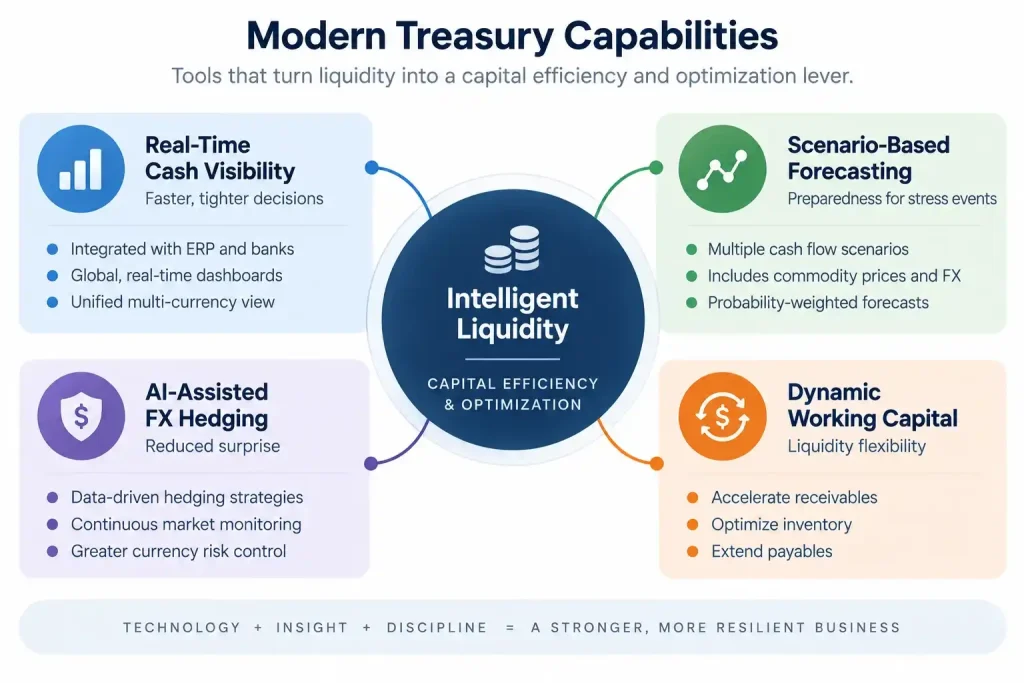
Legacy environments deliver delayed, fragmented cash views. These hide the true position for days or weeks. Systems integrated with ERP and banking APIs produce real-time dashboards instead. This reduces uncertainty and lets treasury run tighter with less idle cash.
Scenario-driven forecasting extends this further. Treasury models integrate commodity prices and FX volatility to simulate multiple cashflow paths, rather than extrapolating from history alone. Firms with pre-built liquidity stress models drew credit lines early during the COVID-19 disruption. That advantage came from modeled foresight, not luck.
| Capability | What it replaces | Strategic benefit |
| Real-time cash dashboards | Delayed, fragmented reports | Faster, tighter decisions |
| Scenario-based forecasting | Static, history-only models | Preparedness for stress events |
| AI-assisted FX hedging | Quarterly forward contracts | Reduced surprise, not just reduced risk |
| Dynamic working capital tools | Fixed vendor terms | Liquidity without harming relationships |
FX risk management benefits from the same shift. Static quarterly hedging often fails to respond to real volatility. Advanced systems model exposure continuously and can automate hedging actions against defined thresholds.
Governance Around Automation
Automation does not remove human judgment. It amplifies it. Parameters, escalation paths, and exception thresholds still need clear definition. Cash sweep programs should carry minimum liquidity floors. FX algorithms should operate within approved corridors. Governance is what separates innovation from recklessness.
Strategic treasury management also shapes creditworthiness and investor perception. A firm that demonstrates intelligent cash management is often seen as lower risk, even at higher leverage. This can lower borrowing costs.
Integrating Strategic Treasury Management with Enterprise Strategy
Capital velocity is the ability to turn insight into action with minimal friction. Precision means matching capital to opportunity at the right time and amount. When treasury is tightly integrated with strategy, it accelerates velocity and sharpens precision at once.
Earlier Involvement in Capital Decisions
Annual capital budgeting often treats treasury reactively. It confirms assumptions and funding capacity after the fact. Earlier involvement changes the conversation entirely. Capital allocation maps and live dashboards showing deployable capacity convert capital from a passive resource into a differentiator.
Corporate development benefits from the same shift. When treasury sits at the table early in M&A discussions, it can assess bid flexibility and simulate post-transaction liquidity impact. Across several such transactions, the difference between winning and losing a deal has often come down to confidence in close certainty rather than price. Treasury models how to digest a deal, not only how to pay for it.
Procurement, Capital Returns, and Risk
Treasury’s reach also extends to procurement and supply chain terms. Vendor payment cycles and inventory buffers shape operational liquidity. Treasury can model how changing terms affects free cash flow. A firm facing supplier concentration risk might fund early payment programs through low-cost treasury lines to protect continuity. This is capital orchestration, not simple cost-cutting.
Capital return decisions, including dividends and reinvestment, rest on the same analytical foundation. How much cash is structurally excess? How do future obligations affect flexibility? Treasury’s most forward-looking role may be in enterprise risk management, where modeling liquidity under stress functions as an early warning system for the board.
Institutionalizing Strategic Treasury Management for Lasting Capital Efficiency and Optimization
Capital efficiency and optimization cannot rest on one strong treasurer. A treasury function built that way will not sustain its advantage. Neither will a single technology purchase. Strategic treasury management becomes durable only when it turns into a system, reinforced through governance and repeatable process.
Mandate, Process, and Talent
Institutionalization begins with a clear mandate. Treasury should be recognized as the orchestrator of capital strategy. It should be seated in planning cycles and investment reviews from the start. This mandate belongs in operating models and enterprise KPIs, reinforced by the CFO.
Liquidity forecasts need repeatable, data-driven processes rather than tribal knowledge. They should pull from receivables, payables, and FX exposures with standardized variance explanations. Talent development matters just as much. Treasury professionals need financial fluency and data literacy. They also need the strategic judgment to engage executives on capital trade-offs. Rotational programs across FP&A, strategy, and investor relations can help build that judgment.
Governance Forums and Feedback Loops
A cross-functional capital council gives capital allocation decisions a consistent forum. It is typically chaired by the CFO, with treasury, FP&A, corporate development, and risk represented. Treasury’s role there is to interpret how choices affect financial flexibility, not only to report figures.
The most resilient organizations build treasury strength during calm periods, not only in a crisis. They develop playbooks for capital deployment and simulate downturn scenarios in advance. Consistent communication with rating agencies and lenders reinforces this readiness. Post-mortems on missed windows or failed hedges turn experience into capability.
At a mission-driven education institution, disciplined monthly and annual board reporting gave leadership durable visibility. Audit committee engagement reinforced the same repeatable rigor that a capital council provides in a larger enterprise.
Three Key Takeaways
- Shift treasury from liquidity insurance to strategic capital architecture by embedding scenario modeling and optionality into every cash decision.
- Invest in real-time visibility, scenario-based forecasting, and governed automation to make capital efficiency and optimization a daily discipline.
- Institutionalize strategic treasury management through a clear mandate, a capital council, talent development, and feedback loops that outlast any one crisis or leader.
Disclaimer: This article is intended for informational purposes only and does not constitute legal, tax, or accounting advice. You should consult your own tax advisor or counsel for advice tailored to your specific situation.
Hindol Datta is a four-time CFO and senior finance executive with over 25 years of leadership experience across cybersecurity, SaaS, gaming, logistics, digital marketing, medical devices, consumer products, and nonprofit organizations. He has led more than $120M in fundraising and over $150M in M&A transactions while building the financial and operational systems that let complex businesses scale with confidence. He is the author of seven books in the Systems CFO Series and holds active CPA, CMA, and CIA credentials.
AI-assisted insights, supplemented by 25 years of finance leadership experience.