
Executive Summary
Most executive performance metrics reward momentum rather than mastery. Executives often treat EBITDA, revenue growth, and total shareholder return as proof of strategic skill. Macro tailwinds, buybacks, or short-term opportunism dressed up as foresight frequently produce those same numbers. A sound executive KPI framework has to reach further than the quarterly print. It must capture the invisible work of stewardship and the culture that attracts talent. It must also account for the disciplined exits from failing bets and the decisions that widen optionality years out.
This article walks through five practitioner lessons for rebuilding executive performance metrics. The lessons are drawn from finance leadership across cybersecurity, consumer products, gaming, education and digital marketing. It closes with takeaways for boards and compensation committees. The goal is measurement systems that reward what endures, not what merely glitters this quarter.
Why Traditional Executive Performance Metrics Fall Short
Profitability, growth and return on capital made sense when businesses were industrial and locally bound. Today, value accrues from brand, data and culture. The old metrics have not died so much as become insufficient, and occasionally misleading.
Momentum Mistaken for Mastery
A revenue beat can come from deferred expense recognition. An EPS print can come from buybacks rather than operating strength. A McKinsey study found that over 70 percent of executives believe long-term value creation is a top priority. Yet only 13 percent say their organization’s metrics reflect that emphasis. That gap between stated belief and measured behavior is where incentive distortion lives.
A $30M ARR cybersecurity and identity access management business employed more than 230 people across five countries. There, actuals held within plus or minus five percent of forecast for eight consecutive quarters. That consistency did not come from a dashboard demanding it. It came from a forecasting engine and capacity model built to reflect the drivers of the business, not its optics. That kind of predictability rarely shows up as a headline metric. Yet it is the difference between a board that trusts its numbers and one that is perpetually surprised by them.
Deferring R&D, cutting training budgets and accelerating revenue recognition all improve executive performance metrics temporarily. Each one erodes the roots that produce future performance. Vanity metrics compound the problem. Website visits and sign-up growth dominate early-stage board decks while saying little about retention or unit economics.
Building an Executive KPI Framework Aligned to Strategy
An executive KPI framework should illuminate strategy, not merely describe the org chart. A strategy built on customer intimacy should not reward volume growth at any cost, and a strategy built on innovation should tolerate measured failure rather than punish it.
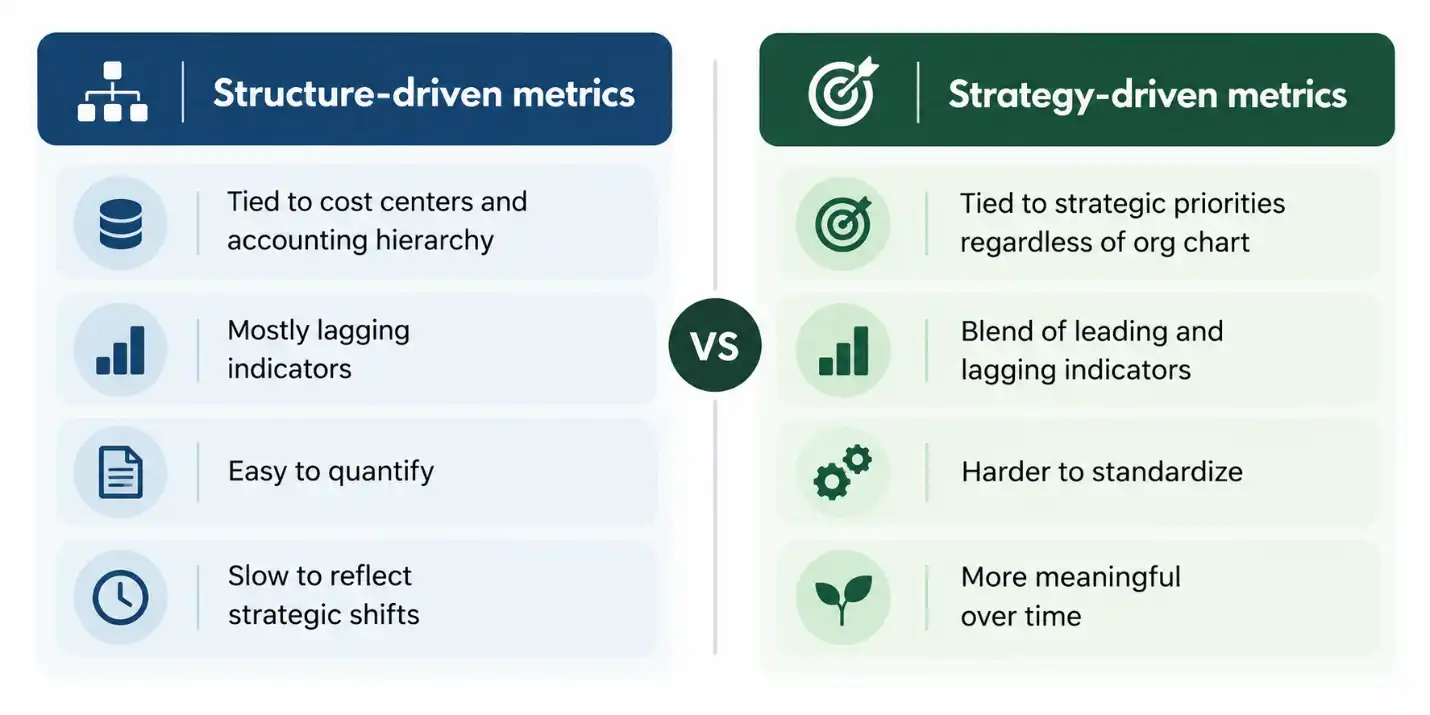
Strategic Objective Mapping offers a practical way to build this kind of executive KPI framework.
- Articulate three to five core strategic objectives, such as shifting revenue mix toward recurring revenue or reducing product development cycle time
- Identify leading and lagging indicators for each objective, pairing net dollar retention with churn, or cycle time with defect rate at launch
- Assign executive ownership and a measurement cadence tied to actual influence, not just functional title
During a Series B raise for a marketplace SaaS platform, consolidated US and Polish reporting alongside cohort and unit economics models anchored investor diligence and withstood scrutiny through a $20M round, precisely because the metrics tracked the strategic bet the company was making rather than the historical org structure inherited from an earlier stage. Decision cycle time, capital deployment effectiveness and customer concentration risk deserve a place in the same framework, since they measure the architecture of judgment rather than its output.
The Case for Qualitative Judgment Alongside Executive Performance Metrics
Numbers tell what happened. They rarely explain why, and almost never predict what happens next, yet leadership lives precisely in the why and the what comes next. A CEO who shuts down a modestly profitable legacy line to protect innovation capacity will show a temporary earnings decline that no standard metric flatters, even though the decision may define the company five years later.
Structured narrative assessment offers a governed alternative to pure subjectivity. Rather than scoring an executive one to five on collaboration, evaluators write a short evidence-based account of how a trait showed up in a real decision, then that account is reviewed by cross-functional peers. Running Finance, HR, IT, Legal and Facilities simultaneously at a mission-driven education and research institution while raising $37M in equity and venture debt made plain that many of the highest-leverage decisions, board trust, audit committee confidence, staff retention through uncertainty, never appear on a standard scorecard, yet they determined whether the capital raise succeeded at all.
Trustworthiness, clarity in crisis and influence across boundaries are difficult traits, not soft ones, and they deserve evaluation with the same rigor applied to margin.
Designing Multi Horizon Scorecards for an Executive KPI Framework
Leadership does not operate on one time horizon, so a single-quarter scorecard is not simply short, it is shallow. A useful executive KPI framework separates indicators by how quickly they mature.
Short term execution -> Midterm capability building -> Long term value creation
- Short term, immediate signals such as cost per acquisition, backlog conversion and fulfillment accuracy, the speedometer of the business
- Mid-term, indicators such as retention, engagement and cycle time that mature over quarters and function as the map
- Long term, brand trust, innovation depth and talent bench strength that compound quietly and are felt acutely in their absence
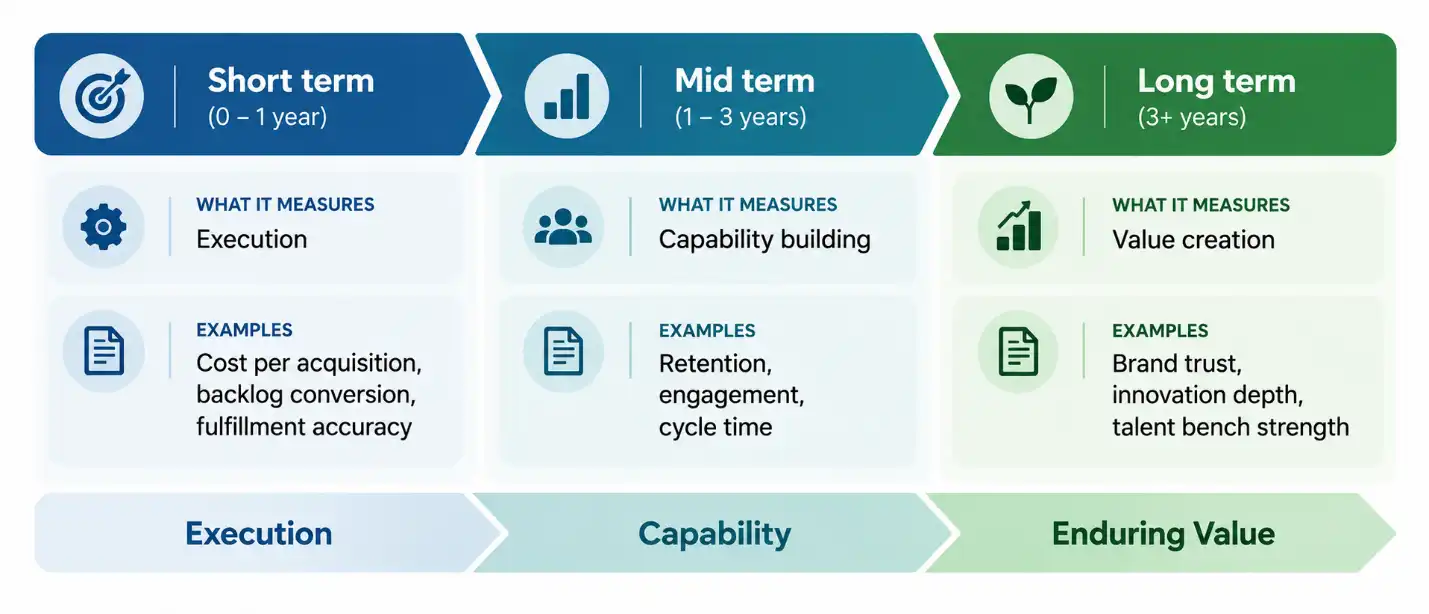
At a $127M global consumer products company spanning DTC, Amazon and wholesale channels with supply chain operations across China and Vietnam, inventory turns more than doubled from three times to seven times while four consecutive clean external audits were delivered, a result that depended on short-term demand planning discipline feeding a mid-term SKU rationalization strategy that only paid off against a long-term working capital thesis. Weighting should shift with company maturity, an early-stage firm may justifiably over-index on short-term execution, while a mature enterprise needs heavier emphasis on long-term resilience.
Building a Measurement Culture That Sustains the Executive KPI Framework
A measurement culture is defined by how data gets used, not by how much of it a company collects. Three conditions make executive performance metrics trustworthy rather than performative.
- Trust, decoupling measurement from fear so that a missed target opens a conversation about learning rather than blame
- Context, pairing every dashboard number with a short narrative so a dip in retention tied to a deliberate pricing restructure is not mistaken for decline
- Rhythm, embedding metrics into weekly and monthly operating cadence rather than an annual ritual
Scaling a venture-backed performance marketing organization from $9M to $180M in revenue within twenty-four months, while growing the finance team from one person to twelve and closing three acquisitions, required customer acquisition cost, lifetime value and contribution margin discipline that the commercial team trusted enough to act on without re-litigating the definitions every quarter. That trust, more than any single dashboard, is what let capital allocation decisions move at the speed the growth demanded.
Legacy KPIs survive long after their relevance fades, and a mature executive KPI framework requires periodic audits asking what still matters, what needs redefining, and what should be retired.
Three Key Takeaways
- Executive performance metrics built solely on quarterly financial outcomes will consistently reward momentum over mastery, so boards should insist on at least one leading indicator for every lagging one already on the scorecard.
- A durable executive KPI framework separates short-term execution, mid-term capability building and long-term value creation, and adjusts the weighting of each horizon as the business matures rather than applying a fixed formula indefinitely.
- Qualitative judgment, captured through structured narrative review rather than unstructured impression, is not a soft addition to performance evaluation but a necessary complement to any numeric system, since the decisions that matter most rarely resolve cleanly inside a spreadsheet.
Disclaimer: This article is intended for informational purposes only and does not constitute legal, tax, or accounting advice. You should consult your own tax advisor or counsel for advice tailored to your specific situation.
Hindol Datta is a four-time CFO and senior finance executive with over 25 years of leadership experience across cybersecurity, SaaS, gaming, logistics, digital marketing, medical devices, consumer products, and nonprofit organizations. He has led more than $120M in fundraising and over $150M in M&A transactions while building the financial and operational systems that let complex businesses scale with confidence. He is the author of seven books in the Systems CFO Series and holds active CPA, CMA, and CIA credentials.
AI-assisted insights, supplemented by 25 years of finance leadership experience.