
Executive Summary
Strategic partnerships have become one of the most powerful levers for margin expansion. They lift both gross and operating margin without compromising customer value or innovation speed. This article explains the economics behind partnership-driven margin gains. It also covers how to structure agreements, operationalize partnerships for results, and institutionalize them as a lasting capability.
Margin expansion does not always require internal restructuring. Readers will find the cost mechanics that make strategic partnerships accretive, a process for selecting and structuring deals, the operational discipline that protects the thesis, and the governance that sustains it.
The Economics of Margin Expansion Through Strategic Partnerships
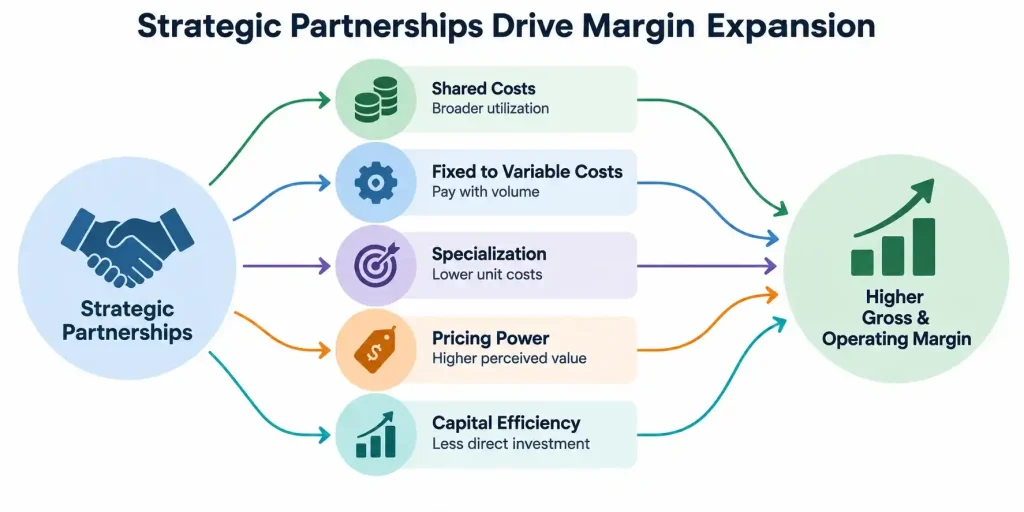
Gross margin is revenue minus cost of goods sold. Operating margin layers in fixed overhead and SG&A. When topline growth slows, margin expansion becomes the more powerful driver of shareholder value. Strategic partnerships reshape unit economics directly instead of only supporting sales.
Cost Absorption, Variable Conversion, and Specialization
Fixed costs become more tolerable when spread across a broader revenue base. A joint manufacturing agreement lets two firms share asset utilization. A partner who brings predictable volume is a cost mitigator and not only a customer. The same logic applies to software development and shared service models. Co-investment lowers the marginal cost of the next unit of value.
Strategic partnerships also convert fixed costs into variable ones. A usage-based cloud arrangement lets a company pay proportionally to volume. This reduces risk and keeps cost moving in tandem with revenue. The result is more predictable margins during demand volatility.
Component specialization adds a third lever for margin expansion. No company excels at everything. Firms that rely on partners for specific components, such as software modules or supply chain orchestration, often gain a lower cost than building internally. Partners who focus on a narrower domain operate at better economies of scale. The resulting surplus can be shared to lift margin for both sides.
Pricing Power, Capital Efficiency, and Shared Incentives
Strategic partnerships can also expand perceived value faster than cost. This shifts pricing power in a firm’s favor. Even in commoditized sectors, alliances in procurement or distribution can produce cost advantages. A structurally lower cost base yields structurally higher margins, even when pricing itself is constrained.
The most sustainable partnerships rest on mutual economic benefit. One-sided arrangements rarely endure. Co-developed products, co-invested IP, and revenue-sharing agreements create alignment that supports long-term collaboration. Margin impact also shows up in capital efficiency. Relying on a partner for infrastructure or R&D reduces the need for direct investment and improves return on invested capital.
A partnership formed without a clear economic thesis becomes a cost center rather than a profit driver. Finance must model and pressure-test the assumptions before the deal proceeds.
Structuring and Negotiating Margin-Accretive Partnerships
Structuring a partnership intelligently is the architecture that turns economic logic into results. Partner identification is a test of fit rather than proximity. The most powerful partners are not always the most obvious ones. A logistics firm seeking cost efficiency might find that a data analytics company outside its traditional supply base cuts delivery lag enough to save millions annually. On cross-border engagements spanning multiple entities, that kind of unconventional fit has often produced the strongest strategic partnerships.
Economic Scoping and Deal Structure
Before discussions begin, the company should model how the partnership affects COGS, SG&A, or capital expenditure. It should also test whether the deal shifts fixed costs to variable. Partnerships that look promising strategically often fall apart under this scrutiny. The finance team must confirm that the deal pencils out and not only feels strategic.
| Structure type | Typical use | Margin mechanism |
| Joint venture | Shared manufacturing or market entry | Shared capital and utilization |
| Long-term supply agreement | Predictable input costs | Volume-based cost reduction |
| Co-development contract | Shared R&D or product design | Shared risk and IP value |
| Licensing deal | Access to technology or IP | Lower build cost, faster time to market |
The cost-sharing, revenue-sharing, and risk-sharing mechanics need precision. In cross-border strategic partnerships, structure shapes both financial outcomes and behavior. A poorly structured deal creates ambiguity. A well-structured one creates accountability. A partner compensated only on volume may flood the system regardless of margin. A partner compensated on cost reduction or gross profit contribution stays aligned with the goal.
Governance and Performance Incentives
Governance belongs inside the structure itself. Joint steering committees, shared KPIs, and predefined dispute resolution all support this. Exit clauses preserve strategic flexibility, since no partnership should create long-term cost rigidity. Culture mismatch and governance gaps erode even sound economic logic. SLAs, data sharing protocols, and shared dashboards must be built in from the start.
Performance-based incentives turn cost partners into strategic allies. A BPO partner might earn a bonus for lowering average handling time below a threshold. A co-manufacturer might gain upside for defect rates below benchmark. The CFO holds the economic integrity of the deal throughout structuring. This means asking whether margins still lift if revenue stays flat, and how the cost curve behaves if volumes decline.
Operationalizing Strategic Partnerships for Margin Delivery
A compelling financial thesis fails without disciplined execution. Operationalizing a partnership means treating external partners with the same accountability as an internal team.
Interfaces, Systems, and Performance Tracking
Margin leaks most often at the interface where one team’s process ends and the partner’s begins. This could be a logistics handoff or a data sync between systems. Joint onboarding protocols align expectations and define escalation paths before work begins. These should be structured and cross-functional, not generic kickoffs.
Systems integration is the next battleground for strategic partnerships. When data does not flow cleanly between companies, invoices are reconciled by hand. Inventory balances get misreported. Full system homogeneity is not the goal. Functional interoperability through APIs and shared dashboards turns friction into insight.
Joint scorecards track margin-relevant KPIs such as cost per unit, defect rates, and service level adherence. These should be reviewed monthly or weekly rather than quarterly. Communication should run on three planes: operational, tactical, and strategic. Issues then surface early, and goodwill holds even when results fluctuate.
Exceptions, Flexibility, and Culture
Partnerships fail less often because problems arise. They fail more often because those problems stay invisible or unmanaged. Documented exception workflows, known to both sides, keep resolution from escalating to senior management every time. Finance should also monitor the cost of running the partnership itself. This means checking whether overhead or hidden costs are eroding the original thesis.
Flexibility mechanisms protect margin expansion over time. Volume tiers that adjust pricing automatically, or review windows tied to changing conditions, prevent a temporary mismatch from becoming a permanent drag. Teams should be trained to treat partners as collaborators in economic performance and not vendors to be managed.
Institutionalizing Strategic Partnerships as a Margin Philosophy
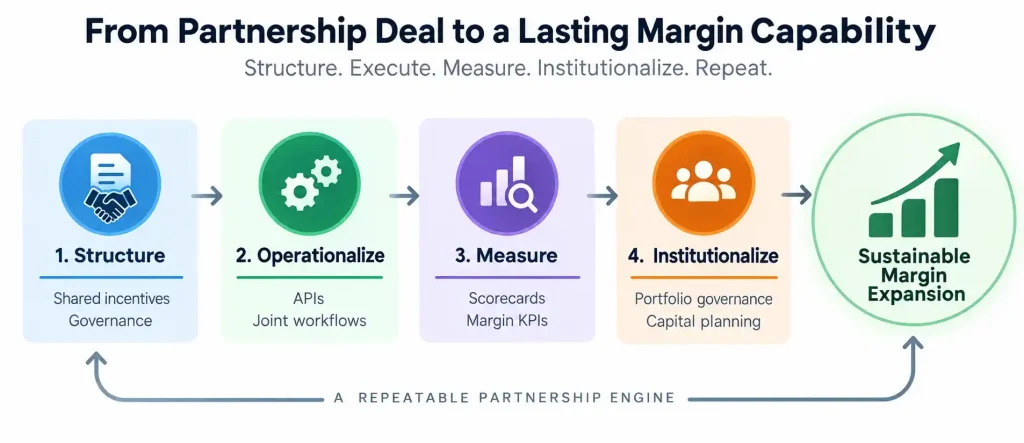
Isolated partnership wins are not the same as a systemic capability. Institutionalization requires portfolio governance. Many companies manage partnerships in silos, which constrains learning and blocks visibility into the collective margin impact of the external ecosystem.
Governance, Measurement, and Capital Planning
Strategic partnerships need an institutional home. A strategic partnership office or center of excellence can centralize expertise and performance insight without centralizing execution. It supports business units in structuring and tracking deals. It also builds a common language for cost analysis and margin attribution across regions.
Measurement becomes the anchor at this stage of margin expansion. A consistent framework for calculating the contribution margin of each partnership, adjusted for cost allocation and risk transfer, helps leaders decide what to scale, renegotiate, or exit. Capital budgeting should evolve as well. Partnering becomes a third lane alongside building and buying, evaluated with the same discipline as internal investment.
Risk, Ecosystem Value, and Incentives
Strategic dependencies on third parties introduce concentration risk and compliance exposure. Partnerships therefore belong inside the enterprise risk management framework, alongside suppliers and technology vendors. Contingency plans and stress tests should cover operational disruption and cultural misalignment, not only economic shocks.
Mature partnership strategy also seeks ecosystem value rather than only bilateral value. This means curating a network of partners whose data flows and innovation cycles compound. Leadership KPIs and incentive structures complete the picture. Executives measured only on internal margin improvement will underinvest in external levers. Scorecards that include partnership contribution reorient the organization toward a more leveraged cost base.
Three Key Takeaways
- Use strategic partnerships for margin expansion by converting fixed costs to variable, sharing specialization, and pricing the resulting value around a clear economic thesis.
- Structure and negotiate deals for shared incentives, with governance, SLAs, and performance-based compensation built into the agreement from the outset.
- Operationalize and institutionalize strategic partnerships through joint scorecards, disciplined communication, portfolio governance, and incentives that reward external margin contribution.
Disclaimer: This article is intended for informational purposes only and does not constitute legal, tax, or accounting advice. You should consult your own tax advisor or counsel for advice tailored to your specific situation.
Hindol Datta is a four-time CFO and senior finance executive with over 25 years of leadership experience across cybersecurity, SaaS, gaming, logistics, digital marketing, medical devices, consumer products, and nonprofit organizations. He has led more than $120M in fundraising and over $150M in M&A transactions while building the financial and operational systems that let complex businesses scale with confidence. He is the author of seven books in the Systems CFO Series and holds active CPA, CMA, and CIA credentials.
AI-assisted insights, supplemented by 25 years of finance leadership experience.