
Executive Summary
Future scenario planning has moved from a strategic off-site exercise to a frontline finance discipline. The shift reflects a simple truth about the current operating environment. Economic expansions create the illusion of stability, while disruption arrives without a calendar. A cybersecurity and identity access management company near $30M in annual recurring revenue gets no advance notice. Funding markets tighten without warning. Neither does a global consumer products business watching freight rates swing across a Vietnam and China supply chain. Future scenario planning gives finance leadership a structured way to define plausible alternative paths and size their financial impact. It lets leadership pre-negotiate the choices that pressure would otherwise dictate.
This article works through four connected stages. It starts by building scenarios grounded in real business exposure. It then turns those scenarios into financial stress models that test earnings and liquidity. Next, it shows how that insight shapes capital allocation and operating decisions. Finally, it covers embedding the discipline into governance and culture so it survives beyond a single planning cycle. Each stage builds on the one before it. Skipping any of them tends to produce either an academic exercise or a reactive one.
Why Future Scenario Planning Matters Now
In expansion periods, organizations lean on models that assume steady growth, predictable cycles, and rational markets. Those assumptions hold right up until they do not. Financial crises, pandemics, commodity shocks, and geopolitical conflict rarely announce themselves on schedule. They arrive with velocity and asymmetry that most annual budgets were never built to absorb. Scenario planning is not an attempt to predict which of these events will occur. It is a discipline for preparing the business to remain solvent, resourced, and directionally sound across a range of plausible futures, so that whichever one materializes, the response has already been rehearsed.
The strongest finance functions treat future scenario planning as a continuous capability rather than a seasonal ritual, woven into strategic planning, capital allocation, and risk management rather than reserved for a crisis. In a mission-driven education and research institution operating on a mix of philanthropic and earned revenue, funding volatility is not hypothetical; it is the operating condition, and multi-year modeling under variable funding scenarios becomes the mechanism that keeps the board and the executive team aligned on what happens if a major funding source contracts.
Mapping Exposure and Defining the Axes of Uncertainty
Every credible scenario begins with an exposure map that links external drivers, inflation, interest rates, foreign exchange, commodity prices, trade policy, credit availability, labor markets, to the specific revenue model and cost structure of the business. A global logistics operation and a venture-backed SaaS company do not share the same exposure profile, and treating them as if they did produces scenarios that miss the drivers that actually matter.
- Interest rate regime and its effect on customer capital budgets and the company’s own cost of capital
- Foreign exchange movement across manufacturing, sourcing, and revenue geographies
- Commodity and input cost volatility tied to the supply chain
- Labor market tightness and its effect on wage inflation and attrition
- Credit availability and covenant headroom under a refinancing scenario
- Consumer or customer demand elasticity under shifting sentiment
Once exposure is mapped, the next step is defining the axes along which futures diverge. A two-axis matrix, interest rate regime against demand elasticity for example, produces four internally coherent quadrants rather than a single linear forecast.
Two-Axis Scenario Matrix
| Demand Behavior | Rates Rising or Tightening | Rates Falling or Easing |
| Demand Elastic | Stagflation pressure: costs rise while volume softens | Demand rebound with easier capital access |
| Demand Defensive | Margin compression with resilient volume | Recovery scenario with cautious reinvestment |
Scenarios built this way remain grounded in economic logic rather than imagined chaos, and finance, strategy, and risk should each test the assumptions from their own vantage point before a scenario is considered ready for modeling.
Translating Scenario Analysis into Financial Stress Models
Narrative alone does not move a board or a lender. The discipline earns its operational weight only once it is translated into a stress model that maps each assumption, a 300 basis point rate move, a 15 percent contraction in demand, through the income statement, balance sheet, and cash flow statement in a way that respects how the shock actually propagates through the business.
In a $170M global medical device manufacturer with plants across three countries, standard costing and bill of materials management were precise enough to withstand line-by-line audit scrutiny, and that same precision is what a stress model requires. It is not enough to shock revenue and call the exercise complete, because the model has to trace how volume, cost of goods sold, SG&A elasticity, and operating leverage move together under the scenario.
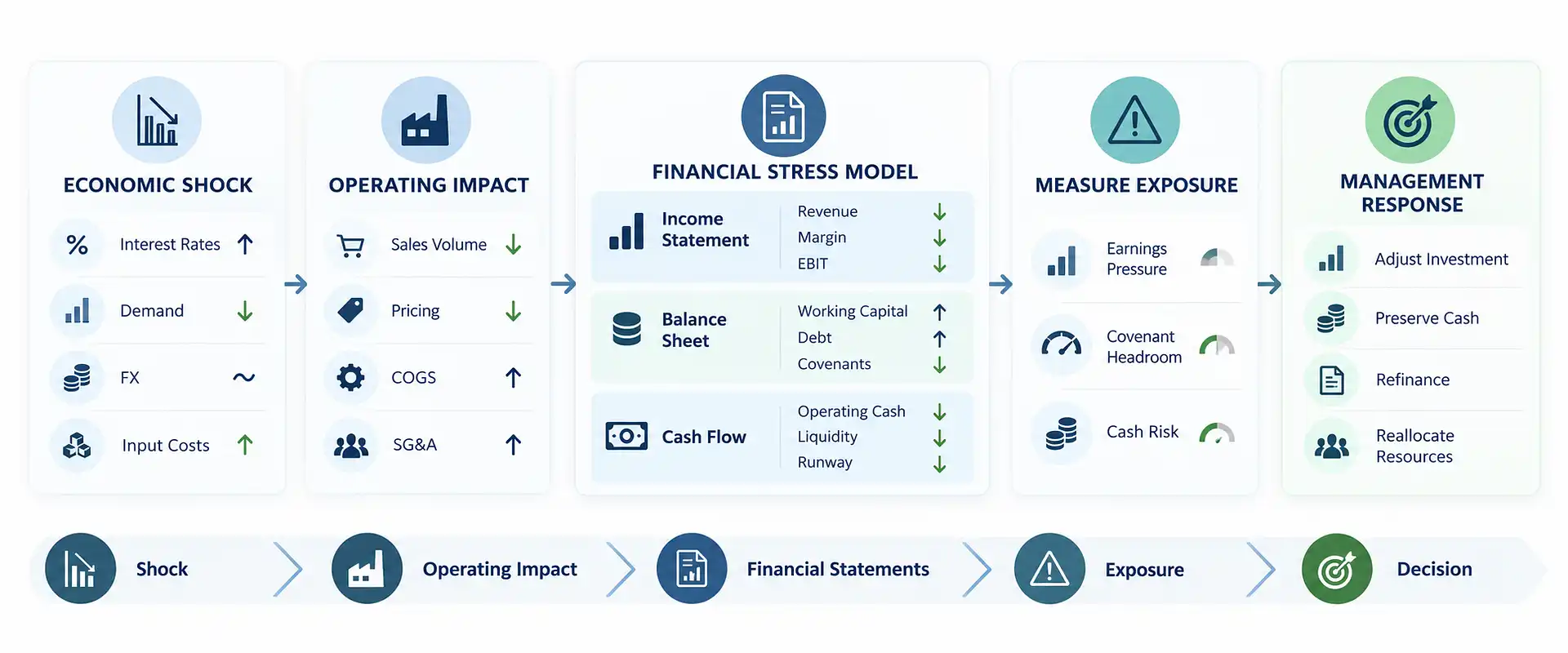
What a Stress Model Needs to Capture
- Working capital behavior: days sales outstanding, days payable outstanding, and inventory turns under demand stress
- Covenant compliance and refinancing risk across the projected balance sheet
- Segment-level vulnerability, since currency and regulatory exposure rarely distributes evenly across business units
- Leading indicators, such as order backlog, churn, or pipeline velocity, that provide early warning before the full shock lands
A $127M global consumer products company with distribution across DTC, Amazon, and wholesale channels illustrates why this granularity matters. Inventory turns moved from three times to seven through demand planning and SKU rationalization, and that improvement became visible only once the stress model separated channel-level cash conversion rather than reporting a single consolidated figure. The value of a stress model is not the precision of its output. A projection showing a 20 percent EBIT contraction under a downside case is not a forecast; it is a measure of exposure, and the conversation it triggers about margin resilience and covenant cushion is where the model earns its keep.
Turning Scenario Insight into Strategic Decisions
Scenario planning that stops at analysis has not finished its job. The translation from insight to decision is where future scenario planning either becomes a strategic asset or remains a filed report. A project that clears the hurdle rate under a base case may fail entirely under a downside scenario, while a counter-cyclical investment may reveal resilience that the base case never surfaced, and capital budgeting built around a single point estimate misses both signals.
- Capital allocation, staging or accelerating investment based on performance across scenarios rather than a single projection
- Supply chain design, testing supplier concentration and safety stock thresholds against a disruption scenario
- Workforce planning, sizing hiring and upskilling investment against wage inflation and attrition scenarios
- Pricing and product strategy, testing elasticity and bundling ahead of an anticipated demand shift
- Liquidity and capital structure, timing refinancing or backup credit lines before a covenant threshold is reached
A venture-backed performance marketing company scaling from $9M to $180M in revenue over twenty-four months could not have sustained that growth without customer acquisition cost, lifetime value, and contribution margin discipline built directly into the forecasting model. That discipline is what allowed pricing and channel decisions to hold up as conditions shifted mid-scale.
Cultural resistance is often the real obstacle at this stage. Base cases carry a kind of gravitational pull, and downside scenarios get dismissed as unlikely long before they are tested against the numbers. Scenario planning belongs at the executive table rather than inside a single FP&A model, and it needs a shared willingness to act on outcomes that feel improbable until the trigger conditions actually appear.
Institutionalizing Future Scenario Planning in Governance and Culture
A scenario model that lives in a single spreadsheet, reviewed once during a turbulent quarter, delivers a fraction of its potential value. Institutionalizing the discipline means embedding it into governance, planning cadence, incentive design, and the language leadership uses every week, not only during a crisis.
Institutionalization Checklist
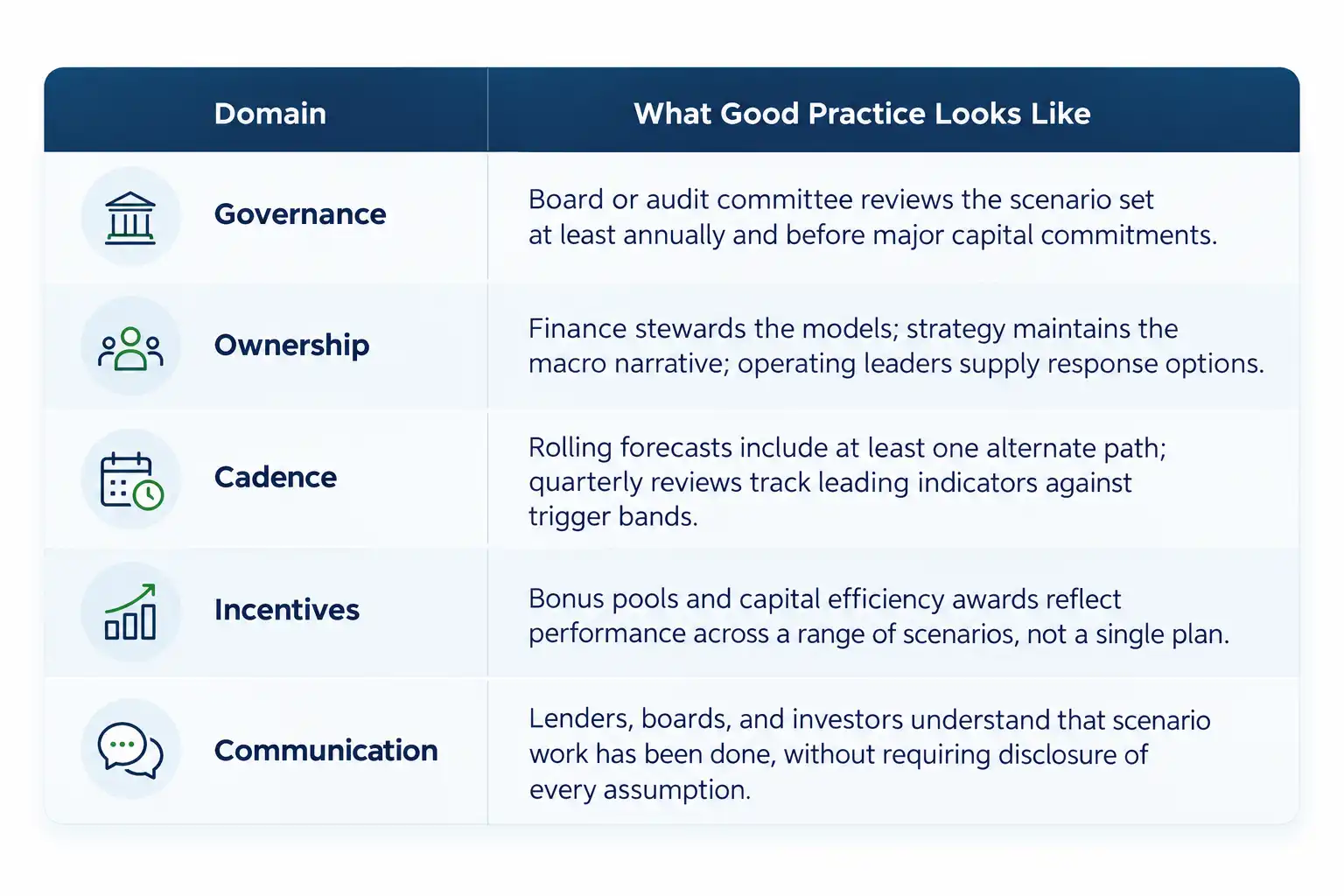
A high-growth cybersecurity and identity access management company with delivery centers spanning five countries held actuals within five percent of forecast for eight consecutive quarters, a result that came from treating the forecasting engine as a living system refreshed on a defined rhythm rather than an annual artifact revisited only when conditions turned unfavorable. That same discipline, applied consistently, is what separates an organization that reacts to shocks from one that has already rehearsed its response.
Three Key Takeaways
- Future scenario planning earns its value only when exposure is mapped to the specific drivers that matter for the business, since a generic set of macro assumptions produces scenarios that miss the risks actually capable of moving earnings and liquidity.
- A scenario is not complete until it has been translated into a financial stress model that traces the shock through the income statement, balance sheet, and cash flow statement, because narrative without quantification rarely survives contact with a board or a lender.
- The organizations that navigate economic shocks well are the ones that embed future scenario planning into governance, cadence, and incentives long before the shock arrives, converting a periodic exercise into a standing capability that shortens the time between disruption and decision.
Disclaimer: This article is intended for informational purposes only and does not constitute legal, tax, or accounting advice. You should consult your own tax advisor or counsel for advice tailored to your specific situation.
Hindol Datta is a four-time CFO and senior finance executive with over 25 years of leadership experience across cybersecurity, SaaS, gaming, logistics, digital marketing, medical devices, consumer products, and nonprofit organizations. He has led more than $120M in fundraising and over $150M in M&A transactions while building the financial and operational systems that let complex businesses scale with confidence. He is the author of seven books in the Systems CFO Series and holds active CPA, CMA, and CIA credentials.
AI-assisted insights, supplemented by 25 years of finance leadership experience.