
Executive Summary
Foreign exchange risk touches every company with a global footprint. It shows up in a supply chain built across borders. It surfaces just as often in a receivable settled in a currency that moves against expectation before payment lands. This article breaks foreign exchange risk into three distinct forms: transaction, translation, and economic exposure. It then works through the instruments, governance, and cultural posture involved. That posture lets a finance organization manage exposure rather than merely react to it. The aim is not to eliminate currency risk, since that is neither possible nor desirable. The real goal is to align the currency profile of the business with its strategic intent.
CFOs who treat fx risk as a quarterly nuisance tend to discover its cost only after margin has already eroded. Those who map, own, and govern forex risk like any other enterprise risk treat it as a structural variable. Currency competence then becomes a source of agility rather than a defensive chore.
The Three Faces of Foreign Exchange Risk
Currency risk, also called forex risk or fx risk, does not present as a single problem. Foreign exchange risk shows up in three distinct forms, each with its own mechanics and its own remedy. Conflating them is a common governance failure. It leads finance teams to overhedge one area while leaving real exposure unmanaged in another.
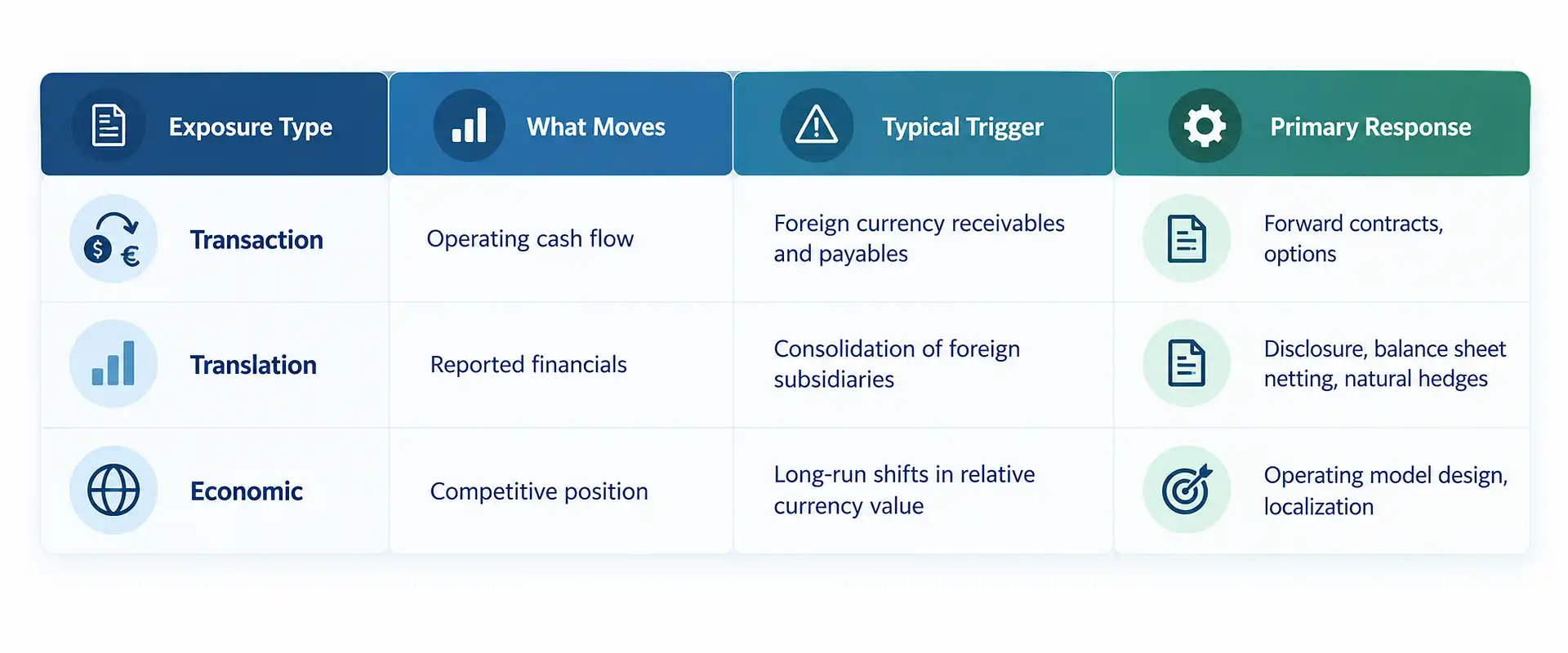
Transaction exposure is the most visible. It arises whenever a company holds a receivable or payable in a foreign currency. The exposure settles directly against operating profit the moment the company settles the invoice. A cybersecurity and identity access management company operates across the United States, Canada, Mexico, India, and Nepal. It carries this exposure by definition. Its payroll, vendor contracts, and intercompany settlements span five different currencies. Getting the entity structure and settlement terms right at that scale matters. It keeps transaction exposure from becoming a line item that surprises the board.
Translation exposure appears when a parent company consolidates the financial statements of foreign subsidiaries into its reporting currency. The underlying cash flows never move, but reported revenue, EBITDA, and equity shift with the exchange rate used at consolidation. This was a constant undercurrent at a Euronext Paris-listed gaming and digital entertainment company. Its operations spanned the United States, France, the United Kingdom, Singapore, and South Korea. The company rolled out a single, unified definition of revenue across every subsidiary through Oracle Financials and MicroStrategy. That definition mattered as much for investor confidence as for statutory accuracy under IFRS and US GAAP.
Economic exposure is the least visible and the most strategic, since it describes how currency movements shift a company’s competitive position over the long term rather than its books over the current quarter. The table below sets out how the three forms differ.
Designing a Foreign Exchange Risk Management Program
Once exposure is mapped correctly, the harder question is how much to hedge and with which instrument, and that decision is philosophical as much as technical, reflecting how a leadership team weighs predictability against flexibility.
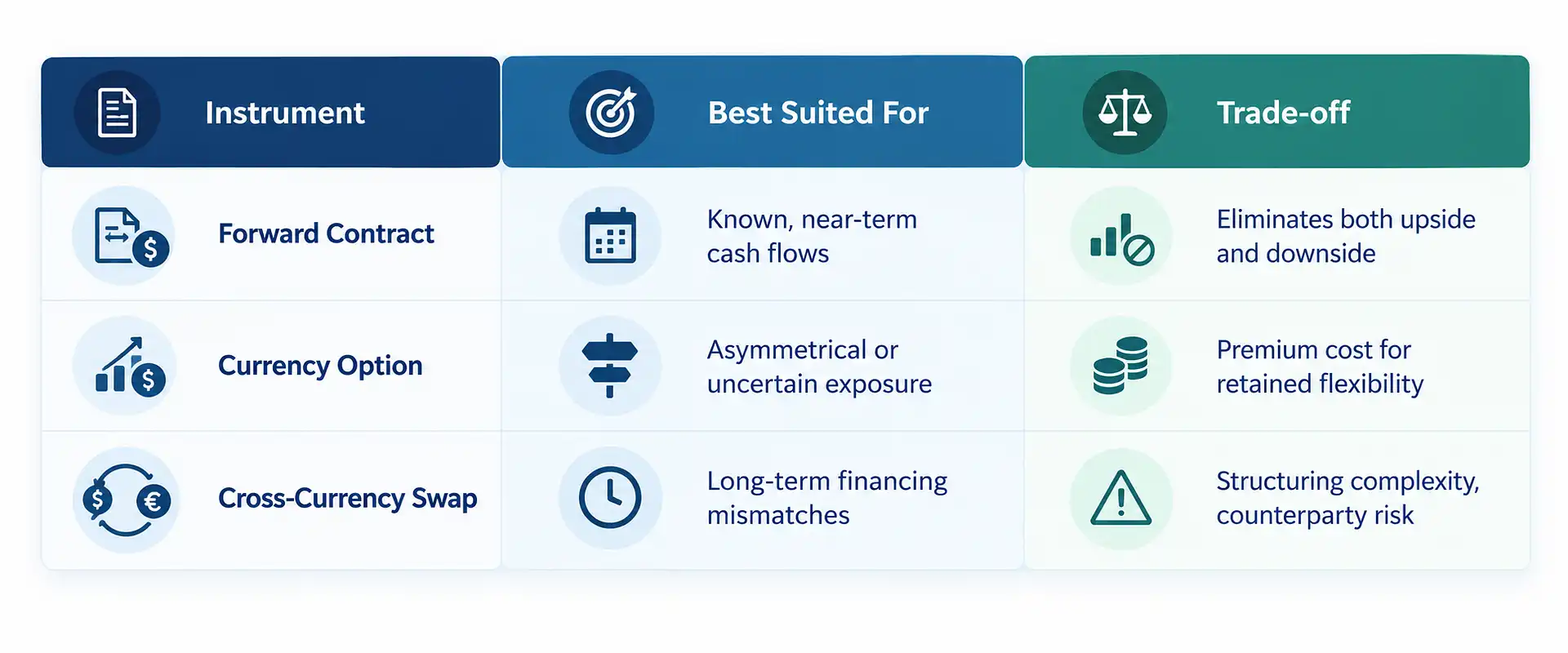
Forward contracts remain the simplest instrument, locking in a rate for a future settlement date at low cost, though they surrender upside along with downside and demand precise timing against known cash flows. Options cost more through the premium paid, but they preserve upside when the exposure is asymmetrical or the cost of an adverse move is severe enough to justify paying for optionality. Cross-currency swaps sit at the more complex end, useful when debt is issued in one currency against revenue earned in another, and they require the kind of counterparty risk management and structuring discipline that belongs with a sophisticated treasury function rather than a lean finance team.
Before reaching for any instrument, the natural hedge deserves first consideration, meaning operational structures such as matching revenue currency to cost currency that reduce net exposure without a derivative in sight. A $170M global medical device manufacturer with plants in Copenhagen, Cork, and Taiwan built this kind of alignment into its footprint, keeping standard costing and supply chain finance tethered to the currencies where the plants actually operated rather than importing exposure through mismatched sourcing. Financial hedges then cover what the operating structure cannot, and the coverage ratio and hedge duration should track forecasting accuracy and the materiality of what remains.
Institutionalizing Foreign Exchange Risk Management Across the Organization
Currency risk stops being a treasury problem the moment it is understood correctly, because pricing terms set by sales, sourcing currency chosen by procurement, and the forecast assumptions built by FP&A all shape exposure long before treasury ever executes a hedge. A cross-functional committee that reviews exposure data, hedge positions, and forecast accuracy on a regular cadence keeps those functions pulling in the same direction rather than each optimizing in isolation.
A functioning FX governance structure typically includes:
- Treasury, which models exposure and executes hedges against an approved policy
- FP&A, which builds currency sensitivity into budgets, forecasts, and investor guidance
- Sales and procurement, which set pricing and sourcing terms that either create or reduce exposure
- The board, which receives a regular briefing on how exposure is evolving by geography and cost base rather than only on realized gains or losses
The playbook matters as much as the committee. Documented responses to plausible currency shifts, rehearsed before volatility arrives rather than improvised during it, are what let a finance team act with composure when a currency moves 8 or 10 percent in a matter of weeks.
From Protection to Strategic Agility
Framing forex risk purely in defensive terms understates what currency competence delivers once it is embedded fully, because organizations that model and understand their exposure move faster and further than peers still diagnosing the problem.
Currency dislocation often mispriced strategic assets, and a company with strong fx fluency can move on that mispricing while less prepared acquirers hesitate over the added complexity. The Euronext Paris-listed gaming company’s $100M+ in cross-border M&A across the United States, France, the United Kingdom, Singapore, and South Korea depended on that fluency, with due diligence and post-merger integration teams already equipped to evaluate currency-adjusted returns rather than treating exchange rate exposure as a late-stage surprise. The same discipline shows up in capital deployment more broadly, from where debt is raised to how cash is repatriated, and in pricing strategy, where invoicing in a stable currency or building automatic adjustment clauses into contracts protects collections without requiring a hedge at all.
None of this depends on forecasting the precise path of any currency pair. It depends on readiness, built through scenario planning, policy discipline, and a governance structure that has already rehearsed the decisions before the market forces them.
Three Key Takeaways
- Map exposure by type before choosing an instrument. Transaction, translation, and economic risk behave differently, and confusing them leads to hedging the wrong thing at the wrong cost.
- Treat the natural hedge as the base case. Aligning revenue currency with cost currency through sourcing and operating footprint reduces net exposure before a single derivative is purchased, and financial hedges should cover what remains rather than substitute for structural discipline.
- Build governance before volatility arrives. A cross-functional committee, a documented playbook, and regular board visibility into evolving exposure turn foreign exchange risk management from a reactive scramble into a source of strategic agility.
Disclaimer: This article is intended for informational purposes only and does not constitute legal, tax, or accounting advice. You should consult your own tax advisor or counsel for advice tailored to your specific situation.
Hindol Datta is a four-time CFO and senior finance executive with over 25 years of leadership experience across cybersecurity, SaaS, gaming, logistics, digital marketing, medical devices, consumer products, and nonprofit organizations. He has led more than $120M in fundraising and over $150M in M&A transactions while building the financial and operational systems that let complex businesses scale with confidence. He is the author of seven books in the Systems CFO Series and holds active CPA, CMA, and CIA credentials.
AI-assisted insights, supplemented by 25 years of finance leadership experience.