
Executive Summary
A digital CFO tech stack is not a matter of licensing more software. It is about choosing and integrating tools so they amplify judgment rather than replace it. This article explains how to design a planning environment around continuous forecasting, how cloud ERP and TMS integration turns fragmented data into one coherent model, how to translate that model into boardroom conviction, and how to extend the stack across currencies and jurisdictions.
Optimization here is a discipline, not a one-time purchase. Readers will find what makes a planning platform genuinely useful, how integration across ERP, CRM, and treasury systems changes what a model can show, how to present that model so it persuades rather than just informs, and how the stack should adapt for a multinational footprint.
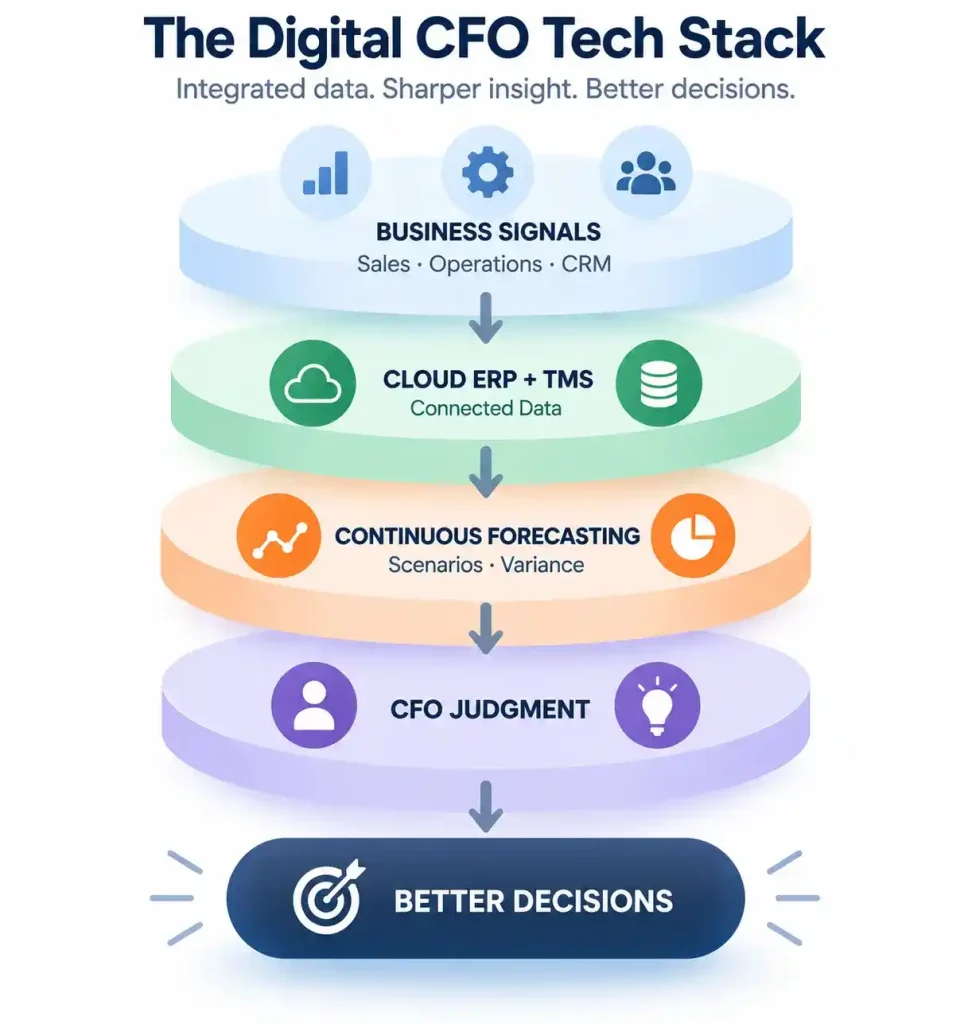
Designing a Digital CFO Tech Stack for Continuous Planning
Adaptive forecasting platforms, integrated business planning systems, and machine learning-based rolling forecasts can do more than most organizations ask of them. They rarely get used to their full potential. Their value depends on intention and design. It does not depend on the software license alone.
From Static Plans to Rolling Forecasts
The traditional financial plan was built with care. It stayed static, often obsolete by the time it reached the executive floor. Rolling forecasts adjust as inputs evolve. Models that digest real-time demand signals replace the static approach with something closer to continuous planning. This works only when forecasting is treated as a constant discipline. It cannot stay a calendar event repeated quarterly.
Decoupling the rhythm of planning from the rhythm of accounting supports this shift directly. A digital CFO tech stack built for continuous planning treats forecasts as forward-moving hypotheses. They get tested and revised in real time, rather than staying backward-looking extrapolations tied to a fiscal close.
Integration Across Functions
A financial model cannot operate in isolation. It needs to connect with operations, align with sales, and reflect supply chain and HR realities together. Many digital transformations stall for a simple reason. The tools are rarely inadequate, but leadership keeps functions fragmented. Pulling disparate systems into one coherent, connected model is a technical task. It is also a leadership one.
Design quality matters as much as raw functionality does. Planning tools built like cockpits for engineers delay insight instead of delivering it. Opaque interfaces and buried assumptions are usually the cause. A well-designed dashboard changes the tempo of a decision. A poorly designed one can let an opportunity pass before anyone notices it.
| Stack layer | What it should do | Common failure |
| Data ingestion | Pull sales, supply chain, and CRM signals automatically | Manual exports that lag by weeks |
| Forecasting engine | Update continuously as inputs change | Locked to a quarterly or annual cycle |
| Integration layer | Connect ERP, TMS, and CRM into one model | Systems that never talk to each other |
| Presentation layer | Surface a clear narrative, not just charts | Dashboards that show data without meaning |
A manufacturing firm moving from spreadsheet-bound planning to a cloud-based, AI-augmented platform illustrates the difference well. Piping in daily sales data and flagging churn signals through CRM intelligence only pays off with real redesign. Modeling supply-side risk through predictive analytics works the same way. The team must redesign the process around these inputs, not simply automate the old one.
Cloud ERP and TMS Integration as the Foundation of the Stack
Cloud ERP and TMS integration turns a collection of separate systems into one model. That model reflects how the business actually moves. Without that integration, a digital CFO tech stack produces fast reports built on slow, disconnected data.
Why Integration Changes What a Model Can Show
Classical models built on trailing twelve-month averages and historical ratios now border on obsolete. Disruption has become a recurring feature of the operating environment, not an occasional event. A model connected through cloud ERP and TMS integration can ingest a much wider mosaic of signals. Customer click-through data, competitor pricing, and inventory turnover velocity all feed it, and it updates continuously instead of on a fixed cycle.
This abundance of data still needs a filter, or it becomes noise. A well-optimized model stays sparse even with strong ERP and TMS integration behind it. It captures the signals that matter rather than crowding the frame with everything the systems can technically provide. The CFO still decides which levers matter. The same judgment sets which thresholds trigger reevaluation and which indicators genuinely predict an inflection.
Variance as Signal Inside an Integrated Stack
Variance analysis often gets reduced to a backward-looking report. It explains results instead of illuminating what changed. Inside a properly integrated stack, variance functions as a signal instead of a scorecard. It reveals assumptions that no longer hold. It surfaces dependencies that were previously hidden, inviting a revised narrative rather than an apology for a plan that no longer fits.
A connected environment, sometimes described as a digital twin of the enterprise, can run simulations continuously in the background. It can flag the cost impact of a tariff change, or the upside of a delayed hiring freeze, well before month-end. The technology for this already exists. The harder question is whether an organization will give up some manual control for that level of foresight. Cloud ERP and TMS integration is the technical precondition that makes the tradeoff possible.
Turning the Stack into Boardroom Conviction
Visibility without meaning does not move a room on its own. A forecast that no one believes represents a failure of communication. So does a scenario that never gets acted on, even when the underlying model is technically sound.
Narrative and Rhythm
Knowing the drivers behind working capital erosion is one skill. Telling that story in a way that creates urgency is another. Strategic rhythm matters here. When the financial plan moves in one tempo, operations in another, and innovation in a third, the result is disharmony that no dashboard alone can fix.
A digital CFO tech stack, used well, aligns these tempos. It connects forecasts to real-time business signals and presents outputs in a form that matches executive intuition, rather than requiring translation. This turns the CFO into a synchronizer across functions, not a reporter of isolated numbers.
Building Credibility Through Consistency
No tool generates trust by itself. Consistency and a willingness to admit uncertainty build more confidence than a model that claims to be right from the start. So does the discipline to revise a position when new data arrives. Scenario planning benefits from that same honesty. What matters is not how many futures a platform can simulate. What matters is which scenario captures the room’s attention, and which trajectory makes an abstract risk feel concrete.
Presentations built on the stack should start with the decision that needs to be made. They should not start with the data itself. The goal is to answer what should happen next, not only what already happened. Tension should build through scenario and resolve through insight.
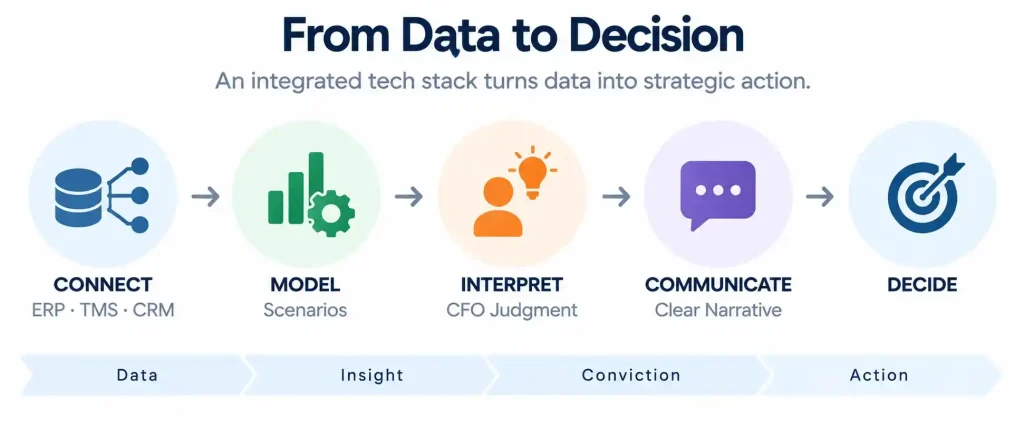
Extending the Digital CFO Tech Stack Across Borders
Forecasts shaped by internal constraints and local rhythms eventually meet outside pressure. Geopolitics, tax treaties, and foreign exchange all apply that pressure. A digital CFO tech stack built only for domestic operations will not hold up once the business crosses borders into new markets.
Synchronizing Across Currencies and Jurisdictions
Complexity in a global operation is now ambient rather than occasional. Intuition alone is not enough to manage it. Cloud ERP and TMS integration allows synchronous scenario modeling across borders. A decision modeled in one region can be reflected and recalibrated for local tax rules, labor costs, and political risk in another region within minutes.
That level of automation is only useful when someone curates it. The CFO still decides which signals to prioritize. The same judgment sets which constraints to hard-code and which risks to elevate above others. Global tax planning illustrates the stakes well. Country-by-country reporting and minimum tax regimes now shift in rolling waves rather than annual cycles, and a well-integrated stack should support transparency and long-term thinking, not just model more jurisdictions faster.
From Model to Message
External communication is the final test of any integrated stack. Board members, investors, and analysts want confidence. Raw dashboards do not give them that. A quarterly earnings call is closer to a ritual than a report. The model can generate the guidance range, but the CFO still has to give that number tone, weight, and context.
At an early-stage email marketing technology company, a turnaround that reduced monthly burn from $800K to $200K depended on this same combination: a connected view of the numbers paired with clear, consistent communication about what those numbers meant for the business. Knowing when a forecast is good enough, and when to stop simulating and start deciding, is as much a part of optimizing a digital CFO tech stack as any integration project.
Three Key Takeaways
- Build the digital CFO tech stack around continuous, rolling forecasts and cross-functional integration, not around adding more disconnected tools.
- Treat cloud ERP and TMS integration as the technical foundation that lets variance function as a signal and lets scenarios update in real time.
- Use the stack to build boardroom conviction and cross-border consistency, since a model only creates value once its output is trusted and acted on.
Disclaimer: This article is intended for informational purposes only and does not constitute legal, tax, or accounting advice. You should consult your own tax advisor or counsel for advice tailored to your specific situation.
Hindol Datta is a four-time CFO and senior finance executive with over 25 years of leadership experience across cybersecurity, SaaS, gaming, logistics, digital marketing, medical devices, consumer products, and nonprofit organizations. He has led more than $120M in fundraising and over $150M in M&A transactions while building the financial and operational systems that let complex businesses scale with confidence. He is the author of seven books in the Systems CFO Series and holds active CPA, CMA, and CIA credentials.
AI-assisted insights, supplemented by 25 years of finance leadership experience.