
Executive Summary
Budget variance is often treated as a footnote. It becomes a red or green number filed into a dashboard and explained away at quarter-end. That treatment misses the point. A variance signals where an assumption broke. A disciplined budget variance analysis turns that signal into strategic direction, not just a corrective note.
This article explains how to read the anatomy of a single variance and how repeated variance reveals patterns worth acting on. It also covers how to embed variance into a continuous feedback loop instead of a quarterly ritual, and how a budget variance report can shape leadership culture. Readers will find a practical structure for each stage.
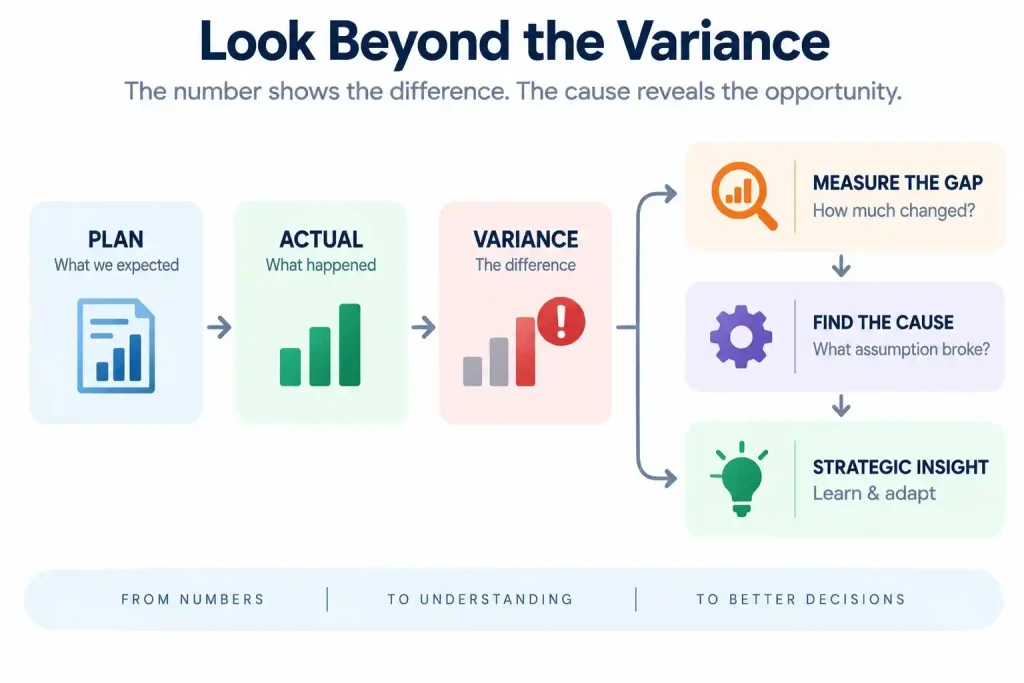
The Anatomy of a Single Budget Variance
Every forecast carries an illusion of control. It rests on the comfortable assumption that the future will follow the patterns of the past. When actuals arrive and diverge from that forecast, the result is variance. Too often, that variance gets treated as a discipline failure. It is really a signal worth decoding.
Magnitude Versus Cause
A variance has two parts. One is the magnitude of the deviation, and the other is its cause. The magnitude is mathematical and easy to state. The cause is narrative. It matters more. A report stating that a department ran 8% under budget in marketing explains nothing on its own. The real question is why. Was the plan unrealistic? Was execution slow? Did the market respond differently than expected?
Consider a business that budgets $10 million for a product launch. It spends $12 million instead. On the surface, a $2 million variance looks unfavorable. Suppose that spend drove a 20% revenue uplift because marketing adjusted mid-flight to a viral customer response. The same number becomes a case study in agility rather than overspending. A sound budget variance analysis looks past the ledger line. It looks at the decision that produced it.
The Psychology Behind Variance
Variance touches something personal for most executives. Planning well feels like a mark of competence, and missing a forecast can feel like a personal failing. This often produces rationalization. A genuine lesson gets buried under the label of a one-time event. A more useful posture treats a large deviation as an opportunity. It is a chance to say plainly what the organization misunderstood, not only where the numbers landed.
| Variance type | Surface read | Deeper question |
| Cost overrun tied to revenue lift | Unfavorable | Did the spend produce disproportionate return? |
| Capex underspend | Underperformance | Did diligence delay reflect sound risk discipline? |
| Recurring hiring miss | One-time delay | Is the hiring assumption structurally wrong? |
| Chronic revenue timing miss | Seasonal noise | Does the market reward a different sales rhythm? |
A capital expenditure variance illustrates this point well. Actuals may fall short of budget because projects were delayed for due diligence rather than because they failed. The shortfall may then reflect discipline and risk awareness rather than underperformance. Risk appetite belongs in this reading too. A variance from prudent risk-taking is different from one caused by negligence, and governance judgment should separate the two.
Reading Patterns Across a Budget Variance Report
A single variance is like a gust of wind. It may knock a plan off balance without changing its direction. A pattern of variances across a budget variance report, seen over several cycles, is closer to the wind shifting entirely. It deserves a different kind of attention.
From Isolated Numbers to Recurring Themes
Financial planning remains a human exercise. Bias, inertia, and optimism all shape it. A sales leader confident in a new product will tend to overstate demand. A team unwilling to expose fragility will understate cost. The plan absorbs these biases smoothly. The variance pushes back against them consistently over time.
A company may consistently miss its hiring targets each quarter, with a different explanation each time, such as pipeline issues in one quarter and competitive offers in the next. That pattern often points to a structurally over-ambitious hiring assumption, not a string of unrelated setbacks. Adjusting that assumption can ripple through revenue projections. It can also force uncomfortable conversations about prioritization, which is often why the model stays unchanged even as the same variance recurs.
Turning Pattern into Policy
Customer behavior patterns show up the same way. A firm may budget for linear revenue realization but see customers consistently delay conversion until the back half of the year. That pattern may reflect a structural feature of the market rather than seasonal noise. Recognizing the pattern raises a deeper question. Does capital deployment actually match how customers behave?
Capacity planning connects to this pattern directly. Revenue can materialize late while costs stay front-loaded. The resulting cash flow tension is not simply a forecasting miss. It is a signal to redesign the company’s operational tempo. It also calls for rebalancing investment against yield. Pattern recognition also reduces planning whiplash. Teams that treat a single quarter’s shortfall as an isolated failure tend to over-correct the following quarter, producing a new variance in the opposite direction. Recognizing a genuine pattern lets a CFO model accordingly, instead of reacting to noise.
Resource allocation benefits from this same lens too. Variance patterns can show consistent over-performance in one geography and under-performance in another. That pattern becomes directional information about where capital, attention, and leadership should concentrate next.
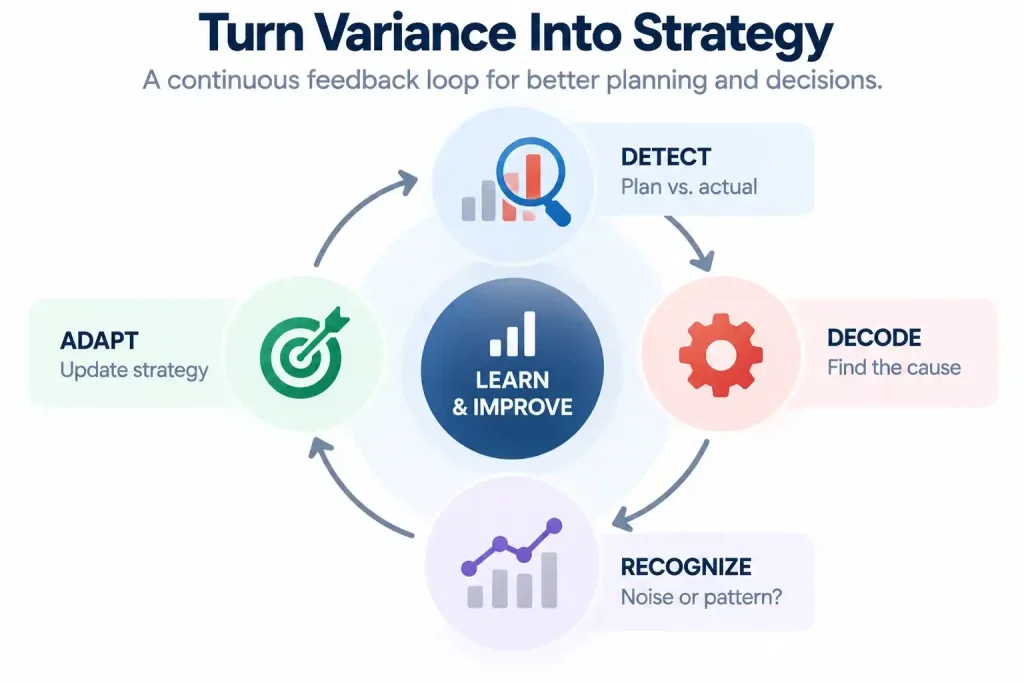
Embedding Budget Variance Analysis into a Continuous Loop
By the time a variance appears on a dashboard, the business has already lived through it. That could mean a delayed launch, a missed sales milestone, or an unexpected cost spike. The dashboard records what already happened rather than surfacing it early. Surfacing it early is the real opportunity in a modern budget variance analysis process.
Moving Away from Calendar-Driven Review
Most financial planning systems still run on an annual budget and a quarterly forecast cadence. That structure fits accounting and investor relations. Strategy and disruption rarely follow the same tidy timeline. A living variance process listens continuously. It does not wait for a formal review to notice that acquisition costs are drifting upward or a partner program is underdelivering.
Building this requires financial collaboration. It cannot rest on financial reporting alone. A sales team should see regional quota attainment mapped against planned acquisition cost. Marketing should see spend velocity against planned campaign curves, and operations should see resource utilization against capacity plans, each in a form suited to their own function.
From Report to Dialogue
Strategic initiatives often launch with strong momentum. They can lose it quietly as costs run over and benefits lag, with a budget variance report noting the gap while the initiative continues on inertia. A system where variance is embedded into the planning rhythm surfaces these gaps early. That gives a team time to course-correct or rescope the initiative before capital is wasted.
At a global SaaS company with chronic churn variance, actual churn ran consistently higher than forecast month after month. Early explanations pointed to product bugs and onboarding friction. The pattern persisted anyway. A cross-functional review across product, customer experience, and marketing found the cause. Early-stage users lacked contextual guidance during their first week. A new onboarding initiative narrowed the variance over time. Just as importantly, the teams began planning together instead of in parallel. This shift from correction to dialogue matters. It separates a budget variance report that sits in a folder from one that actually changes behavior.
Making Budget Variance a Leadership Discipline
At its most developed, budget variance stops being only a number to explain. It becomes a way of leading. The gap between plan and actual becomes a channel. Through it, the business communicates what it is actually experiencing.
Separating Signal from Noise
This does not mean reacting to every deviation. A disciplined approach separates volatility that matters from volatility that is simply noise. It knows when to update a model and when to let a variance run its course first. Some deviations need immediate attention. Others need observation, and others need patience. That judgment is a skill built over many review cycles, not a fixed rule.
At an early-stage email marketing technology company, a turnaround reduced monthly burn from $800K to $200K. That result depended on this kind of disciplined reading of variance, distinguishing real structural cost problems from short-term noise and acting decisively on the former.
Building a Culture That Learns from Variance
How leadership treats variance shapes the whole organization’s relationship with truth over time. A culture where teams manipulate accruals or explanations to protect optics produces strategy that looks sound on paper. That strategy turns out to be fragile under real pressure. A culture that treats variance as feedback tends to build strategy that holds up. A leader who can say plainly what the organization misread, and how it plans to adapt, builds that strategy on honest information.
Psychological safety underpins this entire dynamic. Leaders need to feel safe surfacing a variance and exploring its causes, without fear of being blamed simply for being wrong. That safety has to be modeled consistently by the CFO, not declared once and forgotten.
Three Key Takeaways
- Read every budget variance for both magnitude and cause, since the narrative behind a number usually matters more than the number itself.
- Track budget variance analysis across cycles to spot patterns, since a recurring deviation is a strategic signal and not a repeated coincidence.
- Embed variance review into a continuous loop and a leadership culture, so a budget variance report becomes a tool for dialogue and adaptation rather than a record filed away after the fact.
Disclaimer: This article is intended for informational purposes only and does not constitute legal, tax, or accounting advice. You should consult your own tax advisor or counsel for advice tailored to your specific situation.
Hindol Datta is a four-time CFO and senior finance executive with over 25 years of leadership experience across cybersecurity, SaaS, gaming, logistics, digital marketing, medical devices, consumer products, and nonprofit organizations. He has led more than $120M in fundraising and over $150M in M&A transactions while building the financial and operational systems that let complex businesses scale with confidence. He is the author of seven books in the Systems CFO Series and holds active CPA, CMA, and CIA credentials.
AI-assisted insights, supplemented by 25 years of finance leadership experience.