
Executive Summary
M&A integration is where the value promised in a deal is either realized or quietly lost. The CFO sits closer to that outcome than anyone else on the executive team. A model can close cleanly on signing day, while the combined company still carries two sets of assumptions, systems, metrics, and habits.
This article follows CFO M&A integration through four stages: reconciling the deal model with operating reality, building strategic coherence, turning integration into a repeatable capability, and shaping a shared identity.
Why M&A Integration Remains a CFO Responsibility After Close
On paper, a merger looks tidy: two firms, a clean transaction model, and a press release that promises synergy. Once the deal closes, what remains is a collision of cultures, systems, and incentives that no spreadsheet anticipated. A merger joins two operating organizations, each with its own rhythm, its own reporting logic, and its own legacy assumptions.
Operations sees integration as aligning org charts and technology, while the CFO lens asks which financial truths will survive the blending.
When reconciliation fails, the damage shows up in the numbers before it appears in churn or attrition. Margins sag and forecasts lose accuracy, so the financial statements are where misalignment surfaces first. This is why CFO M&A integration cannot end at diligence and close, since the real work starts when the numbers stop aligning.
| Stage | CFO Role | Core Question |
| 1. Model meets reality | Diagnostician and translator | What do these numbers mean now? |
| 2. Strategic coherence | Architect and narrator | What does performance mean in the new entity? |
| 3. Repeatable capability | Institution builder | Can the organization integrate well again? |
| 4. Shared identity | Author | What has the company become? |
When the Deal Model Meets Operating Reality
In the early days, a merger is an elegant fiction of combined revenues and extracted costs. The danger in post-merger integration is not the absence of planning but the illusion of predictability. Everything fits on paper, yet cultures, people, and incentive structures do not fit so easily.
Reconciling Two Financial Philosophies
Integration works like an X-ray, exposing the skeleton beneath the performance of both companies. Metrics that made sense in isolation now contradict each other, and long-held accounting norms begin to collide.
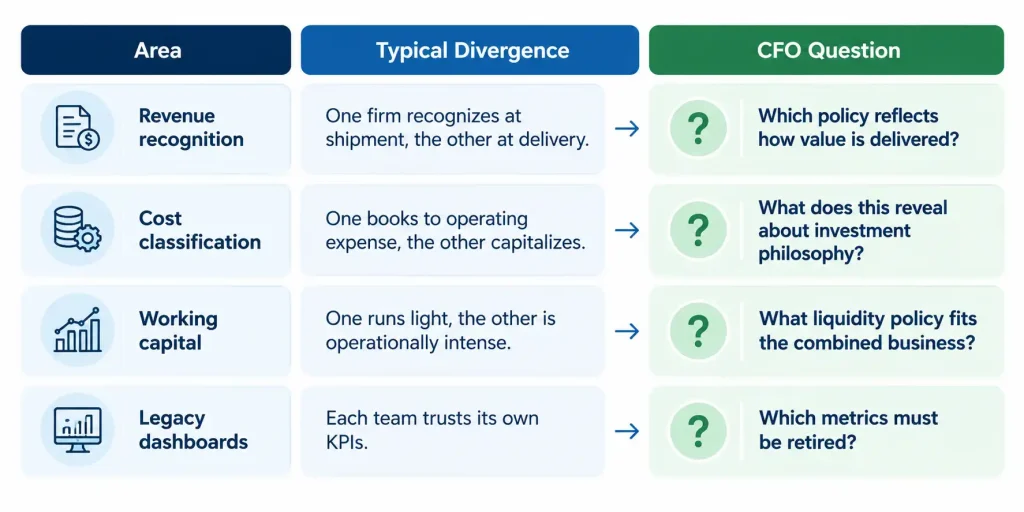
A merged balance sheet can conceal tension over liquidity and capital deployment, and left unaddressed, that tension will slow approvals and widen the variance that is always the first whisper of misalignment. The CFO acts as diagnostician, deciding which legacy metrics to retire and which new ones fit the combined firm.
A public gaming company completing more than $100M in cross-border acquisitions answered this with one revenue definition for every subsidiary, enforced through a firmwide Oracle Financials and MicroStrategy rollout. That shared definition shortened statutory reporting cycles under both IFRS and US GAAP.
Systems Shape Reality, Not Just Report It
In M&A integration, ERP migrations, data harmonization, and consolidation projects are necessary but never neutral. A chart of accounts, a cost center hierarchy, and the grain of data all embed priorities and reflect power. They decide how fast a business moves and how clearly it sees, so the CFO must author this work instead of delegating it.
At a $30M ARR cybersecurity company, a NetSuite implementation across 5 country entities cut the monthly close from 18 days to 10. The ASC 606 framework and controls environment built alongside it later carried the business through acquisition diligence.
The Culture Inside the Finance Team
Two finance teams bring their own rituals, language, and tolerance for risk into the combined entity. One may prize speed and the other precision, while one rewards cost control and the other top-line growth. Left unspoken, these differences erode integration faster than any system gap.
The CFO must redesign rituals through new planning cadences and a shared definition of what good looks like. Investors expect synergy on their timelines, but real integration moves only as fast as both teams come to trust the same numbers.
Building Strategic Coherence Across the Combined Business
After Day One fades, the organization enters its most fragile phase, the operational in-between of M&A integration. Coherence begins with a deceptively simple question about what performance means in the new entity. That question covers the true unit of value, where costs belong, and how investment and return are paced.
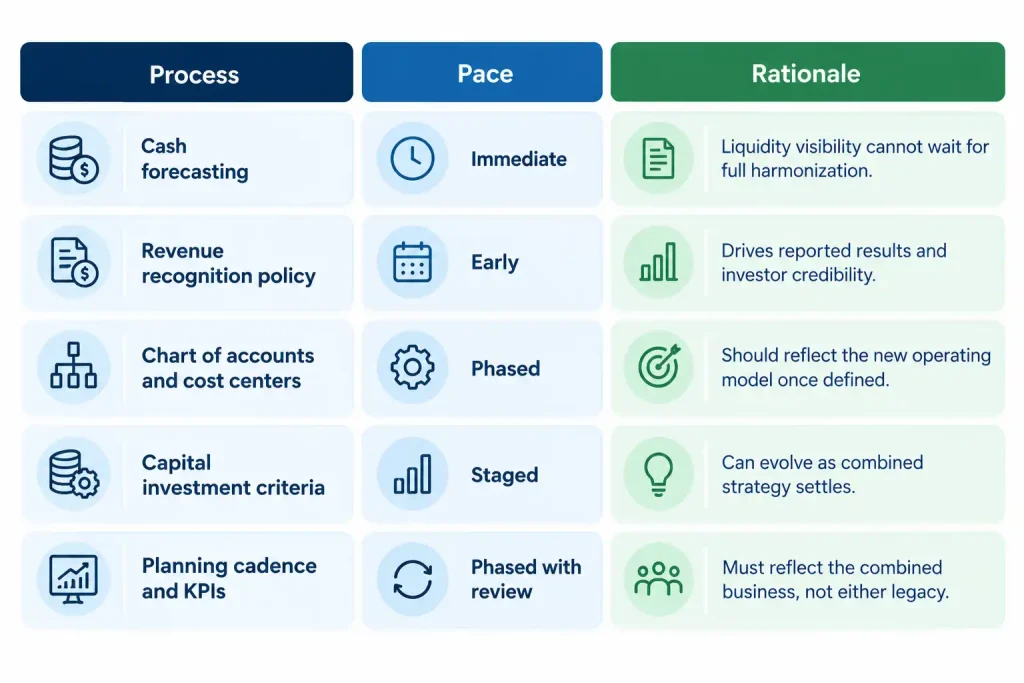
Sequencing the Integration of Finance Processes
Layering legacy forecasts, long-range plans, and budget cycles on top of each other produces dissonance instead of synergy. Each step in M&A integration should tie to a strategic consequence, not just an accounting necessity.
Governance Design and a Consistent Financial Story
Integration at this level becomes an act of narrative, and the CFO serves as its narrator. Teams need to hear why cost centers moved and why a unified EBITDA target now defines success. The ERP, BI platforms, dashboards, and planning models must all tell that same story, from the CFO suite to a regional P&L.
Bolting the acquirer’s governance onto the acquired firm signals that one culture is superior, so governance needs fresh design. Four elements deserve deliberate attention in the new entity:
- Forecast review cadence and format
- Capital approval thresholds and criteria
- Board package structure and language
- Risk monitoring and accountability ownership
Externally, credibility is the largest risk, so the CFO must own the narrative in data instead of marketing gloss.
Making M&A Integration a Repeatable Capability
Every merger begins as an event, but the better question is whether the organization can integrate well again. Treated as a heroic sprint, integration breeds exhaustion and cynicism. Treated as an operational competency like reporting or treasury, it gains owners, process, and memory.
| Dimension | Integration as Event | Integration as Capability |
| Staffing | Borrowed from FP&A and operations | Standing integration function |
| Lessons | Lost in debriefs | Captured in a living playbook |
| Scope | Decided deal by deal | Calibrated to what the firm can absorb |
| External message | Synergy promises | A disciplined, consistent track record |
Institutional Memory and the Integration Playbook
In most firms, integration lessons vanish into forward motion, so a better approach treats each merger as evidence and asks a consistent set of questions afterward:
- Which cost targets were achievable, and which were synergy mirages?
- Which cultures integrated naturally, and which needed scaffolding?
- Which metrics confused more than they clarified?
The playbook should guide without constraining, since tuck-in experience does not prepare a firm for a transformational merger. A venture-backed performance marketing company completed three acquisitions while revenue grew from $9M to $180M in 24 months. At that pace, relearning each deal from scratch was never an option.
Resourcing Integration as Strategic Infrastructure
Ad hoc staffing pulls talent from exhausted operating leaders and breeds burnout. A standing integration function curates the process, protects data fidelity, and explains what numbers mean in transition. It also becomes a mirror that exposes gaps in the acquirer’s own processes.
Quality-of-earnings work on an IT services acquisition shows why that knowledge matters before close. The analysis surfaced material EBITDA adjustments and identified where post-close operational risk was concentrated.
M&A Integration and Shared Identity: From Acquirer to One Company
Eventually the systems run in unison and forecasts run clean, yet teams still refer to a legacy business, and the merger remains incomplete in practice. The numbers can reconcile long before the teams do, which makes this final stage organizational as much as financial.
Measuring Success with New Yardsticks
Identity forms through story, which the CFO shapes through earnings calls, town halls, and board decks. A few questions reveal whether this identity work is complete:
- Is success still measured with legacy yardsticks?
- Do internal metrics reflect unified direction, not just combined scale?
- Are budgets built for alignment or for inertia?
- Are strategy reviews organized around outcomes instead of origin?
The best finance leaders answer through behavior, consolidating KPIs to align incentives, not to erase differences. They hold the public voice steady, because investors notice when the story outruns the numbers. The firm then stops collecting businesses and becomes a curator of coherence, where each acquisition reads as a chapter in one story.
Three Key Takeaways
- Value in M&A integration is created after the deal, so the CFO must reconcile accounting policies and legacy metrics before variance widens.
- Coherence depends on sequencing cash forecasting and revenue recognition first, followed by systems, governance, and planning rituals.
- CFO M&A integration becomes a durable advantage when treated as a capability with a standing team and a living playbook.
Disclaimer: This article is intended for informational purposes only and does not constitute legal, tax, or accounting advice. You should consult your own tax advisor or counsel for advice tailored to your specific situation.
Hindol Datta is a four-time CFO and senior finance executive with over 25 years of leadership experience across cybersecurity, SaaS, gaming, logistics, digital marketing, medical devices, consumer products, and nonprofit organizations. He has led more than $120M in fundraising and over $150M in M&A transactions while building the financial and operational systems that let complex businesses scale with confidence. He is the author of seven books in the Systems CFO Series and holds active CPA, CMA, and CIA credentials.
AI-assisted insights, supplemented by 25 years of finance leadership experience.