
Executive Summary
Financial due diligence in M&A is rarely about catching fraud. It is about separating durable value from momentum that has been dressed up to look permanent. A target’s revenue may climb, its margins may expand, and its investor deck may read like a well-rehearsed performance. The real work of due diligence begins where the polish ends. It lives in the earnings quality, the off-balance-sheet exposures, and the revenue mix a deal leaves behind. It lives, too, in the synergy assumptions and the capital structure implications that follow.
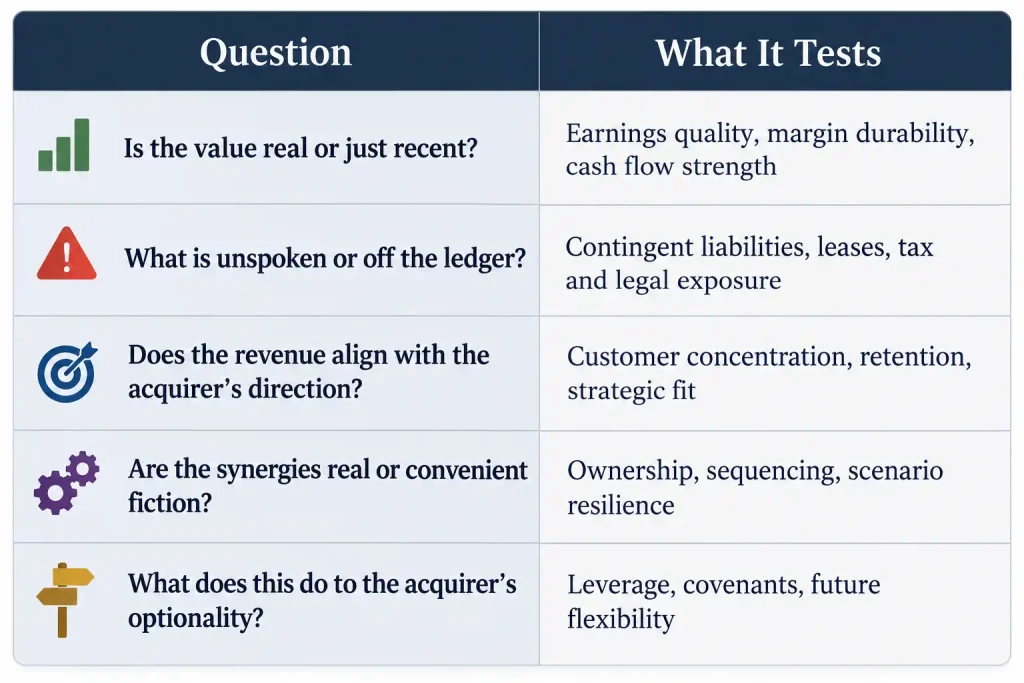
This article lays out a practitioner framework for financial due diligence M&A teams can apply before signing. It is built around five questions. Each one determines whether an acquisition creates lasting value or simply transfers risk from seller to buyer. Each section closes with the operational discipline required to answer that question with evidence rather than assumption.
Testing Earnings Quality Before Trusting the Number
The starting point for financial due diligence M&A processes almost always demand is earnings quality. Adjusted EBITDA is not a destination; it is a trailhead. It bends under non-recurring adjustments, flexes with revenue recognition choices, and often reflects investor narrative more than economic substance. A disciplined review strips out the exclusions and recasts capitalized costs. It then tests whether revenue is recurring in practice or only in labeling.
In one buy-side engagement supporting due diligence on an IT services acquisition, hands-on quality-of-earnings analysis surfaced material EBITDA adjustments that were not visible in the headline numbers, along with integration risks concentrated in areas the seller’s materials had glossed over. Those findings directly reshaped the buyer’s view of both price and structure.
Margins deserve the same scrutiny as revenue. Were they earned through operational efficiency, or borrowed from deferred investment in customer support, infrastructure, or compliance? Free cash flow, adjusted for working capital swings and capex timing, tends to answer the question that adjusted EBITDA obscures: can this business fund itself without the assumptions built into the model continuing to hold?
Off-Balance-Sheet Risk and Contingent Liabilities
The second pillar of financial due diligence M&A teams cannot skip is what does not appear on the balance sheet at all. Contingent liabilities, dormant indemnity clauses, operating leases with escalation terms, and minimum volume commitments do not announce themselves. They surface months after close, usually at the worst possible time.
The categories worth examining closely include:
- Legal contingencies – litigation marked “not expected to result in material losses,” a phrase that recurs regardless of whether the underlying risk is trivial or strategic
- Lease and purchase commitments – long-term obligations signed during a growth surge, with escalation clauses that now outpace inflation
- Customer rebates, returns, and warranties – accrued but rarely stress-tested for adequacy against an aging product line
- Intellectual property encumbrances – expired licenses, open-source obligations, and prior art exposures that transfer to the buyer at close
- Tax exposures – transfer pricing and jurisdictional structures left unreviewed as a company scaled internationally
None of this requires suspicion of the seller. It requires what might be called disciplined skepticism: asking why a legal reserve moved, understanding a controller’s provisioning philosophy, and walking every contractual obligation that does not appear on the balance sheet against the headcount and facilities plan. A lower purchase price based on newly discovered obligations is not a sign of a failed negotiation; it is usually a correction, and a deal restructured with escrow or indemnities reflects maturity rather than mistrust.
Revenue Quality and Strategic Fit
Revenue is the most seductive line in any deal deck, and the least safe to accept at face value. Financial due diligence M&A work must interrogate not only how much revenue a target generates, but how it was earned and whether it aligns with the acquirer’s long-term direction.
A target with eighty percent of revenue in three enterprise contracts may look formidable until those contracts approach renewal under aggressive renegotiation terms. Annual recurring revenue figures can mask churn disguised by top-of-funnel velocity. Customer concentration, discount-driven growth, and go-to-market motions that do not match the acquirer’s sales cycle all convert a promising top line into an integration liability.
In a Series B marketplace SaaS engagement, the reporting framework built to withstand investor diligence combined consolidated multi-country financials with cohort and unit economics models, precisely because top-line growth alone would not have survived scrutiny without evidence of durable retention beneath it. The same logic applies on the buy side: revenue that does not clarify the acquirer’s strategy will eventually distract from it.
Synergy Assumptions: Testing Before Trusting
No word carries more optimism into a deal room than synergy, and few promises are as fragile once integration begins. Cost synergies assume frictionless headcount consolidation; revenue synergies assume customers and sales teams will absorb change without disruption. Both assumptions tend to survive the model and fail the org chart.
Credible synergy analysis requires:
- Granularity – a specific action, owner, timeline, and metric attached to every claimed synergy, not a lump-sum assertion
- Sequencing – synergies mapped across quarters rather than assumed to land immediately
- Scenario testing – modeling what happens if integration runs long, key leaders depart, or a shared customer is confused by the new offering
- Ownership – a named individual accountable for each synergy line, not a department
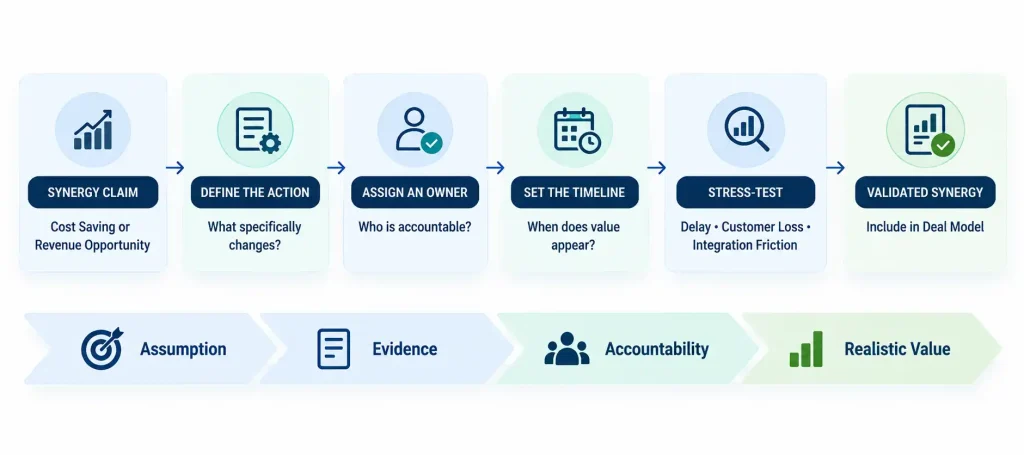
At a Euronext Paris-listed gaming and digital entertainment company, over $100M in cross-border M&A was executed with full due diligence and post-merger integration ownership sitting inside the finance function itself, which is precisely where synergy accountability tends to survive contact with reality and where it tends to disappear when it does not.
Capital Structure and Strategic Optionality
The least visible cost of an acquisition is rarely the purchase price. It is the change to the acquirer’s own capital structure and its capacity to act afterward. Debt financing introduces covenants and refinancing risk; equity financing dilutes ownership; cash financing compresses liquidity. Each choice reshapes what the company can still do once the deal closes.
At a $127M global consumer products company operating across DTC, Amazon, and wholesale channels, inventory turns more than doubled from three times to seven, releasing working capital that preserved exactly the kind of financial flexibility an over-leveraged acquisition would have consumed. That is the tradeoff financial due diligence M&A teams must model explicitly: does the deal preserve the ability to fund organic growth, absorb a downturn, and pursue the next opportunity, or does it spend all of that capacity on the current transaction?
A Practitioner’s Framework: Five Questions
Three Key Takeaways
- Earnings quality and cash flow, not headline growth, determine whether a target’s value is structural or borrowed from deferred pain that will surface after close.
- Off-balance-sheet exposures and synergy assumptions carry the highest risk of any deal component precisely because they are the least visible during negotiation, which makes disciplined skepticism a required practice rather than an optional one.
- An acquisition should be judged not only by what it adds to the acquirer’s revenue, but by what it costs the acquirer’s strategic optionality, since a deal that eliminates future flexibility can outweigh the value it appears to create today.
Disclaimer: This article is intended for informational purposes only and does not constitute legal, tax, or accounting advice. You should consult your own tax advisor or counsel for advice tailored to your specific situation.
Hindol Datta is a four-time CFO and senior finance executive with over 25 years of leadership experience across cybersecurity, SaaS, gaming, logistics, digital marketing, medical devices, consumer products, and nonprofit organizations. He has led more than $120M in fundraising and over $150M in M&A transactions while building the financial and operational systems that let complex businesses scale with confidence. He is the author of seven books in the Systems CFO Series and holds active CPA, CMA, and CIA credentials.
AI-assisted insights, supplemented by 25 years of finance leadership experience.