
Executive Summary
A strategic roadmap is often presented as a tidy chart of milestones, yet the future rarely arrives in the order a slide suggests. The real work lies in turning a company’s intended future into choices that can be modeled, funded, and lived.
This article covers how to create a roadmap for a strategic plan that holds under pressure. It treats vision as a decision and prioritizes by consequence instead of popularity. It also shows how capital becomes a statement of conviction and how a steady review rhythm keeps the roadmap alive.
Why a Strategic Roadmap Is Not a Forecast
Most strategic plans are drawn in a comforting geometry of stacked milestones and neatly divided quarters. That geometry deceives, because markets arrive in waves, lulls, and sudden inflections. The map is still necessary, but its purpose is to prepare the organization for the future’s asymmetries, not to predict them.
Long-term vision is a decision about who the company intends to become before the evidence exists to justify it. That places the CFO in an uncomfortable spot, serving as the voice of prudence while holding the pen for futures not yet proven.
The CFO as Translator Between Ambition and Reality
A strategic roadmap forces questions that few executives volunteer to ask. What must be true for the vision to become real, and by when? Which investments must be front-loaded even though their return is uncertain? What will be deferred, not because it lacks value, but because timing is itself a form of strategic capital?
Each audience sees only a fragment of the plan. Engineers see hiring, product leaders see features, and the board sees capital allocation. The CFO makes those fragments move toward a whole, translating between the CEO’s vision and each unit’s bandwidth.
A company that declares it will double revenue in three years offers a useful test. The declaration earns applause, but the roadmap reveals whether the intent is serious:
- Does the hiring plan reflect the velocity the target requires?
- Does systems infrastructure scale with the ambition, or will it break at the midpoint?
- Does capital flow to enablers first, or only to bottlenecks after they appear?
A Living Document That Resists Noise
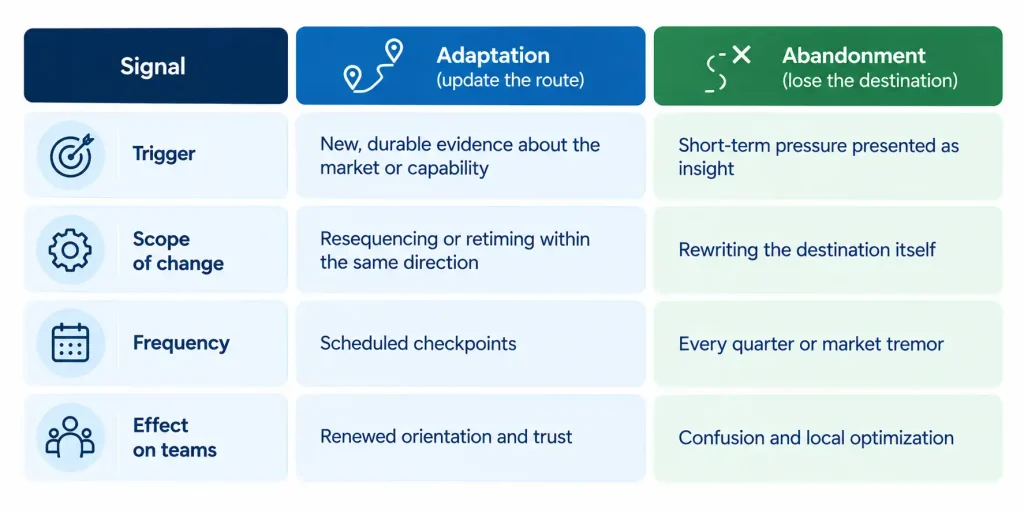
The most common mistake is treating the roadmap as static and revisiting it only during annual planning. A strategic roadmap should be reviewed for alignment as well as accuracy. The opposite failure is just as damaging, since a vision rewritten at every market tremor loses its authority. The roadmap has to bend under pressure without breaking its strategic thread.
How to Create a Roadmap for a Strategic Plan That Survives Reality
Not everything can happen at once, and there is never enough capital, talent, or time. The CFO’s task is not to deny ambition but to order it. Priority is revealed through consequence: what happens if this does not occur now, and what does it unlock if it does?
Sequencing Around Load-Bearing Walls
A good architect begins with load-bearing walls, not aesthetics, and strategic planning follows the same logic. The most enabling actions deserve primacy even when they are invisible to customers and investors. When each priority creates space for the next, the sequence becomes a system that builds momentum.
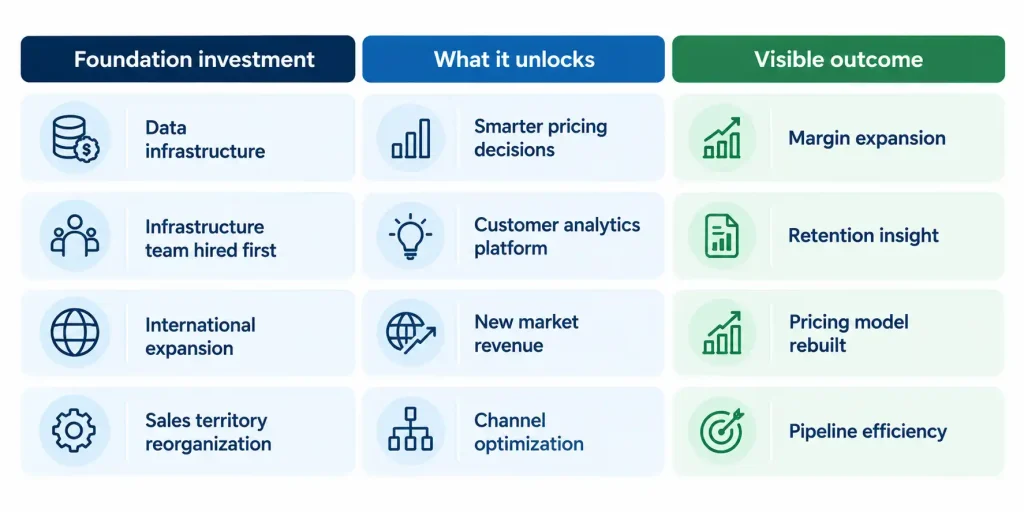
One venture-backed digital marketing company scaled from $9M to $180M in 24 months. Finance built acquisition cost, lifetime value, and contribution margin discipline before the steepest growth arrived. That groundwork let growth hold its shape instead of outrunning the organization.
Forcing Tradeoffs into the Open
Prioritization is a political exercise as much as a logical one. Product pushes for speed, sales demands enablement, and operations calls for constraint, so the CFO must mediate by clarifying rather than appeasing. Every roadmap hides tradeoffs, and naming them turns a wish list into a plan:
- Investing in international growth this year may mean deferring a product relaunch.
- Focusing on talent development may mean holding off on margin expansion.
- Strengthening a foundational system may mean declining a popular initiative.
Without that candor, initiatives pile up, talent is deployed reactively, and teams optimize locally. Tracking hiring pace, onboarding depth, and system rollout velocity shows what the organization can absorb. The most strategic decisions often look conservative at first and reveal themselves as foresight later.
Funding the Strategic Roadmap with Capital as Conviction
A roadmap without capital behind it remains poetry, however well it is drawn. Capital allocation is how a company declares what it believes is worth building. Left unprotected, the roadmap gets distorted by budget cycles, with dollars drifting to the loudest voice instead of the most necessary investment.
The CFO must weigh trajectory as well as ROI, since what looks discretionary this year may be existential the next. A roadmap may name a new market as critical to long-term relevance. The right question is whether entering it accelerates strategic independence, not whether it pays back in 12 months.
Three Filters for Long-Term Capital Allocation
Almost any cost can be justified in the name of vision. Each proposed investment should therefore pass three tests:
- Alignment: does it fit the sequence the roadmap has established?
- Capability: does it deliver something the organization needs to reach the next stage?
- Readiness: can the organization absorb it now without splintering?
| Allocation category | Purpose | CFO posture |
| Foundational investments | Build capabilities that unlock later stages | Protect them even when returns are not yet visible |
| Strategic options and pilots | Test ideas in small iterations before larger bets | Fund them within defined boundaries |
| Convenient or reactive requests | Relieve near-term pressure outside the sequence | Decline or defer them |
Building Board Alignment Around the Sequence
Roadmaps that depend on erratic funding erode, so the board must understand the logic of investment, delay, and reinvestment. That understanding requires a narrative as much as a model, built around three questions: why this now, why this not yet, and why this never.
At a mission-driven education and research institution, that narrative work carried a $37M raise across equity and venture debt. The multi-year models behind it were built for variable philanthropic and earned-revenue conditions. The board needed to see both the destination and the route before committing capital.
Keeping the Strategic Roadmap Alive Through Rhythm
Time is the least forgiving dimension of strategy, since it neither pauses for hesitation nor extends itself for effort. Roadmaps begin with noble energy, then drift as a soft quarter, a market trend, or new leadership pulls attention away. That drift is rarely a failure of design; it is a failure of rhythm.
The remedy is a cadence of reflection and recommitment built around a few recurring questions. What has been learned since the last review? Has anything material changed in the market or the business? Is the company still pointed at the right horizon, and does this quarter’s spending reflect that direction?
Adaptation Versus Abandonment
Roadmaps are adaptive frameworks, yet adaptation and abandonment can look alike from a distance. The difference comes from discipline more than from data.
A cybersecurity and identity access management company with roughly $30M in ARR shows what this rhythm produces. A driver-based forecasting engine and a consistent reporting cadence held its actuals within 5% of forecast for 8 consecutive quarters. Predictability of that kind lets a board trust long-horizon investments, because the near-term numbers stop surprising anyone.
The CFO lives in several time frames at once, closing the quarter while carrying the thread of continuity into every board meeting. Over time, returning to the roadmap builds a culture that asks what should come next, not only what can be done now.
Walking the Strategic Roadmap, Not Only Drawing It
Every company speaks of vision, but few make it visible in how they allocate, sequence, and endure. The CFO’s final task is to walk the roadmap, not only draw it. That means asking, again and again, whether the company is still heading where it said it would.
Three Key Takeaways
- Treat the strategic roadmap as a decision about who the company intends to become, then sequence investments by what they unlock rather than by how exciting or urgent they appear.
- Make capital follow intention by testing every investment for alignment, capability, and readiness, and by helping the board understand why each item is now, not yet, or never.
- Protect the roadmap with a steady review rhythm that separates true adaptation from short-term pressure, so the route can change while the destination holds.
Disclaimer: This article is intended for informational purposes only and does not constitute legal, tax, or accounting advice. You should consult your own tax advisor or counsel for advice tailored to your specific situation.
Hindol Datta is a four-time CFO and senior finance executive with over 25 years of leadership experience across cybersecurity, SaaS, gaming, logistics, digital marketing, medical devices, consumer products, and nonprofit organizations. He has led more than $120M in fundraising and over $150M in M&A transactions while building the financial and operational systems that let complex businesses scale with confidence. He is the author of seven books in the Systems CFO Series and holds active CPA, CMA, and CIA credentials.
AI-assisted insights, supplemented by 25 years of finance leadership experience.