
Executive Summary
Forecast credibility is the quiet currency of the boardroom, and it is earned through judgment more than decimal precision. Directors rarely trust a spreadsheet on its own merits; they trust the reasoning they can see behind it. This article examines how CFOs build boardroom trust through transparent assumptions, consistent variance reporting, and candor when results fall short.
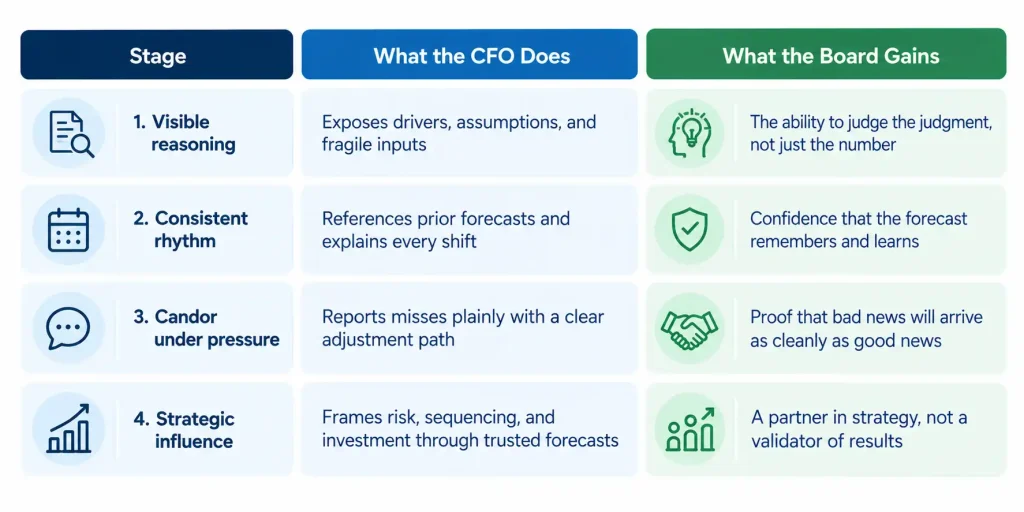
The argument follows four stages of a single arc toward credibility. It runs from visible thinking and steady quarterly rhythm to candor under pressure and strategic influence.
Why Forecast Credibility Is a Test of Judgment, Not Arithmetic
Every forecast is an attempt to draw structure around uncertainty, to make the future speak plainly enough that others can commit to it. It is the most human act a CFO performs, because it exposes how the finance leader thinks.
A board lives one level removed from execution by design. It does not build product, chase receivables, or hire engineers, but it must decide what to believe. Behind every number sits a quieter question the board keeps asking: can we trust what we are being told?
Forecast accuracy alone does not answer that question for the board. A forecast that misses by a few points is forgiven when its logic was sound and its assumptions were transparent. A near-perfect forecast can still erode trust if it arrives wrapped in opacity or inflated by optimism. Over time, directors learn to tell the difference between a result that was earned and one that was engineered.
Building Forecast Credibility Through Visible Reasoning
Before numbers can inspire boardroom trust, they must reveal the mind that produced them. A credible forecast is not the past stretched forward into the future. It is a blueprint of how the CFO sees the machinery of the business. The framework must make assumptions, accepted risks, and chosen beliefs visible to directors.
Choosing Realism Over Elegance in the Financial Forecast
Many forecasts fail by being too elegant, with smooth growth curves and stepwise margin expansion. The model balances, but the story falters, because boards respond to realism over polish. Realism does not mean pessimism; it means every forecasted line carries a traceable rationale. A board-ready forecast should answer questions like these without hesitation:
- Is revenue growth driven by price, volume, geography, or segment mix?
- Which specific levers, such as automation, sourcing, or cost discipline, explain margin expansion?
- Does the cost structure anticipate operating reality, or hope that reality cooperates?
- Which assumptions are soft, and which depend on customer behavior that cannot be predicted?
At a $30M ARR cybersecurity and identity SaaS company, this discipline became a driver-based forecasting engine built from scratch. Every line tied back to a capacity model and an operating driver. Actuals then held within 5% of forecast for 8 consecutive quarters. The board drew confidence less from the accuracy itself than from the visible logic that produced it.
Being Wrong in Useful Ways
Every forecast will be wrong somewhere, so directors want to know whether the CFO has thought deeply enough to be wrong in useful ways. A useful miss reveals the edge of what could be known and invites reflection instead of regret. Acknowledging fragility without panic or excuse earns a kind of capital that no variance report can buy. It shows a CFO walking through the model instead of hiding behind it, treating forecasting as preparation for the future.
Consistency, Memory, and the Long Arc of Boardroom Trust
Forecast credibility is composed in layers, across seasons, earnings cycles, and crises absorbed. Boards listen to what is said, and they also compare it against last quarter’s expectations. They are not looking for stubbornness; they are looking for coherence and a CFO who remembers what she forecasted.
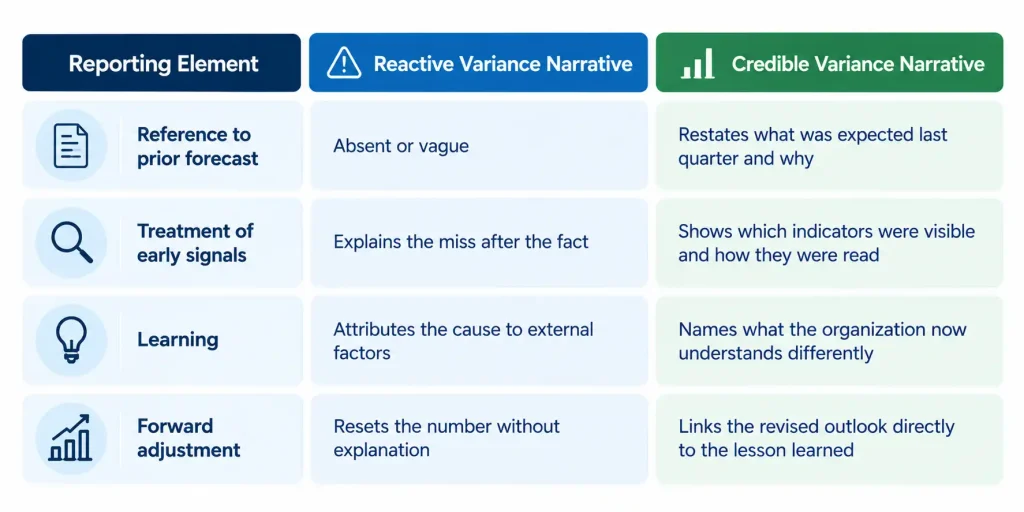
This memory shows most in how variances are discussed with the board. Directors will ask whether the risk was flagged, whether indicators were blinking, and what changed in interpretation. Boards forgive misses, but they lose confidence in blindness.
Guarding Against Forecast Drift
Memory also protects against forecast drift, the quiet quarter-by-quarter inflation of expectations. Drift rarely arrives in one leap; it accumulates through small stretches of optimism, each defensible on its own. The CFO must resist pushing numbers toward consensus when the operating machinery cannot bear the strain. Boards, paradoxically, prefer a slightly lower forecast they can believe to an ambitious one they must doubt.
Scenario Planning That Walks Through Volatility in Advance
Not every forecast needs base, upside, and downside cases, but material uncertainty calls for them. Directors do not want to be surprised by volatility; they want evidence that the CFO has already walked through it. At a mission-driven education and research institution, multi-year models built under variable philanthropic and earned-revenue scenarios served this purpose. The Finance and Audit Committee could see the range of outcomes before any of them arrived. That visibility made each monthly report easier to trust.
Protecting Forecast Credibility When the Numbers Miss
No forecast survives reality untouched, and the moment of disappointment reveals the character of a CFO in full. The pull toward defensiveness is understandable, but language thickens and blame drifts outward. Boards may accept the explanation, yet they remember the evasion, and trust begins to fray.
The credible response is clean and level, and it tends to follow a simple sequence:
- State the miss plainly, without preamble or dramatization.
- Restate what was believed and the assumptions behind that belief.
- Explain what was learned, including whether the cause was execution or judgment.
- Show how the forecast and the operating plan are being adjusted.
A line such as “adoption in this segment is gated by onboarding time” does more than explain. It restores alignment by drawing a line from the miss to a sharper understanding of the business. The credible CFO also resists repairing confidence with new, more ambitious promises. She lets the board sit with the truth, trusting that adults spoken to as adults will respond with maturity.
How Candor Turns Skeptical Directors into Allies
When a board sees bad news reported as plainly as good news, the relationship begins to shift. Directors stop questioning the data and start exploring implications for capital plans, hiring pace, and product roadmaps. That transformation is the fruit of forecast integrity. It must be protected even when the CEO or the market wants a smoother curve.
How Earned Boardroom Trust Becomes Strategic Influence
Once forecast credibility is established, a new kind of power emerges for the CFO: influence rather than control. The board stops auditing and starts advising, listening for insight instead of error. That influence appears in several practical forms:
- Approval of multi-quarter investments that depress margin before they lift revenue
- Board questions focused on strategic conviction over near-term volatility
- Capital allocation against scenarios that are not yet visible in earnings
- Room to pivot the forecast without the board assuming manipulation
This slack matters most during strategic transitions such as market entry, model shifts, acquisitions, or new AI platforms. These events unfold across time, and their financial signature is rarely linear. At a Euronext Paris-listed gaming company, more than $100M in cross-border acquisitions reshaped the financial picture. A single unified definition of revenue across every subsidiary gave the board a map it could believe during that transition.
Credibility, once earned, must be renewed, because a single act of misdirection can unwind years of integrity. Forecasts do not predict or control, but when built with care and delivered with clarity, they give shape to belief.
The Forecast Credibility Arc
Three Key Takeaways
- Forecast credibility rests on visible reasoning, not polish. Every major line in a board forecast should carry a traceable driver and an honest note on fragility.
- Boardroom trust is built through rhythm and memory across quarters. That means referencing past expectations, diagnosing variances, and resisting the slow inflation of forecast drift. A slightly lower number the board can believe outperforms an ambitious one it must doubt.
- The moment of disappointment is where credibility crystallizes into trust. The CFO states the miss plainly, names the lesson, and adjusts without overpromising. Trust earned this way becomes influence, giving finance leaders the slack to guide strategy instead of merely reporting on it.
Disclaimer: This article is intended for informational purposes only and does not constitute legal, tax, or accounting advice. You should consult your own tax advisor or counsel for advice tailored to your specific situation.
Hindol Datta is a four-time CFO and senior finance executive with over 25 years of leadership experience across cybersecurity, SaaS, gaming, logistics, digital marketing, medical devices, consumer products, and nonprofit organizations. He has led more than $120M in fundraising and over $150M in M&A transactions while building the financial and operational systems that let complex businesses scale with confidence. He is the author of seven books in the Systems CFO Series and holds active CPA, CMA, and CIA credentials.
AI-assisted insights, supplemented by 25 years of finance leadership experience.