
Executive Summary
Audit readiness is often mistaken for a formatting exercise. Many assume clean spreadsheets and a working familiarity with GAAP can resolve it on their own. More than two decades of finance leadership across cybersecurity, SaaS, gaming, logistics, digital marketing, medical devices, and nonprofit organizations point to a different picture. Audit readiness is a test of systems, habits, and culture. It is not a test of arithmetic. Companies rarely stumble over a complex technical error buried in the ledger. They stumble because of gaps in process. A revenue policy nobody wrote down. An accrual with no supporting schedule. Equity records out of sync with a board approval. Documentation assembled the week before auditors arrived, instead of maintained continuously.
This article examines the pitfalls that most often undermine audit readiness and argues that genuine readiness is not a sprint before year end. Finance leaders build it as a discipline, months and often years in advance, and the payoff extends well beyond a smoother audit to faster capital raises and cleaner diligence.
Why Audit Readiness Begins with Systems, Not with Numbers
Founders often assume audit readiness comes down to a tidy profit and loss statement paired with a working familiarity with the accounting rules. That assumption rarely survives contact with an actual audit, especially for companies scaling from a Series B toward a Series D or preparing for acquisition. Auditors are not simply verifying that numbers add up. They are testing whether the systems behind those numbers can withstand scrutiny from someone who sat outside the room when the decisions were made.
A Pattern That Repeats Across Industries
Across cybersecurity, SaaS, gaming, logistics, digital marketing, medical devices, and nonprofit organizations, one pattern recurs with striking consistency. The obstacles that stall an audit rarely begin with an esoteric technical question. They begin with a modest gap in process that feels inconsequential until an external party asks for supporting evidence. While serving as the de facto head of finance for a high-growth cybersecurity and identity access management company generating roughly $30M in annual recurring revenue across five countries, that pattern showed up as a forecasting gap. Actuals landed within plus or minus five percent of forecast for eight consecutive quarters only after the forecasting engine and reporting cadence were rebuilt from scratch, a discipline that later carried the business through acquisition diligence without a late-stage scramble.
How Small Gaps Compound into Larger Audit Delays
Any one of the pitfalls below can delay a signoff by weeks on its own. In combination, they can disrupt a financing round or slow an acquisition, and they tend to surface in a fairly predictable order:
- Revenue recognition policies that were never formally written down
- Accruals and prepaids that lack a supporting schedule
- Equity records that drift out of sync with legal approvals
- Contracts and vendor agreements that cannot be located quickly
- Policy documentation that exists only as tribal knowledge
- Reconciliations that were backfilled instead of maintained continuously
None of these gaps is difficult to close on its own. What makes them dangerous is that they tend to arrive together, compounding the time an audit requires.
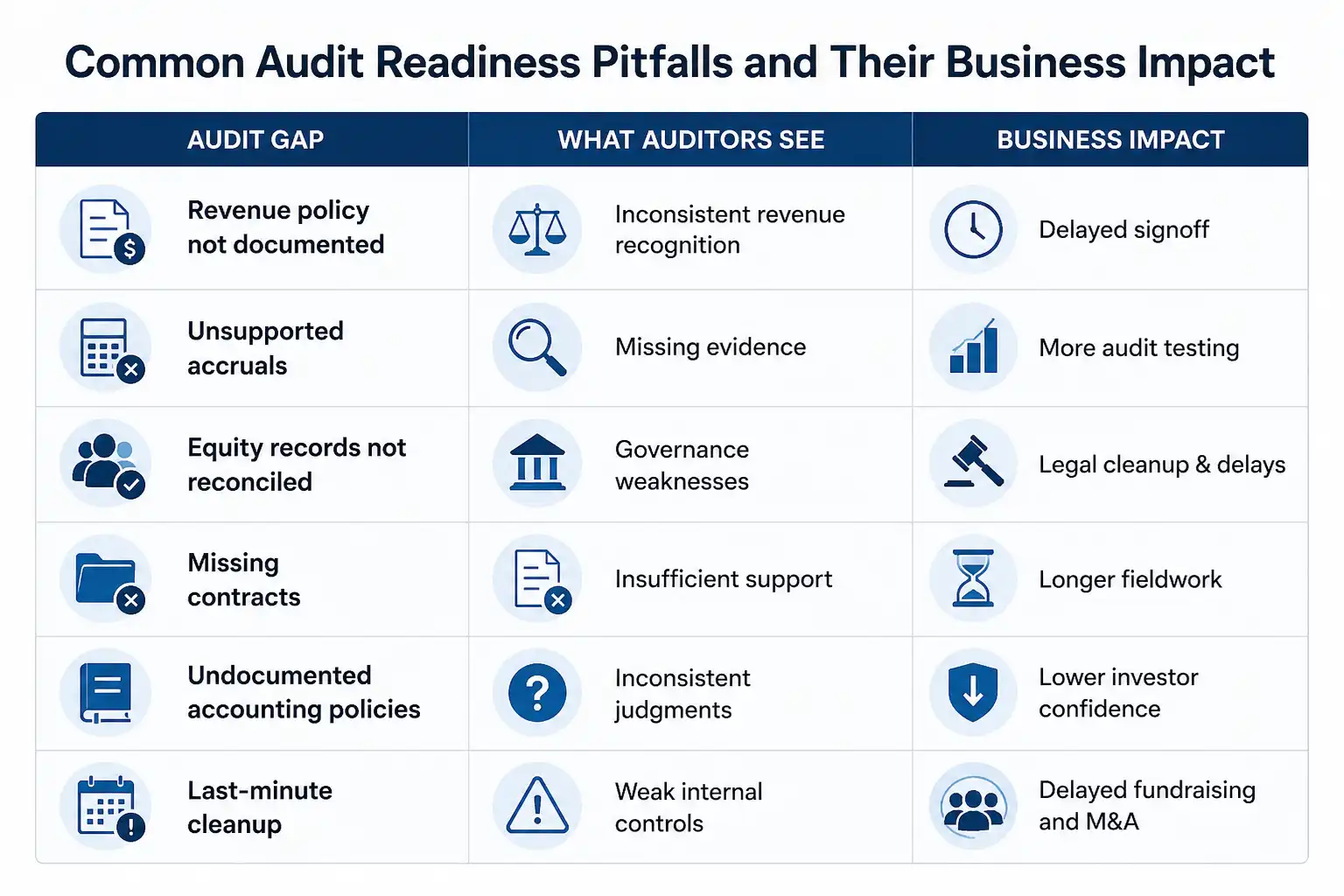
The Recurring Pitfalls That Undermine Audit Preparedness
Unclear Revenue Recognition Policies
Revenue remains the line-item auditors scrutinize most closely, yet many companies treat its documentation as an afterthought. One engagement involved a company recognizing revenue upon invoicing, even for multi-year contracts with delayed delivery. The logic felt intuitive, but it conflicted with ASC 606, which requires recognition to align with when value is delivered. Without a written policy or deferral schedule to point to, the audit uncovered the gap late, requiring a restatement that delayed signoff by 6 weeks and nearly derailed a growth round. A revenue recognition policy built for audit readiness generally covers:
- Contract categorization by type, term length, and delivery schedule
- Written accrual logic for usage based or subscription billing
- Documented treatment of discounts, incentives, and variable consideration
- A deferral schedule maintained monthly rather than reconstructed at year end
Poorly Documented Accruals and Prepaids
Accruals and prepayments are another frequent source of friction, especially for companies leaning on cash-based habits inherited from an earlier stage. A general ledger reviewed in one engagement showed a single year-end entry recording $600K in expense, with no schedule and no vendor backup, triggering additional testing that pushed signoff back by weeks. A close process built for audit readiness typically includes:
- Accruals tied directly to invoices, contracts, or known obligations
- Prepaid balances rolled forward monthly on a schedule someone maintains
- A standing month-end checklist that does not get reinvented each quarter
- Vendor backup attached to every material entry at the time it is booked
Inconsistent or Unreconciled Equity Records
Cap table integrity is easy to overlook when founders assume a 409A provider or outside counsel is handling every detail. Equity is a focal point in nearly every audit: auditors verify option grants, confirm board approvals, and reconcile cap tables. In one case, a company granted options before the board finalized approval, and the equity ledger was never updated to reflect it. Correcting the mismatch required legal cleanup and additional auditor procedures that earlier discipline would have avoided. Equity deserves the same rigor as cash: reconciled monthly, aligned with legal approvals, and maintained as a single source of truth.
Missing Contracts and Inadequate Policy Documentation
Auditors depend on supporting documentation to validate every ledger entry, and when a company cannot produce vendor agreements or lease terms quickly, even routine entries draw scrutiny. This holds especially true of related-party transactions, which require disclosure and often trigger added procedures. A data room should function as a living system, updated continuously, not a once-a-year scramble. The same is true of policy: many organizations run on tribal knowledge until the person who built a process moves on, and an outside reviewer has no other way of knowing the logic behind it. The core policies most audit-ready finance functions keep in writing include:
- A revenue recognition policy covering contract types and deferral logic
- A capitalization policy for software development and internally built assets
- A documented treatment of customer incentives, discounts, and rebates
- An expense reimbursement policy covering employees, advisors, and executives
- A related-party transaction policy defining disclosure and approval steps
Late-Stage Cleanups Masked as Readiness
The most consequential pitfall is mistaking a last-minute cleanup for genuine audit readiness. Bringing in an external controller just before audit season rarely compensates for years of informal practice. Experienced auditors test the process behind the balances, and a rushed reconciliation tends to invite closer scrutiny, not less. Companies do not assemble true readiness in a sprint; they build it across every close cycle.
From Checklist Thinking to Systemic Financial Discipline
Some finance teams treat an audit as a checklist: answer the prepared-by-client list, upload the files, wait for signoff. An audit-ready organization sees it differently, evaluating how well its systems represent the business as it actually operates. A checklist mindset says upload the invoice. A systemic mindset asks why the invoice went missing in the first place. A finance function drifting toward checklist thinking tends to show the same warning signs:
- Documentation exists but nobody can explain the judgment behind it
- Reconciliations happen only when the auditor requests them
- Policy memos get written for the first time during fieldwork
- The same open items resurface, unresolved, from one cycle to the next
This distinction became clear while designing multi-entity finance architecture for a cybersecurity company operating across five country entities, where month-end close came down from 18 days to 10 through automated revenue recognition and a disciplined KPI framework. The same principle held while scaling a venture-backed digital marketing organization from $9M to $180M in revenue over 24 months, and again while overseeing more than $100M in cross-border gaming sector acquisitions for a publicly listed company, where post-merger integration depended entirely on whether the acquired entity’s documentation could stand up to a Big Four audit team.
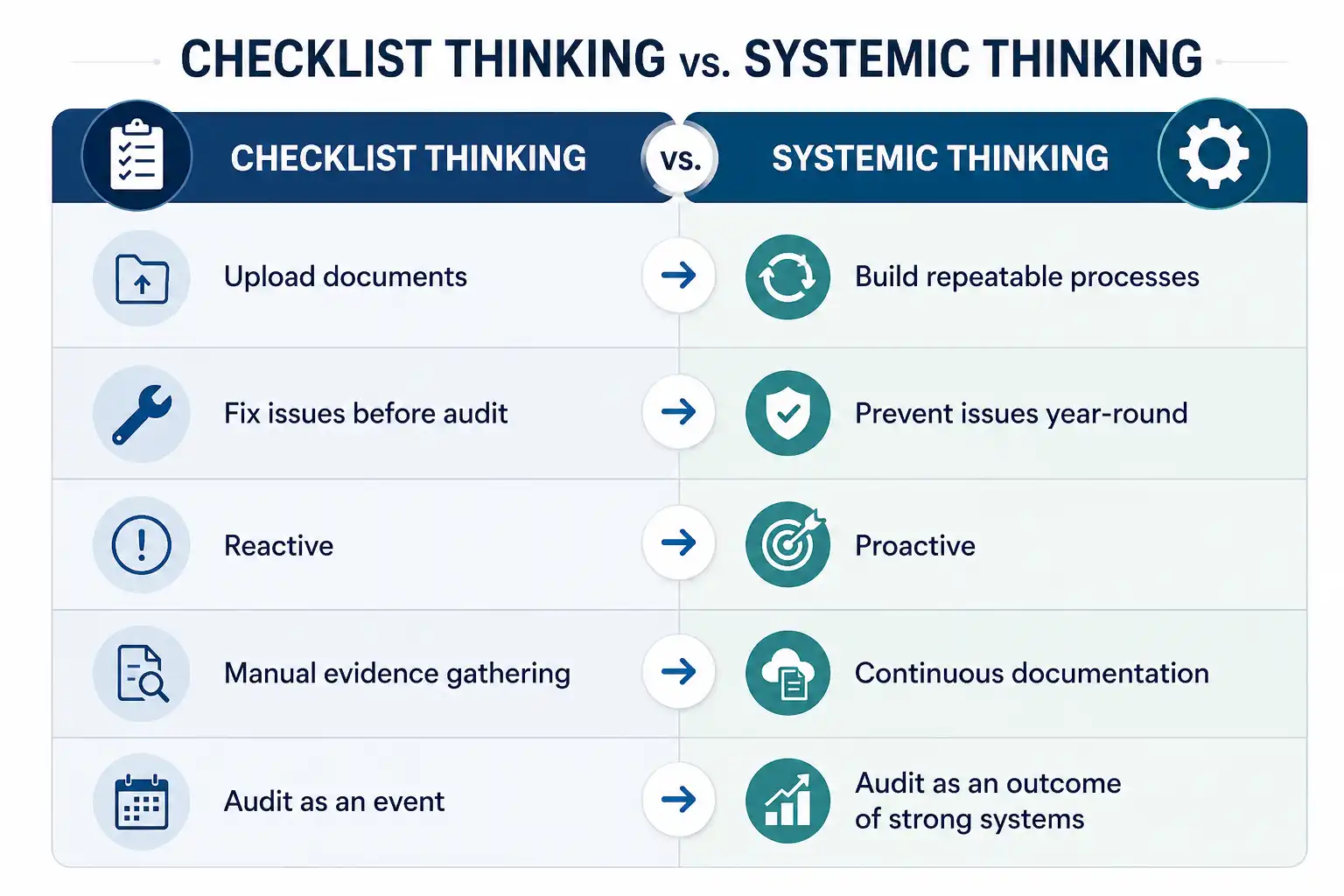
Becoming Audit Ready: A Leadership Discipline
Perfection does not create audit readiness. Preparation does, beginning months before a company engages an auditor, through weekly reconciliations, documented judgments, and a culture that does not wait for an external prompt to surface a problem. This philosophy has shaped finance transformations across more than $120M in capital raised and $150M in M&A transactions, including a $37M raise at a mission-driven education institution where investor confidence rested on the strength of underlying systems rather than a single board presentation, and an operational turnaround that reduced monthly burn from $800K to $200K at an early-stage technology company.
The same discipline holds regardless of sector. In medical devices, operations controllership across a $170M global manufacturer demanded standard costing and inventory records that could withstand line-by-line scrutiny. In consumer products, four consecutive clean external audits at a $127M company were the product of inventory turns that improved from 3x to 7x, not a talented auditor. Systems built to explain themselves are the ones that hold up under pressure.
The Question That Actually Matters for Audit Readiness
The most useful question is rarely whether the numbers are correct. It is whether the finance team can explain, document, and defend every judgment behind those numbers without a scramble to reconstruct it after the fact. A company that reaches audit-ready status well ahead of the engagement closes deals faster and moves through diligence without the delays that erode momentum. Audit readiness is not merely a metric reported to the board once a year; it is a strategic advantage that compounds every time a company raises capital or sits across the table from a new investor. Companies build it the same way every time: through documented revenue policies, reconciled accruals, clean equity records, centralized contracts, and a culture that treats explanation as a daily practice instead of a year-end scramble.
Three Key Takeaways
- Audit readiness is a systems problem before it is an accounting problem, and organizations that treat it that way close their audits faster and with far less strain on the finance team.
- The pitfalls that stall an audit rarely appear in isolation; they compound, so the discipline that prevents one tends to prevent all of them.
- Genuine audit readiness is built months before an auditor is engaged, through weekly reconciliations, documented judgments, and a culture that treats explanation as a daily habit rather than a year-end scramble.
Disclaimer: This article is intended for informational purposes only and does not constitute legal, tax, or accounting advice. You should consult your own tax advisor or counsel for advice tailored to your specific situation.
Hindol Datta is a four-time CFO and senior finance executive with over 25 years of leadership experience across cybersecurity, SaaS, gaming, logistics, digital marketing, medical devices, consumer products, and nonprofit organizations. He has led more than $120M in fundraising and over $150M in M&A transactions while building the financial and operational systems that let complex businesses scale with confidence. He is the author of seven books in the Systems CFO Series and holds active CPA, CMA, and CIA credentials.
AI-assisted insights, supplemented by 25 years of finance leadership experience.