
Executive Summary
Forecast discipline determines whether a global enterprise sees one coherent future or a collection of conflicting regional stories. When global business units submit forecasts built on different assumptions, currencies, and definitions of confidence, the consolidated view becomes a hall of mirrors. The problem is rarely competence or technology; it is the absence of a shared operating philosophy for reasoning about the future.
The sections ahead cover five parts of forecast discipline, starting with why forecasts diverge and how to build a common structure. They then address probabilistic judgment, the role of tools, and how forecasts should drive decisions. Together they show how the CFO can turn forecasting into institutional integrity.
Why Forecasts Diverge Across Global Business Units
Forecasts are narratives shaped by psychology, incentives, and interpretation as much as by math. Across time zones, currencies, and leadership styles, forecasting becomes a test of alignment. Where it fails, capital misallocates, inventory bloats, and hiring freezes at the wrong moment.
Incentives, Information, and Language
Divergence across global business units usually comes from asymmetry, not incompetence. One company might reward a regional leader in one market for caution, while another in a more fluid economy earns credit for bullish projections. Public-market pressure can push some regions toward beat-the-number conservatism, while growth targets tilt others upward.
Information also flows unevenly between regions and functions. One region may see pipeline decay early through rigorous CRM data, while another relies on quarterly surveys. Without transparent assumptions, the CFO receives a set of plausible regional fables instead of one forecast.
Language adds another layer of distortion to the consolidated forecast. Terms like “committed,” “expected,” and “upside” mean different things in different offices. A 70% probability may read as firm in one city and speculative in another. Strong forecast discipline therefore starts with assumption integrity. Every number should carry a note on what the team assumed, what remains unknown, and how confident it feels.
The CFO must also reward honesty over polish. A clear 40% scenario is more useful than a padded 70% one, and precision is not prudence if it hides change. When leaders see that forecasting is about equipping the enterprise instead of punishing misses, they begin to forecast with integrity.
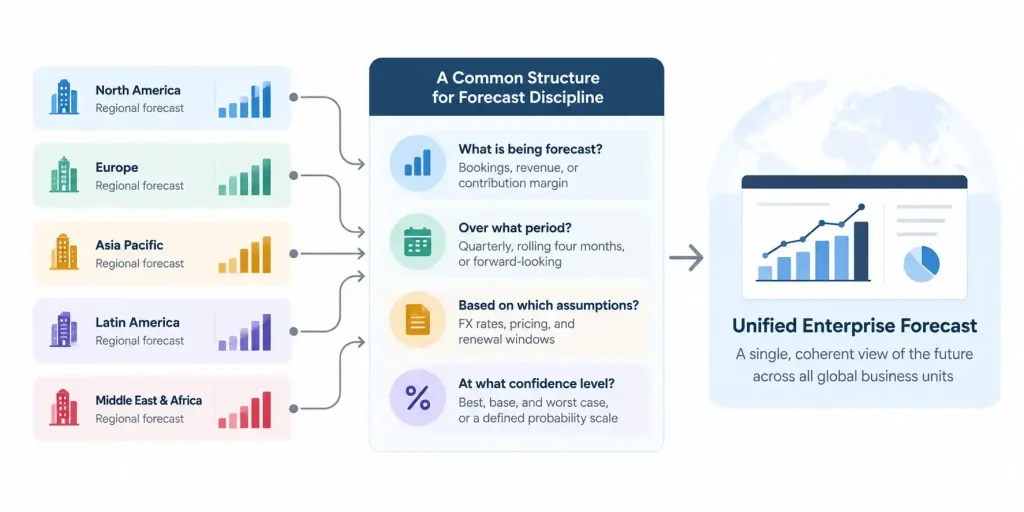
Building a Common Structure for Forecast Discipline
Global business units rarely lack effort or data. What they often lack is a common grid that lets forecasts fit together without distortion.
Cadence, Frameworks, and Governance
Forecasting across global business units must follow a predictable rhythm. Weekly pipeline reviews feed mid-month directional updates, quarter-start retrospectives inform adjustments, and reconciliation checkpoints close the loop with corporate finance. Without that rhythm, one region updates on the 3rd, another on the 7th, and the data is stale before anyone uses it.
Four Questions Every Forecast Must Answer
| Question | Examples | Why It Matters |
| What is being forecast? | Bookings, revenue, or contribution margin | Prevents mixing incompatible measures |
| Over what period? | Quarterly, rolling four months, or forward-looking | Keeps time horizons comparable |
| Based on which assumptions? | FX rates, pricing, and renewal windows | Makes differences explainable |
| At what confidence level? | Best, base, and worst case, or a defined probability scale | Turns guesses into calibrated views |
Standardization here preserves context instead of centralizing control. A decentralized business can still forecast as one, as long as inputs are legible and comparable. Governance then turns each forecast into an accountable statement, with the owner explaining what changed, what the team learned, and what remains uncertain.
Forecasts must also connect to the systems they influence. A sales forecast should flow into collections, cash flow, and investment timing, while a cost forecast should align with hiring plans. Finally, the CFO must declare the official view of the business. Every function then runs to the same forecast instead of treating it as a stretch target or a guess.
A cybersecurity and identity SaaS company with entities in the United States, Canada, Mexico, India, and Nepal shows what this structure can achieve. A driver-based forecasting engine, capacity model, and steady reporting cadence held actuals within plus or minus five percent of forecast for 8 consecutive quarters. Consistent structure across countries made that accuracy possible.
Teaching Probabilistic Judgment to Strengthen Forecast Discipline
A forecast is a reasoned belief under uncertainty, not a promise. Yet many leaders deliver numbers as either prophecy or hedging. The biggest threat to reliability across global business units is the absence of probabilistic thinking, which forces conversations into binaries like hit or miss.
Speaking in Ranges and Interrogating the Chain
The CFO can shift this habit by modeling it. Saying the company is 80% confident of landing between $38M and $41M invites a better conversation than defending a single number. Meetings then move from asking why a region revised its forecast to asking which assumption changed.
Leaders also need to understand a forecast as a chain of dependencies. Useful questions include which assumptions must hold, how reliable leading indicators have been, and where compound errors could appear. Regular post-mortems that examine why variance occurred, not just how large it was, build institutional memory.
Forecast discipline also requires changing incentives across the enterprise. Sandbagging and overpromising thrive when teams win points for looking confident. A forecast that misses by 5% but rests on sound, transparent logic deserves real credit. It earns more than one that beats the number through luck or last-minute maneuvering.
Using Technology to Support Judgment
Forecasting tools promise real-time visibility and automated scenarios, yet forecasting remains a thinking problem as much as a data problem. Technology strengthens forecast discipline only when leaders govern it with respect for context and causality.
What Good Forecasting Tools Should Do
The right system preserves the reasoning behind each number, not just the number itself. Leaders evaluating forecasting platforms should look for several capabilities:
- Version control that shows how conviction evolved over time
- Assumption tagging that highlights key risks and levers
- Drill-through navigation from group level to region, function, and product
- Scenario engines that model best and worst cases with a single adjustment
- Audit trails showing who changed a number, when, and why
Every forecast line also needs a named owner who understands the reasoning and can explain movement over time. Comments and annotations should live alongside the numbers instead of in scattered slides or emails.
A Euronext Paris-listed gaming company with subsidiaries in five countries shows the value of shared systems. A firmwide rollout of Oracle Financials and MicroStrategy created a single, unified definition of revenue across every subsidiary. That common foundation made cross-border forecasts comparable instead of contradictory.
Tools also carry a risk of false precision. Polished dashboards can make a forecast look like fact instead of a hypothesis, so confidence must always match explainability.
Embedding Forecast Discipline into Decision-Making
An organization that forecasts well changes its posture toward time and uncertainty. Leaders bring updates before anyone asks, teams meet assumptions with curiosity, and deviations become lessons instead of blame. In that environment, the forecast acts as the first signal for action.
Timely, Trusted, and Translated into Action
Forecasts must arrive on time, because a late or last-minute revision signals reaction instead of preparation. A timely update with annotated assumptions is worth more than a perfect but delayed one. Trust grows when teams believe numbers are not padded or political and when leadership uses the forecast to navigate instead of to punish.
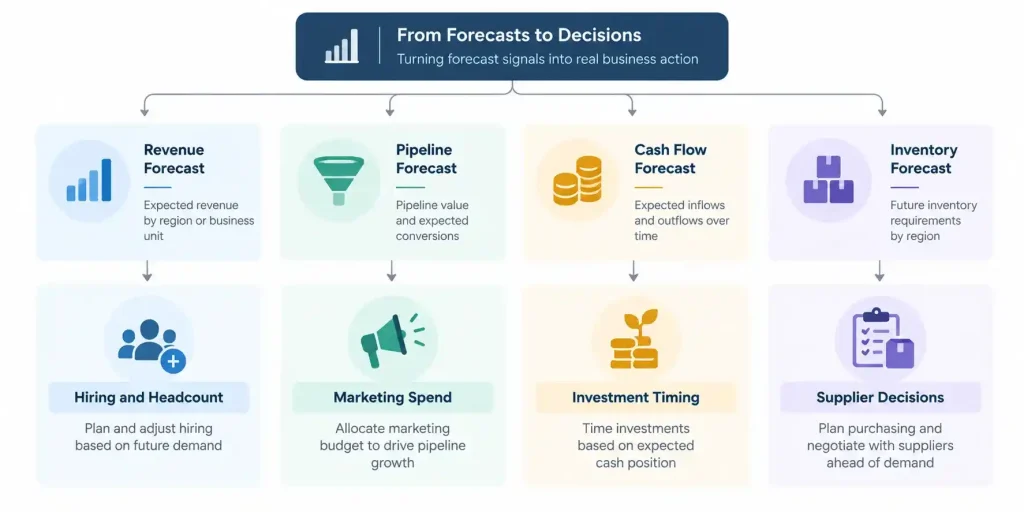
Linking Forecasts to Action
| Forecast Signal | Decision It Should Drive |
| Revenue update | Pace of hiring and headcount additions |
| Pipeline change | Adjustments to marketing spend |
| Cash forecast | Gating or accelerating investment |
| Inventory forecast | Supplier negotiations and purchase timing |
A marketplace SaaS company with operations in the United States and Poland offers another reference point. Its consolidated cross-border reporting framework, along with cohort and unit economics models, anchored investor diligence during a $20M Series B. Shared numbers across both countries gave leaders and investors one coherent view.
When forecasting becomes a cultural rhythm, the future turns from a fog into a navigable landscape. Forecast discipline is less about being right than about being ready, with every cycle deepening the company’s understanding of what comes next.
Three Key Takeaways
- Forecasts diverge across global business units because of incentives, uneven information, and inconsistent language, so forecast discipline starts with transparent assumptions and shared definitions.
- A common structure of cadence, frameworks, governance, and probabilistic judgment turns regional inputs into one coherent view of the business.
- Tools should preserve reasoning and ownership, and every forecast should connect directly to hiring, spending, investment, and inventory decisions.
Disclaimer: This article is intended for informational purposes only and does not constitute legal, tax, or accounting advice. You should consult your own tax advisor or counsel for advice tailored to your specific situation.
Hindol Datta is a four-time CFO and senior finance executive with over 25 years of leadership experience across cybersecurity, SaaS, gaming, logistics, digital marketing, medical devices, consumer products, and nonprofit organizations. He has led more than $120M in fundraising and over $150M in M&A transactions while building the financial and operational systems that let complex businesses scale with confidence. He is the author of seven books in the Systems CFO Series and holds active CPA, CMA, and CIA credentials.
AI-assisted insights, supplemented by 25 years of finance leadership experience.