
Executive Summary
Budget planning often feels ceremonial, with numbers debated, approved, and largely ignored by February. Real decisions about market pivots, hiring, and pricing then happen off-script while the budget sits untouched. Strategic budgeting reverses that pattern by treating the budget as the clearest statement of what a company is willing to bet on.
The sections ahead cover five dimensions of budget planning, starting with its purpose and the choice of framework. They then address trade-offs, communication across the company, and budgeting as a lasting capability. Together they show how the CFO can turn an annual chore into a strategic asset.
Rediscovering the Purpose of Budget Planning
To understand a budget is to understand the company as it actually lives. It shows which machines the company funds, which people it hires, and which bets leadership accepts. For all the talk of values and vision, the budget is the one place where belief becomes measurable.
From Muscle Memory to Intention
Most budget planning starts from habit, asking what the company spent last year and adding a buffer. The real reasoning lives in side conversations, and the budget becomes a tool to protect territory instead of examine truth. The CFO’s job is to reset that dynamic so the budget declares what the company is willing to make real.
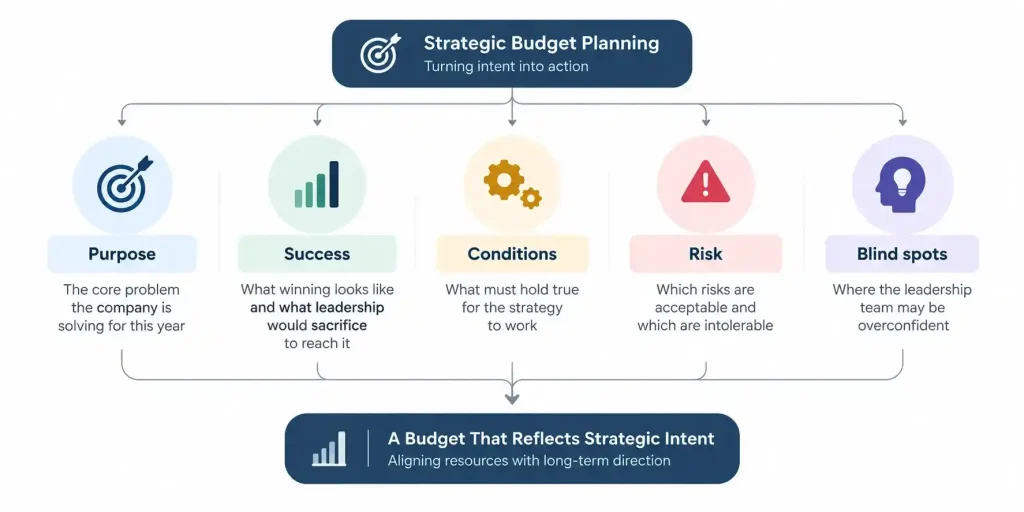
A budget reveals operational identity, meaning the habits of capital and the silent agreements about what matters most. It shows whether a company favors speed or discipline, exploration or its core, margin or scale. Before anyone opens a template, effective budget planning asks leadership to agree on five points:
- Purpose: the core problem the company is solving for this year
- Success: what winning looks like and what leadership would sacrifice to reach it
- Conditions: what must hold true for the strategy to work
- Risk: which risks are acceptable and which are intolerable
- Blind spots: where the leadership team may be overconfident
These answers do not replace models; they inform them. They let leaders ask whether a spreadsheet reflects who the company is, not just whether it looks reasonable. Without that step, familiar biases take over, as sales asks for more headcount and product overshoots timelines.
A $127M global consumer products company shows how this purpose plays out in practice. Ownership of the full P&L, the annual operating plan, and a multi-year long-range plan connected yearly budget choices to long-term direction. That link keeps each budget cycle anchored to strategy instead of last year’s spreadsheet.
Choosing the Right Framework for Strategic Budgeting
The structure of a budget shapes what leaders can see. A poorly chosen framework bends reality until the numbers become hard to trust. Each method reveals something different about how a company thinks.
Budgeting Frameworks Compared
| Framework | Core Strength | Main Risk | Best Use |
| Zero-based | Forces every cost to justify itself from scratch | High effort and political strain if applied everywhere | SG&A, marketing, and legacy programs |
| Driver-based | Links financial outcomes to operating levers | Collapses if the chosen drivers are wrong | High-growth and operationally complex firms |
| Rolling forecast | Adapts quickly to new information | Can weaken commitment if plans change too often | Volatile markets |
| Top-down | Signals clear strategic posture | Breeds compliance instead of ownership | Setting margin or investment stance |
| Bottom-up | Surfaces local insight and ownership | Invites overreach without a company-wide view | Gathering functional intelligence |
Composing a Hybrid Approach
The highest art lies in combining methods instead of choosing one. Zero-based reviews cleanse areas weighed down by inertia, while driver-based logic connects operations and finance. Rolling forecasts help the company respond to shocks, top-down targets set posture, and bottom-up input captures local knowledge.
A cybersecurity SaaS company with roughly $30M in ARR shows the value of driver-based logic. Strategic planning, annual budgeting, and a driver-based forecasting engine held actuals within plus or minus five percent of forecast for 8 consecutive quarters. Accurate drivers made the budget a reliable guide instead of a fragile guess.
The CFO as Arbiter of Strategic Trade-Offs
No company can fund everything it wants, because focus, sequencing, and will are as limited as cash. Most budget meetings are contests of conviction more than battles over spreadsheets. Product wants its roadmap, sales wants headcount, operations warns about fragile infrastructure, and HR points to hiring bottlenecks.
Making Trade-Offs Visible
Strategic budgeting resolves these conflicts through a few disciplines. First, a clear hierarchy of goals shows whether growth, margin, market entry, or retention comes first. That hierarchy must appear in the math, not just a vision deck. Second, comparable language turns each request into common units, such as expected CAC for marketing or velocity gains for product.
When requests share a common measure, trade-offs become visible and decisions feel less personal. Some bets will never fit neatly into an ROI calculation, so the CFO must separate foolish risk from bold risk. Bold risk rests on clear logic, capped downside, and upside that justifies the stretch.
Many budget planning debates involve timing more than choice. Leaders often weigh whether to build now or later, or whether to expand before or after a product launch. A well-sequenced budget stages the company’s evolution across the year instead of forcing everything into one push.
Saying No with Care
How finance delivers a “no” shapes trust in the next cycle. Explaining what the company is optimizing for, what the team did well, and why timing matters keeps relationships intact. A declined request then feels like a matter of sequence, not a rejection of the idea.
Making the Budget a Living Document of Alignment
After approval, many teams file the budget away and cite it only when convenient. The failure usually lies in translation, because numbers do not transmit belief on their own. The CFO must become the narrator of budget planning across every layer of the company.
Communicating Across Three Layers
Effective budget planning reaches beyond finance through a structured cascade. Executives need an alignment workshop that connects allocations to strategy and shows how one team’s choices affect another’s. Managers need a plain-language guide explaining what changed, which metrics matter, and which constraints are real.
Boards benefit from seeing the budget as a map of strategy, including what the company chose not to fund and where ambition exceeds capacity. Each quarter, leadership should revisit the budget to compare assumptions with results and learn how the model is aging. This rhythm builds organizational memory that improves every future cycle.
A mission-driven education and research institution in Silicon Valley illustrates the value of this practice. Multi-year financial modeling under variable philanthropic and earned-revenue conditions, combined with regular board reporting, helped leaders plan with confidence. Clear communication turned uncertain funding into a shared understanding of priorities.
Budgeting as a Lasting Strategic Asset
In the best-run companies, budgeting becomes a continuous capability instead of a once-a-year event. Its value lies less in prediction than in preparation and discipline. That discipline means making commitments clearly, holding teams accountable with grace, and adjusting with integrity when results diverge.
Inquiry, Feedback, and Rehearsal
Strategic budgeting builds this capability in several ways. The cycle surfaces uncomfortable questions about strengths, unproven assumptions, and misplaced confidence. Variance analysis, handled well, becomes institutional learning instead of blame.
Each planning cycle also serves as a rehearsal for strategy. Leaders can test what breaks if the company grows 40%, expands internationally, or doubles headcount. Over time, the team learns to see second- and third-order effects instead of reacting to symptoms.
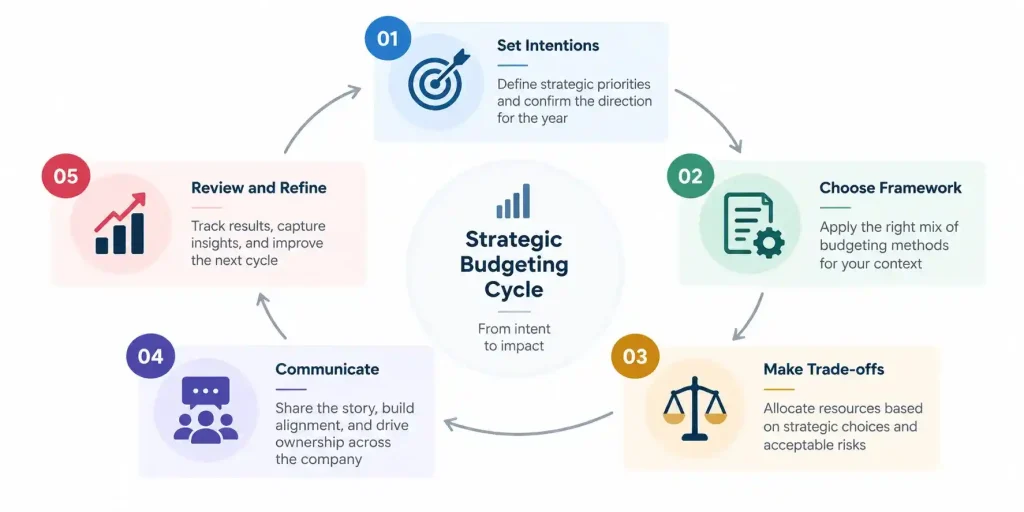
The Strategic Budgeting Cycle
| Intend | Structure | Decide | Communicate | Learn |
| Agree on the five pre-budget points | Choose a hybrid framework | Rank and sequence trade-offs | Cascade the story to every layer | Review variance and refine assumptions |
A disciplined budget signals stewardship to investors, scalability to acquirers, alignment to boards, and trust to employees. It makes the invisible visible, giving form to belief and boundaries to ambition. Above all, it helps a company grow without losing its identity.
Three Key Takeaways
- Budget planning works best when it starts with intention. A few pre-budget questions expose what the company values and what it is willing to sacrifice.
- Strategic budgeting combines frameworks, from zero-based reviews to driver-based models, and turns competing requests into comparable, well-sequenced trade-offs.
- A budget creates value only when leaders communicate it across every layer and revisit it often. That habit turns variance into learning and budget planning into a lasting capability.
Disclaimer: This article is intended for informational purposes only and does not constitute legal, tax, or accounting advice. You should consult your own tax advisor or counsel for advice tailored to your specific situation.
Hindol Datta is a four-time CFO and senior finance executive with over 25 years of leadership experience across cybersecurity, SaaS, gaming, logistics, digital marketing, medical devices, consumer products, and nonprofit organizations. He has led more than $120M in fundraising and over $150M in M&A transactions while building the financial and operational systems that let complex businesses scale with confidence. He is the author of seven books in the Systems CFO Series and holds active CPA, CMA, and CIA credentials.
AI-assisted insights, supplemented by 25 years of finance leadership experience.