
Executive Summary
Cultural integration is the variable that most often decides whether an M&A deal creates value or quietly destroys it. The financial model can be right. The strategic logic can be sound. The deal can still fail once two organizations try to operate as one. Governance, change management, and culture rarely receive the same rigor that valuation and deal structuring receive before close.
This article walks through the three pillars that separate integrations that compound value from integrations that erode it. It draws on work across manufacturing, SaaS, cybersecurity, gaming, and consumer products. It closes with three practical takeaways for finance and operating leaders in the first 100 days after a deal closes.
Why Cultural Integration in Mergers and Acquisitions Determines Deal Success
Acquisitions do not end at close. They begin there. The strategic rationale that justified the purchase price now has to survive contact with reality. That means two payroll systems, two sets of norms around decision making, and two workforces sizing each other up. Are they joining a shared mission, or being absorbed by one?
Deals rarely fail because the thesis was wrong. They fail because execution after signing was treated as an afterthought rather than as its own discipline. Governance, change management, and culture alignment function as three legs of the same stool. Remove any one of them and the platform tips over, no matter how strong the other two legs are.
Governance Structures That Support Cultural Integration in Mergers and Acquisitions
Integration has to be run like a formal transformation program, not a checklist handed to whichever executive has spare bandwidth. Governance defines who owns which decision, how progress gets tracked, and how issues get escalated before they compound.
A working governance model typically includes the following components.
- An Integration Management Office with a dedicated lead and a mandate that predates Day One
- Workstream charters with defined KPIs for finance, operations, technology, and HR
- Decision rights mapped explicitly to functional owners rather than left ambiguous
- Escalation pathways that route unresolved issues to a steering committee within days, not weeks
Building the Integration Management Office
In a $100M-plus cross-border M&A program at a publicly listed gaming and digital entertainment company operating across the United States, France, the United Kingdom, Singapore, and South Korea, the Integration Management Office evolved considerably over time. Early deals were tracked by whichever leader had the most organizational discipline and a notebook. Later transactions installed a cross-functional IMO chartered before close, with risk logs, KPIs, and a clear escalation protocol built into the first 90 days.
A 90-day integration calendar with biweekly steering committee reviews caught IT slippage early enough to reallocate resources before it threatened financial close coordination. That structure allowed one integration to finish three weeks early and under budget, which is the opposite of what most people expect from added process. Structure that looks constraining on paper tends to liberate execution in practice.
Escalation and Real-Time Reallocation
During buy-side due diligence on an IT services acquisition target, quality-of-earnings analysis and integration risk mapping surfaced where reported earnings diverged from operating reality and where post-close risk was concentrated. That diligence work only pays off if the governance structure receiving it after close can actually act on the findings rather than filing them away.
Change Management as the Bridge to Cultural Integration in Mergers and Acquisitions
Employees rarely resist change itself. They resist ambiguity and the sense that their influence has quietly disappeared. Change management, done well, is closer to emotion management than to a communications calendar.
Effective tactics tend to repeat across industries.
- A Day One announcement with clarity on roles, reporting lines, and direction
- Listening tours led by executives rather than delegated entirely to HR
- Weekly integration updates that keep momentum visible instead of letting silence fill the gap
- Structured feedback loops and pulse surveys that catch morale erosion early
A pre-close video message from the CEO, paired with a 100-day campaign of weekly updates and quick-win spotlights, produced a measurable lift in post-close alignment sentiment in a healthcare-adjacent integration, with survey results showing roughly a 20 percent increase.
Retention Is About Purpose, Not Just Payroll
In a venture-backed digital marketing organization that completed three acquisitions during a period of rapid revenue growth, one lesson surfaced repeatedly. Retention bonuses alone do not hold critical talent. In one acquired engineering team, handsome retention packages still lost three key contributors within six months, and exit interviews pointed to diminished influence rather than compensation as the driver. Supplementing financial incentives with defined roles, project ownership, and visible recognition closed that gap in later deals.
Culture Alignment and the Culture Delta Framework
Culture is not the ping-pong table in the breakroom. It is how decisions get made, how feedback gets delivered, and how accountability gets enforced when something goes wrong. Cultural mismatches derail more integrations than financial miscalculations ever do, largely because they are harder to model and easier to ignore until they surface as attrition.
A framework built around culture deltas assesses differences across four dimensions before close, not after.
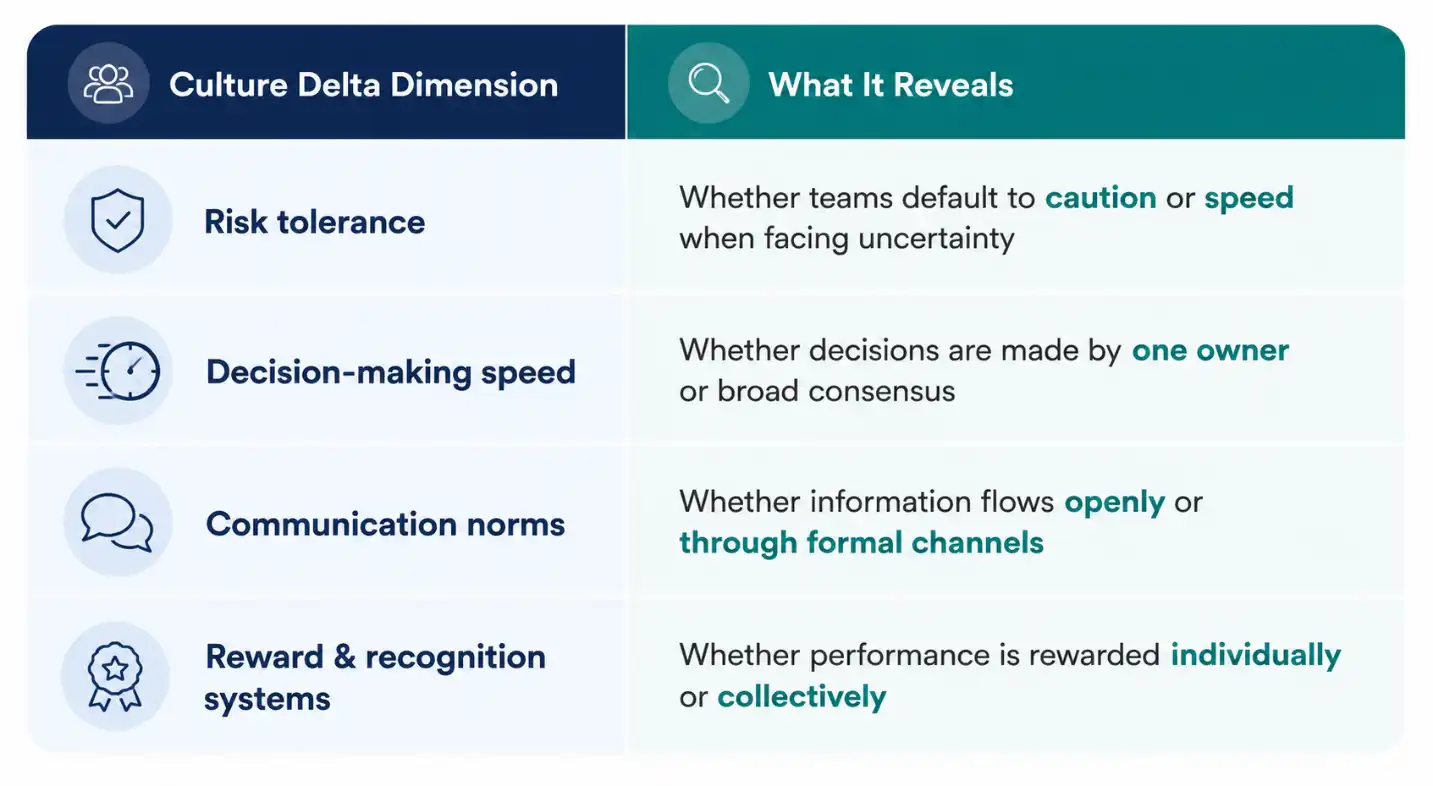
In a high-growth cybersecurity and identity access management company operating across the United States, Canada, Mexico, India, and Nepal, a speed-driven product culture met a consensus-oriented service culture during one integration. The friction was predictable, and it only became productive once the delta was named openly rather than left to fester in hallway conversations.
The resolution was a simple decision matrix. Low-impact decisions defaulted to whichever team owned execution speed. High-impact decisions required cross-functional consensus before moving forward. That structure let each culture operate inside its comfort zone while still honoring a shared integration ethos, which is a more durable outcome than forcing one culture to simply absorb the other.
Managing the First 100 Days After Close
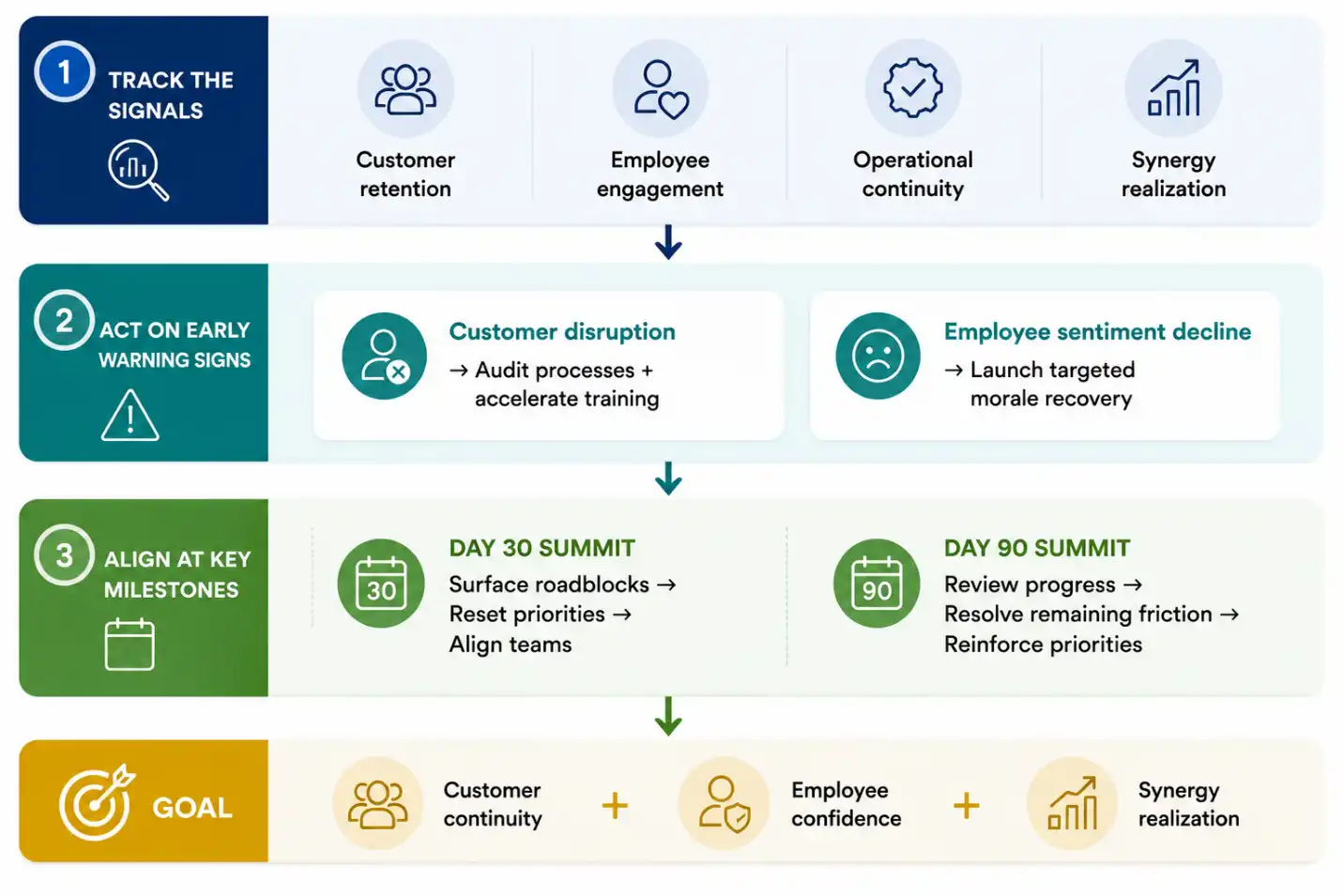
Stabilization in the first 100 days depends on tracking a small set of metrics with discipline rather than a long dashboard nobody reads. The metrics that matter most are customer retention, employee engagement, operational continuity, and synergy realization.
In one integration, losing two customers in the first month due to onboarding disruption triggered an emergency process audit and fast-tracked training that prevented further churn. In another, synergy capture ran ahead of plan while employee sentiment dropped sharply, prompting a targeted morale recovery plan before the gap widened further.
Day 30 and Day 90 integration summits function less as status meetings and more as alignment rituals, gathering functional leads, surfacing roadblocks, resetting priorities, and recognizing the people doing unglamorous integration work that rarely shows up in a board deck.
Lessons From the Field
Co-locating integration teams, even briefly, accelerates trust in a way that video calls rarely replicate. Flying a dozen leaders into the same location for ten days during one integration produced six months of smoother cross-functional collaboration afterward, largely because casual collisions in hallways resolve more ambiguity than scheduled meetings do.
Overcommunication beats undercommunication in nearly every integration scenario. When leadership doubts whether they have said enough, doubling the communication cadence is almost always the right call, because ambiguity breeds fear and silence breeds speculation. Leadership tone in the first two weeks after close tends to set the arc for the entire integration, and a senior leader willing to admit uncertainty while committing to figure it out together creates the psychological safety that lets teams surface problems early rather than hide them.
Three Key Takeaways
- Governance is not an org chart exercise. It is an energy allocation system that determines who owns which decision and how fast unresolved issues reach someone who can act on them, and building the Integration Management Office before close rather than after is what makes that system functional from Day One.
- Cultural integration in mergers and acquisitions succeeds when differences get named explicitly through a structured framework like culture deltas, rather than left ambiguous until they surface as attrition, disengagement, or a stalled decision-making process months into the deal.
- The first 100 days are a stabilization window measured in customer retention, employee sentiment, and synergy realization, and the leaders who treat Day 30 and Day 90 summits as alignment rituals rather than status updates tend to convert integration risk into a genuine source of enterprise advantage.
Disclaimer: This article is intended for informational purposes only and does not constitute legal, tax, or accounting advice. You should consult your own tax advisor or counsel for advice tailored to your specific situation.
Hindol Datta is a four-time CFO and senior finance executive with over 25 years of leadership experience across cybersecurity, SaaS, gaming, logistics, digital marketing, medical devices, consumer products, and nonprofit organizations. He has led more than $120M in fundraising and over $150M in M&A transactions while building the financial and operational systems that let complex businesses scale with confidence. He is the author of seven books in the Systems CFO Series and holds active CPA, CMA, and CIA credentials.
AI-assisted insights, supplemented by 25 years of finance leadership experience.