
Executive Summary
What is an escrow account? The answer decides whether a deal closes cleanly. It can also unravel eighteen months later in a dispute over $700K of disputed indemnity. In mergers and acquisitions, the escrow account meaning goes well beyond the textbook definition. It is more than funds a neutral third party holds. Instead, it functions as a governance instrument. It allocates risk, protects cash flow, and signals how seriously both sides take the representations behind the purchase price. For finance leaders, the escrow account is not paperwork to delegate to counsel. It is deal architecture that deserves the same rigor as valuation and financing.
This article breaks down how an escrow account functions across funding, release mechanics, and administration. It draws on real M&A engagements across cybersecurity, consumer products, and gaming. Together, they show where escrow design succeeds and where it quietly fails. Readers will come away with a working framework for sizing an escrow and structuring release tiers. That framework also covers the administrative missteps that turn a protective mechanism into years of litigation.
What Is an Escrow Account in M&A? Funding Triggers, Sizing, and Risk
An escrow account in M&A is a segregated account that a bank or trust company typically holds. At closing, the buyer deposits a portion of the purchase price into it. The escrow agent releases that amount later, either on a schedule or upon resolution of specific claims. Buyers and sellers usually fund escrows between 5% and 15% of the purchase price. The exact figure depends on perceived risk, deal size, and what diligence surfaced before signing.
Sizing an escrow correctly requires more diligence than most term sheets reflect. A 10% holdback on a $100M deal may look generous. But if there is credible exposure from unresolved tax audits, product warranties, or pending litigation, that cushion can prove thin. Overfunding creates its own cost, tying up seller capital unnecessarily and souring negotiations at the moment goodwill matters most. In one engagement involving a cybersecurity and identity access management company generating roughly $30M in annual recurring revenue, the team modeled escrow sizing against a risk matrix. That matrix quantified the expected value of unresolved exposures, probability-weighted and benchmarked against industry norms. That approach gave both sellers and the board confidence that the number was defensible rather than arbitrary.
Common Risk Factors That Drive Escrow Size
- Specific claims risk, including tax, intellectual property, and employee liabilities
- Buyer risk tolerance and the buyer’s own balance sheet capacity
- Seller credibility, financial strength, and willingness to stand behind representations
Conditional holdbacks offer a middle path when funding the full escrow up front is impractical. These structures trigger upon defined risk crystallization, such as an audit outcome or the resolution of a legal proceeding, rather than sitting idle against a risk that may never materialize.
Escrow Account Meaning in Practice: Release Tiers and Structures
The escrow account meaning shifts considerably depending on how release is structured. Three models dominate: time-based releases, claim-based retention, and hybrid structures that combine both.
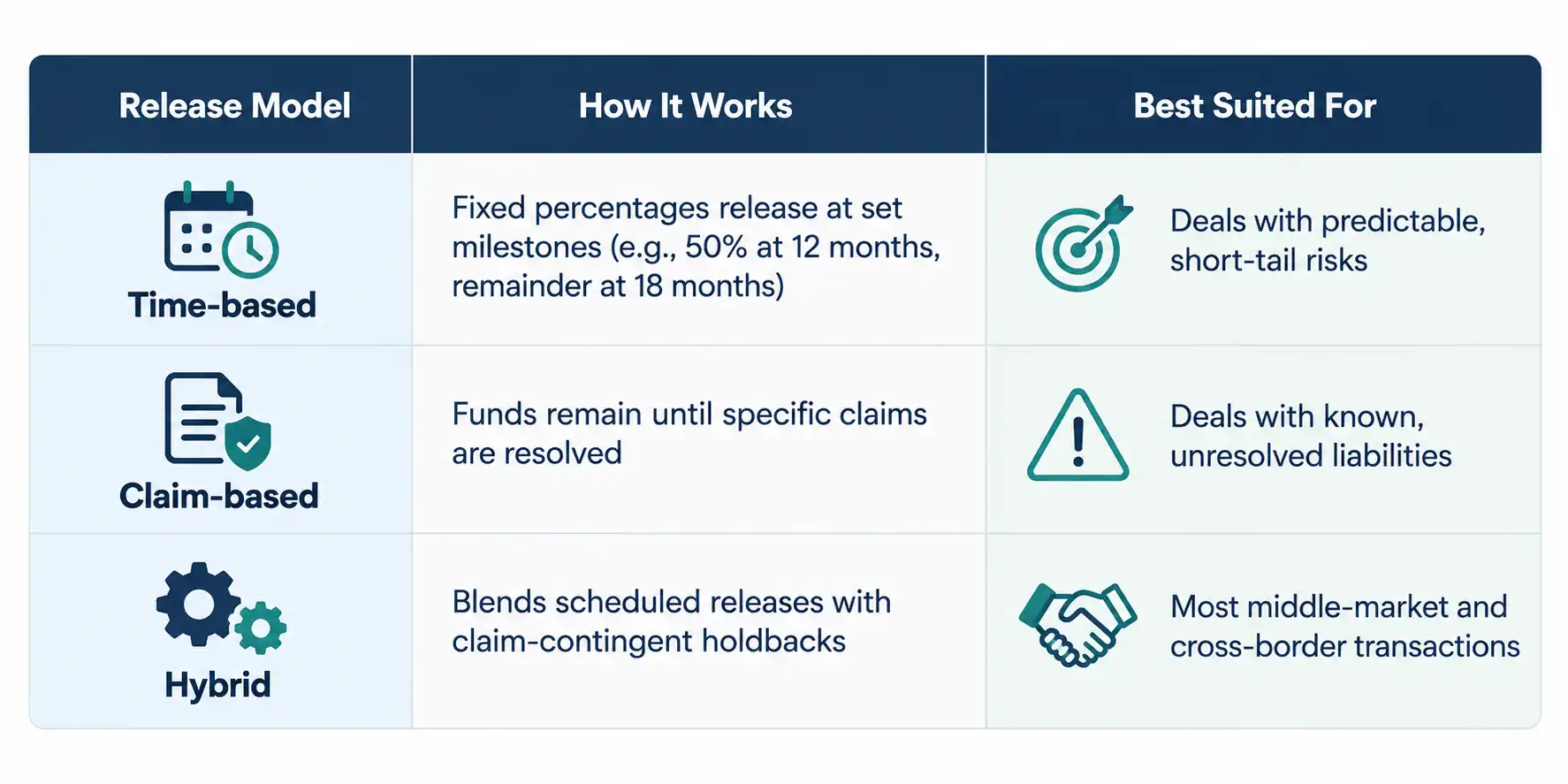
Different risks carry different half-lives, and release schedules should reflect that rather than defaulting to a generic 12- or 18-month lockup. Customer warranty claims tend to surface within six months, while tax assessments can take years to resolve. In a consumer products acquisition involving a $127M global company with distribution across DTC, Amazon, and wholesale channels, escrow release was structured at 40% after six months, 30% after twelve months, and the balance upon completion of a state tax audit. That alignment between risk horizon and release tiers avoided the friction that comes from an all-or-nothing cliff.
When a Single Risk Justifies a Bifurcated Escrow
Where one risk is outsized, such as pending litigation or a known environmental liability, a bifurcated structure often works better than a single blended escrow. One tranche follows standard release terms; a second, narrower “specific risk escrow” carries tailored conditions tied to that one exposure. Sellers tend to negotiate more constructively when the escrow is targeted rather than broadly cautious, because the rest of the proceeds move on a predictable timeline.
Best practice for release design includes the following:
- Align release schedules with the actual risk horizon rather than a market-standard default
- Avoid single release cliffs that create an incentive to manufacture disputes near the deadline
- Pre-define claim caps and deductibles before the escrow agreement is finalized
Administration and Control: Where Escrows Actually Fail
An escrow account in M&A is a segregated account that a bank or trust company typically holds, and the buyer deposits a portion of the purchase price into it at closing. The escrow agent releases that amount later, either on a schedule or upon resolution of specific claims. Buyers and sellers usually fund escrows between 5% and 15% of the purchase price, and the exact figure depends on perceived risk, deal size, and what diligence surfaced before signing.
A properly drafted escrow agreement should spell out who can initiate a claim, what documentation is sufficient to support it, and what happens when one party contests a release. In a global gaming and digital entertainment engagement with a publicly listed parent operating across five countries, the deal team missed a claims notification deadline by a single day because the agreement’s calendar language did not match the actual filing requirement. The escrow agent declined to act without mutual consent, and the resulting dispute cost the ability to recover $700K in disputed intellectual property expenses. The lesson translated directly into practice: teams now build notification timelines into the deal calendar as a tracked, automated milestone instead of treating them as a clause they read once at signing.
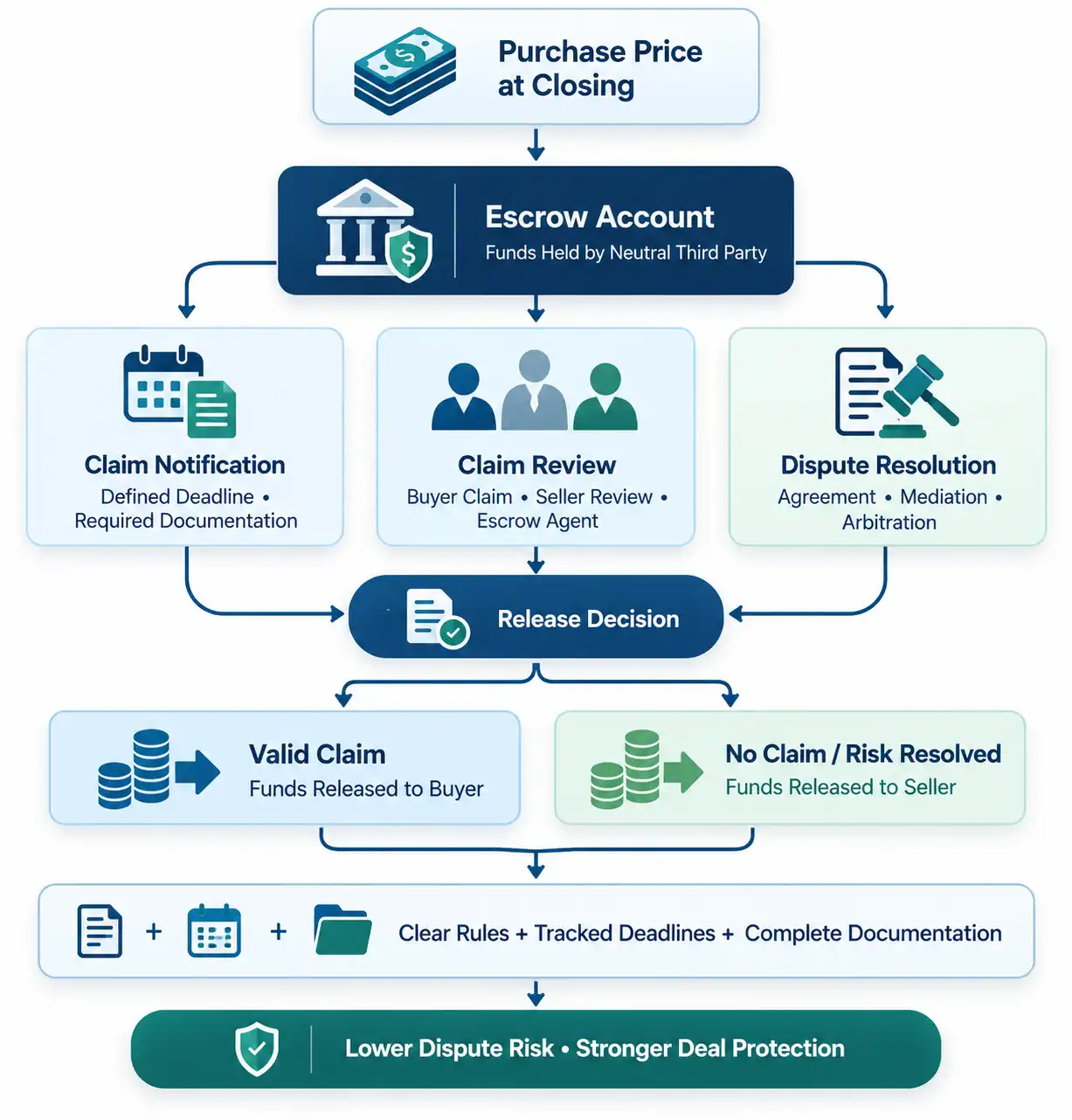
Key administrative controls worth negotiating up front:
- Clearly defined release mechanics and required documentation
- Firm notification timelines for claims, with internal calendar reminders embedded in the deal playbook
- A pre-agreed dispute resolution protocol, whether mediation, arbitration, or a defined escalation path
Escrow Alternatives and the Liquidity Trade-Off
Representations and warranties insurance has become a credible substitute for escrow in larger transactions, particularly above $50M where the target has clean financials and insurers price the policy reasonably. R&W insurance reduces the need for a large holdback and gives sellers a cleaner break at close. Promissory notes and earnouts serve a similar backdoor indemnity function in some structures.
Even so, escrow accounts continue to outperform alternatives on three dimensions: immediate fund availability, stronger negotiation leverage during the deal itself, and simpler enforcement relative to litigation. Escrows remain particularly valuable in cross-border transactions where legal enforcement is uncertain, and in lower-middle-market deals where insurance pricing makes R&W impractical. Notably, the underlying concept travels across borders under different names. In Southeast Asian markets, for instance, local practitioners often call an escrow account a rekening escrow, though the mechanics, funding, release, and third-party control, remain functionally identical to a US or European structure.
Escrow funds tied up post-close are unavailable for reinvestment or debt reduction, and that cash drag deserves a place in the post-close treasury forecast rather than a footnote. In one instance, $6M sat in escrow during a period of strategic cash tightness; a staged release schedule tied to risk resolution, negotiated up front, would have freed roughly half of that capital six months earlier. That gap reshaped how future deals modeled the relationship between escrow structure and near-term liquidity.
Conclusion: Escrows as Strategic Buffers, Not Bureaucratic Hurdles
An escrow account is not a legal formality bolted onto a term sheet. It is a negotiation tool: buyers can offer tighter purchase prices in exchange for larger escrows, while sellers can trade a smaller holdback for more robust R&W coverage. Escrow sizing has bridged valuation gaps, deferred legal disagreements, and smoothed tense integration conversations, but only when both parties trust the integrity of the mechanism itself. That trust depends on clarity, documentation, and administrative discipline applied from the first draft of the agreement, not retrofitted after a dispute arises.
Three Key Takeaways
- Escrow sizing should be modeled against a probability-weighted risk matrix rather than a market-standard percentage, because both underfunding and overfunding carry real costs to the deal and the relationship.
- Release schedules should match the actual half-life of the underlying risk, and single-cliff releases should generally be avoided in favor of tiered or hybrid structures that reduce the incentive for last-minute disputes.
- Administrative discipline, particularly around claims notification deadlines and documentation requirements, determines whether an escrow protects the business or becomes an unenforceable promise; these terms deserve the same negotiation attention as the escrow amount itself.
Disclaimer: This article is intended for informational purposes only and does not constitute legal, tax, or accounting advice. You should consult your own tax advisor or counsel for advice tailored to your specific situation.
Hindol Datta is a four-time CFO and senior finance executive with over 25 years of leadership experience across cybersecurity, SaaS, gaming, logistics, digital marketing, medical devices, consumer products, and nonprofit organizations. He has led more than $120M in fundraising and over $150M in M&A transactions while building the financial and operational systems that let complex businesses scale with confidence. He is the author of seven books in the Systems CFO Series and holds active CPA, CMA, and CIA credentials.
AI-assisted insights, supplemented by 25 years of finance leadership experience.