
Executive Summary
Reps and warranties insurance has moved from a niche instrument to a standard fixture on the M&A deal table. Finance executives who understand when and how to deploy it close cleaner, faster transactions. This article examines what reps and warranties insurance covers and when it earns its premium. It also looks at how the coverage reshapes the psychology of negotiation and what it costs at different deal sizes. The examples draw on deal experience across industries, deal sizes, and geographies.
The central argument is straightforward. Reps and warranties insurance is not a substitute for rigorous diligence. It is also not a universal fit for every transaction. Used with discipline, however, it converts a source of post-closing friction into a manageable, insurable risk. It also frees the deal team to focus on integration rather than indemnity disputes.
What Reps and Warranties Insurance Covers, and What It Does Not
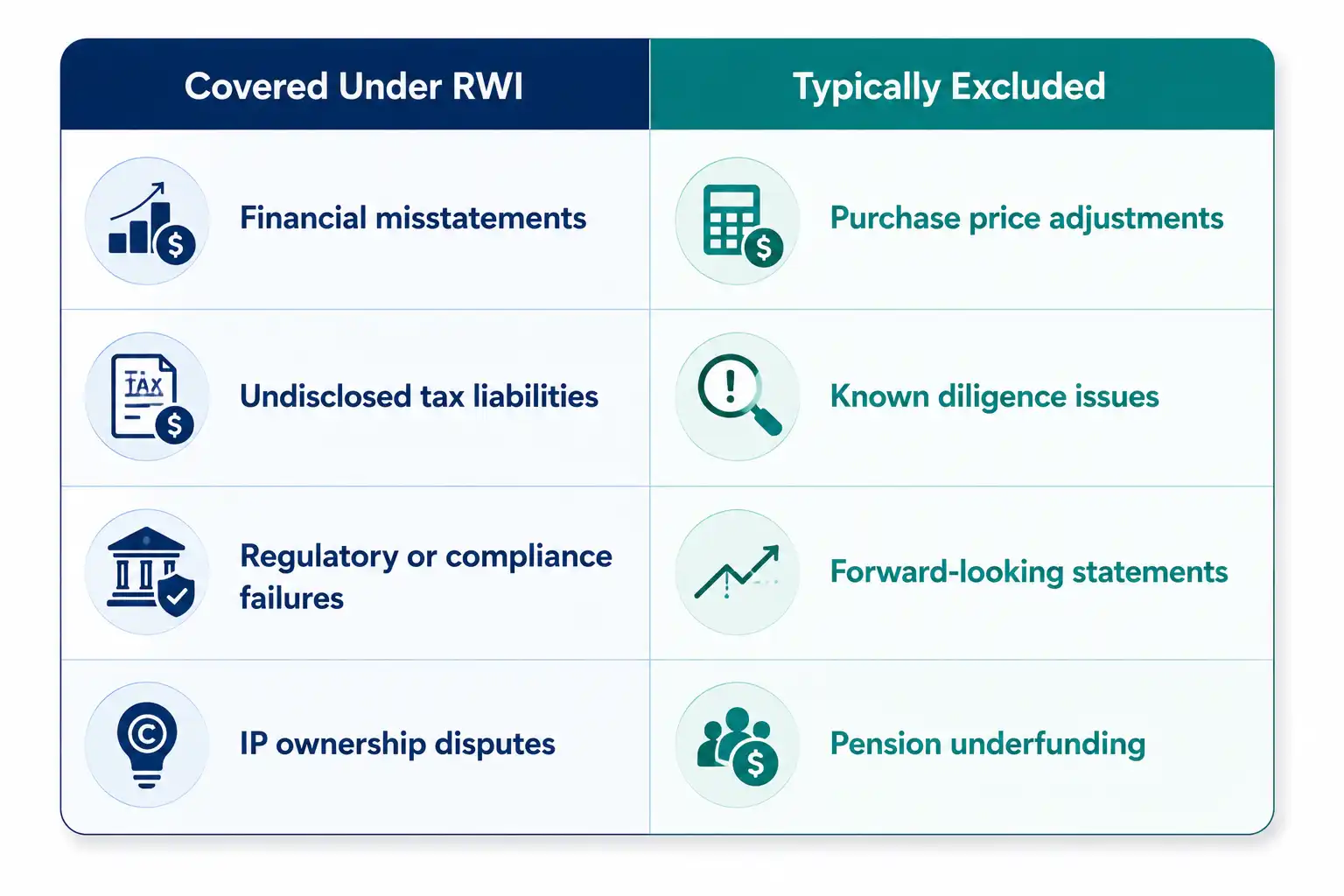
Reps and warranties insurance is often shortened to RWI or R&W insurance. It covers losses that arise when a seller breaches the purchase agreement’s representations and warranties. Instead of pursuing the seller directly, the buyer claims against the insurer. This changes the entire texture of a post-closing dispute. Coverage typically extends to financial misstatements, undisclosed tax liabilities, compliance failures, and intellectual property ownership disputes. These are the categories of risk that tend to surface only after the deal has closed. By then, the new owner is already running the business.
What reps and warranties insurance does not cover matters just as much as what it does. Purchase price adjustments fall outside the policy. Known issues uncovered during diligence are excluded as a matter of course. Insurers will not underwrite a risk the buyer already knows about. Forward-looking statements and pension underfunding are typically carved out as well. That combination of exclusions is precisely why diligence quality matters more, not less, once RWI enters the picture. The same goes for the precision of the representations themselves.
In one technology acquisition, the reps and warranties insurance policy covered a sales tax liability. It surfaced three months after close. The seller avoided a litigation process entirely. The buyer recovered the loss directly from the insurer. There was no need to reopen a negotiation with a counterparty that had already moved on.
When Reps and Warranties Insurance Makes the Most Sense
Reps and warranties insurance delivers the most value in a specific set of deal circumstances. Recognizing them early changes how a transaction gets structured from the term sheet forward.
- The seller is a private equity firm seeking a clean, final exit with no residual liability tail.
- The buyer wants to reduce or eliminate escrow and holdback amounts.
- The transaction involves cross-border legal complexity and unfamiliar indemnity norms.
- Both parties want to preserve a commercial relationship that continues past the closing date.
Deal Types Where RWI Earns Its Premium
In one carve-out acquisition, the selling private equity firm wanted a limited indemnity tail and resisted a meaningful escrow. Reps and warranties insurance bridged that gap, allowing the deal to close with only a $1 holdback while the buyer still retained real recourse for undisclosed liabilities.
Cross-border transactions present a distinct case. In one acquisition involving a European family office as the seller, the counterparty was unfamiliar with United States indemnity conventions and reluctant to accept meaningful post-closing exposure. A reps and warranties insurance policy bridged the cultural and legal gap, requiring only symbolic seller exposure while covering the buyer’s material risks, and the tone of the negotiation shifted from adversarial to collaborative almost immediately.
How Reps and Warranties Insurance Changes Deal Dynamics
The most consequential effect of reps and warranties insurance has less to do with the balance sheet than with the psychology at the negotiating table. Once the insurer becomes the counterparty for a breach claim rather than the seller, the buyer gains genuine recourse, the seller gains finality, and the deal team gains hours previously spent haggling over indemnity caps and survival periods.
RWI is not a free pass around diligence discipline. The underwriting process is rigorous, and insurers scrutinize diligence materials closely enough that gaps in a buyer’s own work often surface during that review. In one transaction, an insurer flagged intellectual property diligence as inadequate, which prompted a second look at a set of licenses carrying transfer restrictions the buyer had missed. That single flag likely prevented a post-close operational disruption, and it illustrates how the insurer functions as a second set of eyes with a genuine financial stake in diligence quality.
In a life sciences transaction, reps and warranties insurance allowed the deal team to concentrate on operational synergies rather than legal skirmishing, since the indemnity structure had already been resolved through the policy.
The Process and Cost of Securing Reps and Warranties Insurance
Securing reps and warranties insurance follows a reasonably standard sequence: a non-binding indication from the insurer, underwriting calls paired with a diligence review, and finally pricing and binder issuance ahead of closing. Timing matters more than most deal teams initially assume.
Premiums, Retention, and Coverage Limits
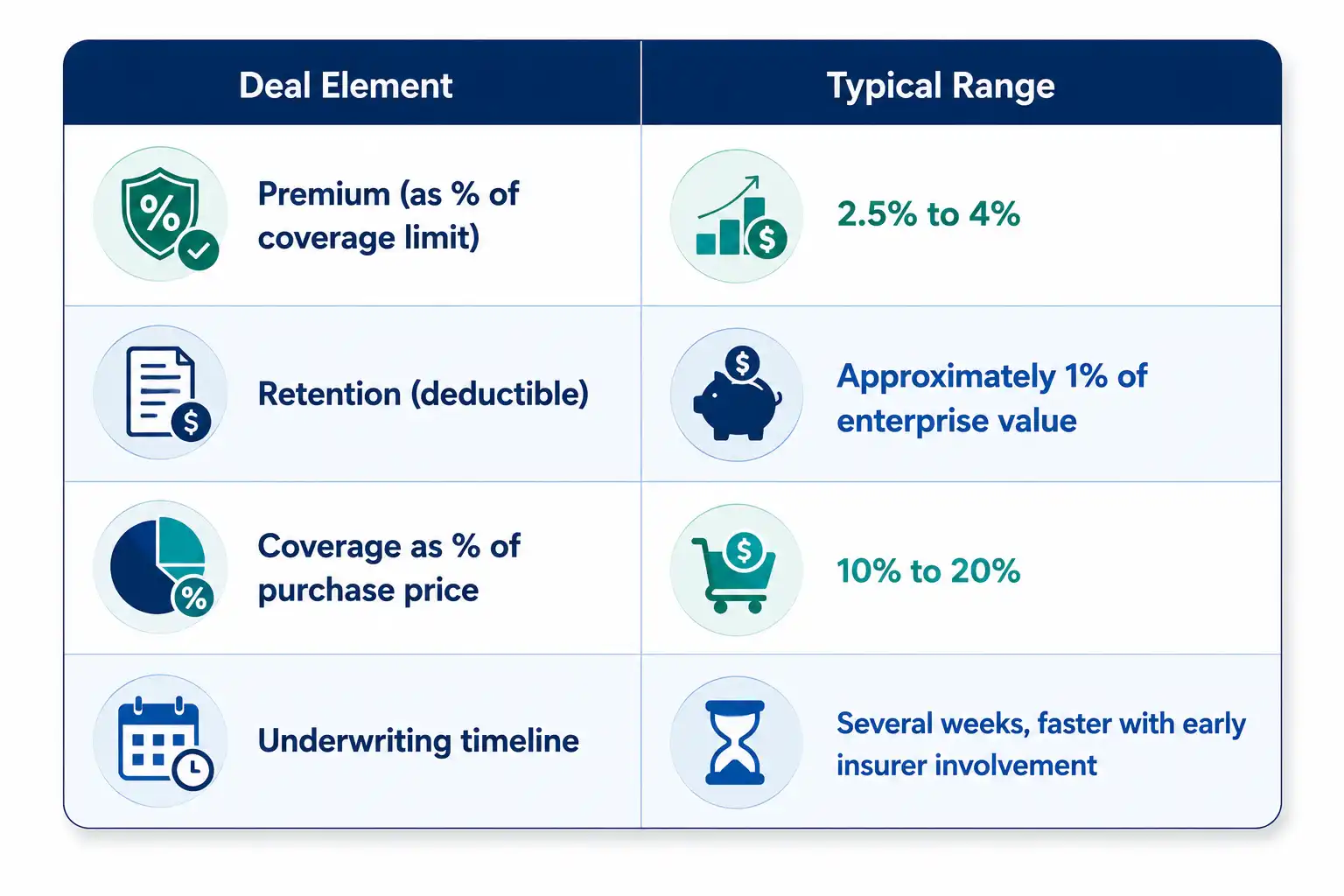
For a $100M transaction, premiums in this range translate to $2.5M to $4M. In one deal, a $20M policy carried a premium of $450K, a reasonable price for the closing speed and certainty it produced compared with the alternative cost of a legal dispute or a fractured seller relationship.
Bringing the insurer into the process late, once the purchase agreement is nearly final, routinely leads to scrambling to align exclusions and rework representations under time pressure. Involving the insurer at the term sheet stage instead, so representations can be drafted with underwritability in mind from the outset, has reduced legal rework by roughly 30 percent on subsequent transactions.
Because coverage rarely exceeds 10 to 20 percent of the purchase price, reps and warranties insurance works best as a complement to other risk-allocation tools rather than a comprehensive substitute. In one transaction, a hybrid structure combined RWI for general breaches, seller escrow for a known regulatory exposure, and a specific indemnity for a pending audit, layering three tools into full protection without overpaying on premium.
Drafting Considerations That Maximize Reps and Warranties Insurance Value
Getting full value out of reps and warranties insurance depends on decisions made well before the underwriting call.
- Ensure diligence is robust and, just as important, well documented.
- Draft representations with the insurer’s underwriting standards in mind from the first draft.
- Prepare a comprehensive disclosure schedule rather than a minimal one.
- Align policy exclusions with the specific risks the deal actually presents.
Legal counsel that involves the insurer early tends to produce representations that are genuinely underwritable and exclusions scoped narrowly rather than broadly. In one transaction, a failure to update the disclosure schedule with a last-minute contract change meant a subsequent claim was denied outright, an outcome that led to a standing practice of auditing every disclosure schedule 48 hours before close.
A pre-close session bringing together the insurer, legal counsel, and finance to align on exclusions, retention mechanics, and claim protocols is worth the hour it costs. That single conversation routinely prevents weeks of confusion after the deal has closed.
Where Reps and Warranties Insurance Fits, and Where It Does Not
Not every transaction requires reps and warranties insurance. In smaller deals or founder exits where trust runs high and exposure runs low, traditional indemnity structures remain entirely adequate. In any deal carrying legal complexity, regulatory exposure, or third-party capital, however, RWI deserves serious consideration as part of the risk-allocation toolkit.
For the finance function specifically, the discipline is to treat reps and warranties insurance as a budgeted line item rather than an afterthought: coverage limits should match realistic exposure, the premium should be modeled into transaction costs early, and the claims process should be understood before it is ever needed. RWI removes the seller from the line of fire, but it introduces a new counterparty in the insurer, and that relationship deserves the same attention as any other party in the transaction.
Three Key Takeaways
- Reps and warranties insurance works best as a complement to, not a replacement for, rigorous diligence and precise drafting, since exclusions for known issues and forward-looking statements mean the underlying representations still carry real weight.
- Bringing the insurer into the process at the term sheet stage, rather than after the purchase agreement is nearly final, produces representations that are genuinely underwritable and meaningfully reduces legal rework later in the transaction.
- The greatest return from reps and warranties insurance often shows up in preserved relationships and compressed timelines rather than in the specific dollar amount recovered on a claim, since it removes the friction that indemnity disputes create between parties who may need to work together long after closing.
Disclaimer: This article is intended for informational purposes only and does not constitute legal, tax, or accounting advice. You should consult your own tax advisor or counsel for advice tailored to your specific situation.
Hindol Datta is a four-time CFO and senior finance executive with over 25 years of leadership experience across cybersecurity, SaaS, gaming, logistics, digital marketing, medical devices, consumer products, and nonprofit organizations. He has led more than $120M in fundraising and over $150M in M&A transactions while building the financial and operational systems that let complex businesses scale with confidence. He is the author of seven books in the Systems CFO Series and holds active CPA, CMA, and CIA credentials.
AI-assisted insights, supplemented by 25 years of finance leadership experience.