
Executive Summary
Every multinational finance function eventually confronts the same repatriation question. Should cash move from a subsidiary to its parent as a dividend? The dividend double entry then runs through retained earnings. Or should it move as a debt-like distribution booked through an intercompany loan account? The answer is never purely mechanical. It touches tax exposure, balance sheet presentation, and covenant capacity. It also signals financial discipline to a company’s board and its lenders.
This article walks through both paths in practical terms. It covers the double entry for dividend paid transactions and the bookkeeping behind intercompany debt. It then turns to withholding tax and treaty planning. Finally, it covers covenant management and the jurisdictional limits that shape which option is actually available in a given country.
The Strategic Calculus Behind Moving Cash Upstream
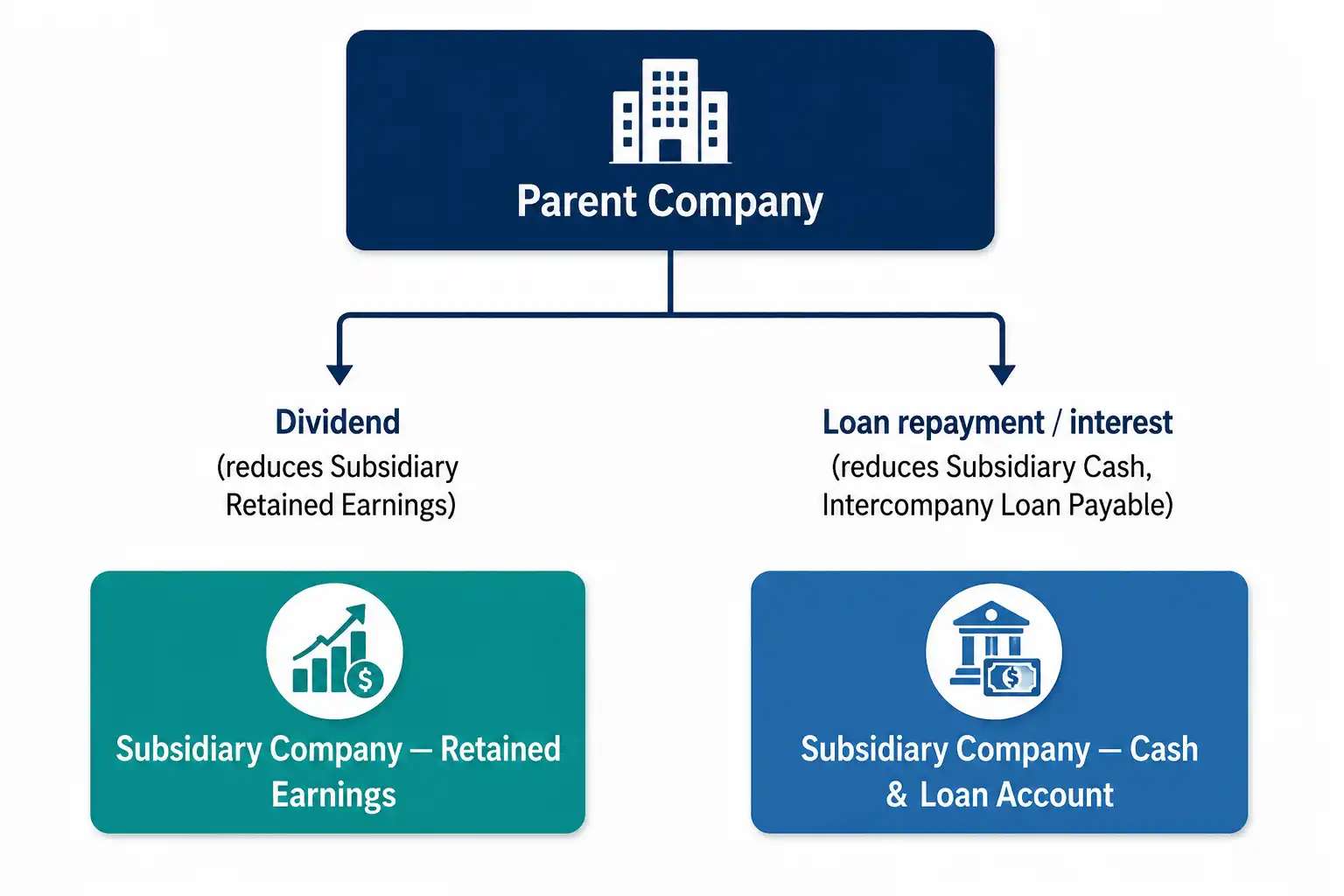
Multinational and multi-entity enterprises rarely have a single, obvious route for extracting value from a subsidiary. Dividends and debt-like distributions both move cash from subsidiary to parent. But the mechanics, the accounting entries, and the downstream consequences diverge sharply. Dividends require retained earnings and compliance with local solvency and capital maintenance rules. Debt-like structures, including intercompany loans and hybrid instruments, sidestep the retained earnings requirement. But they invite scrutiny under transfer pricing, thin capitalization, and earnings stripping rules.
The diagram below illustrates the basic flow for each path.
Dividends: Clean Repatriation, Governed by a Predictable Dividend Double Entry
Dividends remain the traditional path for upstreaming cash because finance teams understand the accounting and the intent stays transparent. The dividend double entry follows a simple two-step sequence: the company declares the distribution, then pays it.
- Declaration: debit Retained Earnings, credit Dividends Payable.
- Payment: debit Dividends Payable, credit Cash.
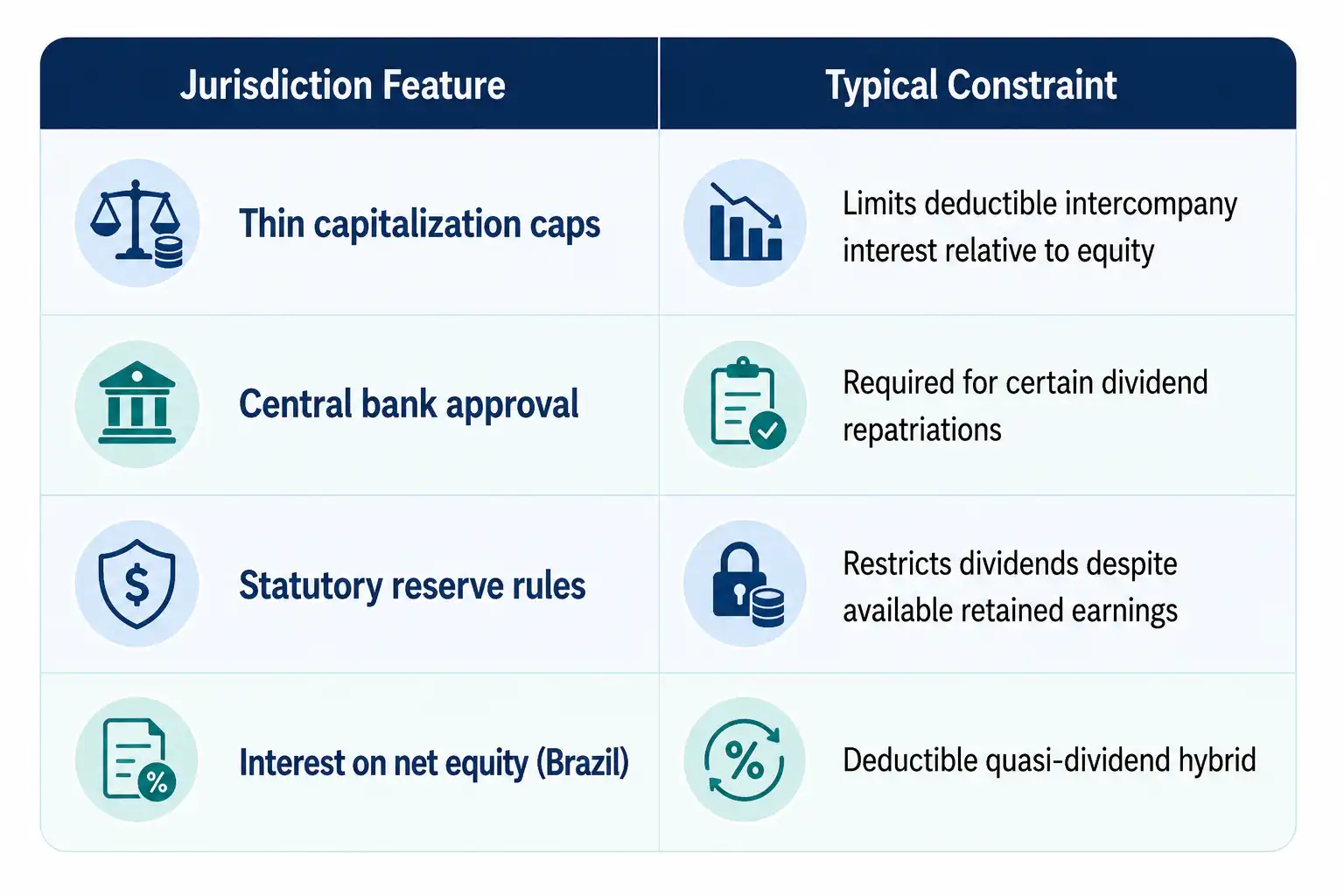
That double entry for dividend paid transactions is straightforward on paper, but the availability of the underlying retained earnings, and the legal capacity to distribute them, is often the real constraint. A subsidiary may show ample accumulated profit while local statutory reserve requirements or capital maintenance rules block a full upstream dividend regardless of what the balance sheet suggests.
The Tax Layer Behind Every Dividend
From a United States tax standpoint, dividends from foreign subsidiaries can trigger Subpart F income or Global Intangible Low-Taxed Income considerations, though the Section 245A dividends received deduction may eliminate the resulting U.S. tax where a C corporation meets the ownership and holding period requirements. This makes a pre-distribution review of earnings and profits, and of the tax pool balance, an essential step before any dividend declaration, not an afterthought once cash has already moved.
A comparable dynamic played out at a mission-driven education and research institution, where board and audit committee reporting required a clear, defensible narrative around distribution capacity even though the organization’s funding model was philanthropic rather than dividend-based. The discipline of tying every capital movement to a documented, board-ready rationale translates directly into the corporate dividend context: the entries are simple, but the governance behind them rarely is.
Debt-Like Distributions: Flexibility That Invites Scrutiny
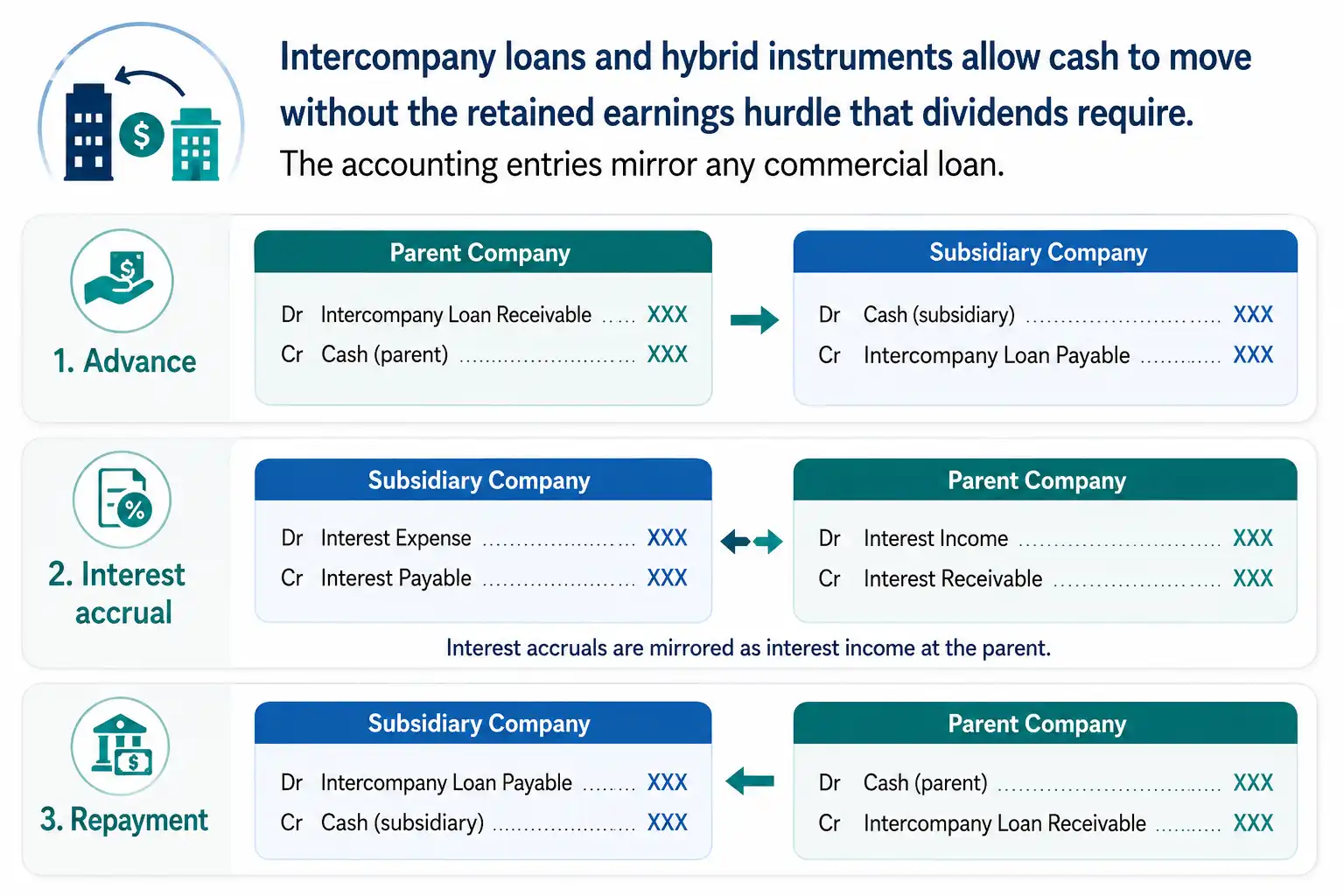
That flexibility comes with exposure. Section 385 regulations, while narrowed in recent years, still impose documentation standards on debt classification, and a failure to meet them can result in reclassification as equity, denied interest deductions, and dividend-style withholding treatment on what was structured as a loan repayment. A formal debt characterization exercise, benchmarking the interest rate against comparable third-party debt and testing repayment terms and enforceability, is the standard defense against reclassification risk.
Where This Plays Out in Practice
At a high-growth cybersecurity and identity access management company operating across the United States, Canada, Mexico, India, and Nepal, the multi-entity finance architecture depended on intercompany funding arrangements that had to withstand audit scrutiny in five jurisdictions simultaneously, alongside a forecasting discipline that held actuals within five percent of plan for eight consecutive quarters. A similar pattern showed up at a Euronext Paris-listed gaming and digital entertainment company with operations across five countries, where cross-border transactions exceeding $100M required documentation robust enough to survive both IFRS and US GAAP reporting scrutiny and Big Four audit review during an IPO-readiness process.
Withholding Tax and Treaty Positioning
Cross-border payments, whether interest or dividends, can attract withholding tax, and the applicable rate depends heavily on treaty positioning and entity classification. Recharacterizing a loan into preferred equity has, in some structures, eliminated a 15 percent withholding requirement where a favorable treaty provision applied to the equity form but not the debt form. These outcomes are jurisdiction-specific and depend on careful legal and tax structuring rather than a template that travels unchanged across borders.
Cash Flow Predictability and Covenant Management
Intercompany debt offers treasury a scheduling advantage that dividends cannot match. Loan repayments can be set on a calendar; dividends remain subject to board approval and current profitability. Yet excessive intercompany debt can distort leverage ratios, breach third-party covenants, or impair internal credit ratings used for treasury purposes. A supply chain-heavy consumer products company with $127M in revenue and manufacturing spanning China and Vietnam illustrates the tension well: growth financing and working capital discipline had to be balanced carefully so that intercompany funding never crowded out the bank and lender relationships the business depended on for its $12M in growth capital.
Regulatory and Jurisdictional Limits
Certain jurisdictions impose hard caps on debt-to-equity ratios or require central bank approval for dividend repatriation. Brazil offers a notable hybrid: interest on net equity, a mechanism that allows a portion of equity returns to be treated as a tax-deductible quasi-dividend.
Best Practices for Structuring Repatriation
- Conduct entity-level tax modeling before any cash is upstreamed.
- Align transfer pricing documentation with the terms of any intercompany debt.
- Monitor local legal limitations on both dividends and loans before committing to a structure.
- Evaluate treaty access and hybrid mismatch rules jointly, not as separate exercises.
- Segment the group into dividend-capable, debt-optimized, and hybrid-structured buckets, and review each quarterly.
Three Key Takeaways
- The dividend double entry is simple in form, debiting retained earnings and crediting dividends payable, but the legal and tax capacity to declare a dividend is frequently the binding constraint, not the accounting itself.
- Debt-like distributions offer scheduling flexibility that dividends cannot match, but they carry real reclassification risk under Section 385 and transfer pricing rules unless the interest rate and repayment terms are benchmarked and documented as arm’s length.
- Coordination between tax, treasury, legal, and controllership is essential before any repatriation decision, since a structure that resolves a tax question can just as easily trigger a covenant breach or a GAAP reclassification.
Disclaimer: This article is intended for informational purposes only and does not constitute legal, tax, or accounting advice. Readers should consult their own tax advisor or counsel for advice tailored to their specific situation.
Hindol Datta is a four-time CFO and senior finance executive with over 25 years of leadership experience across cybersecurity, SaaS, gaming, logistics, digital marketing, medical devices, consumer products, and nonprofit organizations. He has led more than $120M in fundraising and over $150M in M&A transactions while building the financial and operational systems that let complex businesses scale with confidence. He is the author of seven books in the Systems CFO Series and holds active CPA, CMA, and CIA credentials.
AI-assisted insights, supplemented by 25 years of finance leadership experience.