
Executive Summary
An earnout is one of the most useful instruments for bridging a valuation gap in mergers and acquisitions. It is also one of the most litigated. The mechanism ties part of the purchase price to the acquired company’s performance after closing. That sounds elegant on a term sheet, until integration stress, market shifts, or ambiguous language enter the picture. Most earnout disputes trace back to a single deceptively simple phrase: commercially reasonable efforts.
This article examines how to draft earnout clauses with enough specificity to survive contact with reality. It also covers which governance rights protect sellers without paralyzing buyers. And it looks at which dispute resolution mechanisms keep disagreements out of court. The goal is not to eliminate risk from an earn out; contingent consideration always carries some. The goal is to engineer the clause so that it bounds risk, keeps it measurable, and leaves it resolvable.
The Ambiguity Problem at the Heart of Every Earn Out
Courts across jurisdictions have never settled on a single meaning for “commercially reasonable efforts.” Some treat it as a low bar equivalent to ordinary good faith. Others read it as a rigorous, almost fiduciary-level obligation to pursue every avenue that would move the earnout metric forward. That inconsistency is exactly why the phrase should never stand on its own in a purchase agreement.
In one cross-border acquisition, a public gaming and digital entertainment company operated across five countries. Those included the United States, France, the United Kingdom, Singapore, and South Korea. The deal value topped $100M, which made post-merger integration planning a board-level priority long before the ink dried. Ambiguous efforts language in a deal of that size does not just generate legal fees. It distorts the integration roadmap itself, because it leaves operating teams guessing what level of investment the earnout actually requires.
A separate buy-side engagement, where the mandate was hands-on quality-of-earnings analysis and integration risk assessment ahead of an IT services acquisition, surfaced a related lesson: many of the EBITDA adjustments that later became earnout flashpoints were visible in diligence all along. They simply never made it into contract language that either side could point to after closing.
What Specificity Actually Looks Like
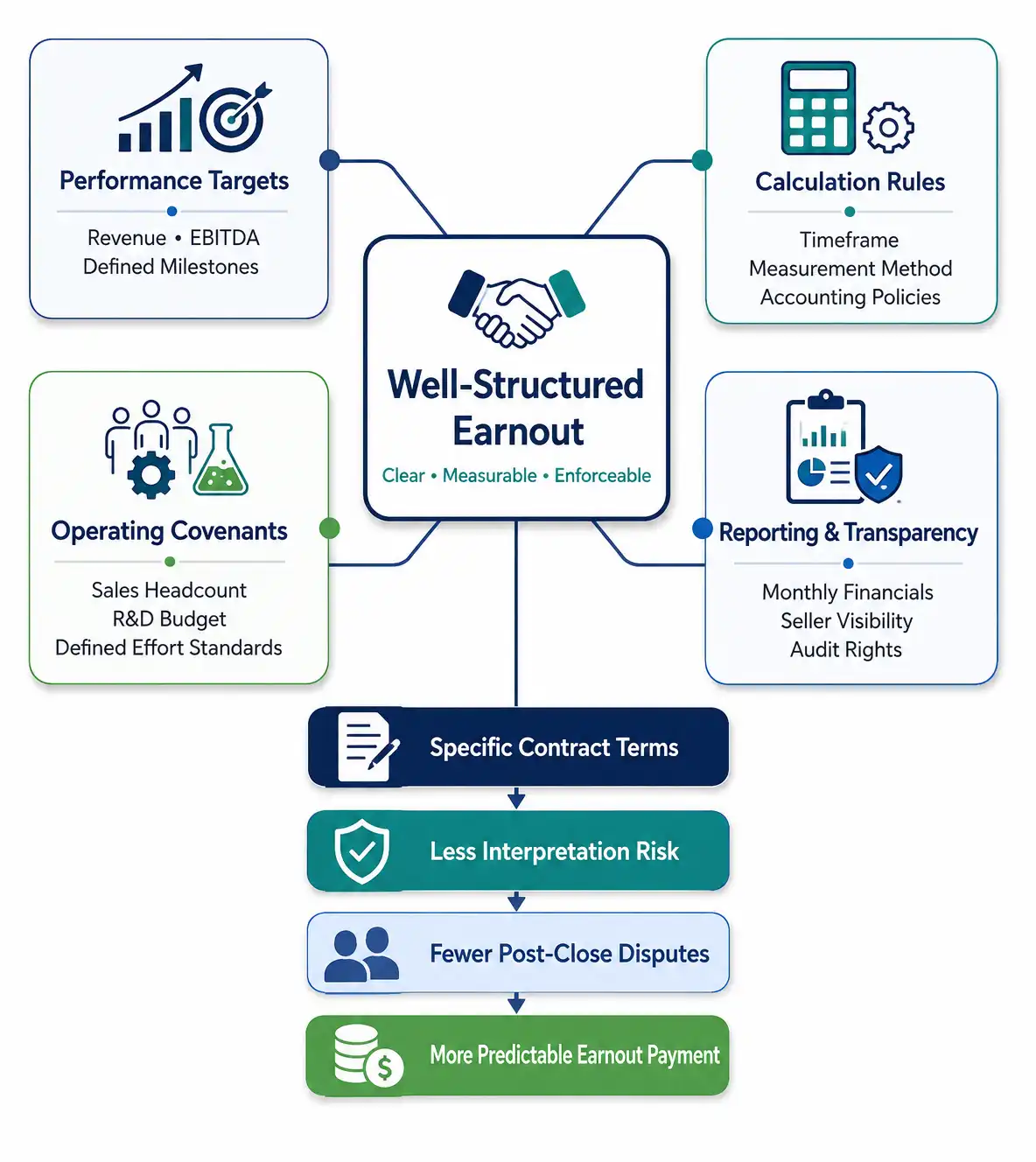
Reducing ambiguity requires the earnout clause to state, in numbers rather than adjectives, what the buyer must do and how success will be measured. A well-drafted clause typically includes:
- Objective performance targets, expressed in revenue, EBITDA, or another metric both sides have already stress-tested during diligence
- Clear timeframes and a calculation methodology that leaves no room for competing interpretations of how the metric was counted
- Defined effort standards backed by concrete examples, such as a covenant to maintain no less than 90% of the acquired sales headcount for the earnout period
- Reporting frequency and transparency rights that give the seller visibility without requiring board-level escalation to get it
A software covenant requiring the buyer to maintain a minimum research and development budget for the acquired product line, tied to a trailing average of pre-close spending, has repeatedly proven to be the single clause that keeps an earnout dispute from ever reaching arbitration.
Governance Rights and Audit Access
Sellers rarely sue over genuine manipulation. Far more often, they sue because they cannot see what is happening inside a business they no longer control, and the absence of visibility curdles into suspicion. Earnout contracts should therefore grant sellers proportionate monitoring rights, including:
- Board observer status for the duration of the earnout period
- Access to monthly financials at a level of detail matching what the buyer’s own management team reviews
- An independent audit trigger that activates automatically if the earnout calculation is disputed
In a cybersecurity and identity access management company generating approximately $30M in annual recurring revenue across five country entities, the ASC 606 revenue recognition framework and board-grade reporting infrastructure built ahead of an eventual acquisition became the backbone that carried the business through diligence without a single earnout-style dispute. The lesson generalizes well beyond that one deal: the discipline of clean, consistent revenue recognition before a transaction closes removes most of the ambiguity that fuels earnout litigation after it does.
Dispute Resolution Mechanisms That Keep Deals Out of Court
Litigation over an earn out is slow, expensive, and public in ways that damage relationships neither side wants to burn. The better path is a tiered mechanism that escalates deliberately rather than jumping straight to a courtroom.
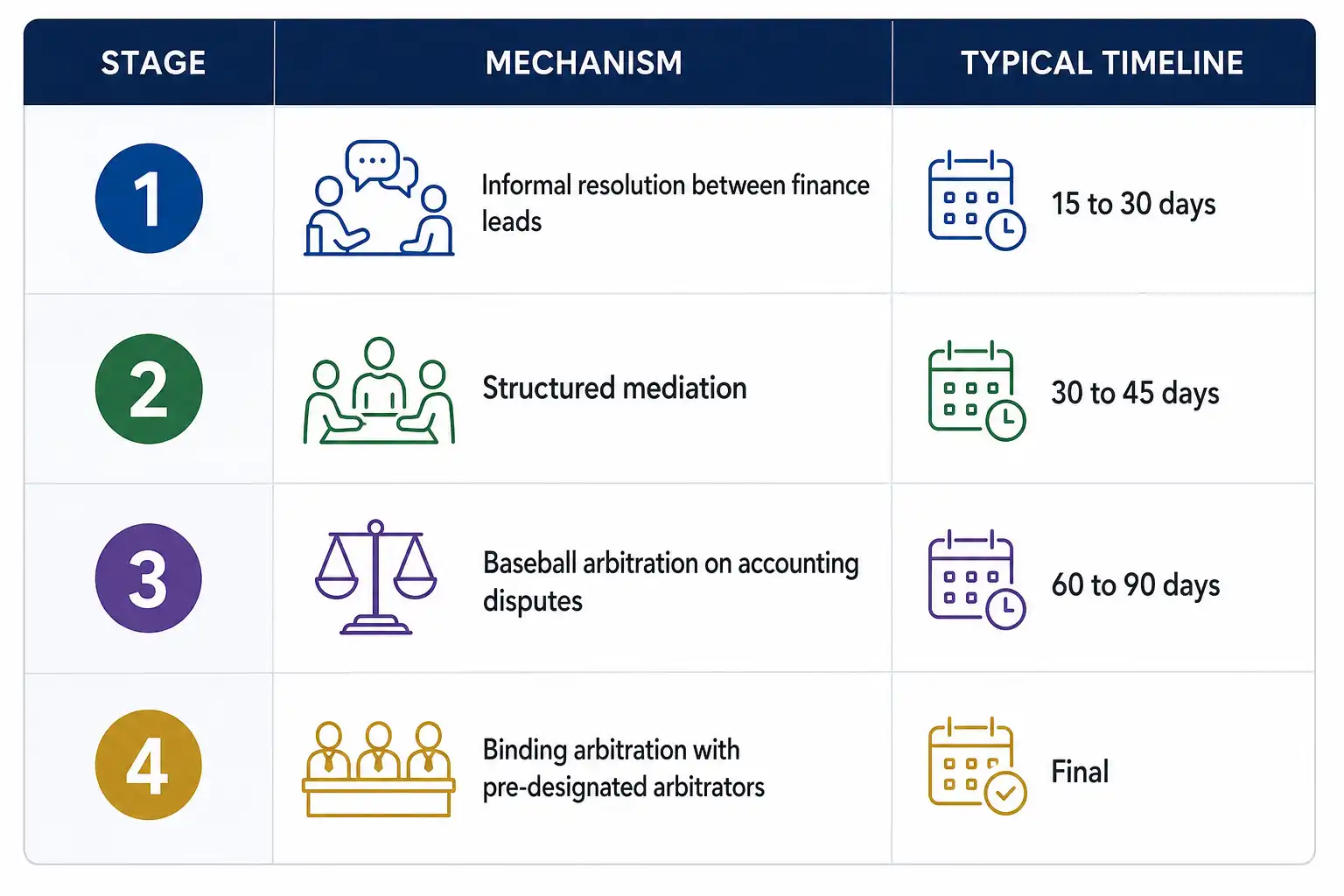
Baseball arbitration, where each side submits a single number and a neutral arbitrator must choose one of the two rather than splitting the difference, discourages extreme opening positions because neither side wants to be the one whose number looks unreasonable. Pre-designating acceptable arbitrators inside the purchase agreement itself removes an entire layer of negotiation friction at precisely the moment when trust between the parties is thinnest.
Interplay With GAAP and Accounting Choices
Post-close accounting decisions can quietly determine whether an earnout is met, even when no one intends manipulation. Revenue recognition timing, reserve policy changes, and reclassification of incentives between gross and net revenue all move the metrics an earnout depends on. Courts have sided with sellers in cases where a buyer changed accounting treatment after closing in a way that deviated from the target’s historical policy, even absent bad faith.
Three acquisitions led during a period of rapid growth at a venture-backed performance marketing organization, where revenue scaled from $9M to $180M in twenty-four months, reinforced a standing rule: earnout calculations should be tied explicitly to the target’s pre-close accounting policies, with any material change requiring mutual written agreement. That single provision closes off the most common source of good-faith accounting disputes before they start.
Three Key Takeaways
- An earn out is only as reliable as the specificity behind the phrase “commercially reasonable efforts,” and every agreement should replace that phrase with objective metrics, defined operating covenants, and named examples of the conduct required to earn the payment.
- Sellers need governance visibility, not control, and board observer rights, monthly financial access, and a standing audit trigger cost the buyer little while removing the suspicion that drives most earnout litigation.
- A tiered dispute resolution structure, anchored by baseball arbitration and pre-designated arbitrators, resolves earnout disagreements faster and at a fraction of the cost of litigation, provided the mechanism is written into the agreement before it is ever needed.
Disclaimer: This article is intended for informational purposes only and does not constitute legal, tax, or accounting advice. You should consult your own tax advisor or counsel for advice tailored to your specific situation.
Hindol Datta is a four-time CFO and senior finance executive with over 25 years of leadership experience across cybersecurity, SaaS, gaming, logistics, digital marketing, medical devices, consumer products, and nonprofit organizations. He has led more than $120M in fundraising and over $150M in M&A transactions while building the financial and operational systems that let complex businesses scale with confidence. He is the author of seven books in the Systems CFO Series and holds active CPA, CMA, and CIA credentials.
AI-assisted insights, supplemented by 25 years of finance leadership experience.