
Executive Summary
Every acquisition produces a purchase price, and the buyer must allocate that price across the assets it bought. That allocation is where goodwill and intangible assets diverge. The split shapes financial statements, tax outcomes, and the investor story for years after the deal closes. Understanding what goodwill in accounting is separates a defensible purchase price allocation from one that invites audit pushback. The same goes for knowing how it differs from identifiable intangible assets.
This article walks through the ASC 805 framework and the practical mechanics of separating goodwill from intangibles. It also covers the tax consequences of that split. It also covers the valuation calls that decide a deal’s split. How much becomes amortizable intangible value, and how much becomes residual goodwill exposed to future impairment?
The ASC 805 Framework for Purchase Price Allocation
Under ASC 805, an acquiring company must allocate the purchase price of a target business. That price gets split between the fair value of its tangible assets and identifiable intangible assets. Whatever remains gets recognized as goodwill. This process is not optional, and it sits inside a fair value hierarchy that auditors scrutinize closely. Within that structure, however, there is real room for judgment. Which assets qualify as separately identifiable, and what assumptions drive their fair value, are open questions.
In one high growth cybersecurity and identity access management company, annual recurring revenue reached roughly $30M. Its initial allocation exercise leaned heavily toward goodwill. Reassessing customer contract duration and attrition patterns shifted a meaningful share of value into customer relationships and non-compete agreements. That shift changed amortization schedules for years. It also signaled to investors that the company’s worth rested on recurring relationships rather than speculative upside.
What Is Goodwill in Accounting
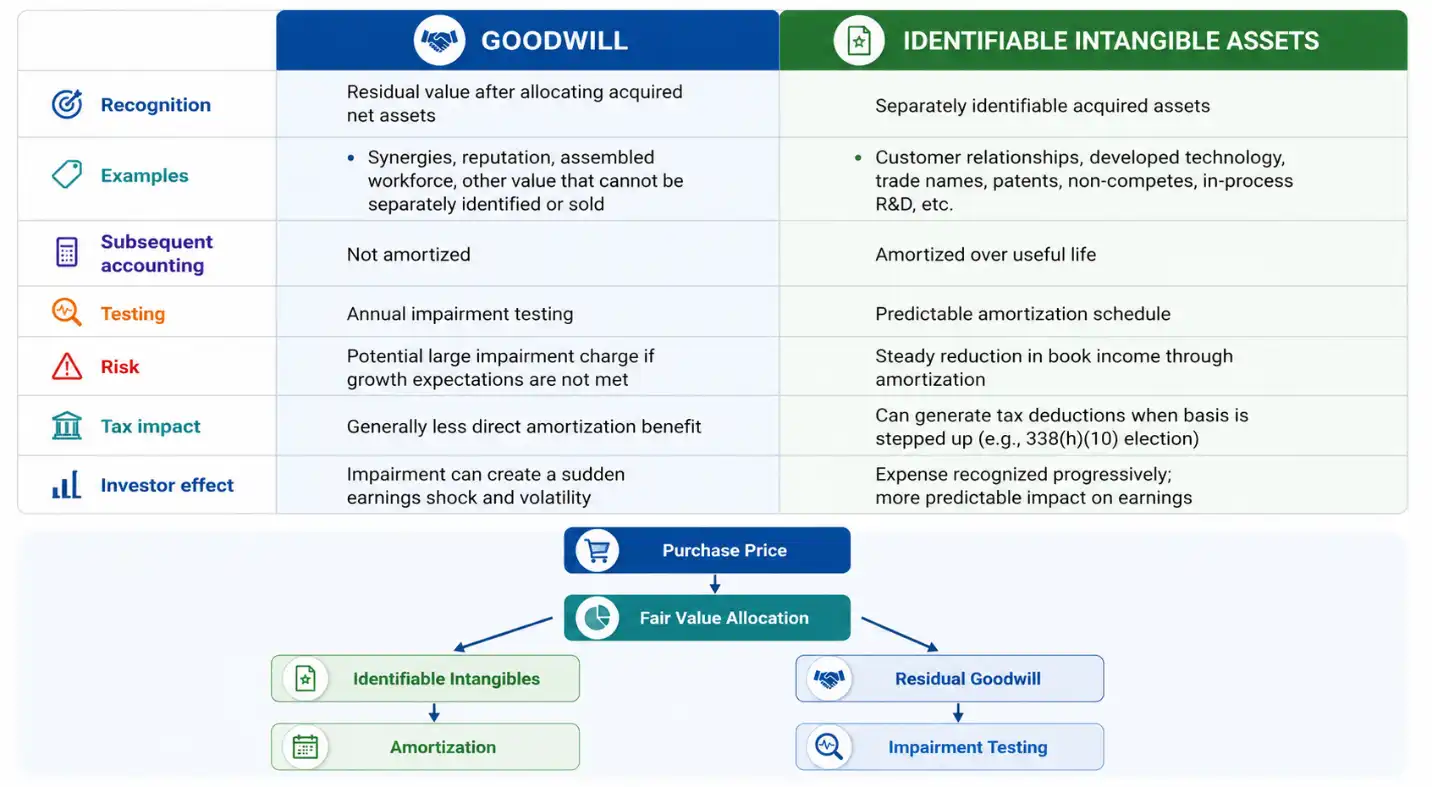
Goodwill represents the excess of the purchase price over the fair value of the net assets acquired. It captures reputation, assembled workforce, expected synergies, and other value that cannot be separately identified or sold. Companies never amortize goodwill under GAAP, but it faces annual impairment testing, which makes it both a cushion for the buyer and a warning light for anyone reviewing the deal later.
In high multiple transactions, goodwill can represent more than 70 percent of total deal value, a figure that draws attention from auditors and future acquirers alike. In one cross border acquisition inside a publicly traded gaming and digital entertainment company, an aggressive goodwill heavy allocation passed initial audit review but led to a $15M impairment charge within two years once growth projections fell short. The write down was not just an accounting entry. It unsettled the board and slowed investor relations for an entire quarter.
Identifiable Intangibles as More Than an Audit Checkbox
Identifiable intangible assets include customer relationships, developed technology, trade names, non competes, and in process research and development. Each must be valued separately and amortized over its useful life, and that amortization flows through EBIT, tax shields, and deferred tax accounting.
The judgment lies in segmentation. A customer base with low churn and contractual revenue justifies a longer amortization period and a higher fair value than a transient user list. During due diligence for an IT services acquisition, quality of earnings work surfaced material EBITDA adjustments that reshaped how reported earnings were interpreted, showing where economic reality diverged from the numbers on the page and where integration risk was concentrated. That same discipline applies to intangible segmentation, where the following factors typically separate a strong allocation from a weak one.
- Contract length and renewal history behind the customer base
- Historical churn by industry vertical or customer cohort
- Whether the technology asset has a short replacement cycle or a durable moat
- Legal protections tied to trade names, patents, or non-compete agreements
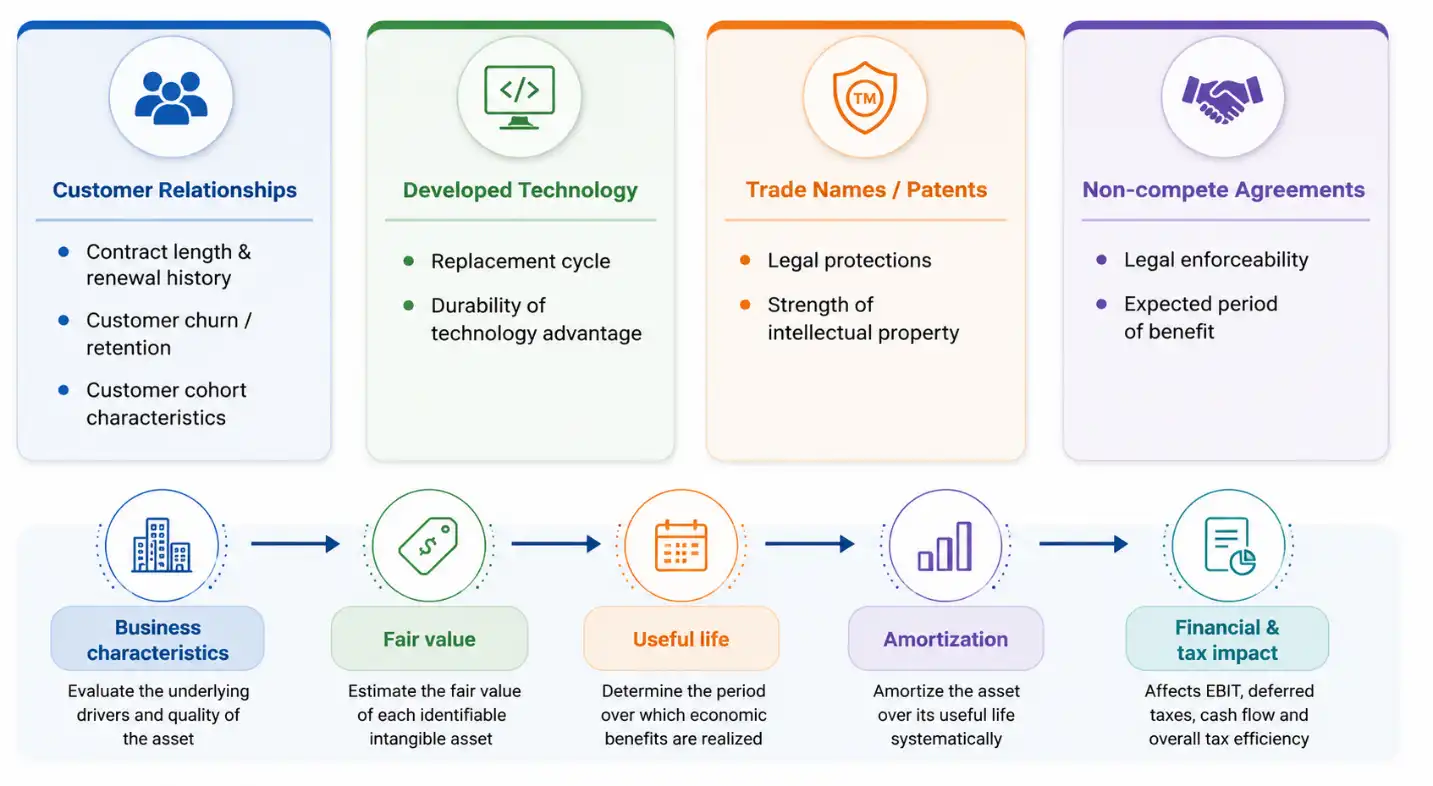
A sticky business to business customer base with strong renewal history can justify a ten year amortization life for customer relationships, materially strengthening the deferred tax asset position. A consumer app with a short user life cycle calls for a more conservative three year life on developed technology, which reduces front loaded amortization expense and keeps the numbers aligned with internal forecasts.
The Tax Lens on Elections and Deferred Tax Implications
Allocation decisions affect tax reporting as much as GAAP financials. A larger allocation to amortizable intangibles can generate greater deductions and improve post deal cash flow, but only when the deal structure allows a step up in basis. A 338(h)(10) election, for example, can be used specifically to secure tax amortization of acquired intangibles, and the resulting deduction stream can offset income from an unrelated transaction, improving overall tax efficiency across a portfolio.
Differences between book and tax allocations create deferred tax assets and liabilities that require ongoing coordination between tax, accounting, and legal teams. Left unmanaged, those differences produce confusing investor disclosures and invite inquiries from tax authorities.
Valuation Methods and Assumptions Behind the Numbers
Valuation firms typically rely on income, market, and cost approaches to value intangibles. The income approach, and specifically the multi period excess earnings method, is common for customer relationships, while relief from royalty methods are used for trade names and patents. The assumptions behind those models matter as much as the method itself, and they generally include the following.
- Attrition and retention rates by customer segment
- Discount rates benchmarked against comparable transactions
- Economic useful life for each intangible category
- Forecasted revenue contribution from the acquired asset base
A one-point shift in a discount rate, from 15 percent down to 12 percent based on a lower risk profile and stronger market comparables, can raise the fair value of a technology intangible by roughly 10 percent, with downstream effects on amortization schedules and deferred taxes.
Impairment Testing and Its Effect on Future Reporting
Goodwill is not amortized, but it is tested for impairment annually under ASC 350, and a decline in expected cash flows or market value can trigger a write down. These non-cash charges can be large and can shake investor confidence even when the underlying business is sound. During periods of macroeconomic disruption, portfolio companies with strong long-term fundamentals have still recorded goodwill impairments when short term forecasts were revised downward, and those charges often become significant investor relations events regardless of the longer term outlook.
Intangibles, in contrast, amortize on a predictable schedule that reduces book income steadily rather than in a single shock, which is generally the more useful pattern for financial modeling and forecasting.
Three Key Takeaways
- The split between goodwill and identifiable intangible assets under ASC 805 is a judgment heavy process, and small changes in assumptions such as discount rates or contract attrition can materially shift the fair value allocated to each category.
- A heavier allocation to identifiable intangibles generally produces better tax outcomes, stronger deferred tax positioning, and a cleaner narrative for auditors and investors, while a goodwill heavy allocation carries greater impairment risk down the road.
- Because goodwill faces annual impairment testing while intangibles amortize on a predictable schedule, the allocation decision made at close continues to affect reported earnings, tax deductions, and investor confidence for the full useful life of the acquired assets.
Disclaimer: This article is intended for informational purposes only and does not constitute legal, tax, or accounting advice. Consult a qualified tax advisor or counsel for guidance tailored to a specific transaction.
Hindol Datta is a four-time CFO and senior finance executive with over 25 years of leadership experience across cybersecurity, SaaS, gaming, logistics, digital marketing, medical devices, consumer products, and nonprofit organizations. He has led more than $120M in fundraising and over $150M in M&A transactions, and is the author of seven books in the Systems CFO Series, holding active CPA, CMA, and CIA credentials.
AI-assisted insights, supplemented by 25 years of finance leadership experience.