
Executive Summary
Reps and warranties are the seller’s contractual assurances about the state of a business at signing. They function as the primary mechanism through which M&A deals allocate risk between buyer and seller. Reps and warranties in M&A are not just boilerplate legal language. Any finance leader who wants a deal to hold together after closing needs to understand what reps and warranties accomplish.
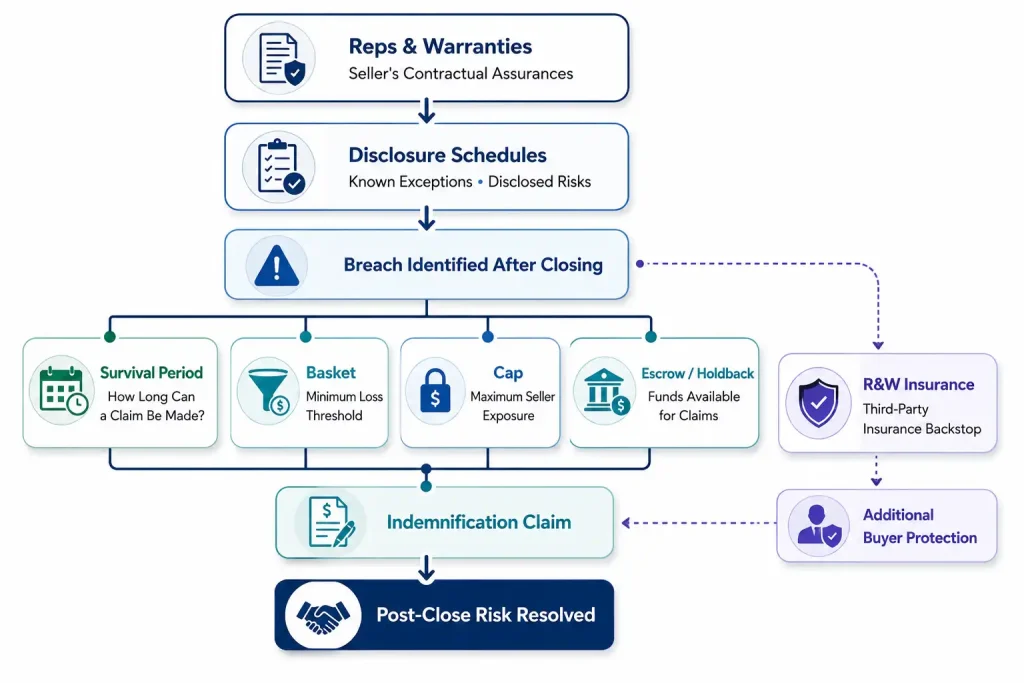
The architecture behind reps and warranties includes several pieces. Indemnification provisions give them teeth. Escrow and holdback structures fund claims without resorting to litigation. Disclosure schedules define the boundaries of what a seller is actually promising. Reps and warranties insurance plays a growing role in bridging gaps between buyer and seller expectations. None of it is legal theory. It is a practitioner’s map of where the real risk sits in an acquisition agreement. It shows how experienced finance teams negotiate around it.
What Are Reps and Warranties in M&A?
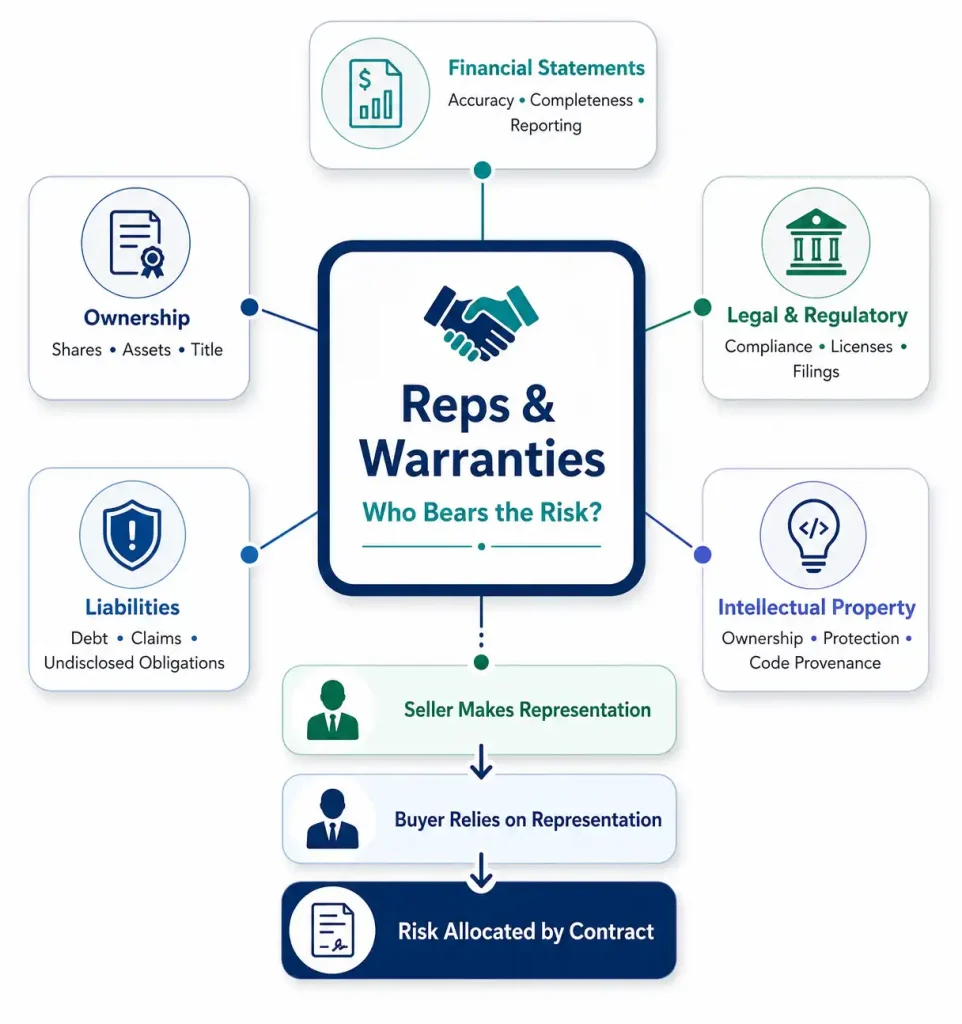
At its simplest, a representation is a statement of fact about the business as of a given date. A warranty is the promise that the statement is true. A remedy backs it up if it turns out not to be. Buyers and their counsel treat the terms as a single category in practice. Together they cover nearly everything a purchaser needs to know before wiring funds. Who actually owns the shares or assets up for sale. Whether the financial statements hold up. Does the business comply with applicable laws? Any liabilities that remain undisclosed. Who owns and protects the intellectual property.
The scope and specificity of these representations tend to track the risk profile of the industry. Consider a $100M+ cross-border acquisition inside the gaming and digital entertainment sector. Due diligence and integration work there turned substantially on getting the intellectual property and regulatory representations right across five jurisdictions. A single overlooked filing in one country could have unwound the value case for the entire transaction. Life sciences deals work differently. Representations frequently run to a dozen pages or more of regulatory schedule detail. The FDA status of a product line is often the whole reason the deal exists.
None of this happens by accident. Every representation a seller makes shifts a category of risk onto their side of the ledger. Every representation a seller resists including tells a buyer something. It signals how confident that seller actually is in their own numbers.
Indemnification: The Mechanism That Gives Reps and Warranties Teeth
A representation without an indemnification remedy is a statement, not a protection. Indemnification provisions determine what a seller owes a buyer when a representation turns out to be false. Negotiators work out the mechanics of that compensation with as much care as the representations themselves.
Four terms tend to dominate this negotiation:
- Cap – The maximum dollar exposure a seller carries for breaches of the representations, often set as a percentage of purchase price.
- Basket – The minimum threshold of losses a buyer must accumulate before making a claim, which keeps small, immaterial issues out of the claims process.
- Survival period – The window of time after closing during which a representation remains actionable, typically ranging from twelve to thirty-six months depending on the nature of the representation.
- Escrow – A portion of the purchase price withheld at closing specifically to fund indemnification claims, so a buyer is not left chasing a seller who has already moved on.
Why Survival Periods Vary by Representation
Not every representation deserves the same clock. Tax and intellectual property representations tend to carry longer survival periods than general operational representations, because the underlying exposures often take years to surface. A payroll tax issue rooted in a legacy filing, for example, can remain invisible well past the point at which a standard twelve-month survival period would have expired, which is precisely why practitioners who have lived through a late-emerging tax claim tend to negotiate extended survival for tax and IP representations as a matter of habit rather than as an afterthought.
Escrow and Holdbacks: Funding Claims Without Litigation
Escrow and holdback structures give indemnification something to draw against, and their design directly shapes whether the parties resolve post-closing disputes through negotiation or through litigation. A well-structured escrow, tiered by risk category, tends to produce faster and cheaper resolutions than a single undifferentiated pool of withheld funds.
In one private equity buy-side due diligence engagement supporting an IT services acquisition, the escrow was split across general indemnity, a pending litigation reserve, and a revenue milestone tranche, which gave both sides clarity about which pool of money would fund which category of dispute. When a vendor dispute surfaced after closing, it was resolved directly against the relevant escrow tranche, with no need for outside counsel to get involved at all.
Working capital true-ups deserve attention here as well, since a poorly defined working capital target is one of the most common sources of post-closing conflict. A dispute over working capital mechanics can tie up an entire escrow pool for months, which is why a detailed, pre-agreed working capital model, with every input defined before signing, has become standard practice in most well-run transactions.
Disclosure Schedules: Where the Exceptions Live
Reps and warranties are only as strong as the disclosure schedules that qualify them. A seller’s schedule carves out the specific exceptions to each representation, and once a fact has been properly disclosed and accepted by the buyer, it generally stops being available as grounds for an indemnification claim. A representation stating that no litigation exists against the company means very little if the accompanying schedule already lists three pending lawsuits that the buyer has agreed to accept as known risk.
This is why thorough disclosure work is worth the time it costs. In a cybersecurity and identity access management company carrying roughly $30M in annual recurring revenue, board-grade financial reporting and a properly built revenue recognition framework carried the business through the eventual buyer’s acquisition diligence cleanly, in large part because the underlying disclosures were accurate and complete before diligence ever began. The alternative, a rushed or incomplete disclosure process, tends to surface exactly the kind of contingent liability, an old lease obligation, an unresolved vendor claim, that a representation alone would never have flagged.
Reps and Warranties Insurance and the Negotiation Dynamic
Contract negotiation around representations, indemnification, and escrow is not a legal exercise conducted at arm’s length from the commercial deal. It is commercial leverage, traded in both directions. A seller who wants a lower cap may agree to a broader definition of covered claims. A buyer who wants a longer survival period may accept a smaller basket in exchange.
Reps and warranties insurance has become an increasingly common tool for closing the gap between what a seller is willing to accept and what a buyer needs for comfort. Under an R&W insurance policy, a third-party insurer effectively steps into the seller’s shoes for breach claims above a retention threshold, which allows a seller to accept a lower personal cap while still giving the buyer meaningful post-closing protection. Across a series of acquisitions completed by a venture-backed digital marketing organization scaling from $9M to $180M in revenue over three funding rounds, a hybrid structure combining a modest seller cap with an R&W insurance backstop allowed both sides to close on terms that would otherwise have stalled the negotiation for weeks.
The mechanics of a deal should ultimately reflect what is actually being acquired. A transaction built around technology should weight its representations toward intellectual property ownership, employee inventions, and code provenance. A transaction built around market position should weight its representations toward customer contract assignability, non-compete enforceability, and exclusivity terms. Reps and warranties that are not calibrated to what actually drives a deal’s value tend to protect against the wrong risks entirely.
Three Key Takeaways
- Reps and warranties are not boilerplate. They are the mechanism through which risk gets allocated between buyer and seller, and the specificity of a representation should always track the actual risk profile of the industry and the deal.
- Indemnification, escrow, and disclosure schedules only function as protection when they are designed together, with survival periods, caps, and baskets calibrated to the categories of risk that are genuinely likely to surface after closing.
- Reps and warranties insurance and tiered escrow structures give negotiators room to close gaps between buyer and seller expectations without abandoning the underlying protections that make an M&A contract worth signing.
Disclaimer: This article is intended for informational purposes only and does not constitute legal, tax, or accounting advice. You should consult your own tax advisor or counsel for advice tailored to your specific situation.
Hindol Datta is a four-time CFO and senior finance executive with over 25 years of leadership experience across cybersecurity, SaaS, gaming, logistics, digital marketing, medical devices, consumer products, and nonprofit organizations. He has led more than $120M in fundraising and over $150M in M&A transactions while building the financial and operational systems that let complex businesses scale with confidence. He is the author of seven books in the Systems CFO Series and holds active CPA, CMA, and CIA credentials.
AI-assisted insights, supplemented by 25 years of finance leadership experience.