
Executive Summary
Subsidiary risk management is not a legal formality tucked into the corporate secretary’s calendar. Subsidiary discipline is one of the clearest signals of how a finance organization actually operates. It shows up long before it ever reaches the consolidated numbers. Executives tend to focus on revenue growth and local market share. In doing so, they often underestimate the compliance drag and exposure built into every entity added to a global footprint. Four risk categories drive this exposure: foreign currency movement, tax structuring, transfer pricing, and statutory compliance. Together, they decide whether international expansion strengthens the enterprise or quietly erodes it.
This article works through each risk category in turn. It offers frameworks and controls built to hold up under audit pressure and board scrutiny. These draw on experience building finance functions across cybersecurity, consumer products, gaming, and mission-driven organizations operating in multiple countries. The goal is a governance model that treats subsidiaries as living parts of the balance sheet. They are not a static list of legal entities.
Foreign Currency Risk Across Multi Entity Structures
Currency volatility does more than distort the consolidated financial statements at quarter end. It reaches into intercompany settlements, local margins, and the timing of cash available for reinvestment. Unhedged exposure between subsidiaries and headquarters can erode profitability faster than most planning cycles account for. In a Latin America based entity within a venture backed portfolio, operating profit swung 18 percent year over year. The swing came purely from a depreciating local currency against the US dollar. The fix came through natural hedging built around local sourcing and billing alignment, rather than financial instruments.
A related distinction trips up even experienced finance teams. It’s the difference between transaction exposure and the unrealized foreign exchange gain or loss on the balance sheet. This unrealized figure comes from revaluing open intercompany balances, and it moves every reporting period. Treating it as a rounding item rather than a tracked exposure carries a risk. A cash rich entity can end up reporting a currency loss nobody saw building. This shows up in a cybersecurity and identity access management company operating across the US, Canada, Mexico, India, and Nepal. The company kept actuals within plus or minus five percent of forecast for eight straight quarters. That consistency depended partly on modeling unrealized exposure alongside operating forecasts. The team did not treat it as a separate accounting exercise. A $127M global consumer products company sourcing from China and Vietnam faced a similar dynamic. The finance team had to model currency movement against the supply chain cost base with the same rigor as demand planning.
Best practices that hold up across industries include the following measures.
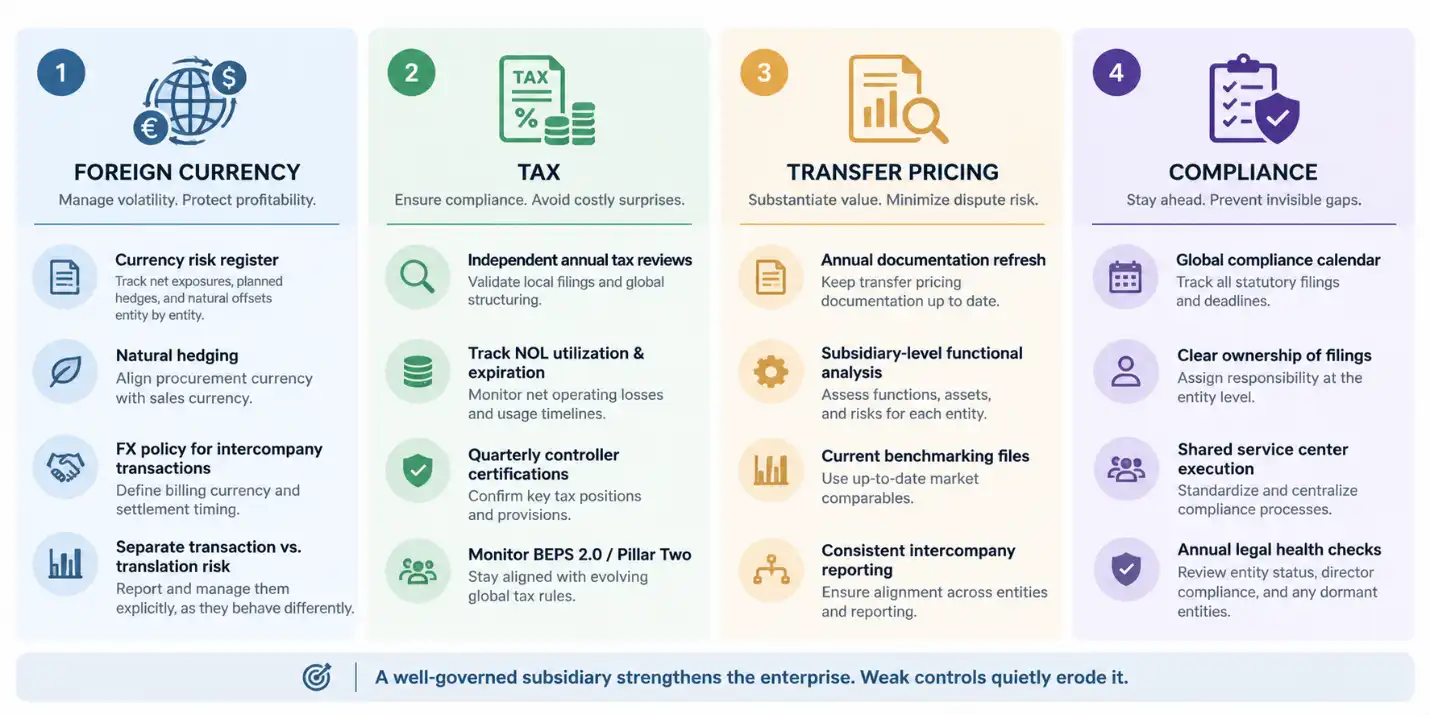
- Establishing a currency risk register that tracks net exposures, planned hedges, and natural offsets entity by entity
- Prioritizing natural hedging, such as aligning procurement currency with sales currency, before reaching for financial instruments
- Defining a written FX policy for intercompany transactions, including billing currency and settlement timing
- Separating translation risk from transaction risk explicitly in board reporting, since the two behave differently and require different responses
Tax Risk Embedded in Local Filings and Global Structures
Tax risk builds slowly and bites without warning. Each jurisdiction carries its own code, and a position that looks compliant locally can quietly conflict with group level planning around interest deductibility, controlled foreign corporation rules, or treaty limitations. An Eastern European subsidiary in a private equity backed transaction had carried forward net operating losses on paper for years while its returns were not properly filed due to an expired digital certificate, and those losses were disallowed entirely in a subsequent merger scenario, closing off a meaningful tax offset that leadership had assumed was available.
Local rules interacting badly with global structuring is where the real damage tends to concentrate. A controlled foreign corporation with local thin capitalization rules disallowed interest deductions locally while the same interest income was treated as Subpart F income in the United States, producing double taxation because two tax teams were operating in silos rather than a shared framework. That kind of collision is avoidable, and the mission driven education and research institution experience of staffing a finance and audit committee with monthly and annual board reporting reinforced how much smoother tax governance runs when local tax decisions are routed through a global model with shared impact visibility rather than resolved entity by entity.
Key controls worth building into any subsidiary tax program include the following.
- Annual local tax compliance reviews conducted independently of the local controller’s own certification
- Entity level tracking of net operating loss utilization and expiration
- Quarterly compliance certifications from every subsidiary controller
- Active monitoring of BEPS 2.0 and Pillar Two readiness as global minimum tax rules continue to phase in
Transfer Pricing and the Discipline of Defensible Documentation
Intercompany pricing remains the single most frequent trigger for tax audits and adjustments, and the pricing charged between a subsidiary and headquarters for intellectual property, services, or goods has to be both documented and defensible under scrutiny, not just internally consistent. In a Euronext Paris listed gaming and digital entertainment company with operations spanning the United States, France, the United Kingdom, Singapore, and South Korea, a South Korean auditor deemed a software license fee excessive and issued a material adjustment, and the benchmarking file behind that fee, though technically compliant, had not been refreshed in two years. That gap between technical compliance and audit readiness is where most transfer pricing exposure actually lives.
The fix is procedural rather than clever. Refreshing transfer pricing documentation on an annual cycle, running a functional analysis at the subsidiary level, and building the benchmarking file before an audit challenge rather than in response to one turns transfer pricing from a defensive scramble into routine finance hygiene. Rolling out a single global systems platform, the kind of unified Oracle Financials and MicroStrategy implementation that created one consistent definition of revenue across every subsidiary in that gaming company’s footprint, also removes a common source of transfer pricing inconsistency, since pricing disputes often trace back to entities reporting the same intercompany flow in slightly different ways.
Compliance Risk and the Cost of Invisible Gaps
Statutory compliance covers local GAAP reporting, VAT filings, labor law obligations, and corporate secretarial requirements, and the risk rarely comes from intent. It comes from ignorance or a simple loss of visibility. A dormant subsidiary in Asia incurred $300K in penalties for late filings, and the root cause was almost administrative in nature, since the person responsible for tracking that entity’s reporting calendar had left the organization and no one inherited the calendar behind them. The fine itself was smaller than the internal cost of resolving it, and the reputational cost with an audit committee asking why a dormant entity had gone unmanaged for years was harder to repair than the penalty.
A $170M global medical device manufacturer with plants in Copenhagen, Cork, and Taiwan illustrates the other end of the spectrum, where standard costing, bill of materials management, and inventory controls had to withstand line by line audit scrutiny in a heavily regulated industry, and that discipline only held because the compliance calendar was centrally owned rather than left to individual site controllers. A global compliance calendar with clear ownership, ideally run through a shared service center rather than distributed across local staff who may or may not prioritize it, is the single highest leverage control in this category.
- Maintaining one global compliance calendar covering every entity and filing type
- Using shared service centers to standardize filing execution across jurisdictions
- Conducting annual legal health checks that flag dormant or at-risk entities before regulators do
Building an Integrated Subsidiary Governance Model
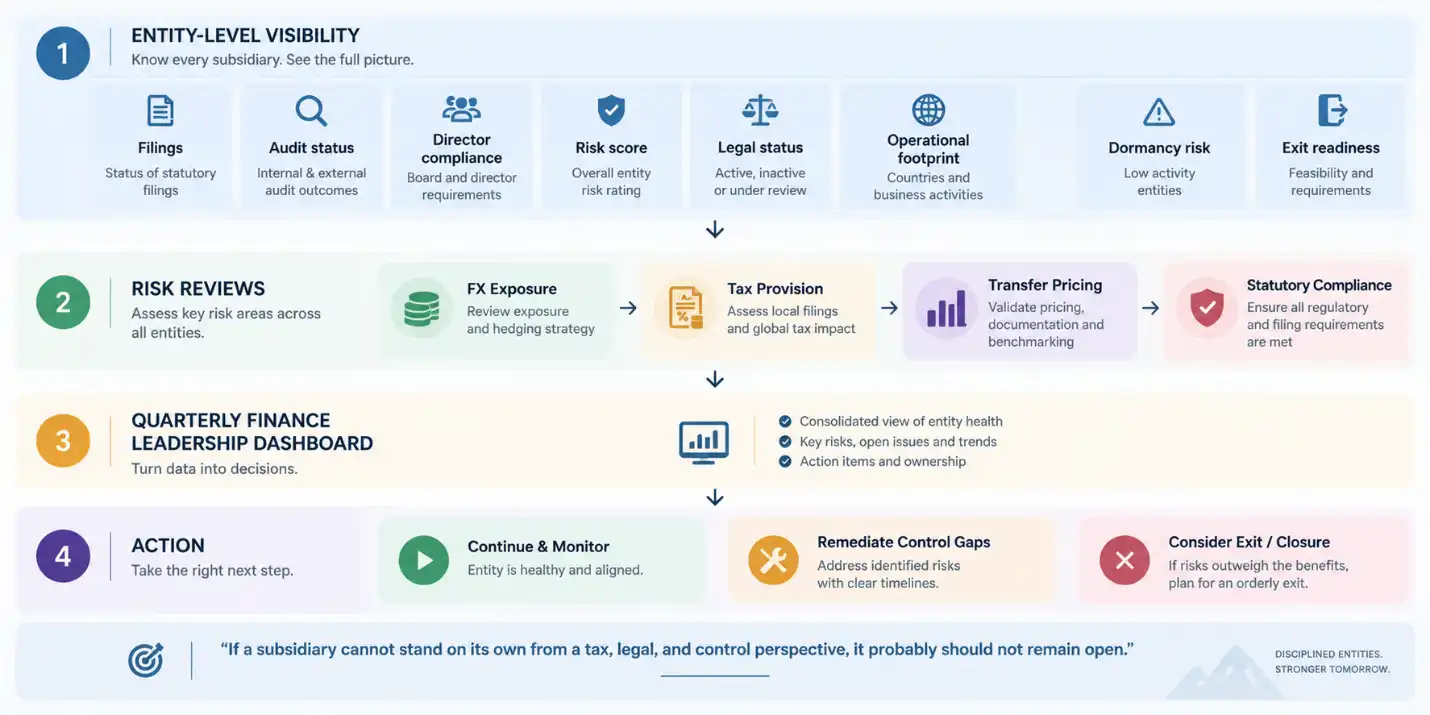
None of these four risk categories operate in isolation, which is the reasoning behind the governance model above. Currency exposure feeds tax planning, tax structuring shapes transfer pricing defensibility, and compliance gaps expose all three to reputational damage that reaches well beyond the entity where the failure originated. A $127M consumer products company delivered four consecutive clean external audits while simultaneously owning supply chain and logistics economics across ocean freight, trucking, and warehousing, and that consistency came from treating audit readiness as a year-round discipline rather than a fourth quarter scramble.
A working dashboard that tracks every entity’s filing, audit status, director compliance, and risk score, reviewed quarterly by finance leadership, turns subsidiary governance from a reactive exercise into a preemptive one. Entity level health checks each year, covering legal status, operational footprint, dormancy risk, and exit readiness, paired with tax provision reviews and FX exposure modeling, complete the picture. If a subsidiary cannot stand on its own from a tax, legal, and control perspective, it probably should not remain open, and that judgment only becomes possible once the underlying data is visible in one place rather than scattered across local advisors and inboxes.
Three Key Takeaways
- Foreign currency exposure requires tracking both realized transaction risk and the unrealized foreign exchange gain or loss sitting on the balance sheet from intercompany revaluation, since the second category is where surprises most often originate.
- Tax and transfer pricing risk both stem from documentation that falls out of date faster than most finance teams expect, and an annual refresh cycle for compliance filings and benchmarking files is cheaper than any single audit adjustment.
- Compliance risk is rarely about intent. It is about ownership, and a centrally maintained global compliance calendar with a dashboard reviewed quarterly is the control that prevents dormant entities from becoming board level embarrassments.
Disclaimer: This article is intended for informational purposes only and does not constitute legal, tax, or accounting advice. You should consult your own tax advisor or counsel for advice tailored to your specific situation.
Hindol Datta is a four-time CFO and senior finance executive with over 25 years of leadership experience across cybersecurity, SaaS, gaming, logistics, digital marketing, medical devices, consumer products, and nonprofit organizations. He has led more than $120M in fundraising and over $150M in M&A transactions while building the financial and operational systems that let complex businesses scale with confidence. He is the author of seven books in the Systems CFO Series and holds active CPA, CMA, and CIA credentials.
AI-assisted insights, supplemented by 25 years of finance leadership experience.