
Executive Summary
The most persistent myth in dealmaking is that integration begins after signatures dry. In practice, disciplined M&A integration planning starts in the diligence room, long before a term sheet becomes a closing binder. Organizations that treat integration as a parallel workstream, not a post-close afterthought, close faster. They also bleed less value along the way. A well-built mergers and acquisitions IT integration plan turns integration from reactive cleanup into a proactive accelerant of the deal. Early HR, finance, and operational readiness reinforce that shift.
Pre-integration planning spans four functions. Each shape whether a deal succeeds: HR and people strategy, IT infrastructure, finance controls, and operations. It closes with the governance structure that holds all four together. A plan without clear decision rights tends to unravel within the first ninety days.
Why Pre-Integration Planning Gets Skipped
Deal timelines move fast, and by the time teams wrap diligence and sign the documents, executives are running on fumes. Integration then becomes reactive by default. It gets handled in the gaps between other priorities rather than treated as a discipline in its own right. Organizations that plan a few weeks before signing tend to emerge from the first six months with fewer surprises. Their path to stability is also materially shorter.
In one European SaaS acquisition, M&A integration planning began three weeks before signing rather than after close. HR teams templated onboarding workflows. IT validated system maps. Finance aligned reporting calendars well ahead of Day One. That groundwork turned a potential 180-day integration into one that closed in roughly sixty.
HR and People Strategy: Cultural Fit Beyond the Org Chart
People do not consolidate as cleanly as spreadsheets. Organizations that treat HR integration as a headcount roll-up tend to lose the talent that made the acquisition worth pursuing. A sound pre-integration HR workstream typically includes:
- Role mapping and org design scenarios
- Compensation benchmarking across both entities
- Benefit plan compatibility checks
- Retention risk assessments for critical talent
- Cultural touchpoint identification and a “culture crosswalk” of rituals, decision norms, and communication styles
One high-growth cybersecurity and identity access management company ran a retention model. It had roughly $30M in annual recurring revenue and a workforce spread across five countries. It flagged two senior engineers as high attrition risks tied to equity cliffs and prior churn patterns. Targeted retention bonuses and early introductions to the incoming leadership team were arranged before close. Both engineers stayed, and post-integration engagement surveys showed they felt informed rather than blindsided.
Psychological readiness matters as much as the mechanics. In one carve-out involving a mission-driven education institution, incoming employees received integration welcome kits with FAQs, org charts, and a 30-60-90-day roadmap, and engagement scores came in fifteen percent higher than in comparable prior deals.
Building a Mergers and Acquisitions IT Integration Plan
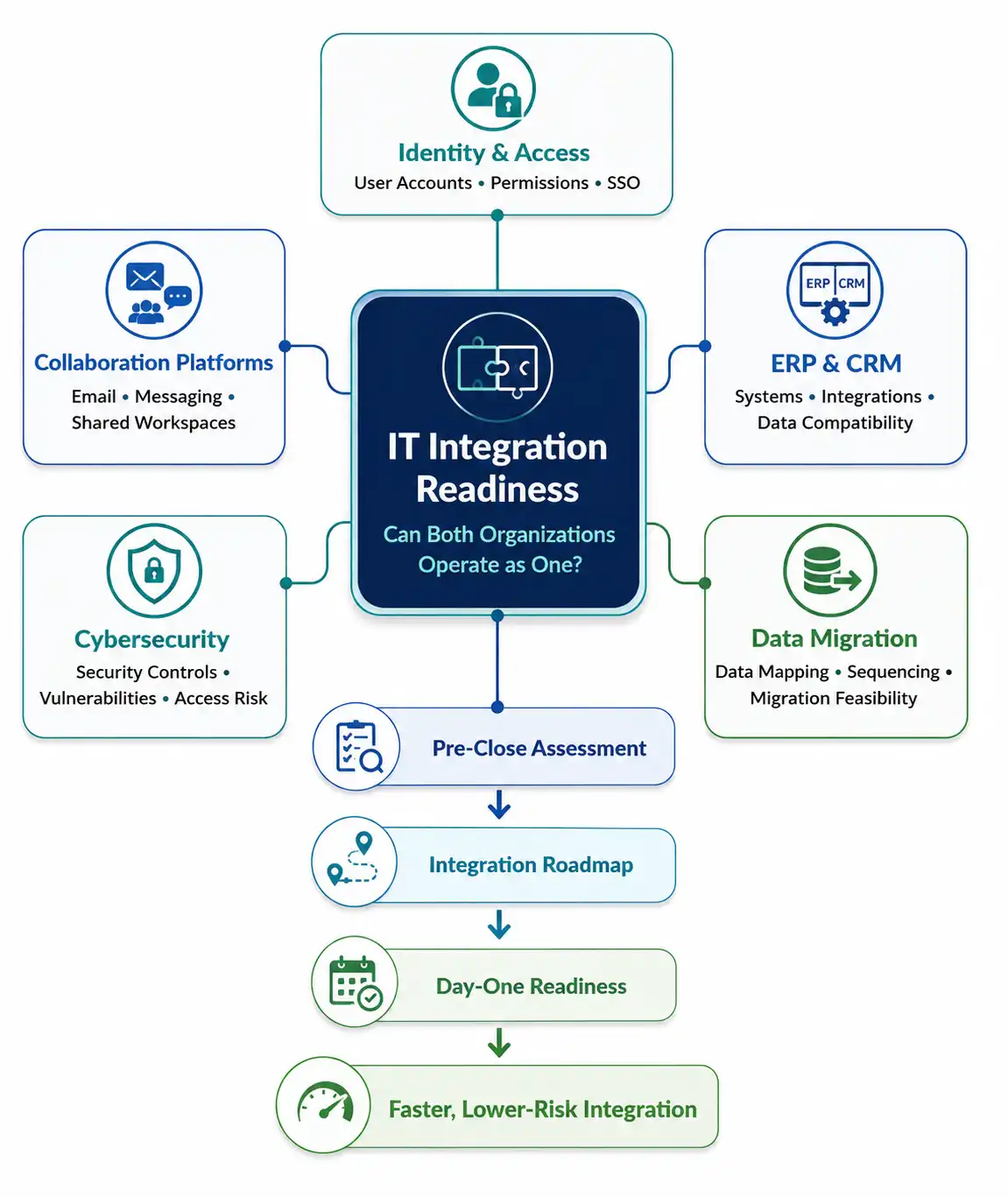
IT readiness sets the tempo for how quickly two organizations can actually function as one, which is why a mergers and acquisitions IT integration plan deserves attention as early as HR and finance. Core areas to assess before close include:
- Identity and access management protocols
- Email and collaboration platform alignment
- ERP and CRM compatibility
- Cybersecurity posture across both entities
- Data migration feasibility and sequencing
Staging the Technical Debt Instead of Forcing It
In a technology acquisition where the target had no single sign-on protocol in place, a forced Day One conversion was rejected in favor of a staged ninety-day identity integration. The approach preserved security posture while still allowing functional collaboration to begin immediately, avoiding what would otherwise have been a nine-month delay in system harmonization. That sequencing decision, made during pre-integration rather than improvised post-close, is often what separates a mergers and acquisitions IT integration plan that actually holds up from one that collapses under its own ambition.
Finance: Synchronizing Calendars, Controls, and Close
The finance dimension of M&A integration planning centers on a handful of recurring friction points: chart of accounts mapping, budget cadence alignment, close timeline integration, treasury account rationalization, and audit and compliance preparation. Misalignment on any one of these can extend the first post-close close cycle by weeks and, in worse cases, create liquidity blind spots when treasury accounts have not been rationalized in time.
Multi-entity finance work offers a useful reference point here. In one $127M global consumer products company operating across DTC, Amazon, and wholesale channels with a supply chain spanning China and Vietnam, aligning reporting templates and controls before close proved decisive in delivering four consecutive clean external audits after acquisition activity. Joint budget cycles run with the target organization in the final weeks before close tend to ensure the first post-close quarter is not a surprise to either side.
Operations: Harmonizing Processes and KPIs
Operational integration does not wait politely for Day One, and it rarely earns a slide in the board deck, yet it is where day-to-day friction actually lives. The functions worth mapping during diligence include order-to-cash workflows, procurement and vendor overlaps, logistics and fulfillment systems, inventory policies, and performance metrics alignment.
In one cross-border consumer products integration, customer onboarding in the acquired entity took ninety days against ten days internally, a gap wide enough to threaten early customer experience if left unaddressed. Flagging that disparity during diligence made it possible to begin standardizing workflows before the deal was even announced publicly, rather than scrambling to fix it under the pressure of an already-closed transaction.
Governance: Who Owns What, and When
Integration without defined governance tends to produce duplication, drift, and decisions made twice by two different teams. The elements worth establishing before close include a decision rights matrix, an Integration Management Office (IMO) charter, and a clear reporting cadence with escalation protocols built in.
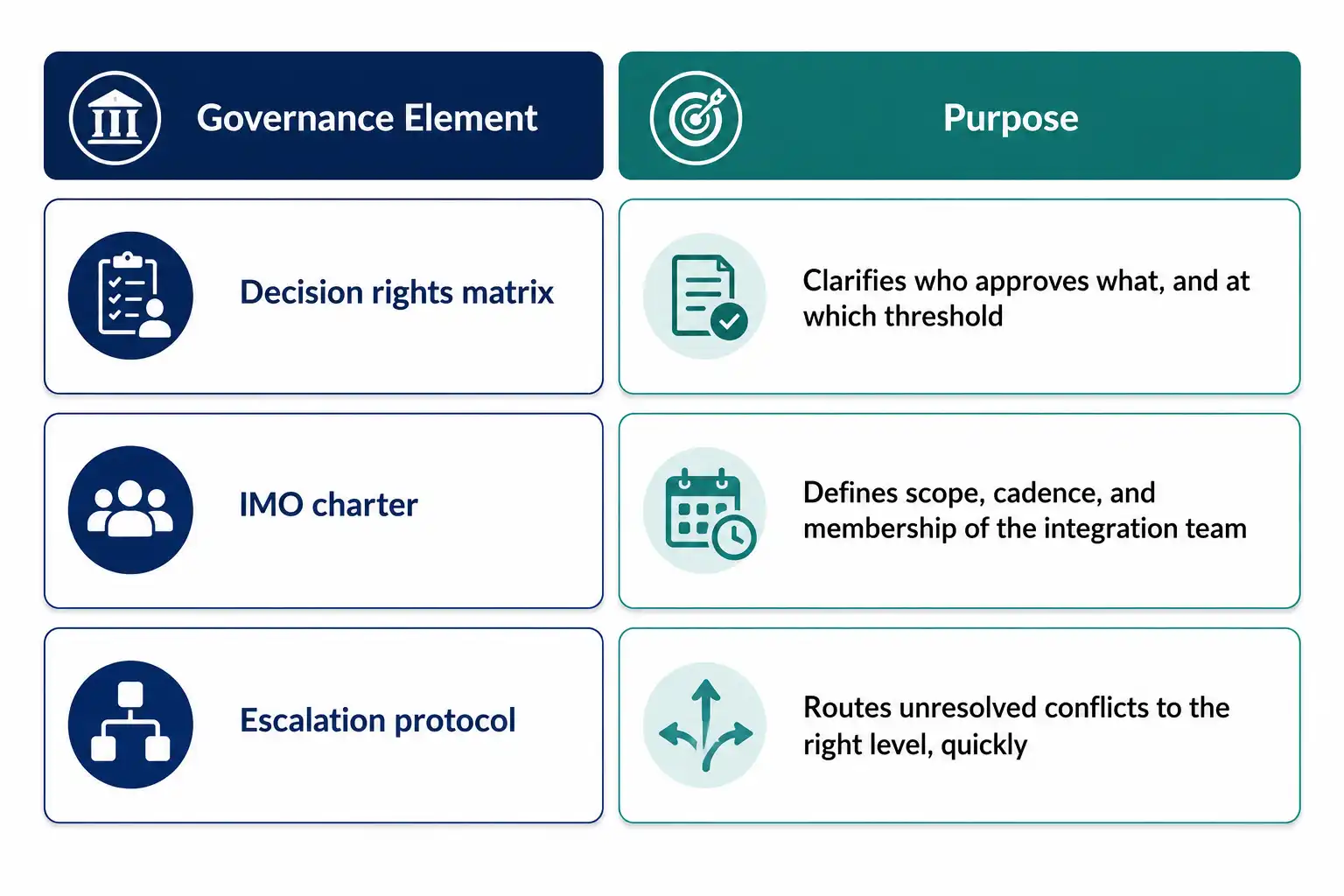
Strong governance is what separates M&A integration planning that holds under pressure from a binder that gets shelved after Day One. A tri-party IMO structure, one that includes deal sponsors, functional leaders, and integration project managers together rather than siloed by function, tends to create alignment across geographies that a single-owner model cannot. In a Euronext Paris-listed public gaming and digital entertainment company operating across five countries, this structure supported more than $100M in cross-border M&A execution with full due diligence and post-merger integration responsibility, backed by a unified Oracle Financials rollout that gave every subsidiary the same definition of revenue.
Three Key Takeaways
- M&A integration planning should begin during diligence, not after signing, because the organizations that template HR workflows, validate IT system maps, and align finance calendars before close consistently compress integration timelines and reduce the surprises that erode deal value.
- A mergers and acquisitions IT integration plan is often the pacing element for the entire integration, and staging technical decisions, such as identity management or ERP consolidation, in phases rather than forcing Day One conversions can preserve security while still enabling early collaboration.
- Governance is the connective tissue that holds every other workstream together, and establishing a decision rights matrix and an Integration Management Office charter before close prevents the duplication and drift that otherwise stall integration in its first ninety days.
Disclaimer: This article is intended for informational purposes only and does not constitute legal, tax, or accounting advice. You should consult your own tax advisor or counsel for advice tailored to your specific situation.
Hindol Datta is a four-time CFO and senior finance executive with over 25 years of leadership experience across cybersecurity, SaaS, gaming, logistics, digital marketing, medical devices, consumer products, and nonprofit organizations. He has led more than $120M in fundraising and over $150M in M&A transactions while building the financial and operational systems that let complex businesses scale with confidence. He is the author of seven books in the Systems CFO Series and holds active CPA, CMA, and CIA credentials.
AI-assisted insights, supplemented by 25 years of finance leadership experience.