
Executive Summary
Much of the hard negotiation in a transaction does not end at closing. It moves downstream into the mechanisms that govern what happens afterward. None carry more weight than the earnout and the escrow account. An M&A escrow account protects the buyer against unforeseen indemnification claims. An earnout closes the gap. The seller wants credit for what the business is worth; the buyer will not pay until performance proves it. Used well, these instruments align incentives and preserve trust between parties who must continue working together long after they sign.
Used carelessly, the same structures become the seeds of the first post-close dispute. This article walks through how earnouts and escrow accounts function, individually and together. It covers the governance that separates collaborative deals from ones that end in arbitration. It also covers how accounting and tax treatment shape decisions long before the ink dries.
Understanding Earnout Structures in M&A
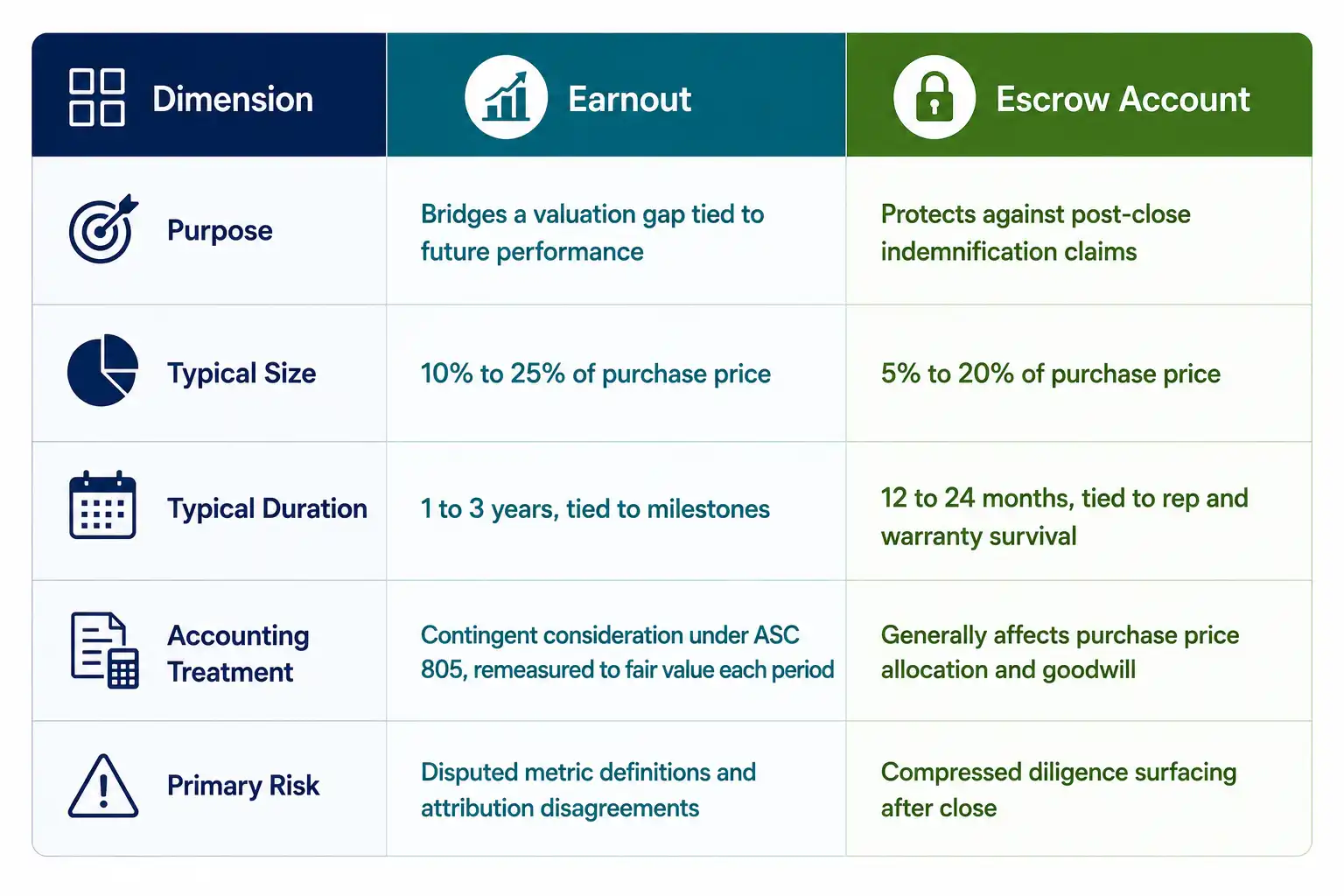
An earnout ties a portion of the purchase price to the future performance of the acquired business. It typically ties to revenue, EBITDA, or an operational milestone specific to the industry. Current financials rarely settle a valuation disagreement on their own. A seller who believes in the company’s trajectory wants credit for growth that has not yet happened. A buyer facing genuine uncertainty about that trajectory is reluctant to pay for it in advance. An earnout converts that disagreement into a measurable, contractual bet both sides have reason to see succeed.
The complexity surfaces once the ink dries. In one acquisition involving a machine learning firm, the earnout tied payout to a defined count of enterprise contracts. The metric appeared simple on the term sheet. Within months it became contested over how to define a renewal and how to classify a customer segment. Ambiguity in the metric produces ambiguity in the payout.
Metrics That Hold Up Under Scrutiny
Earnouts that survive intact share a bias toward metrics that are binary and documentable. They resist interpretation after the fact. Contract signings, cash receipts, and regulatory milestones travel well because they do not require a forensic accountant to adjudicate. A performance-marketing scale-up grew from $9M to $180M in revenue over twenty-four months. An earnout anchored to raw user growth alone would have invited an attribution fight. One grounded in customer acquisition cost, lifetime value, and contribution margin discipline instead gave both sides a shared, auditable language for success.
Best practice for earnout design includes the following:
- Define metrics with precision before signing, not after a dispute arises.
- Align performance measurement windows with the operational cycle of the business rather than an arbitrary calendar period.
- Avoid all-or-nothing cliffs in favor of tiered payouts that reward partial performance.
- Build the agreed-upon measurement methodology into the term sheet itself, since waiting until post-close to define terms is already too late.
Escrow Accounts in M&A: The Shield Against Unforeseen Risk
Where the earnout is about upside, the escrow account in M&A exists purely for risk mitigation. A portion of the purchase price, typically ranging from 5% to 20% of deal value, sits in a neutral third-party account for 12 to 24 months to cover indemnification claims that surface after closing. An escrow account also functions as a quiet referendum on the diligence that preceded it. Thorough diligence leaves the escrow untouched. When deal timing compresses diligence, the same account often becomes the reserve against which a genuine dispute plays out.
An escrow account in M&A tends to function well when three conditions are present:
- Claims procedures are clearly articulated in the purchase agreement, including notice periods and documentation requirements.
- Materiality thresholds are defined in advance so that immaterial disputes do not consume the escrow’s administrative bandwidth.
- Both buyer and seller retain symmetrical access to the underlying financial and operational information relevant to a claim.
In a buy-side due diligence engagement on an IT services acquisition target, quality-of-earnings analysis surfaced EBITDA adjustments and integration risks that were not obvious in the seller’s initial reporting, and the escrow structured into that deal became the mechanism through which those identified risks were later resolved without derailing the relationship between the parties. In a separate transaction, an eight percent escrow held for eighteen months absorbed a labor claim tied to a misclassified contractor in a foreign jurisdiction; because the jurisdictional risk had been anticipated during diligence, the claim was covered in full.
Combining Earnouts and Escrow Accounts: Strategic Trade-Offs
Many transactions include both mechanisms, and the central risk is allowing them to work against one another. An earnout structured to maximize growth can be quietly undermined by an escrow claim that drains working capital or demoralizes the very employees whose retention the earnout was designed to secure. The two instruments were built to solve different problems, but a seller-turned-employee experiences them as a single, continuous relationship with the acquirer.
One structure paired 20% of the purchase price to a two-year EBITDA target with 10% held in an escrow account for twelve months, and the arrangement stayed workable because escrow release milestones were deliberately coordinated with earnout review dates. That procedural symmetry signaled to the retained management team that both mechanisms were being managed as one coherent post-close relationship, not two unrelated legal obligations.
Governance: Who Calculates What, and When
Disputes over earnouts and escrow claims rarely originate in bad faith. They originate in misaligned expectations about process, and the fix is procedural rather than legal. Across multiple post-merger integrations within a public, multi-country operating structure, the deals with the least friction after close were consistently the ones where the calculation and review cadence had been agreed upon before the deal closed.
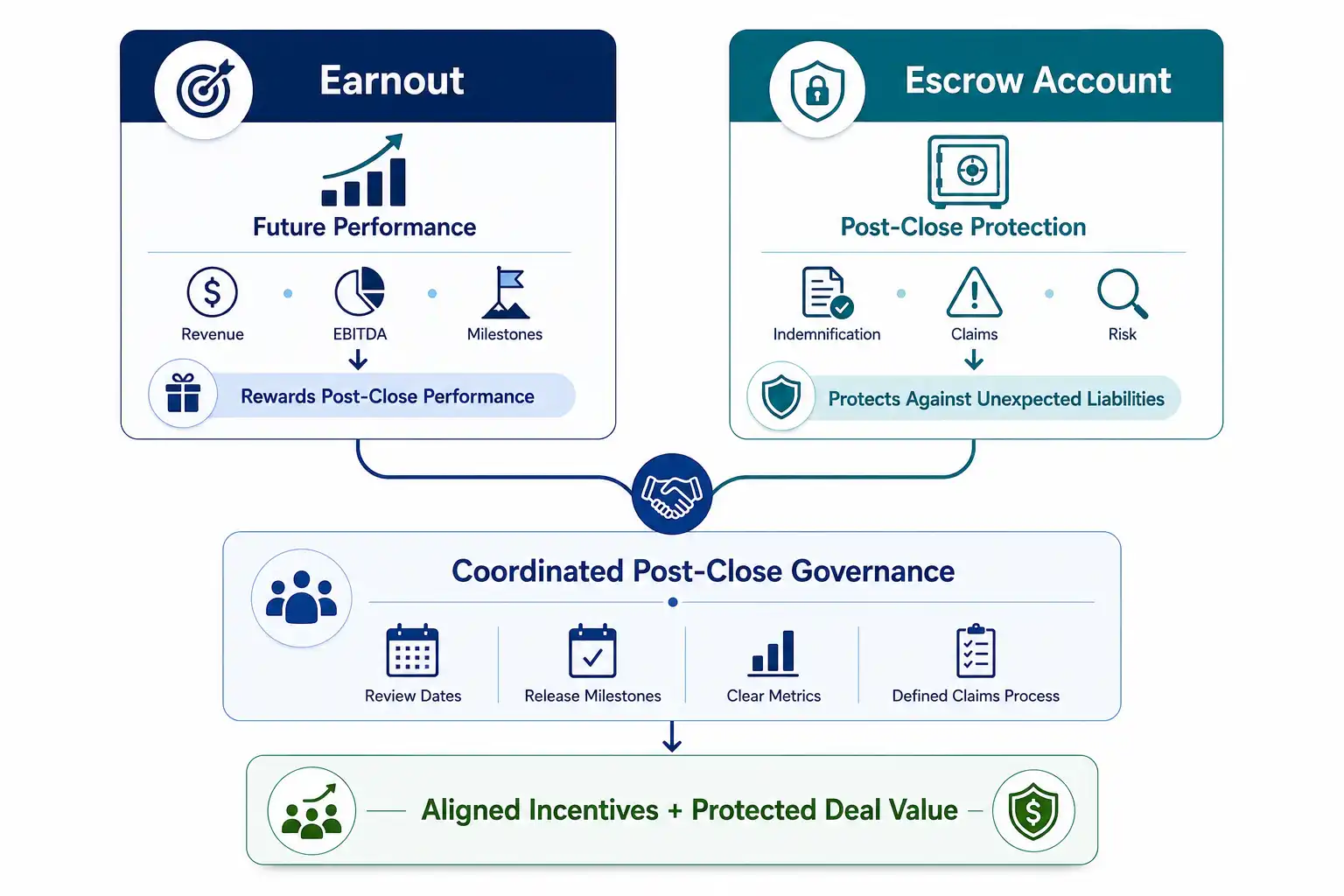
Effective governance for earnouts and escrow claims generally includes the following:
- A clear designation of who prepares the performance statements underlying the earnout calculation.
- Defined timelines for review, objection, and resolution, with escalation paths that do not default to litigation.
- Use of neutral third-party accountants or mediators when the parties cannot reach agreement internally.
In one life sciences transaction, a quarterly review cadence gave the seller full transparency into the relevant profit-and-loss line items throughout the earnout period. That visibility, sustained over multiple quarters, did more to preserve trust than any clause in the purchase agreement, because it removed the surprise that tends to convert a legitimate performance shortfall into a perceived betrayal.
Accounting and Tax Implications
Under ASC 805, earnouts are generally classified as contingent consideration and measured at fair value on the acquisition date, with subsequent changes in that fair value flowing through the buyer’s income statement each reporting period. That accounting requirement has real consequences for a CFO managing quarterly earnings, because a large earnout can introduce volatility into net income unrelated to the underlying operating performance of the business. An escrow account tied to indemnities, by contrast, typically affects purchase price allocation and goodwill rather than ongoing earnings.
Tax classification carries similar weight. An earnout tied to continued employment of the seller may be reclassified as compensation rather than purchase price, triggering payroll tax obligations and ordinary income treatment that neither party wants. A revenue recognition framework built under ASC 606 for a cybersecurity and identity access management company at roughly $30M in annual recurring revenue became one of the assets that carried the business cleanly through acquisition diligence, because the underlying financial statements left little room for the kind of reclassification dispute that erodes deal value after signing. Every earnout should be run through a compensation risk screen before the term sheet is finalized, since the reclassification, once triggered, is rarely reversible.
In a multi-entity structure, staggering earnouts across different metric types, annual recurring revenue for one business line and a clinical milestone for another, reduces the volatility a single large contingent consideration mark would otherwise introduce into consolidated earnings.
Three Key Takeaways
- An earnout functions best when its underlying metric is binary and documentable rather than open to post-close interpretation, and the methodology for measuring it belongs in the term sheet, not in a conversation that happens after a dispute has already begun.
- An escrow account in M&A operates as a quiet referendum on the quality of pre-close diligence, and the transactions that treat it as a coordinated governance mechanism, with claims procedures, materiality thresholds, and release timelines defined in advance, consistently generate less post-close friction than those that leave it as legal boilerplate.
- Earnouts and escrow accounts should never be managed as isolated legal instruments; they carry accounting consequences under ASC 805 that affect quarterly earnings, tax consequences that can reclassify purchase price as compensation, and cultural consequences that shape whether the first year after close becomes a period of collaboration or conflict.
Disclaimer: This article is intended for informational purposes only and does not constitute legal, tax, or accounting advice. You should consult your own tax advisor or counsel for advice tailored to your specific situation.
Hindol Datta is a four-time CFO and senior finance executive with over 25 years of leadership experience across cybersecurity, SaaS, gaming, logistics, digital marketing, medical devices, consumer products, and nonprofit organizations. He has led more than $120M in fundraising and over $150M in M&A transactions while building the financial and operational systems that let complex businesses scale with confidence. He is the author of seven books in the Systems CFO Series and holds active CPA, CMA, and CIA credentials.
AI-assisted insights, supplemented by 25 years of finance leadership experience.