
Executive Summary
Mergers and acquisitions examples rarely fit neatly into a single category. The four dominant structures, horizontal, vertical, conglomerate, and reverse triangular, carry distinct strategic logic, regulatory exposure, and integration risk. A finance leader evaluating any merger example needs more than a taxonomy. The deal form should follow directly from the combination’s underlying goal. That goal might be scale, supply chain control, portfolio diversification, or contractual continuity.
This article walks through examples of mergers and acquisitions drawn from cybersecurity, gaming, medical devices, consumer products, and digital marketing. Each one shows how a given structure behaves once due diligence ends and integration begins. The goal is not academic classification but a practical framework. CFOs can apply it the next time a merger structure decision lands on their desk.
Why Structure Should Follow Strategy in Every Merger Example
Selecting a merger type is a strategic act, not a legal formality. The four categories described below sit on a spectrum from operational consolidation to pure diversification. Horizontal mergers favor cost optimization and scale but attract antitrust scrutiny. Vertical mergers strengthen control over the value chain but demand operational readiness that acquirers frequently underestimate. Conglomerate mergers pursue diversification and often struggle to justify themselves once the initial capital allocation logic fades. Reverse triangular mergers offer structural finesse for preserving contracts and licenses, at the cost of technical precision in execution.
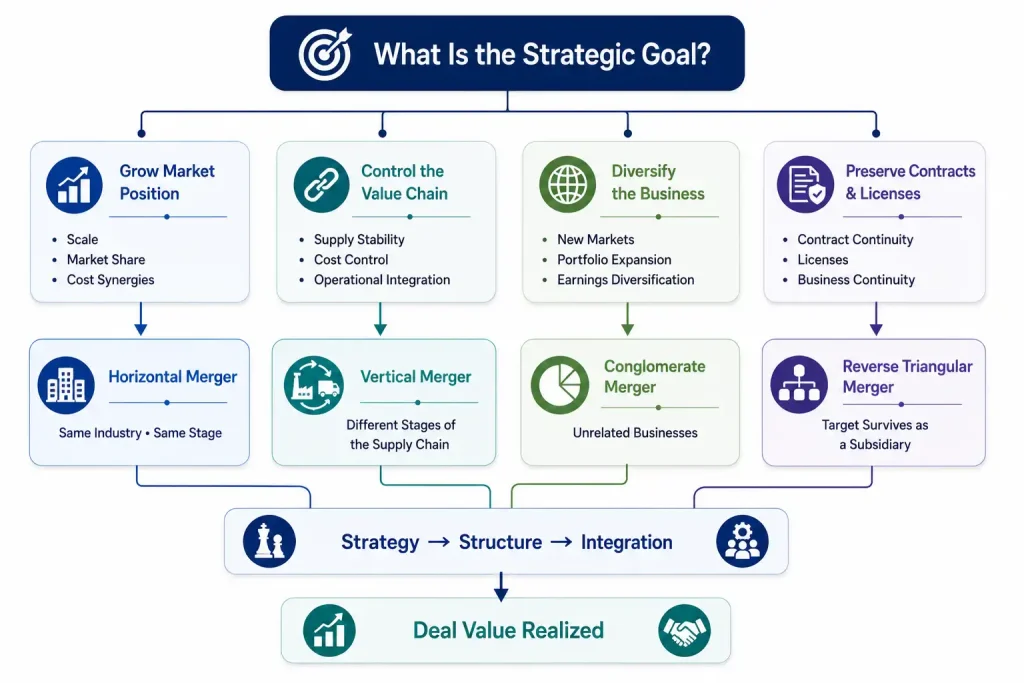
Systems, reporting, HR alignment, and cultural harmonization must be anticipated regardless of structure. The merger form sets the table; execution determines what actually gets served.
Horizontal Mergers: Consolidating Market Position
Horizontal mergers occur when two companies operating in the same industry, often at the same stage of production, combine. Two fintech platforms serving small businesses, or two SaaS vendors selling HR software, are classic examples of this type. The rationale is usually straightforward: scale, market share, cost synergies, and expanded customer acquisition.
A Merger Example from Synergy to Execution Risk
In a horizontal merger between two Series C companies in the B2B analytics space, the projected infrastructure savings were sizable. The harder problem was rationalizing two sales teams and two pricing models simultaneously. Customers noticed the inconsistencies before finance could reconcile them. A clean-sheet approach to go-to-market resolved the friction. It rebuilt pricing and territory logic from scratch rather than blending the two legacy models. A comparable pattern shows up in performance marketing consolidation. A venture-backed digital marketing organization scaled from $9M to $180M in revenue over twenty-four months, partly through acquisitions layered onto an existing customer acquisition and contribution margin framework rather than bolted on as separate units.
Antitrust Considerations in Horizontal Deals
Horizontal mergers raise regulatory flags whenever market concentration increases post-deal. In the United States, Hart-Scott-Rodino thresholds become relevant, and deals can stall for months under Department of Justice review once the combined entity approaches monopoly risk. Modeling concentration indices early, before terms are finalized, avoids surprises later in the process.
Vertical Mergers: Taking Control of the Value Chain
A vertical merger unites companies operating at different stages of the same supply chain, such as a manufacturer acquiring a raw materials supplier or a distributor acquiring a logistics provider. The logic centers on operational control, cost reduction, and strategic integration rather than market share.
Examples of Mergers and Acquisitions Along the Supply Chain
A medical device manufacturer acquiring an overseas contract manufacturer to stabilize supply and shorten lead times illustrates the trade-off well. The move addressed a genuine supply risk, yet the acquired plant lacked a compatible ERP system and had no prior exposure to FDA compliance requirements, so integration costs outstripped initial estimates and synergies arrived later than modeled. Inventory volatility still dropped 40 percent within 18 months once standard costing, bill-of-materials management, and supply chain finance were rebuilt around a common framework. A comparable dynamic plays out in global consumer products, where inventory turns can move from three times to seven times through demand planning, SKU rationalization, and logistics optimization following a vertical combination, releasing working capital that had been trapped in the channel.
Vertical mergers also draw regulatory scrutiny when the integration could foreclose competitors from critical components or distribution channels. Legal and economic arguments demonstrating consumer benefit, prepared well before filing, tend to determine how smoothly review proceeds.
Conglomerate Mergers: Diversification Without Guardrails
Conglomerate mergers combine companies in unrelated businesses, typically pursued for diversification, portfolio expansion, or smoothing earnings volatility. These deals are consistently the hardest to justify and the hardest to integrate, because there is no shared customer base, platform, or operating rhythm to anchor the combination.
A logistics firm acquiring a niche software company to diversify revenue and add digital services is a representative merger example of the pattern: the diversification rationale is straightforward on the surface, but cultural mismatch and misaligned KPIs stall integration, and the acquired division often spins back out within a few years. These deals test governance directly. Holding structures need explicit frameworks for capital allocation, talent development, and strategic alignment; absent that discipline, diversification benefits get outweighed by management distraction and brand dilution. Not every conglomerate structure fails. In capital-constrained environments, acquiring cash-generative but non-core businesses can fund innovation elsewhere, provided the governance model supports decentralized operations while maintaining financial discipline.
Reverse Triangular Mergers: Structuring for Continuity
A reverse triangular merger occurs when the acquiring company forms a subsidiary that merges into the target, leaving the target as a surviving subsidiary of the acquirer. This structure is chosen specifically when the buyer needs the target’s contracts, licenses, and goodwill to remain intact without triggering assignment or renegotiation.
A technology acquisition involving hundreds of enterprise contracts with strict change-of-control clauses is a clear merger example for this structure. A direct merger or asset purchase would have triggered wholesale renegotiation, while the reverse triangular form let the target entity survive, kept contracts valid, and preserved business continuity through closing. Cross-border transactions in regulated sectors, gaming and digital entertainment among them, have used the same logic to execute over $100M in acquisitions while carrying full due diligence and post-merger integration responsibility without disrupting licensing relationships across multiple jurisdictions.
These transactions must satisfy tax-free reorganization rules under IRS guidance and meet fiduciary duties under corporate law simultaneously, and they offer flexibility in structuring consideration as cash, stock, or a blend.
Comparing the Four Merger Structures
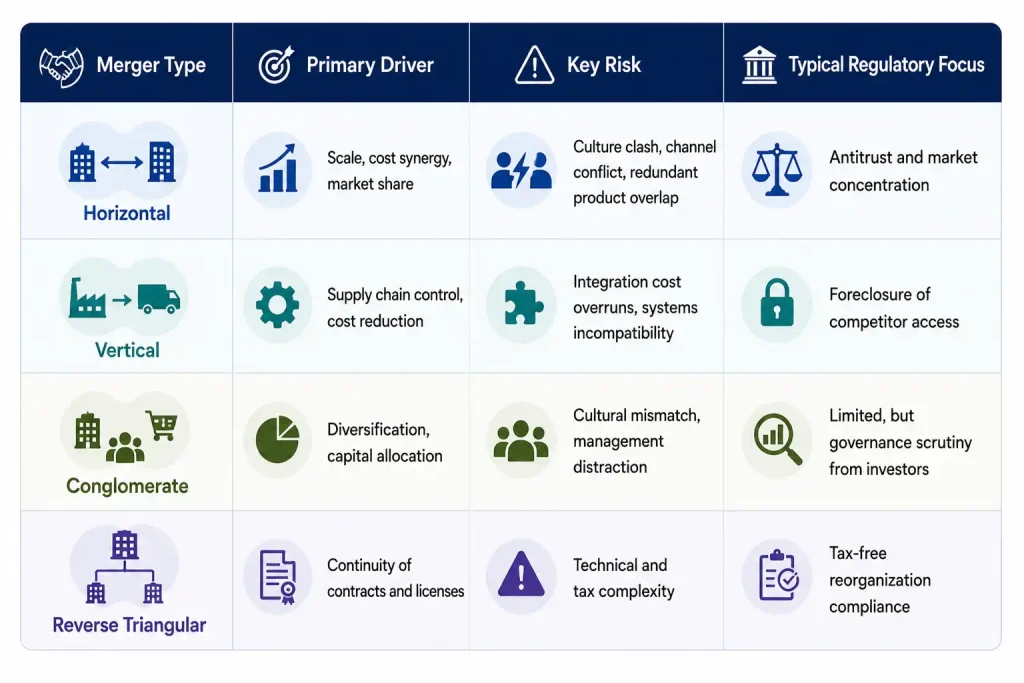
Three Key Takeaways
- The strategic question always precedes the structural one; before selecting among horizontal, vertical, conglomerate, or reverse triangular mergers, the acquiring team should be explicit about whether the goal is market access, supply stability, platform extension, or earnings diversification, since the answer determines which structure actually fits.
- Integration planning belongs in the deal model from day one, not after signing, because the mergers and acquisitions examples that hold up over time are the ones where systems compatibility, regulatory readiness, and cultural alignment were priced into the timeline rather than discovered during the first post-close quarter.
- Regulatory and tax considerations are not back-office details; modeling antitrust exposure, foreclosure risk, or reorganization compliance early, alongside the commercial case, prevents deals from stalling or losing value after terms are already agreed.
Disclaimer: This article is intended for informational purposes only and does not constitute legal, tax, or accounting advice. You should consult your own tax advisor or counsel for advice tailored to your specific situation.
Hindol Datta is a four-time CFO and senior finance executive with over 25 years of leadership experience across cybersecurity, SaaS, gaming, logistics, digital marketing, medical devices, consumer products, and nonprofit organizations. He has led more than $120M in fundraising and over $150M in M&A transactions while building the financial and operational systems that let complex businesses scale with confidence. He is the author of seven books in the Systems CFO Series and holds active CPA, CMA, and CIA credentials.
AI-assisted insights, supplemented by 25 years of finance leadership experience.